Legal Teams: Zero-Trust Contract Redaction for ChatGPT
Legal Teams: Maintain attorney-client privilege while using ChatGPT. Redact client names, deal values, and confidential contract terms natively in the browser.
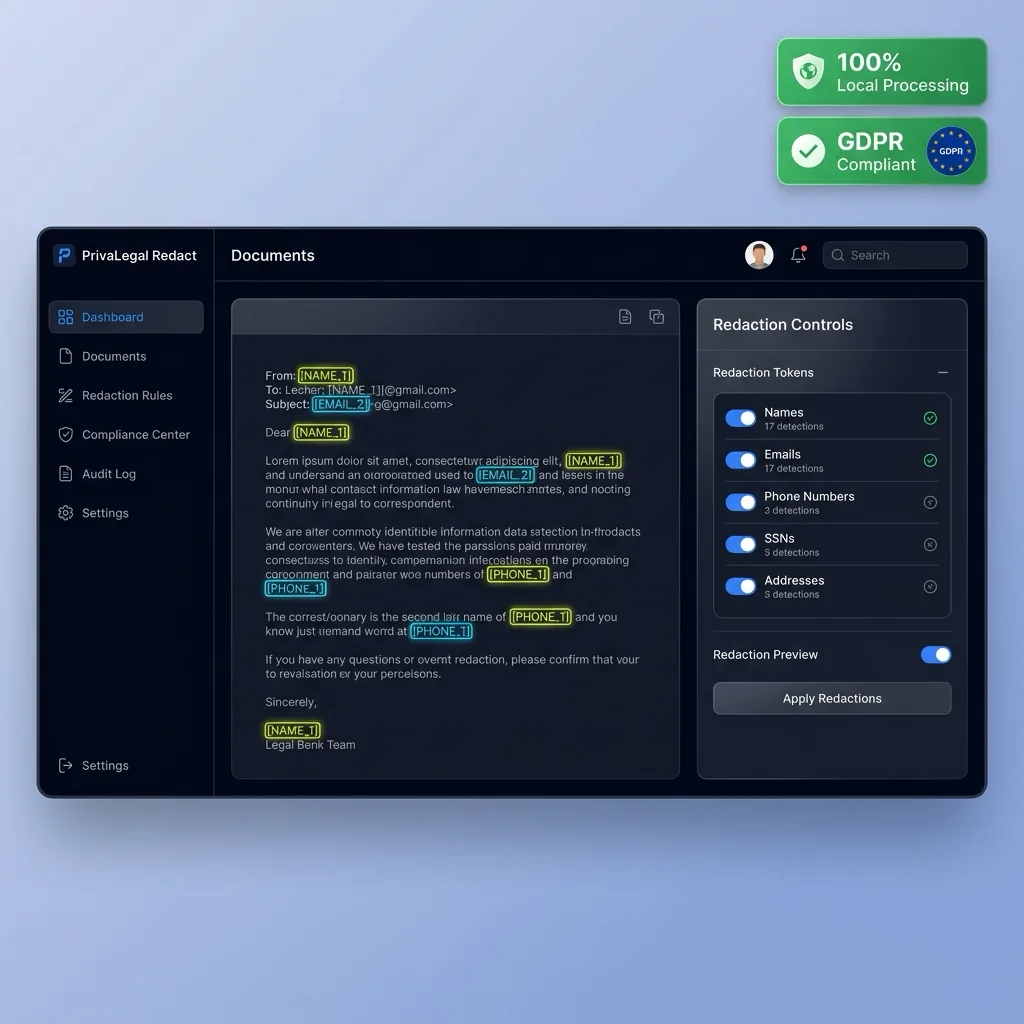
Attorneys, general counsel, and contract managers use AI to redline complex commercial agreements, analyze indemnity clauses, and summarize case law. PrivacyScrubber's Legal Extension protects attorney-client privilege by sanitizing client names, deal amounts, and proprietary clauses before prompts leave the law firm's local network.
Attorney-Client Privilege Defense & Contract Tokenization
Tokenizes client names, counterparty entities, monetary settlement figures, and proprietary patent disclosures in <2ms local browser memory.
Defending Third-Party Disclosure Privilege Waivers
Under US and international legal standards, sharing unencrypted client communications or draft agreements with third-party cloud AI vendors can constitute a waiver of attorney-client privilege. PrivacyScrubber's browser extension intercepts legal text, substituting client names with [CLIENT_ENTITY_1] and transaction amounts with [TRANSACTION_VALUE_1], allowing attorneys to analyze clauses without waiving privilege.
Commercial Contract Indemnity Clause Redline
-
1
Copy or Paste Unsanitized Content: Attorney pastes 20-page Master Services Agreement (MSA) containing client corporate name, counterparty name, and liability caps.
-
2
Real-Time In-Browser Sanitization: The extension replaces party names with [PARTY_A] and [PARTY_B] while leaving all governing law, indemnity, and arbitration terms intact.
-
3
Submit to LLM with Zero Cloud Exposure: Attorney prompts ChatGPT: "Analyze limitation of liability enforceability under Delaware law for [PARTY_A]". AI performs legal analysis.
-
4
Instant Local Reversal (Contextual Reveal): Attorney restores actual party names via 1-click in-page reveal and exports redlined agreement for client review.
ABA Model Rule 1.6 (Confidentiality of Information) Compliance
American Bar Association (ABA) Model Rule 1.6 requires lawyers to make reasonable efforts to prevent inadvertent disclosure of client information. Local edge tokenization satisfies Rule 1.6 requirements, following our Legal AI Compliance framework.
Offline Parsing of Large Multi-Party Agreements
Parse multi-hundred page PDF loan agreements and merger filings locally in browser memory without sending un-redacted documents to cloud servers, as detailed in attorney-client privilege in AI and protecting DOCX contracts.
Privilege Defense Audit Receipts
Generate cryptographic audit receipts proving that contract analysis prompts contained zero identifiable client information, meeting enterprise data governance standards.
Latest Capabilities: Multi-Line Stitching & Local OCR
The PrivacyScrubber Chrome Extension features a smart 3-Line Name-Stitching Lookahead to capture names split across lines (e.g. Firstname
MiddleInitial
Surname) in scanned medical/clinical records, NDAs, and PDFs. It also supports Local Wasm OCR & PDF Sanitization to redact text from screenshots/PDFs offline, and Zero-Trust Session Sync (Argon2id + XChaCha20-Poly1305) to share rules peer-to-peer securely.
Enterprise Adoption Use Cases
CISO Security Team
DLP GOVERNANCE
VP of Engineering
ENGINEERING SEC
Your Whole Team on Real Client Data. Safely. $99/mo Flat.
No per-seat pricing. No DPA negotiation. No IT portal. Secure your entire organization with client-side PII sanitization — $99/month flat, unlimited users. SOC 2 & HIPAA ready. Works in Airplane Mode.
Frequently Asked Questions
Common questions about deploying zero-trust AI for Chrome Extension Teams.