Automate ISO 27001 Annex A.8.11 Data Masking for ChatGPT & Claude
AI Summary / Key Takeaways
"PrivacyScrubber operationalizes ISO/IEC 27001:2022 Annex A.8.11 (Data Masking), Annex A.8.12 (Data Leakage Prevention), and ISO/IEC 27701 PIMS controls at the point of AI prompt entry. By tokenizing PII, infrastructure FQDNs, and cryptographic secrets in local browser RAM before any LLM transmission, organizations establish verifiable Statement of Applicability (SoA) evidence with zero external supplier risk (Annex A.5.19–A.5.22)."
How to fulfill ISO/IEC 27001:2022 Control A.8.11 (Data Masking) for corporate AI usage?
Satisfy ISO/IEC 27001:2022 Control A.8.11 by implementing client-side data masking on all outbound prompts. PrivacyScrubber enforces automated pseudonymization in browser RAM, ensuring that only tokenized data reaches AI service providers while retaining decryption capabilities locally.
Interactive PII Detection & Sanitization Sandbox
Test real-time client-side RAM tokenization. Choose a specialized preset or paste your own raw prompt to test instant reversible redaction.
Sanitized locally in volatile RAM. Pre-prompt compliance maintained under ISO 27001 standards (GDPR, HIPAA, SOC 2).
Enterprise-Grade AI Privacy
Add custom redaction rules and priority support with PRO.
Executive Summary: ISO 27001
ISO 27001:2022 Control A.8.11 (Data Masking) requires that data is protected against unauthorized access. For organizations using AI, this means applying masking at the point of origin. PrivacyScrubber's zero-trust architecture ensures that PII is neutralized in-memory before it reaches any external cloud endpoint. By shifting the security boundary to the browser, you satisfy the 'Privacy by Design' requirements of ISO 27701 and ensure your ISMS covers the entire generative AI lifecycle.
Privacy Checkpoints
- A.8.11 Alignment: Enforce data masking for all unstructured AI prompts.
- Data Sovereignty: Retain control of your data by processing it entirely locally.
- Risk Assessment: Mitigate the impact of potential AI provider data breaches.
- Global Standards: Use one unified tool for GDPR, ISO, and NIST compliance.
- MCP Integration: Programmatically enforce Annex A.8.11 Data Masking across all automated agents via MCP.
PII Detection Matrix
| Entity Type | Exposure Risk | Local Edge Control |
|---|---|---|
| Internal Strategy | High (Confidentiality) | Contextual Redaction |
| Asset Identifiers | Medium (Inventory) | [ID_N] Tokenization |
| Employee Records | High (Privacy) | Local ZTDS™ Protection |
Select Your ISMS & Accredited Certification Mandate
Statement of Applicability (SoA) & ISMS Scope Isolation
Prevent commercial AI cloud providers (ChatGPT, Claude, Gemini) from expanding your Clause 4.3 ISMS boundary during Stage 1, Stage 2, and annual surveillance audits with BSI, DNV, TÜV, or Schellman.
Technical Data Masking & Leakage Prevention
Operationalize Annex A.8.11 (Data Masking) and A.8.12 (Data Leakage Prevention) at the local workstation RAM layer. Strip Secret and Confidential information assets prior to outbound AI prompt transmission.
PIMS Privacy Protection & AI Management Systems
Satisfy ISO/IEC 27001 Annex A.5.34 (Privacy and Protection of PII), ISO/IEC 27701 PIMS controller/processor obligations, and ISO/IEC 42001 Clause 6.1.2 AI risk treatment with verifiable SHA-256 receipts.
ISO/IEC 27001:2022 Annex A.8.11 & A.8.12: Enforcing Client-Side Data Masking Across Your ISMS Boundary
The transition to ISO/IEC 27001:2022 introduced dedicated technological and organizational controls that directly govern enterprise generative AI adoption: Annex A.8.11 (Data Masking), Annex A.8.12 (Data Leakage Prevention), and Annex A.5.23 (Information Security for Use of Cloud Services). When employees paste source code, customer contracts, incident logs, or HR records into external cloud LLMs, unmasked information classified as Confidential or Restricted under Annex A.5.12 exits the organization's Information Security Management System (ISMS) boundary. During Stage 2 certification or annual surveillance audits, accredited Lead Auditors flag unregulated AI usage as a Major Non-Conformity against Clause 4.3 (Determining the Scope of the ISMS) and Annex A.5.19 (Information Security in Supplier Relationships).
PrivacyScrubber provides a deterministic Technical Safe Harbor (Defense-in-Depth) that satisfies ISO 27001 Annex A.8.11 data masking for AI directly inside local device RAM. Powered by the ZTDS™ (Zero-Trust Data Sanitization) protocol, the appliance intercepts classified corporate assets and regulated PII before any outbound network request is created, substituting sensitive tokens ([PERSON_1], [CONTRACT_ID_1], [API_SECRET_1]). Because classified data never crosses the ISMS boundary into external LLM clouds, organizations maintain clean ISMS scope isolation for ChatGPT and frontier AI without onboarding every model vendor as a critical cloud supplier.
Data Masking Commensurate with Classification & Access Policy
Annex A.8.11 mandates that data masking, pseudonymization, or anonymization techniques be applied in accordance with the organization's topic-specific policy on access control and information classification (A.5.12), taking applicable legislation into consideration.
ZTDS™ Control Mapping: Enforces Annex A.8.11 generative AI pseudonymization inside volatile client RAM across 30 Specialized Industry Profiles, ensuring external AI processors never observe cleartext PII or trade secrets.
Data Leakage Prevention Across Endpoints & AI Channels
Annex A.8.12 requires data leakage prevention measures to be applied to systems, networks, and any other devices that process, store, or transmit sensitive information to prevent unauthorized disclosure by insiders or external channels.
ZTDS™ Control Mapping: The Chrome MV3 in-DOM shield, Web App, and IDE MCP stdio firewall intercept sensitive payloads before transmission, delivering ISO 27001 AI tools security without intrusive network MITM proxies.
Excluding External AI Clouds from Confidential ISMS Scope
Under Clause 4.3 and Annex A.5.23, cloud services that process classified organizational assets must be governed under strict supplier acquisition, exit strategies, and shared-responsibility matrices.
ZTDS™ Control Mapping: By de-classifying prompts into synthetic tokens prior to egress, outbound payloads drop from Confidential/Restricted to Public/Unclassified structure under your ISO 27001 AI data classification policy.
Integrated PIMS Privacy & ISO/IEC 42001 AI Risk Treatment
Organizations extending their ISMS to ISO/IEC 27701 (Privacy Information Management) or ISO/IEC 42001 (AI Management System) must demonstrate technical data minimization and verifiable risk treatment records (Clause 9.1 Monitoring & Measurement).
ZTDS™ Control Mapping: Generates immutable SHA-256 compliance receipts for every sanitization event, providing objective audit evidence for Stage 2 and surveillance assessments without storing cleartext PII.
Zone A (Certified ISMS Boundary) vs. Zone B (External Cloud AI Service)
Classified assets (board minutes, M&A contracts, source code secrets, employee HR files, customer PII) remain 100% inside the controlled ISMS endpoint memory.
External AI endpoints receive only synthetic structural tokens carrying zero classified value. The AI vendor never processes or stores regulated ISMS assets.
Comparing ISO/IEC 27001:2022 AI Control Architectures
How accredited certification bodies (BSI, DNV, TÜV Rheinland, LRQA, Schellman) evaluate client-side ZTDS™ sanitization against cloud DLP proxies and policy-only controls during Stage 2 audits.
| ISO/IEC 27001:2022 Requirement | PrivacyScrubber (ZTDS™ Local RAM) | Cloud CASB / Inline DLP Proxy | Enterprise AI Cloud Subscription | Written AI Policy Only (A.5.1 / A.5.10) |
|---|---|---|---|---|
| Annex A.8.11 (Data Masking Execution) | Deterministic local RAM tokenization prior to outbound network egress. | Masks data only after raw classified payloads traverse external proxy servers. | No masking applied; raw classified assets are transmitted to external AI servers. | Manual employee redaction; fails technical control verification under A.8.11. |
| Clause 4.3 & A.5.19 (ISMS Scope & Suppliers) | Zero external supplier servers; keeps third-party AI tools outside confidential ISMS scope. | Introduces the Cloud DLP vendor into your A.5.19 Critical Supplier Register. | Requires full A.5.20 supplier security agreements and A.5.22 annual supplier audits. | Triggers Major Non-Conformity when auditors discover unmanaged shadow AI tools. |
| Annex A.8.10 (Information Deletion) | Volatile tab-isolated token dictionary wiped automatically on tab close. | Requires complex log retention and deletion policies on third-party proxy storage. | Subject to external cloud backup cycles and abuse-monitoring retention windows. | Zero deletion control over consumer AI chat logs. |
| Clause 9.1 (Monitoring & Audit Evidence) | Cryptographic SHA-256 compliance receipts proving A.8.11 & A.8.12 execution. | Generates alert logs containing cleartext snippets that require A.8.15 log protection. | Provides billing/usage metrics only; zero proof of field-level data minimization. | Zero technical telemetry for Stage 2 operating effectiveness sampling. |
| Annex A.5.34 & ISO/IEC 27701 (PII Protection) | 100% client-side PII zero-egress + 30 Specialized Industry Profiles. | Requires cross-border data transfer impact assessments for the proxy vendor. | Requires Chapter V SCCs/TIA if the AI provider processes cleartext EU/UK PII. | Uncontrolled cross-border PII transfers violating A.5.34 and GDPR Art. 32. |
6 Annex A & ISO/IEC 42001 Playbooks for Accredited Certification
Map PrivacyScrubber directly into your Statement of Applicability (SoA) and Risk Treatment Plan (Clause 6.1.3) across software engineering, cloud operations, supplier management, and NIS2 incident response.
Automated De-Classification of Confidential Assets for AI Prompts
Under Annex A.5.12 (Classification of Information) and A.5.10 (Acceptable Use of Information), documents marked Confidential or Restricted cannot be uploaded to public cloud services. PrivacyScrubber strips corporate names, project codenames, financial figures, and PII in local RAM—downgrading the outbound prompt to unclassified structural syntax before AI ingestion.
Secure Coding Assistants & Repository Secret Leakage Prevention
Annex A.8.28 (Secure Coding) and A.8.12 (Data Leakage Prevention) require preventing proprietary algorithms, cryptographic keys, and production configuration secrets from leaking through AI coding assistants. Deploying @privacyscrubber/mcp-server in Cursor and Claude Desktop sanitizes local code context via air-gapped stdio before model inference.
Keeping Commercial LLMs Out of Your Clause 4.3 ISMS Scope
Expanding your ISMS scope to include third-party generative AI platforms triggers complex Annex A.5.19–A.5.23 supplier governance audits. By enforcing client-side ZTDS™ sanitization at the workstation boundary, your Statement of Applicability documents that external AI services never receive, store, or process in-scope confidential assets.
Sanitized Cyber Incident Triage & EU NIS2 24-Hour Reporting
Under Annex A.5.24–A.5.28 and the EU NIS2 Directive, security teams must rapidly analyze forensic logs and draft 24-hour early warning reports without leaking active vulnerability details or victim PII to external clouds. PrivacyScrubber tokenizes internal IP ranges, CVEs, hostnames, and affected identities locally before AI-assisted report drafting.
PIMS Controller & Processor PII Minimization in AI Workflows
Enterprises maintaining dual ISO/IEC 27001 + ISO/IEC 27701 certification must prove technical data minimization (PIMS 7.4.1 / 8.4.1) and prevent unauthorized subprocessor transfers (PIMS 7.5 / 8.5). Client-side RAM tokenization ensures zero direct PII leaves the PIMS boundary while preserving full semantic utility via Reverse Scrub.
ISO/IEC 42001 AI Risk Treatment & Stage 2 Surveillance Receipts
For organizations certifying against ISO/IEC 42001 (Artificial Intelligence Management System), PrivacyScrubber provides a turnkey technical control for Clause 6.1.3 (AI Risk Treatment) and Annex B.7 (Data for AI Systems). Every scrub generates a cryptographic SHA-256 receipt mapping redacted entities directly to ISO 27001, GDPR, and SOC 2 controls.
Turnkey Annex A.8.11 & A.8.12 Deployment Across Your ISMS
15k chars free on General Profile; 5k trial quota across 30 vertical profiles. Offline PDF, DOCX, CSV, and OCR sanitization.
Enforces A.8.12 leakage prevention directly inside ChatGPT, Claude, Gemini, Copilot, and Perplexity with zero external servers.
@privacyscrubber/mcp-server enforces A.8.28 secure coding inside Cursor, Claude Desktop, and Windsurf.
@privacyscrubber/sdk ($299/mo) for backend microservices, ETL pipelines, and RAG ingestion at <1ms in-memory latency.
$99/mo flat for unlimited seats. Centralized A.8.11 rule distribution, XChaCha20-Poly1305 handoff, and Clause 9.1 audit exports.
5-Step ISO/IEC 27001 Lead Auditor Verification Protocol (Airplane Mode)
Provide this reproducible 5-step verification protocol to your accredited Certification Body Lead Auditor (BSI, DNV, TÜV, LRQA, Schellman) to demonstrate objective conformity with Annex A.8.11, A.8.12, and A.8.10:
Open the PrivacyScrubber workspace or Chrome MV3 extension alongside browser DevTools (F12 → Network) and clear active logs.
Disable physical network interfaces or set DevTools throttling to Offline to prove zero external cloud dependency.
Input a test document classified as Confidential containing synthetic PII, IBANs, and API credentials; verify instant replacement with [TYPE_N] tokens.
Download the SHA-256 Compliance Receipt for your Statement of Applicability evidence binder and confirm 0 outbound network requests.
Close the browser tab and verify that the volatile token dictionary is cryptographically zeroized from device memory.
ISO/IEC 27001:2022 Annex A.8.11 Profile: Detection Coverage
ISO/IEC 27001:2022 Annex A.8.11 (Data Masking), A.8.12 (Data Leakage Prevention), and ISO 27701 PIMS ruleset. Enforces deterministic client-side pseudonymization across ISMS-scoped assets.
Top 6 ISO 27001 Sensitive Entity Types Detected & Scrubbed
PIMS Data Subject Identity
ISMS Information Asset Tag
Cryptographic Key & Token
Internal Infrastructure FQDN
Personnel HR Identifier
A.5.24 Security Incident Ticket
Continuous Detection Engine Expansion & Custom Regex Sovereignty
The 6 entity types above represent the core detection baseline for ISO 27001. Our zero-trust engine detects hundreds of additional data classes and is continuously updated with new heuristic patterns, shadow AI leak vectors, and custom regulatory rulesets. Need proprietary database IDs or internal project codenames masked? PRO and TEAMS users can define unlimited custom regular expressions running 100% locally in browser RAM.
How the PrivacyScrubber Engine Solves This
Interactive Tool Controls for ISO 27001. Hover for specs.
ISO 27001:2022 Control A.8.11
Implement automated data masking for generative AI in full compliance with ISO 27001 Annex A data protection controls.
- Engine WASM-Accelerated
- Privacy 100% Local RAM
- Security Zero-Server Leak
Enforce ISMS Information Boundary
Ensure sensitive organizational assets and proprietary secrets never breach the organization's verified ISMS scope.
- Engine WASM-Accelerated
- Privacy 100% Local RAM
- Security Zero-Server Leak
Air-Gapped Operation Verification
Prove to ISO auditors that all AI sanitization occurs within local endpoint RAM with zero external telemetry.
- Engine WASM-Accelerated
- Privacy 100% Local RAM
- Security Zero-Server Leak
ISO 27001 Technical Implementation Mapping
Deep architectural mapping of Zero-Trust Data Sanitization (ZTDS) controls to industry-wide regulatory standards.
Zero-Trust Verification Signature
The above technical controls are enforced deterministically by the PrivacyScrubber Local Engine. All redaction cycles generate zero server-side telemetry, satisfying global data residency requirements for ISO 27001 institutions.
Hardened Audit Standards
Implementing ISO/IEC 27001:2022 Annex A.8.11 data masking and A.8.12 data leakage prevention at the browser edge.
No data persistence on untrusted infrastructure.
Privacy by design at the engineering layer.
Ensures transparency and data minimisation for high-risk models.
Federal PII minimisation and transparency controls.
Satisfies Safe Harbor de-identification requirements.
ISO 27001 Compliance Library
Step-by-step redaction workflows for ISO 27001 environments.
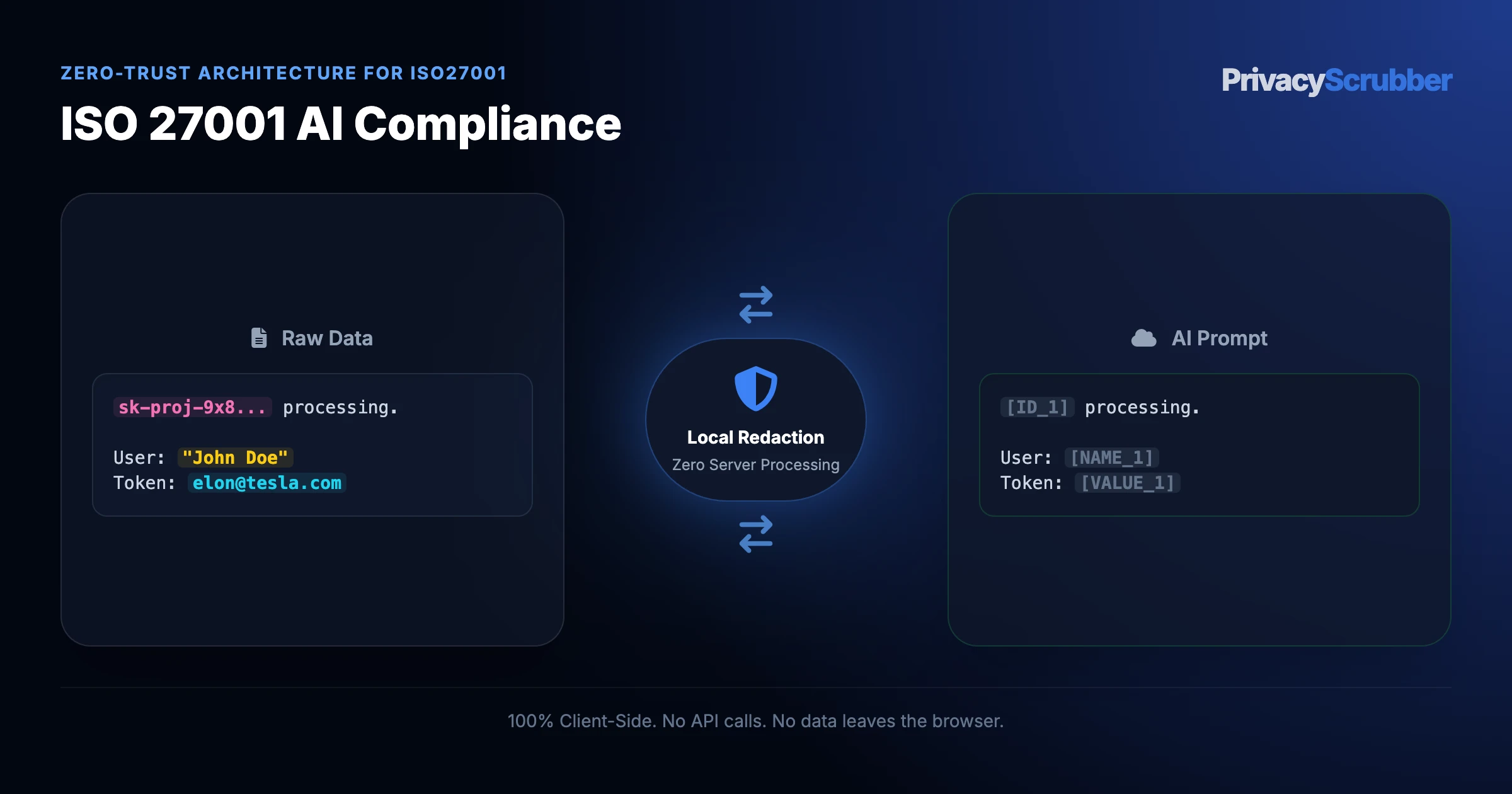
ISO 27001 AI Compliance
Align AI tool usage with ISO 27001 information security controls using local PII scrubbing. Client-side tokenization satisfies enterprise confidentiality norms.
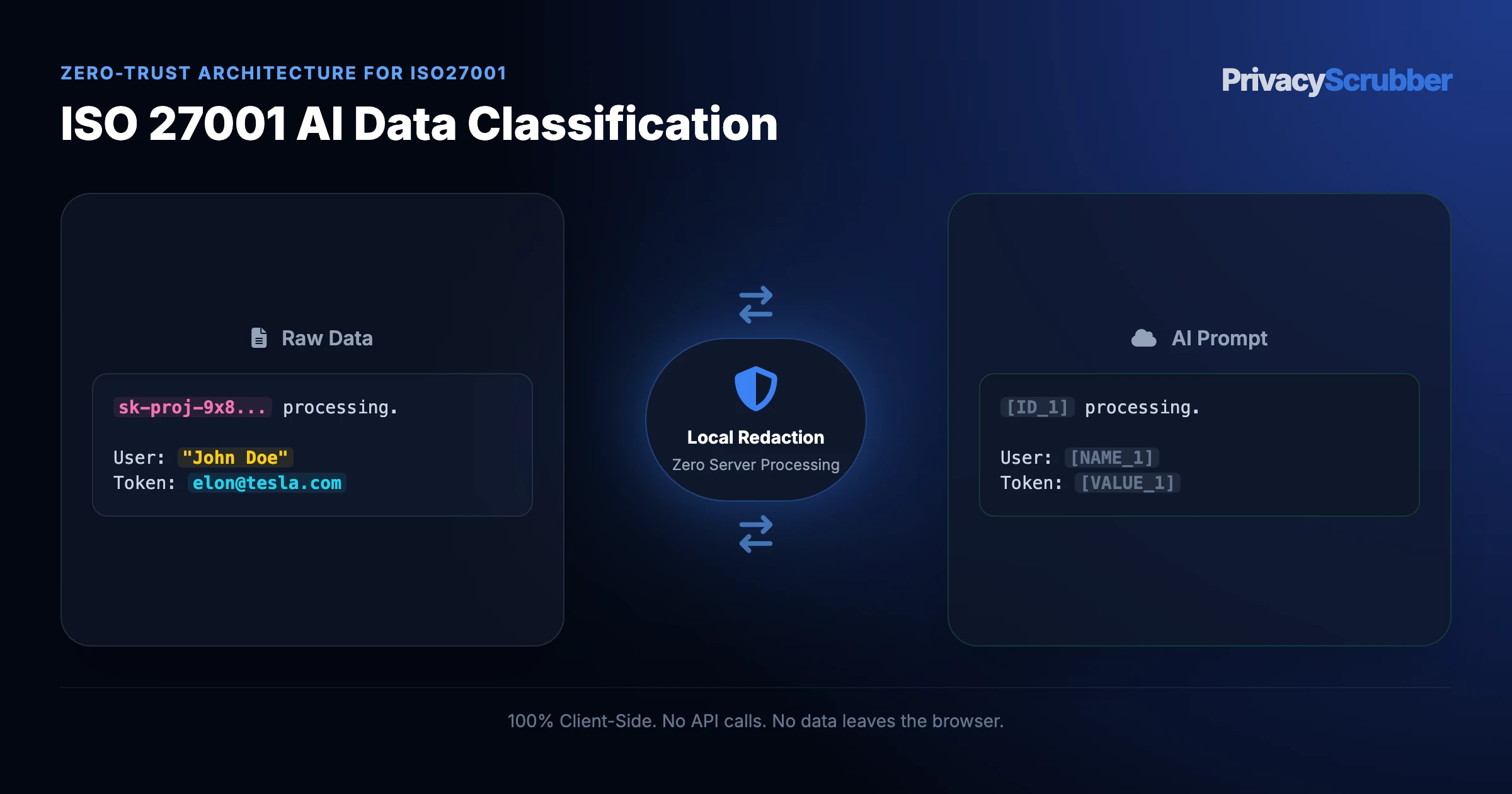
ISO 27001 AI Data Classification
Apply ISO 27001 A.5.12 data classification controls to AI workflows. Ensure confidential and restricted data is masked before reaching ChatGPT or enterprise LLMs.
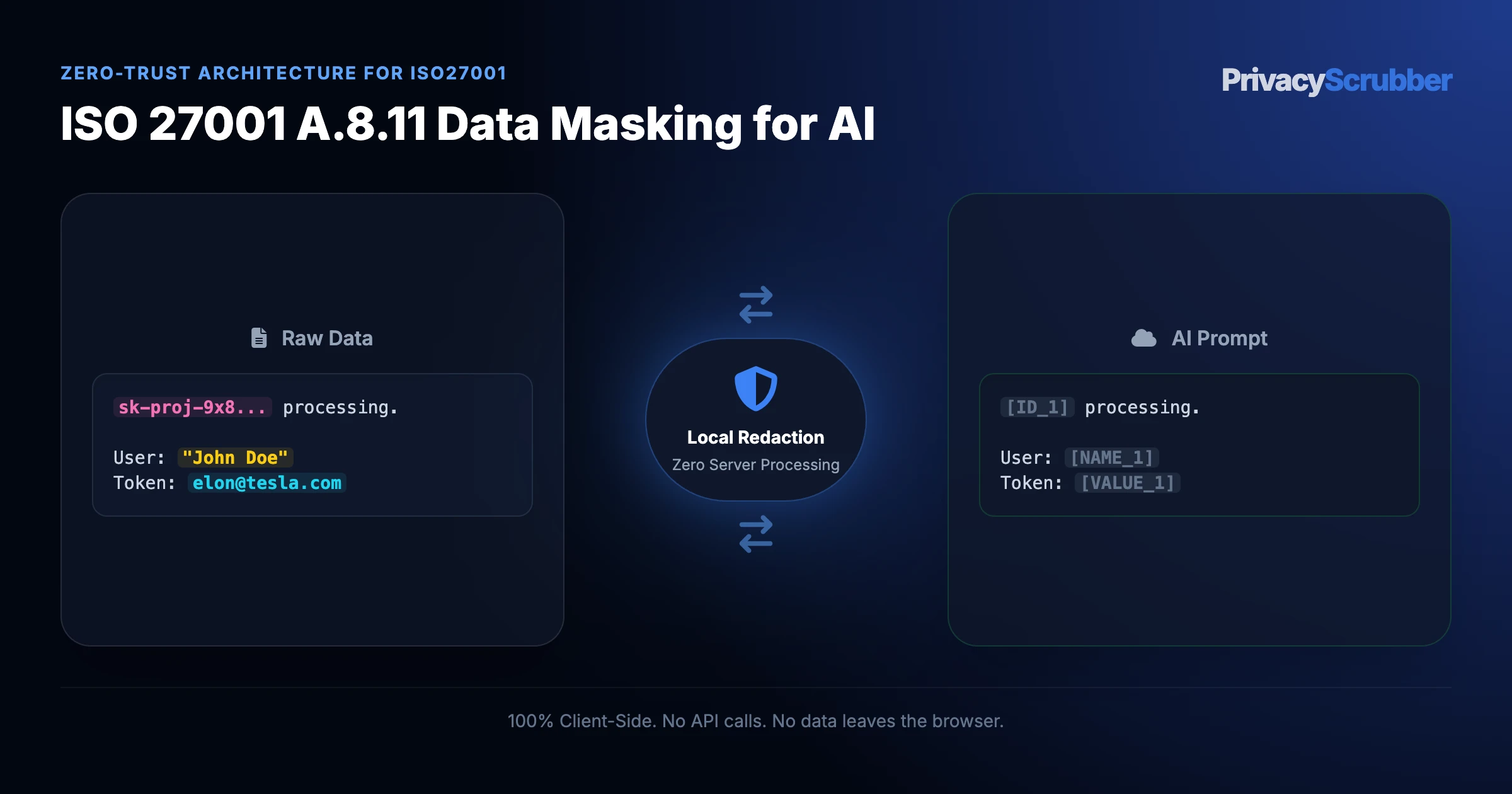
ISO 27001 A.8.11 Data Masking for AI
Satisfy ISO 27001:2022 Annex A.8.11 data masking requirements for AI workflows. Automate local PII tokenization in RAM before ChatGPT or Copilot prompts.
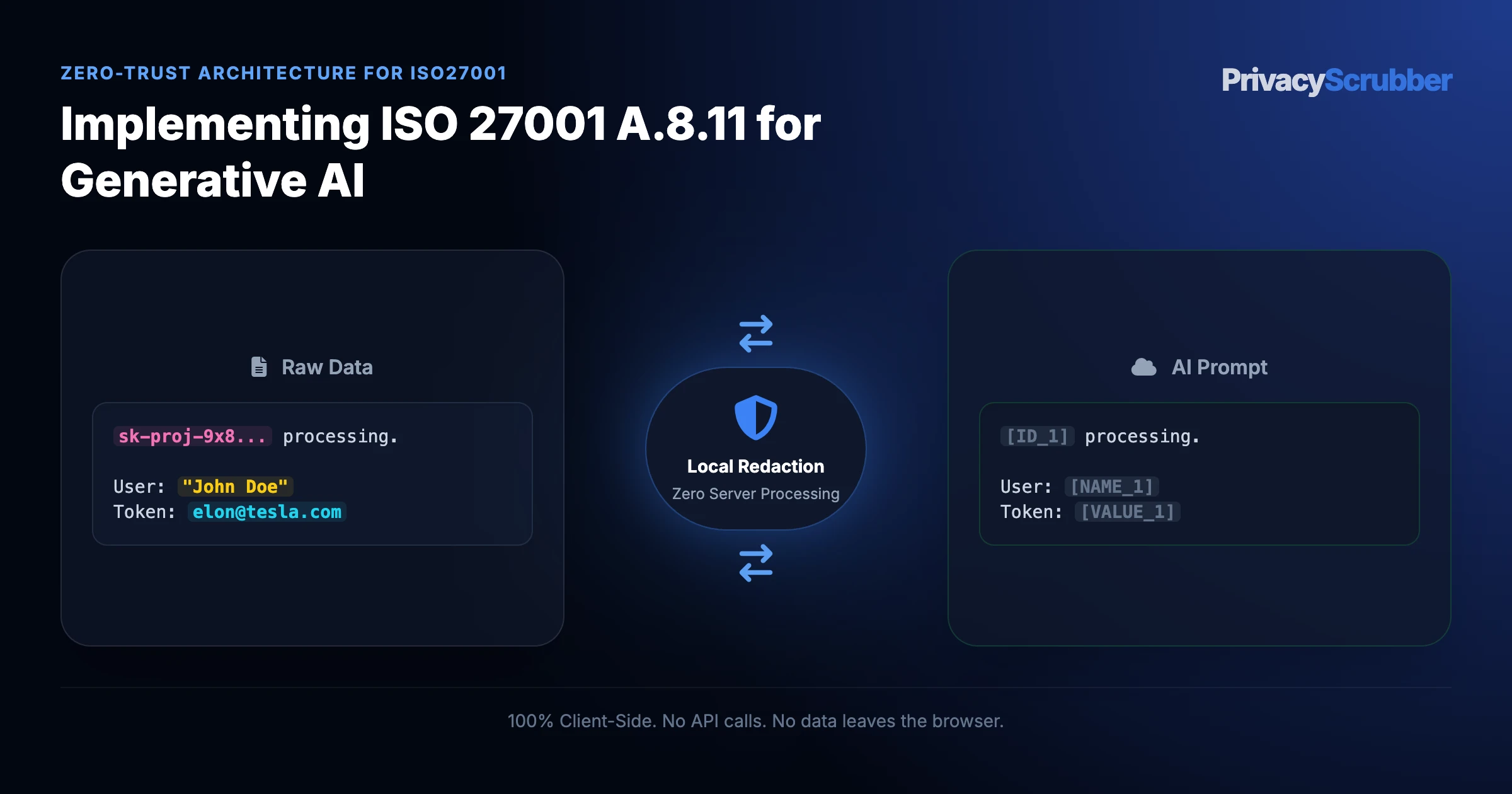
Implementing ISO 27001 A.8.11 for Generative AI
A practical guide to implementing Data Masking (Control A.8.11) for ChatGPT and Claude using client-side zero-trust tools. Zero-server architecture.
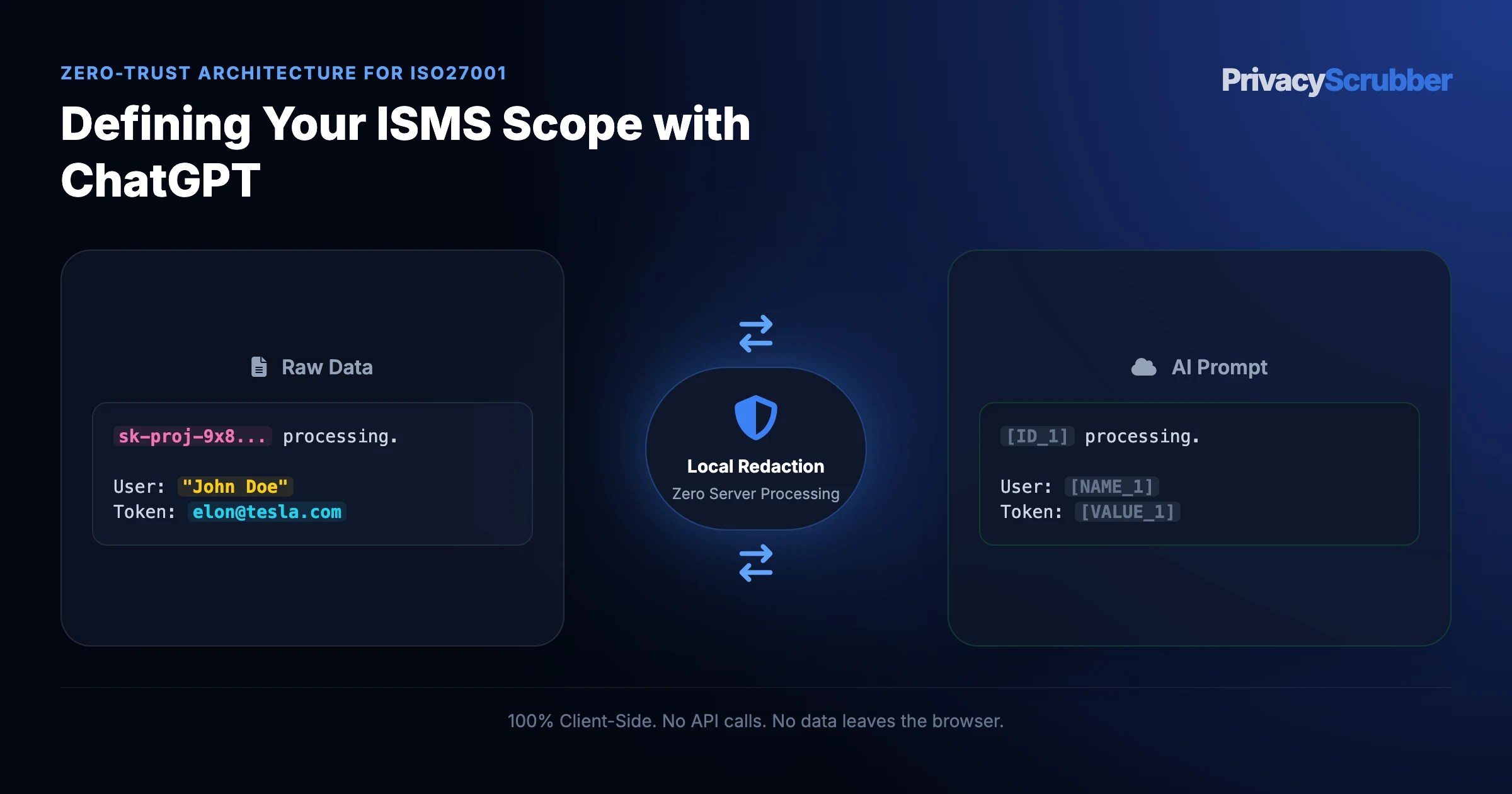
Defining Your ISMS Scope with ChatGPT
Keep public AI models out of your ISMS scope by masking sensitive assets locally. Reduce audit complexity while empowering your workforce.
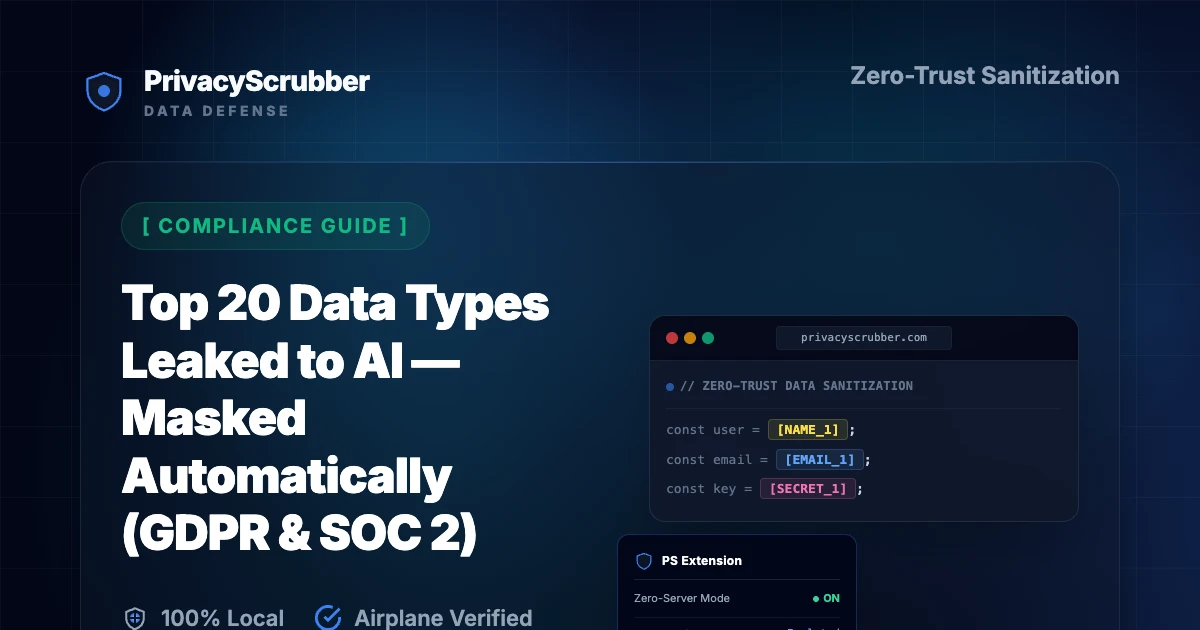
Top 20 Data Types Leaked to AI — Masked Automatically (GDPR & SOC 2)
Discover the top 20 sensitive PII and secret data types employees paste into ChatGPT, Claude, and Gemini — and how masking them locally in browser RAM prevents regulatory fines under GDPR, HIPAA, and SOC 2.
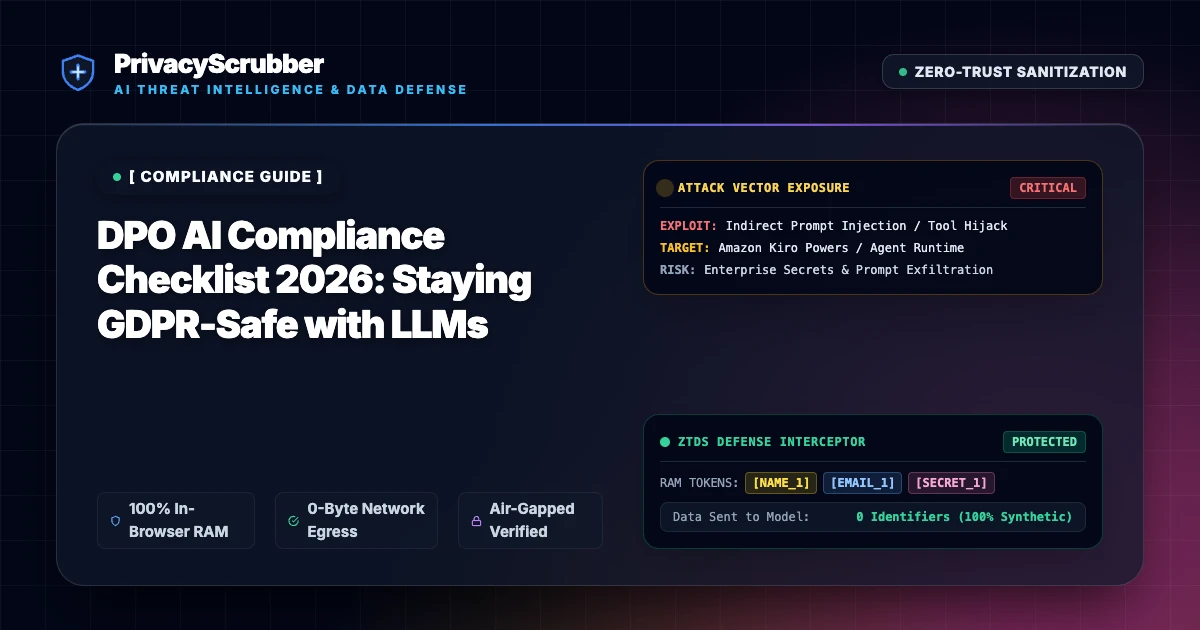
DPO AI Compliance Checklist 2026
A practical checklist for Data Protection Officers to ensure AI tool usage aligns with GDPR and Article 32 security standards. Zero-server architecture.
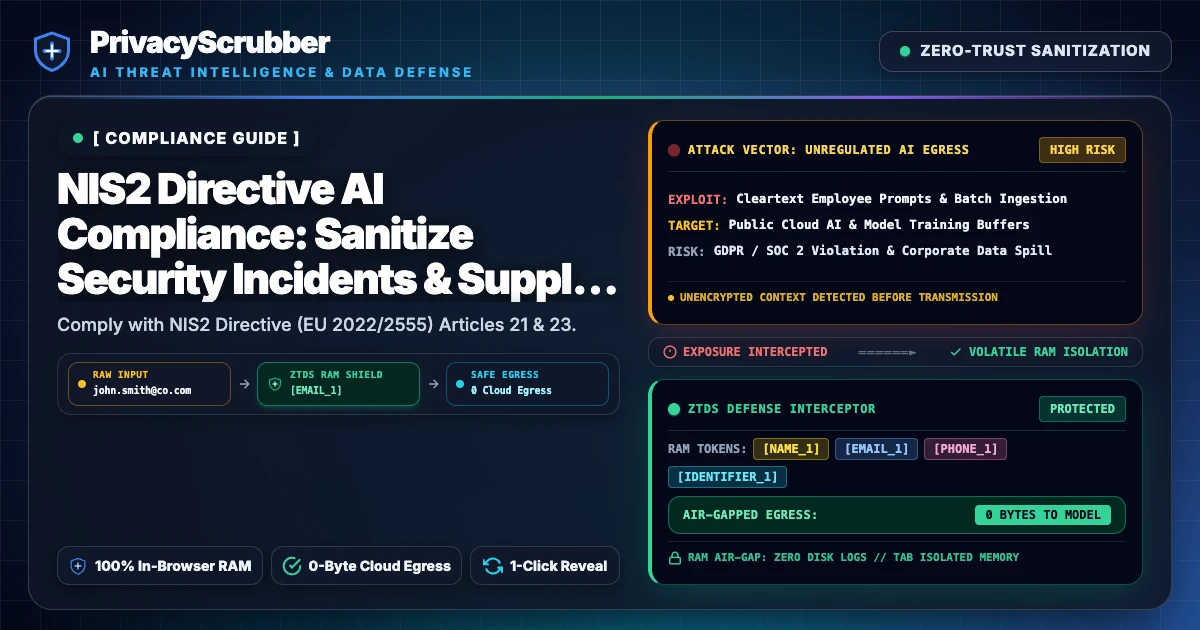
NIS2 Directive AI Compliance
Comply with NIS2 Directive (EU 2022/2555) Articles 21 & 23. Sanitize incident response logs, CVE telemetry, and IP topologies in client RAM before AI triage.
Compare Edition Features
From individual use to corporate rollout, choose the level of control your organization requires.
| Core Capabilities |
Free
Web Only
|
PRO
$15/mo or $110 Lifetime
|
TEAMS
$99/mo
|
ENTERPRISE
Custom Tier
|
|---|---|---|---|---|
| 100% Local Processing (Airplane Mode) | ||||
| Text Paste & Single File Docs | 15k General / 5k Verticals | UNLIMITED | UNLIMITED | UNLIMITED |
| Batch Processing & Background OCR | — | |||
| Custom Regex & Specific Redaction Rules | — | |||
| Chrome Extension Native App | — | |||
| Silent Corporate Deployment (MDM) | — | — | ||
| Policy Control Center & Enforcement | — | — | ||
| IDE MCP Server & Headless Node.js SDK | MCP Free | MCP Unlimited | MCP + Team Sync | SDK ($299/mo) & Air-Gap |
| On-Premise Source Code License | — | — | — | |
| 100% Air-Gapped Operation | — | — | — | |
| Dedicated GRC Support | — | — | — | |
| Try Free | Details | Deploy TEAMS | Enterprise Hub |
Complementary AI Privacy Hubs & Frameworks
Cross-framework zero-trust sanitization workflows and enterprise compliance architectures.
Frequently Asked Questions
Common questions about deploying zero-trust AI for ISO 27001 Teams.
How does PrivacyScrubber substantiate ISO/IEC 27001:2022 Annex A.8.11 and A.8.12 in our Statement of Applicability (SoA)?
Does adopting PrivacyScrubber reduce our ISO 27001 Annex A.5.19–A.5.23 supplier and cloud audit scope?
How does PrivacyScrubber align with ISO/IEC 27701 (PIMS) and ISO/IEC 42001 (AIMS)?
Is this suitable for Annex A.6.2 (Teleworking / BYOD) and developer log sanitization?
What cryptographic algorithms are used for Annex A.8.24 compliance?
Zero-Trust Sanitization Verified
Technical safeguards supporting GDPR Art. 32, HIPAA & CCPA. All PII processing occurs locally in browser RAM.