Hand Your Auditor a Signed SOC 2 Compliance Receipt for AI Usage
AI Summary / Key Takeaways
"PrivacyScrubber operationalizes the ZTDS™ (Zero-Trust Data Sanitization) open standard for SOC 2 Type II compliance. By sanitizing conversational prompts, logs, and unstructured files in local RAM before transmission, it guarantees that customer data and production credentials never reach third-party AI databases—satisfying AICPA Trust Services Criteria CC6.1, CC6.6, CC6.7, and C1.1."
How to maintain SOC 2 Type II compliance when employees paste production customer data into AI?
Preserve SOC 2 Type II confidentiality and privacy trust criteria by intercepting customer identifiers before external egress. PrivacyScrubber redacts customer names, emails, and identifiers into RAM tokens, providing tamper-evident SHA-256 audit receipts to prove zero unauthorized third-party disclosure.
Interactive PII Detection & Sanitization Sandbox
Test real-time client-side RAM tokenization. Choose a specialized preset or paste your own raw prompt to test instant reversible redaction.
Sanitized locally in volatile RAM. Pre-prompt compliance maintained under SOC 2 standards (GDPR, HIPAA, SOC 2).
Enterprise-Grade AI Privacy
Add custom redaction rules and priority support with PRO.
Executive Summary: SOC 2
SOC 2 Type II compliance for AI involves proving that customer data is protected through rigorous 'Security' and 'Confidentiality' controls. PrivacyScrubber implements these controls at the edge, redacting PII before it ever crosses your network perimeter. This 'Sanitization at the Source' approach is the most effective way to prevent Shadow AI and satisfy auditors that un-redacted production data is never processed by third-party generative models. 100% local, 100% auditable. You cannot block all AI sites. Our In-DOM Shadow AI Firewall prevents unapproved LLM usage by visualizing a protective shield on any generative interface. PrivacyScrubber solves the Shadow AI problem by masking data directly in the employee's browser DOM before it is sent to the network, ensuring SOC 2 compliance without proxying traffic.
Privacy Checkpoints
- Security & Confidentiality: Mask production data before AI-led analysis.
- Access Control: Local-only session maps prevent unauthorized data exposure.
- Risk Mitigation: Eliminate the risk of mass cloud-side data harvesting.
- Audit Proof: Provide a zero-log audit trail of all local scrubbing activities.
- MCP Integration: Enforce SOC 2 CC6.1 compliance in your agentic workflows with our PII MCP Server.
PII Detection Matrix
| Entity Type | Exposure Risk | Local Edge Control |
|---|---|---|
| Production Logs | High (Confidentiality) | Automatic Masking |
| Customer PII | Critical (SOC 2) | Deterministic Tokenization |
| System Secrets | Critical (Security) | Pattern-Based Detection |
Select Your SOC 2 Type II Audit & Governance Mandate
Subservice Organization Carve-Out & Evidence
Prevent external LLM providers from becoming in-scope subservice organizations holding Customer Confidential Information (CCI) during your 6-to-12-month Type II observation window. Generate SHA-256 receipts for Vanta, Drata, and AICPA CPA sampling.
Zero-Egress Boundary & Secret Sanitization
Enforce deterministic logical access and transmission boundary controls across browser prompts, IDE coding assistants, and CI/CD pipelines. Strip AWS IAM keys, JWT bearer tokens, and production customer payloads in local device RAM.
Sanitized Incident Triage & Postmortems
Enable on-call SREs and Tier-3 support engineers to debug production stack traces, SQL deadlocks, and Zendesk/Jira tickets with frontier AI while preserving referential integrity across multi-service logs.
AICPA SOC 2 Type II & Generative AI: Eliminating Subservice Scope Creep via ZTDS™ Local Sanitization
For B2B SaaS, FinTech, and cloud infrastructure enterprises undergoing an AICPA SOC 2 Type II examination, unregulated generative AI usage introduces an immediate threat to audit opinion integrity. Under the AICPA Trust Services Criteria (TSC) for Security, Confidentiality, and Privacy, any customer production payload, tenant identifier, authentication credential, or proprietary log transmitted to an external large language model violates CC6.1 (Logical Access Controls), CC6.6 (System Boundary Protection), CC6.7 (Data Transmission Restriction), and C1.1 (Confidential Information Identification and Protection). Worse yet, transmitting unredacted Customer Confidential Information (CCI) to an external AI API forces your independent CPA firm to evaluate that AI provider as an in-scope vendor or subservice organization under CC9.2—triggering formal exceptions when commercial AI chat tools or shadow AI endpoints lack complementary subservice controls.
PrivacyScrubber establishes a deterministic Technical Safe Harbor (Defense-in-Depth) across the entire Type II observation period by executing SOC 2 client-side data masking directly inside local device RAM before any outbound transmission occurs. Built on the open ZTDS™ (Zero-Trust Data Sanitization) standard, the appliance intercepts customer PII, cloud secrets, and tenant metadata at the workstation and pipeline boundary, replacing them with synthetic tokens (such as [TENANT_ID_1], [AWS_KEY_1], and [EMAIL_1]). Because raw CCI and regulated PII never cross the system boundary into third-party AI clouds, external LLMs process only non-confidential structural syntax—supporting clean SOC 2 Type II opinions without shadow AI exceptions.
Hard System Boundary Enforcement Prior to External Transmission
Criteria CC6.6 and CC6.7 require the entity to implement logical access security measures to protect against threats outside system boundaries and restrict the transmission, movement, and removal of information to authorized external parties.
ZTDS™ Control Mapping: All prompt and document sanitization executes 100% locally inside volatile device RAM. Sensitive customer identifiers and credentials are stripped before the payload reaches the browser DOM or outbound HTTPS socket, enforcing SOC 2 AI privacy controls at the endpoint edge.
Protection & Ephemeral Disposal of Customer Confidential Data
Criterion C1.1 requires identifying and maintaining confidential information to meet entity objectives, while C1.2 mandates identifying and disposing of confidential information when no longer needed. Cloud AI chat history and proxy logs create persistent C1.2 disposal liabilities.
ZTDS™ Control Mapping: The local token dictionary resides strictly in tab-isolated volatile memory and is cryptographically zeroized the instant the browser tab closes or ztds_reset_session executes, leaving zero retained customer data in external AI logs.
Neutralizing External AI Vendor & Subprocessor Scope
Under CC9.2, management must assess and manage risks associated with vendors and business partners that process production data. Onboarding every frontier LLM model as a production data subprocessor stalls enterprise procurement and customer security reviews.
ZTDS™ Control Mapping: By guaranteeing zero network egress of direct PII and CCI, external LLMs receive only non-sensitive synthetic structures—drastically simplifying SOC 2 AI vendor risk assessments and customer DPA negotiations.
Zero-PII Cryptographic Audit Receipts for CPA Sampling
A SOC 2 Type II examination requires proving that controls operated effectively throughout the entire 6-to-12-month audit period. However, logging raw user prompts to prove DLP enforcement creates a secondary repository of unencrypted customer PII.
ZTDS™ Control Mapping: Every sanitization action produces a tamper-evident SHA-256 compliance receipt recording timestamp, active profile, entity category counts, and triggered frameworks—providing verifiable Type II data masking evidence with zero cleartext exposure.
Zone A (In-Scope Production & Corporate Endpoint) vs. Zone B (External LLM API)
Raw production stack traces, customer support tickets, database dumps, and IAM configs remain strictly inside the engineer's local volatile memory.
External AI models (ChatGPT, Claude, Gemini, Cursor) receive only anonymized structural tokens. Zero Customer Confidential Information or credentials ever enter third-party cloud telemetry.
Comparing SOC 2 Type II AI Privacy Architectures
Why cloud DLP proxies and policy-only governance fail CPA sampling scrutiny during a SOC 2 Type II audit, and how client-side ZTDS™ sanitization eliminates third-party subprocessor dependencies. For a deeper vendor evaluation, read our SOC 2 privacy software comparison guide.
| SOC 2 Audit Dimension | PrivacyScrubber (ZTDS™ Local RAM) | Cloud DLP / CASB API Proxies | Enterprise LLM BAA / Zero-Retention Tier | Written AI Acceptable Use Policy Only |
|---|---|---|---|---|
| Point of Sanitization (CC6.6 / CC6.7) | 100% Client-Side Device RAM prior to network socket creation. | External cloud proxy server after raw CCI leaves the corporate endpoint. | None. Raw production data and secrets are ingested into the AI vendor cloud. | None. Relies on manual employee copy-paste discipline. |
| Subservice / Vendor Risk Scope (CC9.2) | Zero external server footprint; AI vendors receive only synthetic tokens. | Adds the Cloud DLP vendor itself as a critical Tier-1 subprocessor holding cleartext CCI. | Requires full CC9.2 vendor onboarding, SOC 2 bridge letters, and customer DPA updates. | High risk of unauthorized Shadow AI usage discovered during CPA walkthroughs. |
| Confidentiality & Disposal (C1.1 / C1.2) | Ephemeral tab-isolated memory; automatic cryptographic wipe on session close. | Proxy inspection logs often retain unmasked payload snippets on third-party disks. | Subject to 30-day abuse monitoring caches or enterprise workspace retention settings. | Permanent retention in consumer LLM chat histories and model training queues. |
| Type II Operating Effectiveness Evidence (CC7.2) | Deterministic SHA-256 cryptographic compliance receipts (zero cleartext PII). | Centralized alert logs that require secondary access controls due to embedded PII. | Shows API call volume only; does not prove confidential fields were redacted. | Fails Type II operating effectiveness testing; policies alone are design-only controls. |
| Context & Multi-Turn Code / Log Integrity |
Deterministic bi-directional token dictionary ([JWT_1], [TENANT_1]) + Reverse Scrub.
|
Destructive static masking (***REDACTED***) breaks code compilation and root-cause correlation.
|
Preserves context only by exposing raw customer production data to external servers. | Manual find-and-replace introduces human error and inconsistent variable naming. |
| Deployment Velocity & Cost Structure | Instant browser/CLI/SDK deployment; $15/mo PRO, $99/mo TEAMS (unlimited seats), $299/mo SDK. | Months of TLS MITM certificate deployment, PAC file routing, and $50k+ annual contracts. | $60+/seat/mo enterprise minimums; locks engineers into a single AI model vendor. | $0 upfront, followed by customer churn when enterprise buyers audit your AI controls. |
6 Technical Sanitization Playbooks for SOC 2 Type II Audits
How high-growth SaaS engineering, DevSecOps, and customer support teams operationalize PrivacyScrubber across the 5 Trust Services Categories without slowing developer velocity. Pair these technical controls with our SOC 2 AI Acceptable Use Policy template.
Production Log, Stack Trace & IAM Secret Sanitization
When engineers paste stack traces, Kubernetes pod logs, or Terraform state snippets into ChatGPT, Claude, or Cursor, embedded credentials create immediate CC6.1 logical access violations. PrivacyScrubber detects and tokenizes AWS Access Keys (AKIA/ASIA), JWT Bearer Tokens, GitHub PATs, Stripe Live Keys, and Database Connection Strings locally in RAM.
Customer Support Ticket & Multi-Tenant Payload Redaction
Tier-2 and Tier-3 support teams summarizing escalations or HAR/JSON webhook captures in Zendesk and Jira must protect Customer Confidential Information (CCI) under enterprise MSAs. The appliance masks tenant UUIDs, customer names, emails, billing addresses, and session cookies before AI summarization, then restores exact tenant context locally via Reverse Scrub.
AI-Assisted Incident Triage & Root-Cause Postmortems
During P0 security incidents or availability outages, SOC analysts and SREs use LLMs to analyze SIEM alerts, firewall logs, and postmortem timelines. PrivacyScrubber consistently maps internal IPv4/IPv6 CIDR blocks, hostnames, employee IDs, and affected customer records to deterministic tokens ([INTERNAL_IP_1], [HOST_2]) so AI can correlate attack vectors without exposing internal topology.
RAG Ingestion & Vector Database Pre-Sanitization
Organizations including the AICPA Privacy category (P1–P8) in their SOC 2 report must prevent personal information from being embedded into immutable vector indexes or LLM fine-tuning pipelines. Deploying @privacyscrubber/sdk in Node.js ETL pipelines strips 20+ corporate and consumer PII classes in under 1ms before embeddings are generated.
Unified SOC 2 Type II + HIPAA / GLBA Cross-Framework Compliance
Vertical SaaS platforms serving healthcare or financial institutions undergo simultaneous SOC 2 Type II, HIPAA Security Rule, and GLBA Safeguards audits. PrivacyScrubber's 30 Specialized Industry Profiles enforce overlapping statutory redaction (18 HIPAA Safe Harbor identifiers + ABA/IBAN/SWIFT financial ledgers) in a single client-side pass.
Automated Type II Evidence Collection & Encrypted Team Handoff
When your CPA auditor selects a sample of 25 to 60 engineering changes or support tickets across the Type II observation window, teams attach the locally generated SHA-256 compliance receipts directly to Jira tickets or Vanta/Drata evidence tasks. For collaborative debugging, TEAMS ($99/mo flat) enables encrypted session handoff protected via XChaCha20-Poly1305 and Argon2id.
Complete SOC 2 Type II Coverage Across Every Engineering Workflow
15k chars free on General Profile; 5k trial quota across 30 vertical profiles. Offline PDF, DOCX, CSV, and OCR sanitization.
Real-time prompt interception inside ChatGPT, Claude, Gemini, Perplexity, and Zendesk with zero remote code execution.
@privacyscrubber/mcp-server for Cursor, Claude Desktop, and Windsurf. Air-gapped stdio JSON-RPC sanitization.
@privacyscrubber/sdk ($299/mo) for backend microservices, CI/CD log pipelines, and RAG ingestion at <1ms latency.
$99/mo flat for unlimited seats. Centralized custom rule governance, XChaCha20-Poly1305 handoff, and CPA audit exports.
5-Step CPA Auditor Verification Protocol (Airplane Mode Standard)
During your SOC 2 Type II examination, share this deterministic 5-step walkthrough with your independent CPA firm so they can independently verify that CC6.6, CC6.7, and C1.1 controls operate with zero external data egress:
Load the PrivacyScrubber workspace or Chrome Extension, open Chrome DevTools (F12 → Network), and clear all network logs.
Toggle macOS/Windows Wi-Fi off or set DevTools Network throttling to Offline (Airplane Mode) to physically block external socket egress.
Select the DevOps / SaaS Profile and scrub a sample payload containing synthetic AWS keys, JWTs, customer emails, and tenant UUIDs.
Generate the CISO Compliance Receipt and verify that 0 outbound XHR/Fetch requests occurred during sanitization and reverse restoration.
Close the active browser tab or trigger session reset and confirm that the volatile token dictionary is completely wiped from memory.
SOC 2 Trust Services (CC6.1 / C1.1) Profile: Detection Coverage
AICPA Trust Services Criteria CC6.1, CC6.6, and C1.1 ruleset for SaaS engineering and support teams. Strips customer tenant IDs, bearer tokens, DB connection strings, and confidential SLA payloads before AI debugging.
Top 6 SOC 2 Sensitive Entity Types Detected & Scrubbed
Production Secret & Bearer Key
Tenant Database URI
Enterprise Customer Tenant UUID
Customer User Identity
Support & Incident Reference
VPC Subnet & Bastion Host IP
Continuous Detection Engine Expansion & Custom Regex Sovereignty
The 6 entity types above represent the core detection baseline for SOC 2. Our zero-trust engine detects hundreds of additional data classes and is continuously updated with new heuristic patterns, shadow AI leak vectors, and custom regulatory rulesets. Need proprietary database IDs or internal project codenames masked? PRO and TEAMS users can define unlimited custom regular expressions running 100% locally in browser RAM.
How the PrivacyScrubber Engine Solves This
Interactive Tool Controls for SOC 2. Hover for specs.
SOC 2 Type II CC6 Alignment
Satisfy CC6.1, CC6.6, and CC6.7 logical access and boundary controls by sanitizing prompts before external transmission.
- Engine WASM-Accelerated
- Privacy 100% Local RAM
- Security Zero-Server Leak
Zero Subprocessor Risk (CC9.2)
Eliminate vendor risk management bottlenecks by running 100% client-side with zero cloud infrastructure.
- Engine WASM-Accelerated
- Privacy 100% Local RAM
- Security Zero-Server Leak
Cryptographic SOC 2 Audit Receipts
Generate tamper-evident, SHA-256 signed audit receipts demonstrating zero sensitive data egressed corporate browsers.
- Engine WASM-Accelerated
- Privacy 100% Local RAM
- Security Zero-Server Leak
SOC 2 Technical Implementation Mapping
Deep architectural mapping of Zero-Trust Data Sanitization (ZTDS) controls to industry-wide regulatory standards.
Zero-Trust Verification Signature
The above technical controls are enforced deterministically by the PrivacyScrubber Local Engine. All redaction cycles generate zero server-side telemetry, satisfying global data residency requirements for SOC 2 institutions.
Hardened Audit Standards
Proving AICPA Trust Services Criteria CC6.1, CC6.6, and C1.1 confidentiality controls with zero subprocessor scope.
Data masking as a core organisational control.
Federal PII minimisation and transparency controls.
Privacy by design at the engineering layer.
Satisfies Safe Harbor de-identification requirements.
Cardholder data masked before AI processing.
SOC 2 Compliance Library
Step-by-step redaction workflows for SOC 2 environments.
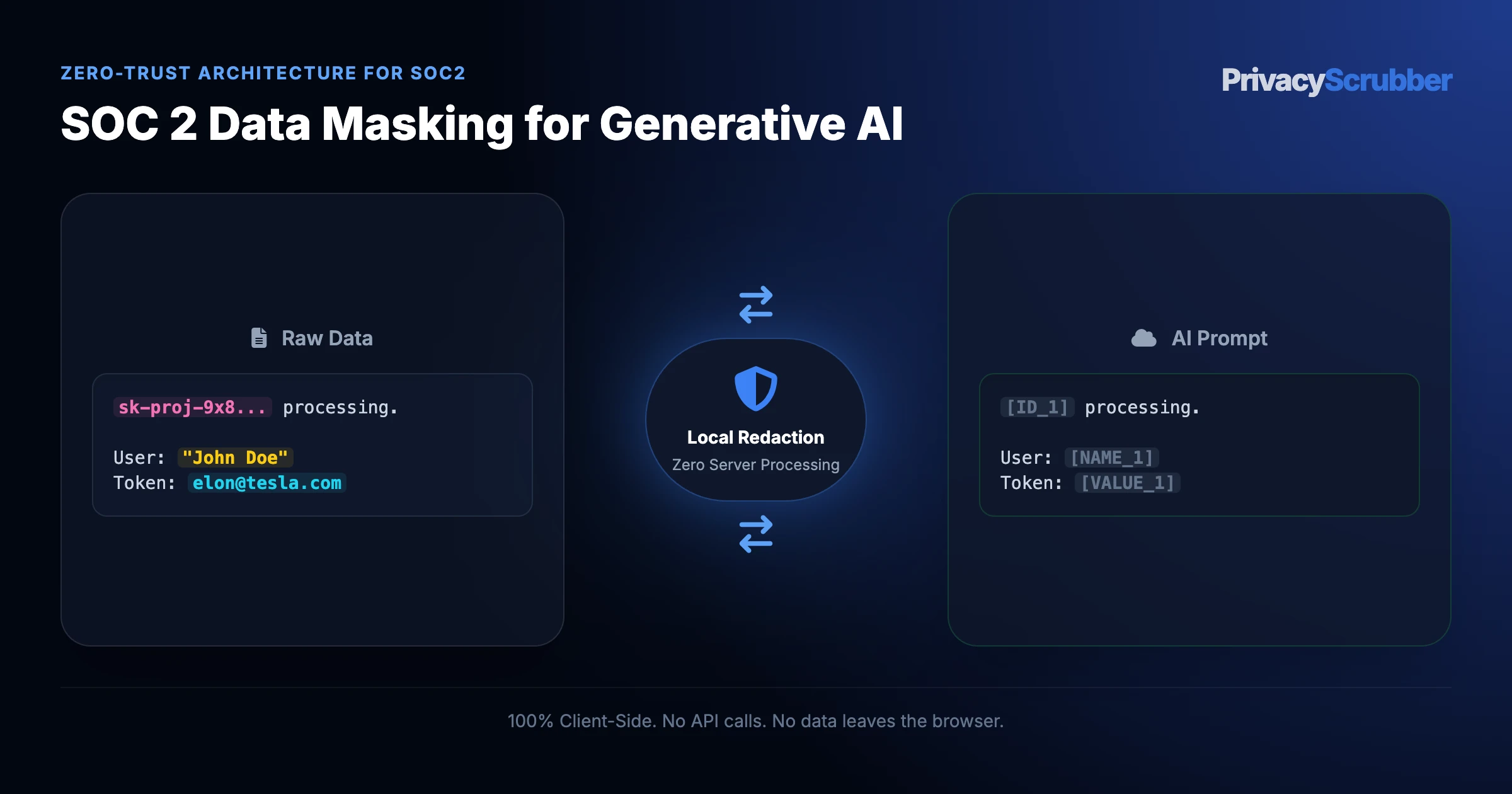
SOC 2 Data Masking for Generative AI
How to implement SOC 2 data masking controls for Generative AI workflows. Local vs. API-based redactors compared. Flat-rate TEAMS pricing available.
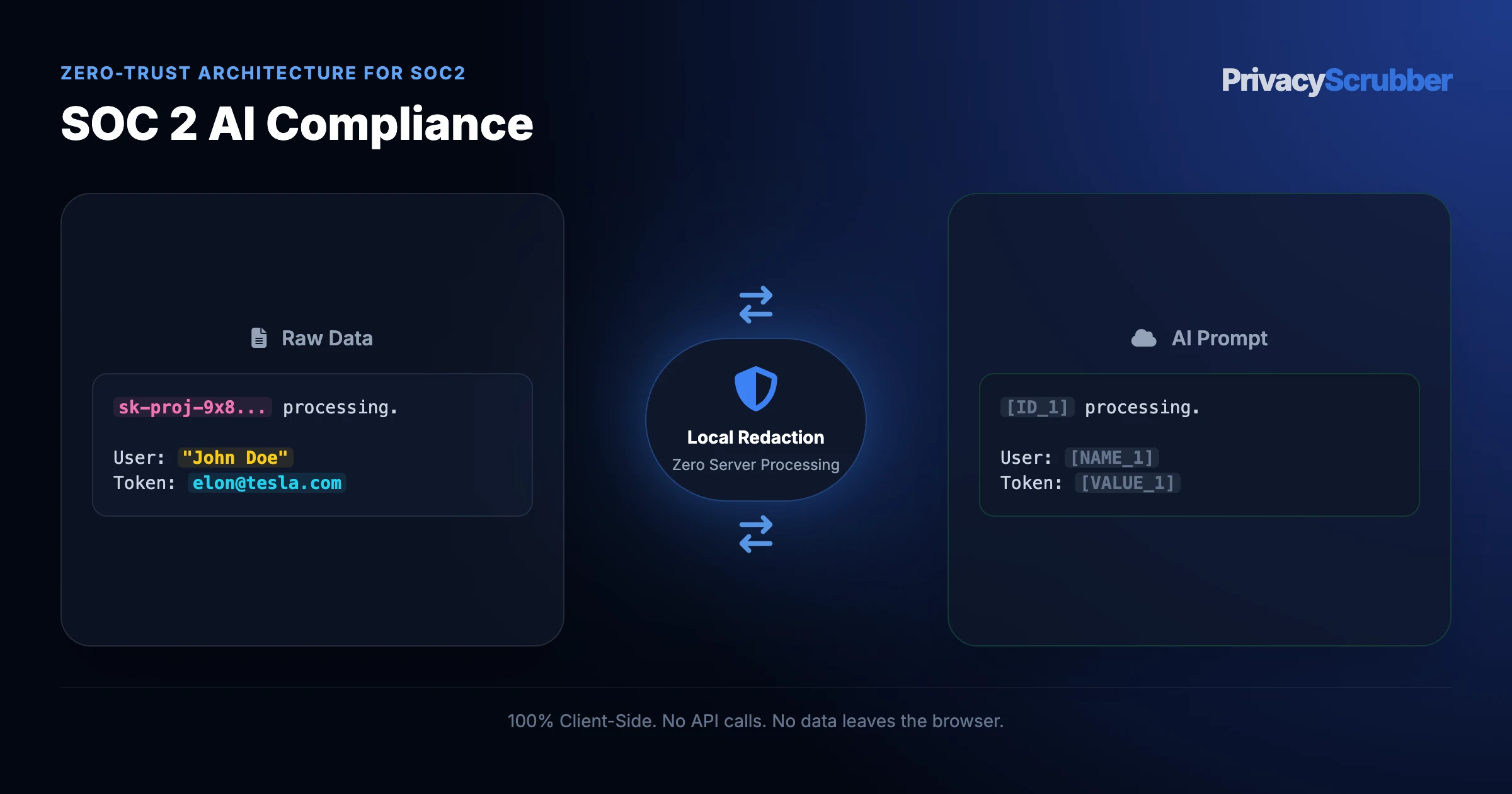
SOC 2 AI Compliance
Satisfy SOC 2 CC9.1 confidentiality with AI. De-identify customer PII locally in browser memory before cloud transmission to avoid compliance breaches.
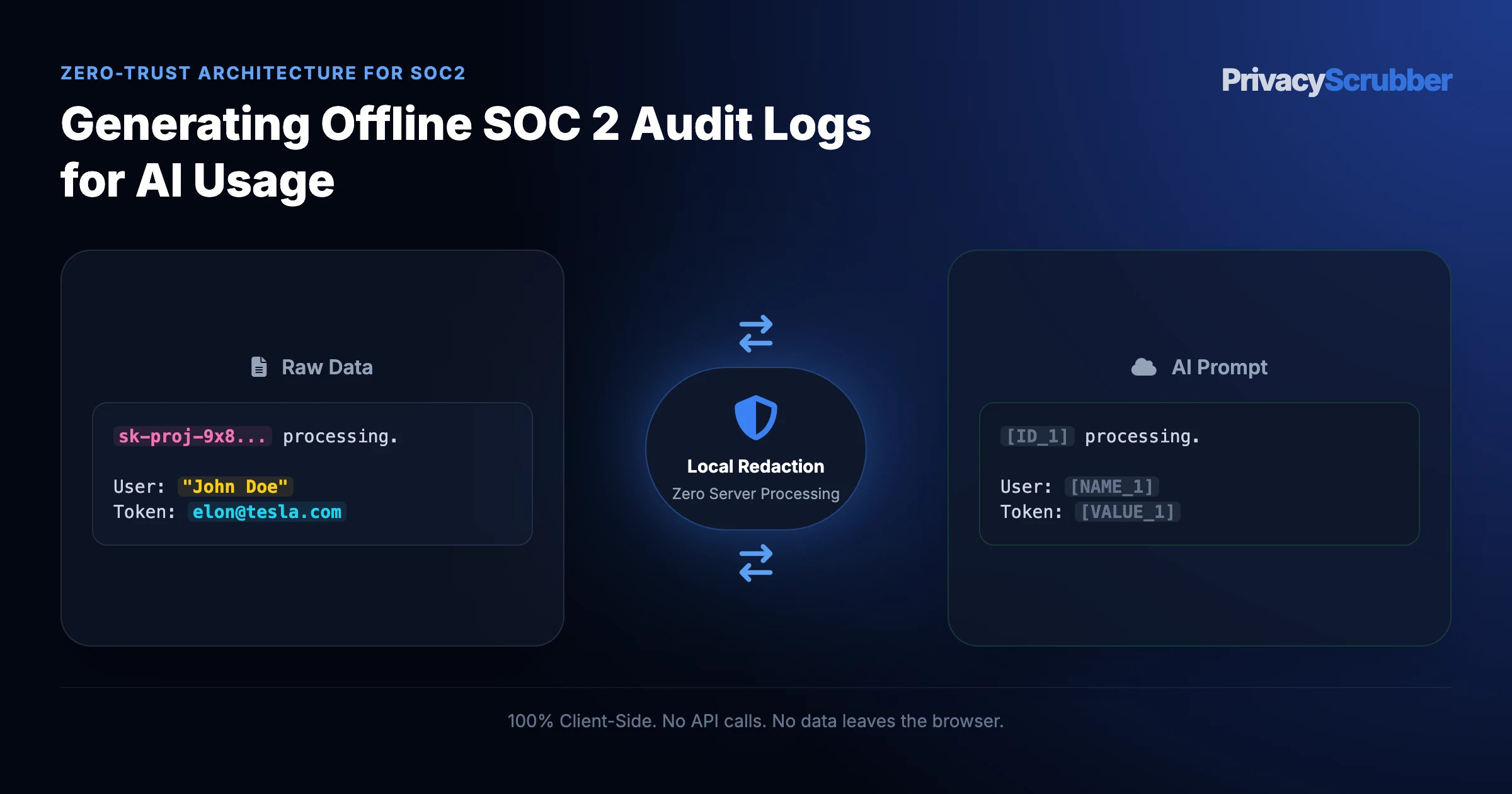
Prevent SOC 2 Audit Trail & Evidence Log Leakage to Cloud
Prevent auditor evidence logs and compliance trails from leaking to external clouds. 100% in-RAM sanitization under SOC 2 CC6.1 & CC6.7 requirements.
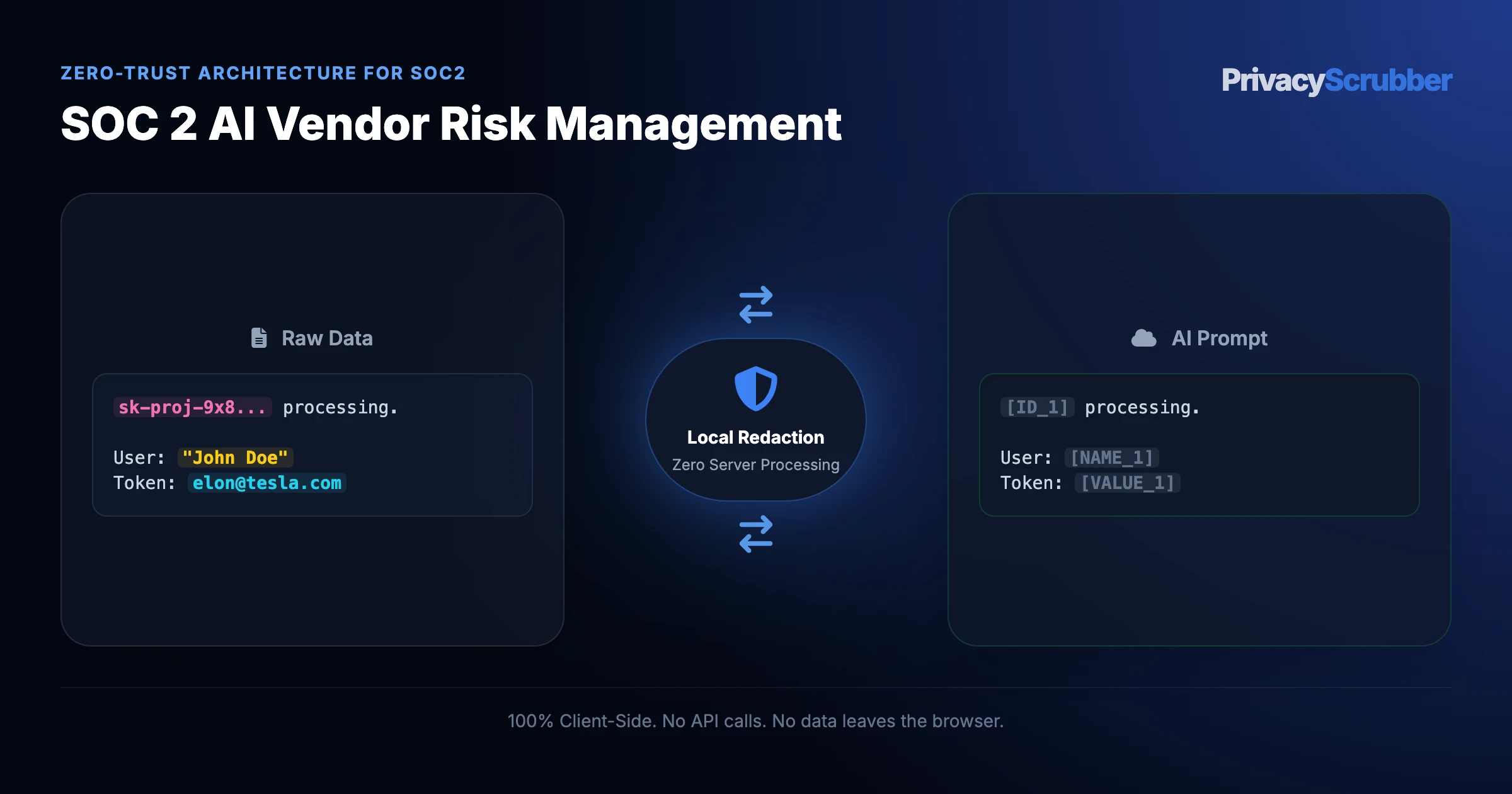
SOC 2 AI Vendor Risk Management
Manage SOC 2 vendor risk when using AI tools. Apply CC9.1 third-party controls to ChatGPT and enterprise LLMs using local PII tokenization to eliminate exposure.
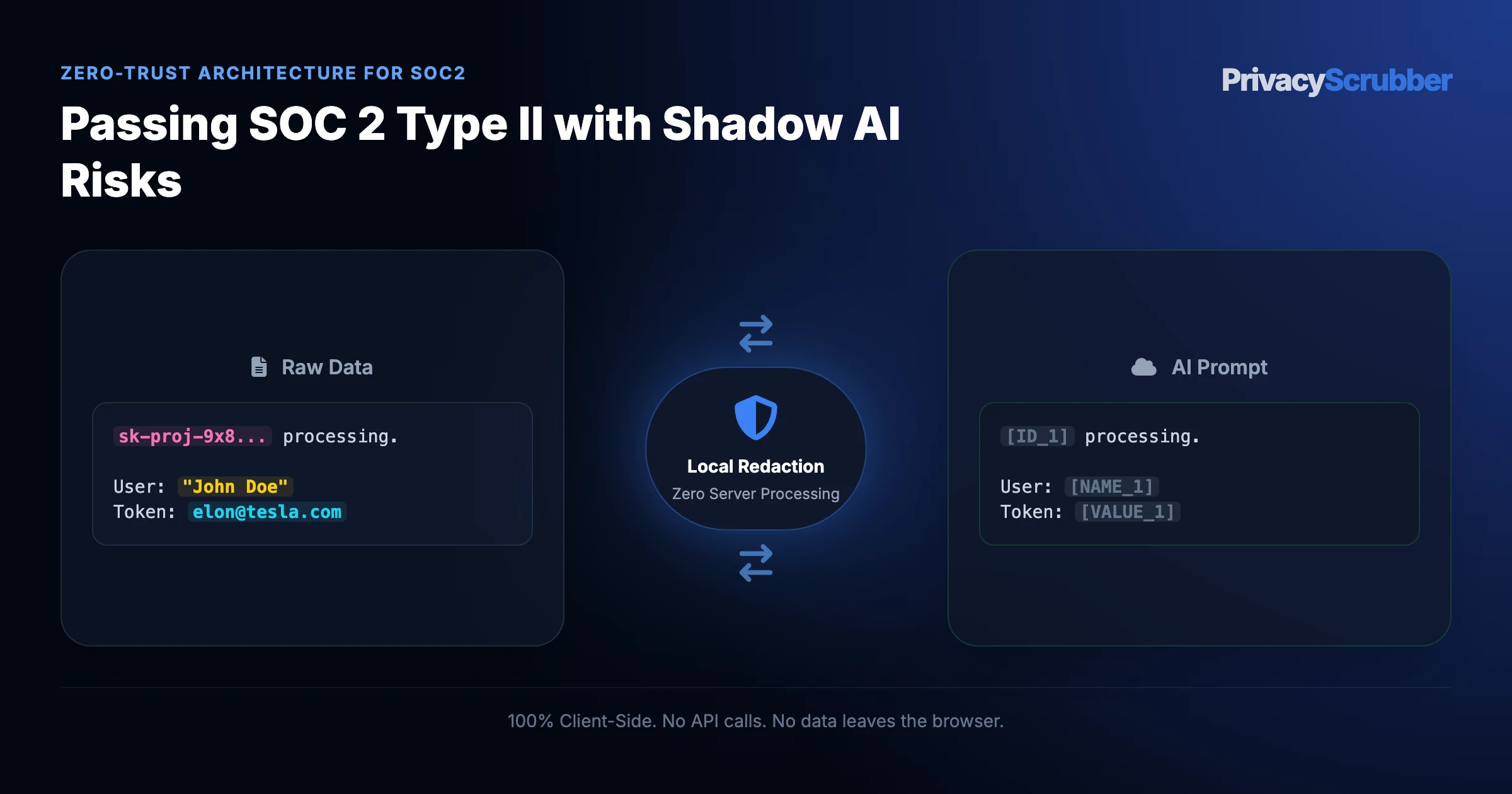
Passing SOC 2 Type II with Shadow AI Risks
Unsanctioned AI usage is a major SOC 2 vulnerability. Learn how to pass your Type II audit by implementing Zero-Trust Data Sanitization at the endpoint.
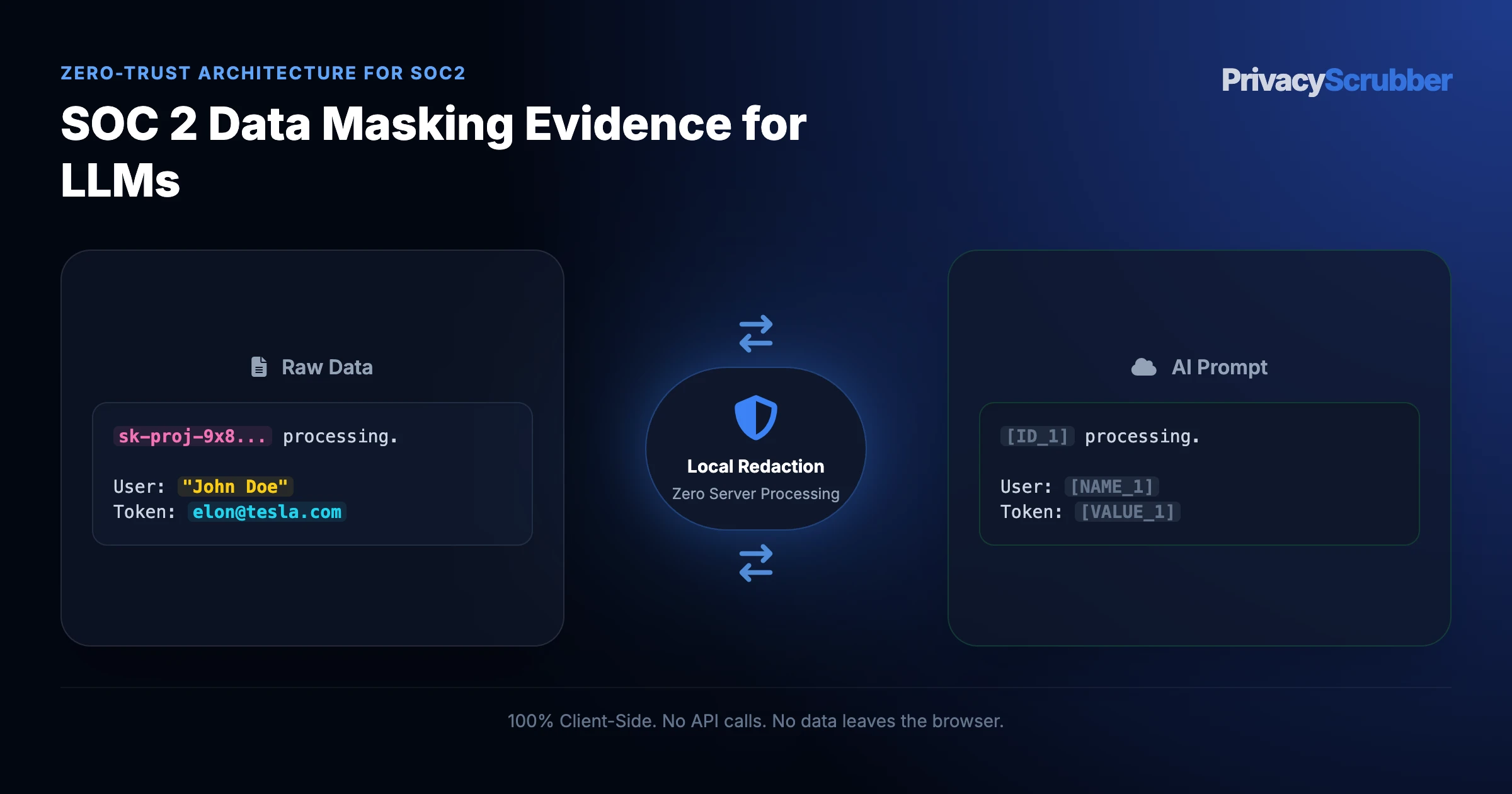
SOC 2 Data Masking Evidence for LLMs
How to provide auditors with cryptographic proof of data masking for Generative AI workflows. Achieve SOC 2 CC6.1 compliance with in-browser scrubbing.
AI Acceptable Use Policy Template for 2026
A free, editable AI acceptable use policy template covering data privacy, PII scrubbing requirements, and AI tool governance.
Comparing AI Privacy Software for SOC 2 Compliance
A comparison of data masking and PII redaction software for SOC 2 Type II audit readiness. Compare local-first tools vs cloud DLP proxies.
Top 20 Data Types Leaked to AI — Masked Automatically (GDPR & SOC 2)
Discover the top 20 sensitive PII and secret data types employees paste into ChatGPT, Claude, and Gemini — and how masking them locally in browser RAM prevents regulatory fines under GDPR, HIPAA, and SOC 2.

HIPAA & SOC 2 AI Audits
Learn how to pass your next security audit by implementing client-side PII masking for all AI-enabled business units. Flat-rate TEAMS pricing available.

GLBA AI Sanitization
Satisfy FTC GLBA Safeguards Rule (16 CFR Part 314) for financial AI. Mask customer NPI locally in browser RAM before LLM analysis with zero cloud leaks.
Compare Edition Features
From individual use to corporate rollout, choose the level of control your organization requires.
| Core Capabilities |
Free
Web Only
|
PRO
$15/mo or $110 Lifetime
|
TEAMS
$99/mo
|
ENTERPRISE
Custom Tier
|
|---|---|---|---|---|
| 100% Local Processing (Airplane Mode) | ||||
| Text Paste & Single File Docs | 15k General / 5k Verticals | UNLIMITED | UNLIMITED | UNLIMITED |
| Batch Processing & Background OCR | — | |||
| Custom Regex & Specific Redaction Rules | — | |||
| Chrome Extension Native App | — | |||
| Silent Corporate Deployment (MDM) | — | — | ||
| Policy Control Center & Enforcement | — | — | ||
| IDE MCP Server & Headless Node.js SDK | MCP Free | MCP Unlimited | MCP + Team Sync | SDK ($299/mo) & Air-Gap |
| On-Premise Source Code License | — | — | — | |
| 100% Air-Gapped Operation | — | — | — | |
| Dedicated GRC Support | — | — | — | |
| Try Free | Details | Deploy TEAMS | Enterprise Hub |
Complementary AI Privacy Hubs & Frameworks
Cross-framework zero-trust sanitization workflows and enterprise compliance architectures.
Frequently Asked Questions
Common questions about deploying zero-trust AI for SOC 2 Teams.
Does deploying PrivacyScrubber add a new subprocessor to our SOC 2 CC9.2 vendor inventory?
How does PrivacyScrubber help us pass SOC 2 Type II testing for CC6.1, CC6.6, and C1.1?
How does PrivacyScrubber satisfy SOC 2 Confidentiality criterion C1.2 (Disposal of Confidential Information)?
Can our engineering team use PrivacyScrubber inside Cursor, Claude Desktop, and CI/CD pipelines?
How does encrypted session handoff work for support and SRE escalations?
Zero-Trust Sanitization Verified
Technical safeguards supporting GDPR Art. 32, HIPAA & CCPA. All PII processing occurs locally in browser RAM.