GDPR Article 25 & 32 Technical Safe Harbor for Enterprise AI
AI Summary / Key Takeaways
"PrivacyScrubber operationalizes GDPR Article 25 (Data Protection by Design and by Default), Article 32(1)(a) (Pseudonymization and Encryption TOMs), and Article 5(1)(c) (Data Minimization) via Zero-Trust Data Sanitization (ZTDS RFC v1.0). Direct EU personal identifiers are replaced with deterministic tokens ([NAME_1], [IBAN_1]) inside local browser RAM in <1.4ms while the re-identification token dictionary remains strictly in volatile EEA client memory—satisfying EDPB Recommendations 01/2020 Use Case 2 for Chapter V cross-border transfers and reducing contextual quasi-identifier entropy across 30 Specialized Industry Profiles."
How to achieve GDPR Article 25 & 32 technical safe harbor and EDPB 01/2020 cross-border compliance when using US LLMs?
Enforce GDPR Article 25 (Data Protection by Design), Article 32(1)(a) (Pseudonymization TOMs), and EDPB Recommendations 01/2020 Use Case 2 by tokenizing European personal data in local browser RAM (<1.4ms, 0-byte network egress) before prompting US-hosted LLMs. Retaining the cleartext token dictionary exclusively in volatile EEA client memory prevents direct PII from crossing borders while 30 Specialized Industry Profiles suppress contextual quasi-identifiers under Recital 26.
Interactive PII Detection & Sanitization Sandbox
Test real-time client-side RAM tokenization. Choose a specialized preset or paste your own raw prompt to test instant reversible redaction.
Sanitized locally in volatile RAM. Pre-prompt compliance maintained under GDPR standards (GDPR, HIPAA, SOC 2).
Enterprise-Grade AI Privacy
Add custom redaction rules and priority support with PRO.
Executive Summary: GDPR
GDPR Article 32(1)(a) mandates pseudonymization and encryption as primary Technical and Organizational Measures (TOMs), while Article 25 enforces Data Protection by Design and by Default. For Generative AI, this requires ensuring European personal data is sanitized before leaving the data controller's boundary. PrivacyScrubber enforces statutory risk minimization and technical safe harbor locally in browser RAM via Zero-Trust Data Sanitization (ZTDS RFC v1.0). Direct identifiers (EU citizen names, IBANs, national IDs, emails, IP addresses) are replaced with deterministic tokens ([NAME_1], [IBAN_1]) in <1.4ms while the cleartext mapping table (token dictionary) remains strictly in volatile EEA client memory—satisfying EDPB Recommendations 01/2020 Use Case 2 against Schrems II cross-border transfer exposure.
Privacy Checkpoints
- Article 25 & 5(1)(c) (By Design & Minimization): Strip direct identifiers in client RAM before any HTTP request to OpenAI, Anthropic, or Google.
- Article 32(1)(a) (Pseudonymization TOMs): Deterministic AST & regex tokenization with reversible local-only token dictionary restoration.
- Chapter V & EDPB 01/2020 Use Case 2: Zero cleartext PII crosses into US cloud subprocessors; re-identification keys never leave EEA endpoints.
- Article 17 (Right to Erasure / RTBF): Prevent raw personal data from entering immutable LLM weights or RAG vector indexes; O(1) RAM zeroization.
- Article 30 & 35 (ROPA & DPIA Evidence): Generate cryptographically signed SHA-256 Compliance Receipts proving pre-egress sanitization.
- Works Council Co-Determination (BetrVG § 87 / CSE): Zero keystroke logging, zero central proxy telemetry, and 100% local employee autonomy.
PII Detection Matrix
| Entity Type | Exposure Risk | Local Edge Control |
|---|---|---|
| EU Citizen Names & Contacts | Critical (Art. 5 / Art. 83(5) Fine) | Deterministic RAM Tokenization ([NAME_1]) |
| SEPA IBAN & SWIFT Bic | Critical (Financial / Art. 32 Breach) | Deterministic IBAN Redaction ([IBAN_1]) |
| EU National IDs (Steuer-ID, NIR, BSN, DNI) | Critical (Art. 9 / National Member Law) | Strict Pattern Tokenization ([ID_1]) |
| DSAR & Support Ticket Identifiers | High (Art. 15 / Recital 26 Linkage) | Contextual Entity Suppression ([DSAR_1]) |
| Residential & IPv4/IPv6 Addresses | High (Online Identifier / CJEU Breyer) | Network & Location Masking ([IP_1]) |
| Employee HR & Works Council Records | Critical (Art. 88 / BetrVG § 87(1) No. 6) | Client-Side Zero-Telemetry Scrubbing |
Verified by the European Enterprise Governance Board
How Data Protection Officers, CISOs, and European Works Council Legal Counsel evaluate client-side Zero-Trust Data Sanitization (ZTDS™ RFC v1.0) under Regulation (EU) 2016/679.
"GDPR Article 5(1)(c) (Data Minimization) and Article 25 (Data Protection by Design) require stripping personal identifiers before third-party processing begins. By tokenizing direct identifiers in local EEA browser RAM and suppressing vertical quasi-identifiers across 30 specialized profiles, controllers establish a demonstrable Technical Safe Harbor under Article 32 and Recital 26."
"Relying on an AI vendor's contractual 'opt-out of training' toggle is an administrative promise, not an Article 32 Technical Measure. PrivacyScrubber enforces a deterministic cryptographic boundary inside client RAM (<1.4ms latency, 0-byte cleartext egress) and outputs SHA-256 Compliance Receipts without introducing a new cloud DLP subprocessor."
"German Betriebsrat (BetrVG § 87(1) No. 6) and French CSE routinely block Cloud DLP proxies because central prompt logging enables employee performance and behavioral surveillance. Because PrivacyScrubber executes locally on the employee's endpoint with zero central telemetry, enterprises secure rapid Works Council co-determination sign-off."
Why Contractual AI Vendor DPAs Fail GDPR Articles 5, 17, 25, 32 & Chapter V
When employees paste customer support tickets, HR evaluations, SEPA IBAN records, or legal discovery bundles into US-hosted Large Language Models (OpenAI ChatGPT, Anthropic Claude, Google Gemini, Microsoft Copilot), the organization triggers immediate obligations as a Data Controller under Regulation (EU) 2016/679. Signing a standard AI Vendor Data Processing Agreement (DPA) or enabling "Zero Data Retention" does not cure four structural statutory failures:
1. Chapter V Cross-Border Transfers & Schrems II (CJEU Case C-311/18)
Transmitting unredacted European personal data to US cloud infrastructure subjects the payload to extraterritorial US intelligence authorities (FISA Section 702 and Executive Order 12333) and the US CLOUD Act. Under EDPB Recommendations 01/2020 (Section 2.2, Use Case 2), supplementary technical measures only satisfy Chapter V if personal data is pseudonymized prior to egress and the re-identification dictionary remains under the exclusive physical custody of the EEA Data Controller.
2. Article 17 Right to Erasure ("Right to be Forgotten") Impossibility
Once cleartext PII enters LLM abuse-monitoring logs, fine-tuning datasets, or enterprise RAG vector databases (Pinecone, Weaviate, Qdrant), honoring an Article 17 erasure request within the mandatory 30-day statutory window is mathematically intractable without purging vector indexes or retraining weights. Pre-ingestion client-side tokenization ensures raw PII never enters external AI memory, while local O(1) RAM zeroization destroys the mapping table on tab close.
3. Article 5(1)(c) Data Minimization & Article 25 By-Default Violations
To summarize a contract, debug a JSON payload, or translate an HR letter, an LLM requires only syntactic structure and semantic relationships—never the real name, IBAN, or Steuer-ID of the data subject. Transmitting raw identities when synthetic tokens ([NAME_1], [IBAN_1]) yield identical analytical utility violates Article 5(1)(c) proportionality and Article 25(2) data protection by default.
4. Statutory Risk Minimization & Technical Safe Harbor (Recital 26 Defense-in-Depth)
Unstructured free-text prompts can contain contextual quasi-identifiers (unique litigation timelines, rare clinical combinations, or corporate M&A markers) evaluated under GDPR Recital 26. Rather than making scientifically false claims of "blanket legal exemption," PrivacyScrubber delivers a three-layer Technical Safe Harbor under Article 32(1)(a): (1) 100% Direct PII ZTDS™ via deterministic RAM tokenization, (2) Contextual Entropy Reduction across 30 Specialized Industry Profiles + AES-256-GCM custom literal vaults, and (3) DPO/CISO Legal Shield via SHA-256 Compliance Receipts proving proactive technical due diligence to mitigate Article 83 administrative fines.
Cleartext Input (Never Transmitted):
Core GDPR & EU AI Act Pillars
GDPR Compliance Architecture Comparison
Evaluating Contractual AI Vendor DPAs, Cloud DLP Proxy Gateways, and Client-Side Zero-Trust Data Sanitization (ZTDS™) across European regulatory controls.
| GDPR Statutory Dimension | AI Vendor DPA Only (OpenAI / Anthropic) | Cloud DLP API / CASB Proxy | PrivacyScrubber (Client-Side ZTDS™) |
|---|---|---|---|
| Art. 5(1)(c) & Art. 25 Data Minimization Boundary | Fails: Full cleartext PII leaves the EEA endpoint and enters vendor servers. | Partial: Cleartext PII leaves the endpoint and transits to proxy cloud servers. | Enforced at Source: Scrubbed inside local V8/WASM RAM before network egress. |
| Chapter V & EDPB 01/2020 Use Case 2 (Schrems II) | Exposed: Subject to US CLOUD Act & FISA 702; relies on contested SCCs/DPF. | Exposed: Proxy provider holds both cleartext stream and tokenization keys. | Compliant: US LLM sees only synthetic tokens; local ZTDS™ token dictionary stays in EEA RAM. |
| Art. 28 Subprocessor Onboarding & Audit Scope | Requires DPA, TIA (Transfer Impact Assessment), and subprocessor tracking. | Adds a new Tier-1 processor inspecting 100% of corporate prompt traffic. | Zero Subprocessors: Stateless local runtime; PrivacyScrubber never enters the Art. 28 processor chain. |
| Art. 17 Right to Erasure (LLM & RAG Memory) | High Risk: 30-day abuse logs or vector embeddings retain raw personal data. | Medium Risk: Proxy audit logs and SIEM buckets store cleartext inspection traces. | Enforced by Design: Direct PII never enters LLM/RAG; O(1) RAM zeroization on tab close. |
| Works Council Co-Determination (BetrVG § 87 / CSE) | Blocked by DPO due to unredacted employee and applicant data egress. | Frequently vetoed: Central prompt inspection constitutes employee surveillance. | Approved: 100% local employee control; zero keystroke or behavioral telemetry. |
| Art. 30 ROPA & Art. 35 DPIA Audit Evidence | None: No per-prompt cryptographic proof of data minimization. | Centralized logs that themselves create a secondary toxic PII honeypot. | Tamper-Evident SHA-256 Compliance Receipts with zero cleartext retention. |
Interactive GDPR Article 30 ROPA, Article 35 DPIA & Works Council Clause Generator
Select a statutory template below to copy or download pre-verified technical safeguard clauses for your GDPR compliance binders, Transfer Impact Assessments, and Works Council agreements.
PROCESSING ACTIVITY: Generative AI & LLM Assisted Enterprise Workflows
TECHNICAL & ORGANIZATIONAL MEASURE (GDPR Art. 30(1)(g) & Art. 32(1)(a)):
Before any prompt, document, or database excerpt is transmitted to an external Large Language Model (LLM) or cloud API, the Data Controller enforces mandatory client-side Zero-Trust Data Sanitization (ZTDS™ RFC v1.0) via PrivacyScrubber.

1. EXECUTION BOUNDARY: 100% of direct personal identifiers (names, email addresses, telephone numbers, SEPA IBANs, national identification numbers, IP addresses) and sector-specific quasi-identifiers are intercepted and replaced with deterministic synthetic tokens ([NAME_1], [IBAN_1], [ID_1]) inside local EEA endpoint volatile memory (RAM).
2. ZERO SUBPROCESSOR SCOPE (GDPR Art. 28): PrivacyScrubber operates as a stateless client-side appliance with zero external server communication (0 bytes cleartext network egress). No third-party DLP processor is introduced into the processing chain.
3. RETENTION & ERASURE (GDPR Art. 17): The re-identification token dictionary resides exclusively in tab-isolated volatile RAM and undergoes immediate O(1) memory zeroization upon session termination.
4. VERIFICATION EVIDENCE: SHA-256 Cryptographic Compliance Receipts are generated locally to evidence pre-ingestion data minimization without storing cleartext personal data.
European Supervisory Authority & Works Council Playbooks
Jurisdiction-specific implementation blueprints aligning client-side ZTDS™ sanitization with national Data Protection Authorities and European employee co-determination statutes.
German BfDI & Betriebsrat Clearance
Satisfy German Federal Commissioner (BfDI) AI guidelines, BDSG § 26 employee data rules, and Works Council (Betriebsrat) co-determination without central proxy monitoring. Tokenizes Steuer-ID, Sozialversicherungsnummer, and SEPA IBANs locally.
French CNIL & CSE Works Council
Align generative AI deployments with CNIL AI System Action Plan recommendations on data minimization and secure prompt engineering while passing Comité Social et Économique (CSE) consultation. Redacts French NIR (Numéro de Sécurité Sociale) and SIREN/SIRET.
Italian Garante & Statuto dei Lavoratori
Address the Italian Garante's enforcement precedents against unlawful LLM data ingestion and comply with Article 4 of the Workers' Statute (Statuto dei Lavoratori) prohibiting remote worker monitoring. Strips Italian Codice Fiscale and Partita IVA in RAM.
UK ICO Generative AI & IDTA Compliance
Operationalize the UK Information Commissioner's Office (ICO) Generative AI consultation framework across UK GDPR, the Data Protection Act 2018, and International Data Transfer Agreements (IDTA). Redacts UK National Insurance Numbers (NINO), NHS numbers, and Sort Codes.
Dutch AP, Ondernemingsraad & Irish DPC
Satisfy the Dutch Autoriteit Persoonsgegevens (AP) strict guidelines on citizen Burgerservicenummer (BSN) processing, Dutch Works Council (Ondernemingsraad WOR Art. 27) consent, and Irish Data Protection Commission (DPC) Lead Supervisory Authority audits.
Austria, Switzerland (revDSG), Nordics & Spain
Complete technical alignment for Austrian Betriebsrat (ArbVG § 96a), Swiss revised Federal Act on Data Protection (revDSG / nFADP), Swedish MBL co-determination, and Spanish AEPD / Workers' Statute Article 20 bis digital rights.
5-Plane GDPR Technical Enforcement Suite
Deploy deterministic Article 25 & 32 pseudonymization across browser workspaces, enterprise Chrome fleets, encrypted team handoffs, Node.js/RAG backends, and AI IDEs.
Web App & In-DOM Extension
Intercepts paste and prompt submissions inside ChatGPT, Claude, Gemini, Copilot, Perplexity, and DeepSeek. Includes offline PDF/DOCX/OCR scrubbing and 30 Specialized Industry Profiles.
TEAMS & Encrypted Handoff
Share re-identification context across Slack, Jira, or MS Teams via XChaCha20-Poly1305 + Argon2id encrypted .pssession containers. Includes centralized custom regex governance and SHA-256 receipts.
Headless NPM SDK
Embed @privacyscrubber/sdk in Node.js microservices, LangChain/LlamaIndex orchestrators, and ETL pipelines to scrub EU PII in memory (<1ms) before embedding into vector databases.
MCP Stdio Server
Run @privacyscrubber/mcp-server over local stdio in Cursor, Claude Desktop, and Windsurf. Enforces pre-call PII/secret sanitization and SHA-256 leakage auditing for engineering teams.
Interactive 5-Step Airplane Mode Audit for GDPR Article 32
Click each verification step below as you test in Chrome DevTools to confirm zero-server processing for your Article 30 ROPA and Article 35 DPIA evidence file.
Load the Client Workspace
Open the PrivacyScrubber web workspace or launch the Chrome MV3 Extension and select the GDPR / Legal / Finance sector profile.
Sever Network Connectivity
Physically disconnect Wi-Fi/Ethernet or enable OS Airplane Mode (DevTools → Network → Offline). The sanitization engine remains 100% operational.
Sanitize Regulated EU Records
Paste a sample DSAR ticket containing EU citizen names, SEPA IBANs, and national IDs (Steuer-ID, NIR, Codice Fiscale), then trigger Scrub PII.
Verify Zero Network Egress
Inspect Chrome DevTools (F12 → Network). Confirm that 0 outbound HTTP/Fetch/WebSocket requests occur during scrubbing or token restoration.
Export SHA-256 Audit Receipt
Download the SHA-256 Compliance Receipt and attach it to your GDPR Article 35 DPIA and Article 30 Record of Processing Activities.
Sample GDPR SHA-256 Receipt
Copy a sample GDPR Article 32 SHA-256 Compliance Receipt JSON payload for SIEM ingestion or launch the live browser scrubber.
Complete your GDPR Article 28, Article 30, and Article 35 vendor due diligence with our primary architectural disclosures:
GDPR & EU Data Sovereignty Profile: Detection Coverage
GDPR Art. 25, Art. 32(1)(a), and EDPB 01/2020 Use Case 2 ruleset. Tokenizes European national IDs, SEPA IBANs, VAT numbers, DSAR ticket IDs, and data subject identities in local RAM before external LLM egress.
Top 6 GDPR Sensitive Entity Types Detected & Scrubbed
EU Data Subject Identity
SEPA Bank Account (IBAN)
EU National ID (Steuer-ID / NIR / BSN)
Art. 15 Subject Access Request Ref
EU Corporate VAT / USt-IdNr.
Online Identifier (CJEU C-582/14)
Continuous Detection Engine Expansion & Custom Regex Sovereignty
The 6 entity types above represent the core detection baseline for GDPR. Our zero-trust engine detects hundreds of additional data classes and is continuously updated with new heuristic patterns, shadow AI leak vectors, and custom regulatory rulesets. Need proprietary database IDs or internal project codenames masked? PRO and TEAMS users can define unlimited custom regular expressions running 100% locally in browser RAM.
How the PrivacyScrubber Engine Solves This
Interactive Tool Controls for GDPR. Hover for specs.
In-DOM Article 25 Interception
The MV3 Browser Extension intercepts paste and submit events across ChatGPT, Claude, Gemini, Copilot, and DeepSeek, tokenizing EU PII in local RAM.
- Engine WASM-Accelerated
- Privacy 100% Local RAM
- Security Zero-Server Leak
EDPB 01/2020 Use Case 2 Custody
Satisfy Schrems II supplementary measures: synthetic tokens traverse the network while the cleartext token dictionary remains strictly on the EEA device.
- Engine WASM-Accelerated
- Privacy 100% Local RAM
- Security Zero-Server Leak
Article 30 & 35 Audit Receipts
Export SHA-256 Compliance Receipts documenting entity counts, triggered GDPR controls, and ZTDS™ verification for DPO audits.
- Engine WASM-Accelerated
- Privacy 100% Local RAM
- Security Zero-Server Leak
How privacy-conscious GDPR teams use the tool
Our Zero-Trust engine is uniquely positioned to solve the most critical compliance bottlenecks when adopting modern AI workflows.
DPO & Legal DSAR Triage (Art. 15 & Art. 17)
Sanitize Data Subject Access Requests, supervisory authority correspondence, and cross-border litigation bundles in browser RAM before using Claude or ChatGPT for legal summarization.
Works Council & HR AI Clearance (BetrVG § 87 / CSE)
Enable German, French, Dutch, and Nordic HR teams to screen CVs and draft performance reviews with zero central employee surveillance and full works council co-determination sign-off.
Cross-Border Engineering & RAG Pipelines (Chapter V)
Enforce EDPB 01/2020 Use Case 2 in Node.js microservices, LangChain pipelines, and Cursor/Claude Desktop IDEs via @privacyscrubber/sdk and @privacyscrubber/mcp-server.
GDPR PRO Engine
Advanced Semantic Data Masking
Protected Parameters (Masked Locally)
Key Problems Solved
- Enforces GDPR Article 25 (Privacy by Design) at the browser input layer.
- Prevents illegal cross-border personal data transfers (Schrems II).
- Implements reversible pseudonymization under GDPR Article 4(5) in RAM.
GDPR Technical Implementation Mapping
Deep architectural mapping of Zero-Trust Data Sanitization (ZTDS) controls to industry-wide regulatory standards.
Zero-Trust Verification Signature
The above technical controls are enforced deterministically by the PrivacyScrubber Local Engine. All redaction cycles generate zero server-side telemetry, satisfying global data residency requirements for GDPR institutions.
Hardened Audit Standards
Enforcing Article 25 Privacy by Design and Article 32(1)(a) pseudonymization across European AI workflows.
Ensures transparency and data minimisation for high-risk models.
Data masking as a core organisational control.
No data persistence on untrusted infrastructure.
Federal PII minimisation and transparency controls.
State-level compliance for consumer data masking.
GDPR Compliance Library
Step-by-step redaction workflows for GDPR environments.
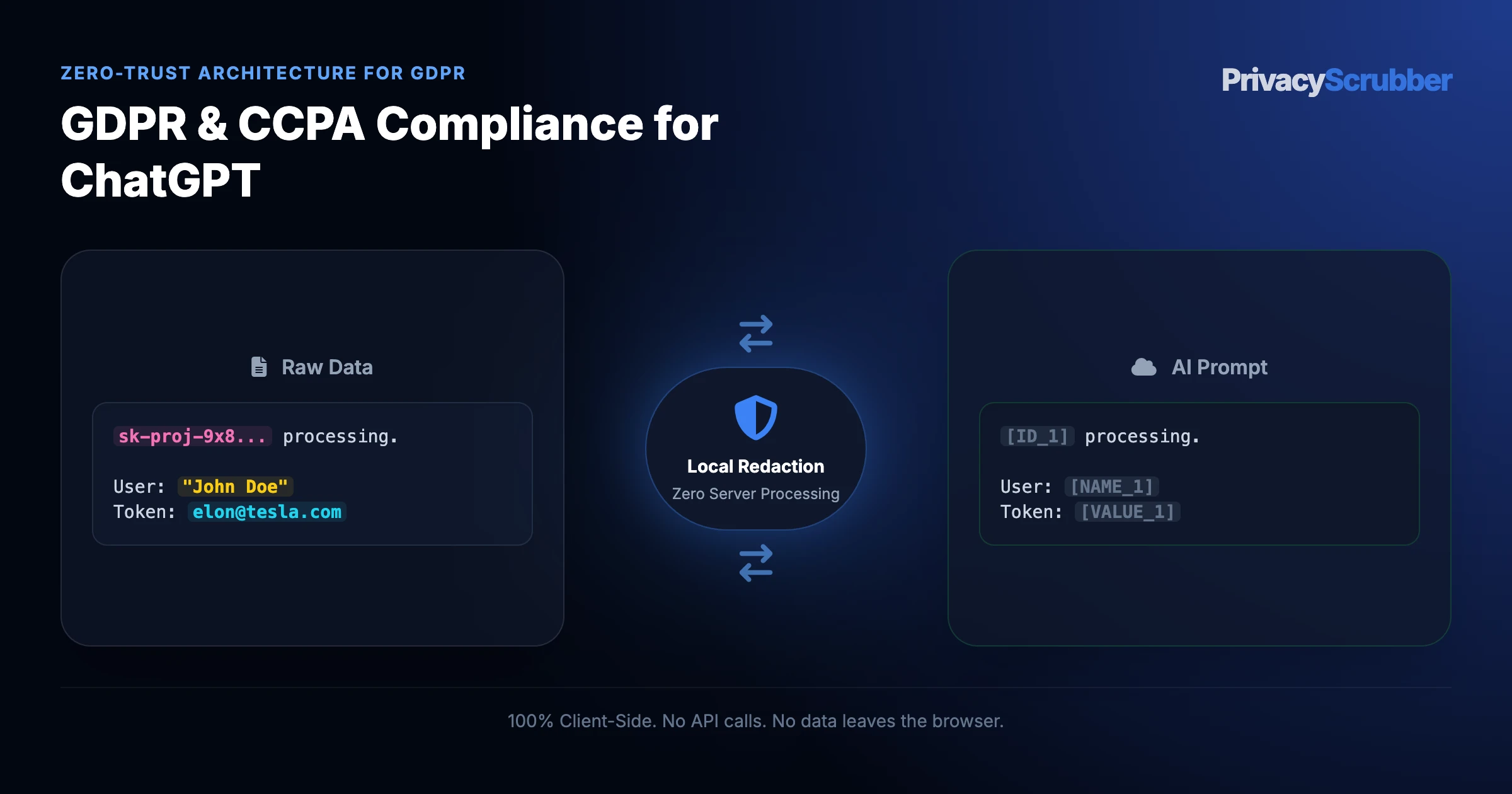
GDPR & CCPA AI Compliance
Meet GDPR Art. 28/32 and CCPA/CPRA AI rules in 2026: tokenize consumer PII in local browser RAM before ChatGPT or Claude prompts with 0 cloud egress.
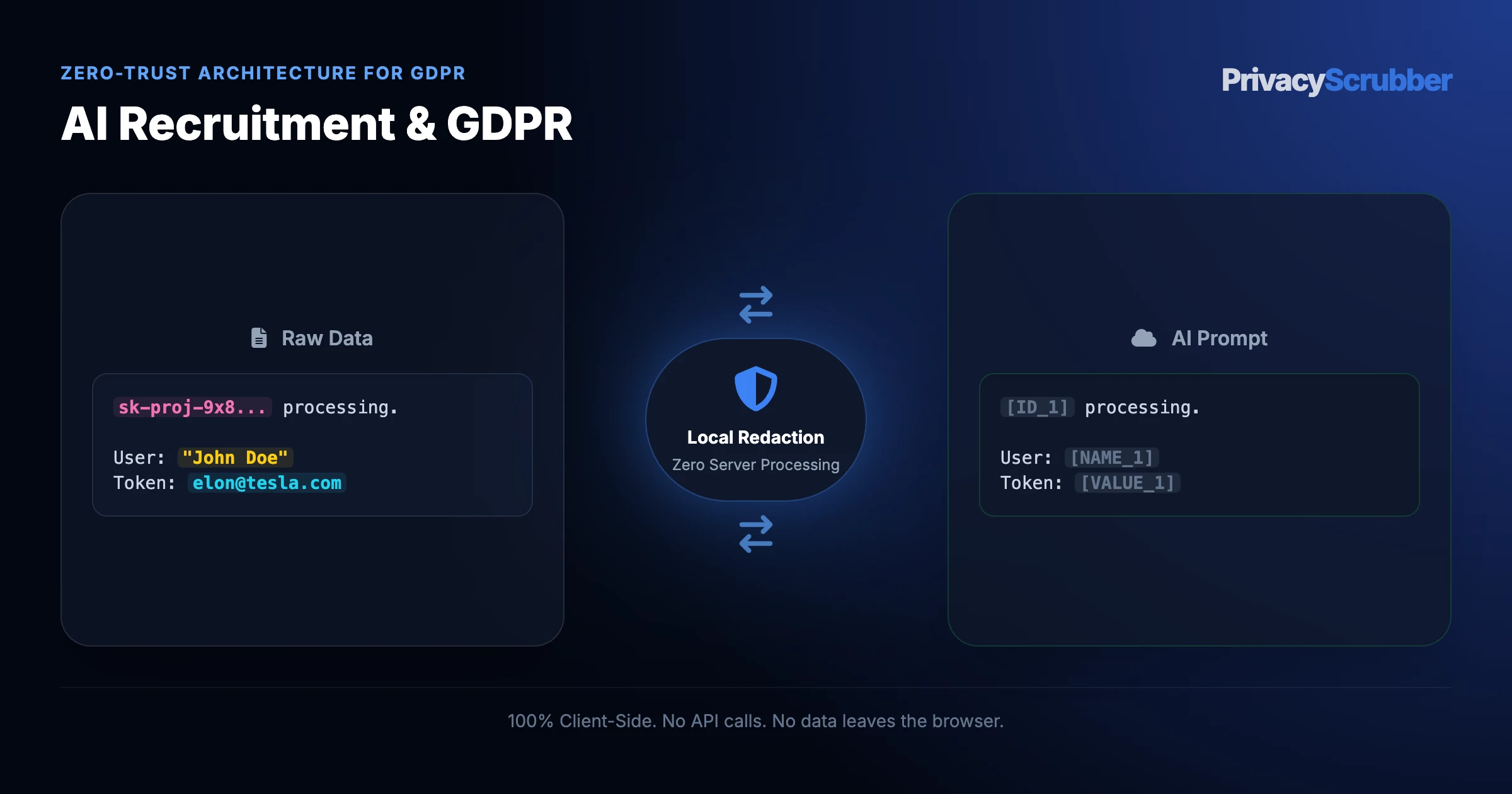
AI Recruitment & GDPR
Hiring AI is high-risk under the EU AI Act and handles personal data under GDPR. Mask candidate identity locally before screening. TEAMS flat rate.

OpenAI DPA Compliance
An OpenAI DPA sets vendor terms, not what employees paste. Remove personal data locally first to shrink GDPR Art. 28 and 32 exposure. TEAMS flat rate.
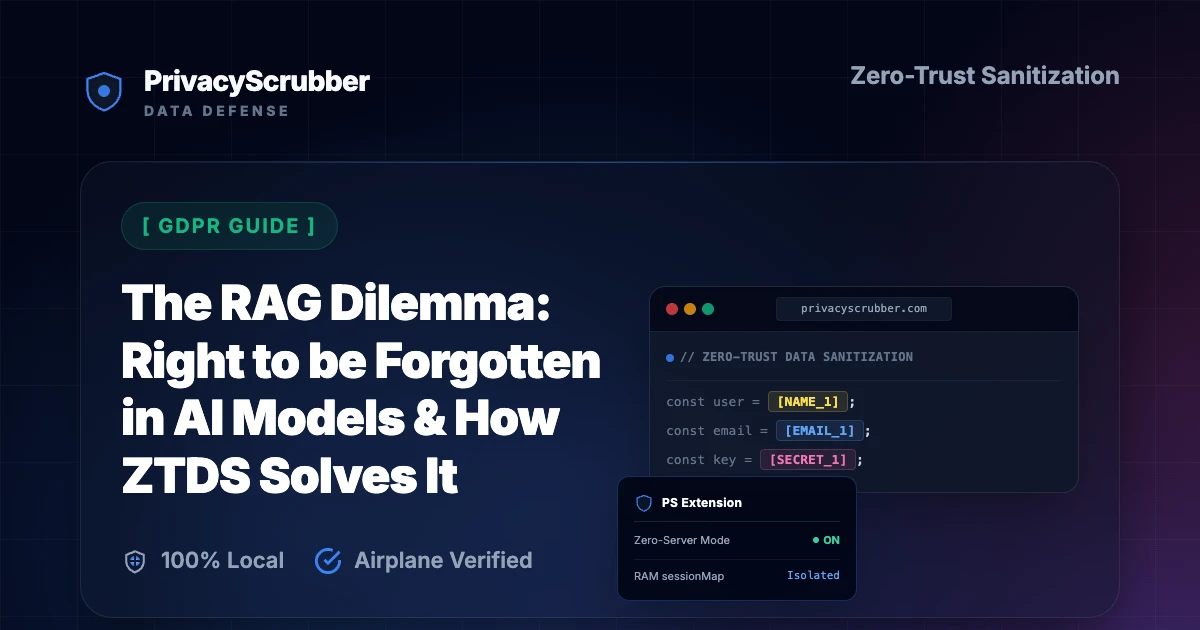
The RAG Dilemma
Solve the AI Machine Unlearning problem. Achieve GDPR Article 17 compliance by masking PII before it reaches LLMs using Zero-Trust Data Sanitization.
Passing a Generative AI DPIA
Streamline your GDPR Article 35 DPIA for Enterprise AI. Lower risk profiles from High to Low using client-side pseudonymization and Zero-Trust Data Sanitization.
GDPR Article 22
Comply with GDPR Automated Decision-Making rules. Prevent algorithmic bias in HR and Finance by scrubbing demographic PII from AI prompts.
Bypassing Schrems II
Comply with GDPR Chapter V cross-border rules for AI without US transfer risks. Redact EU personal data locally in browser RAM before prompt submission.
The DSAR Nightmare in RAG Systems (And How Pre-Ingestion Scrubbing Stops It)
Fulfilling Data Subject Access Requests within RAG vector databases is nearly impossible. Avoid the DSAR trap entirely by masking PII before vectorization.
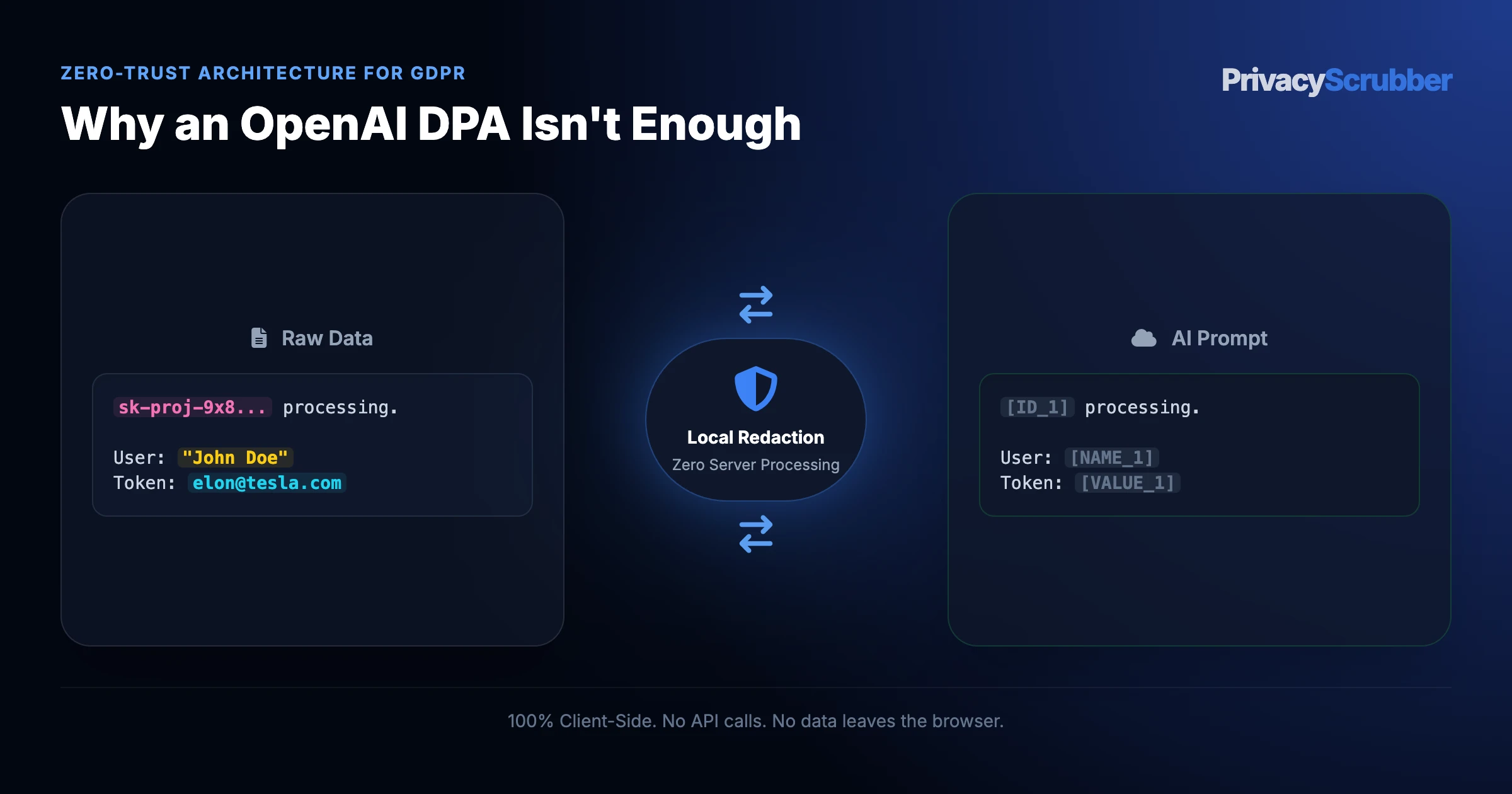
Why an OpenAI DPA Isn't Enough
A Data Processing Agreement is just a legal promise. Zero-Trust Data Sanitization provides mathematical proof that your enterprise AI vendor cannot leak your PII.
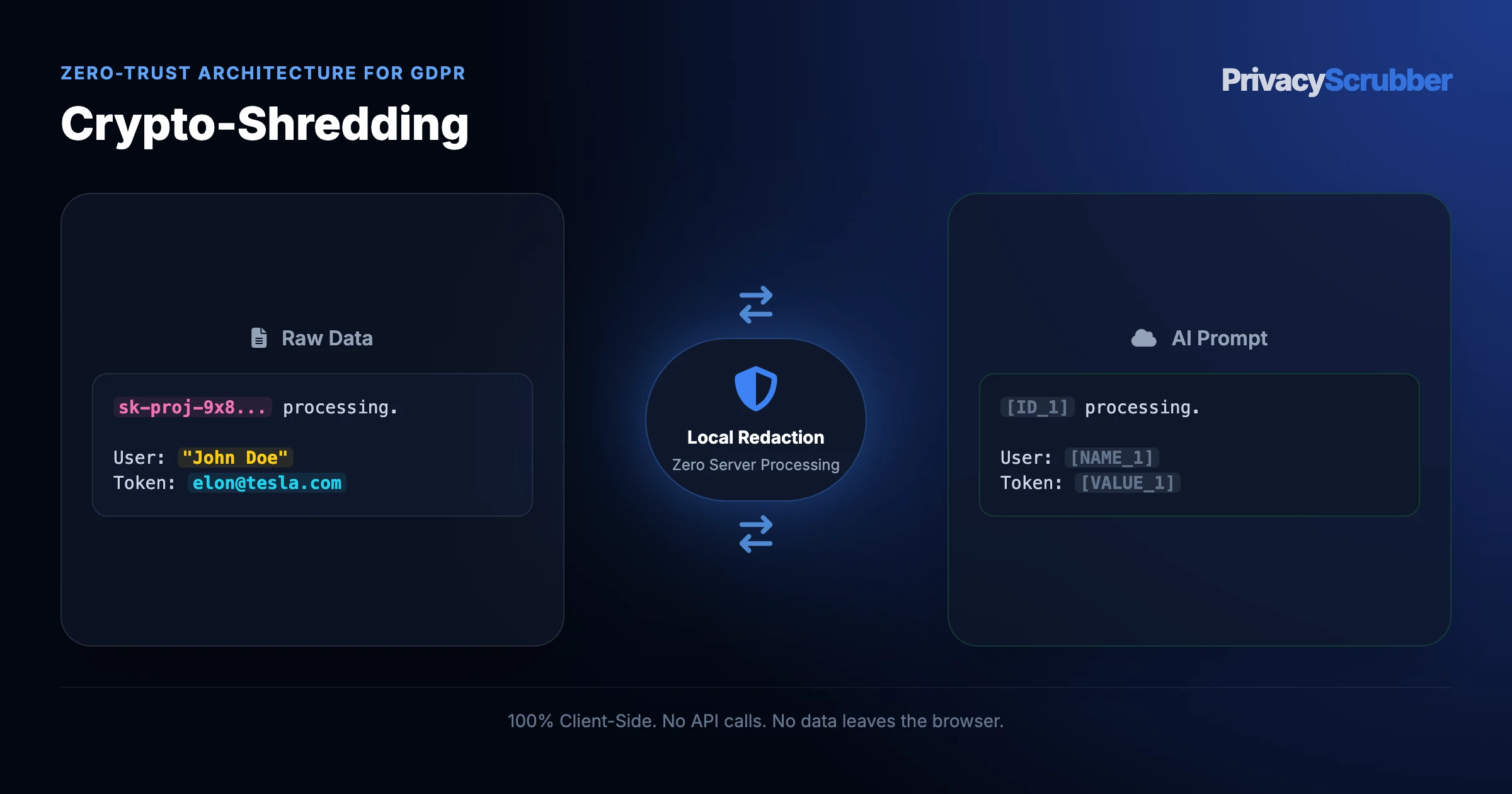
Crypto-Shredding
Deleting personal data from massive vector databases is technically impossible. Learn how Crypto-Shredding verifiably satisfies GDPR Article 17 for RAG and AI memory.
The Science of LLM Data Minimization
Learn how deterministic data minimization allows frontier models like GPT-5 to preserve 100% reasoning utility with 85%+ of sensitive PII redacted in RAM.
Privacy-First AI APIs
Why no-training-on-data AI APIs still leave GDPR and CCPA gaps in 2026. Mask personal data in local RAM before API calls for verifiable zero egress.
Privacy Impact Assessment (PIA) for AI
Learn which actions require a Privacy Impact Assessment (PIA), the purpose of PIA audits, and how client-side PII sanitization satisfies data minimization controls.
UK GDPR & ICO AI Guidance
Apply ICO data minimisation to AI use: replace names, NI and NHS numbers with tokens locally before prompting. Risk reduction for UK teams.
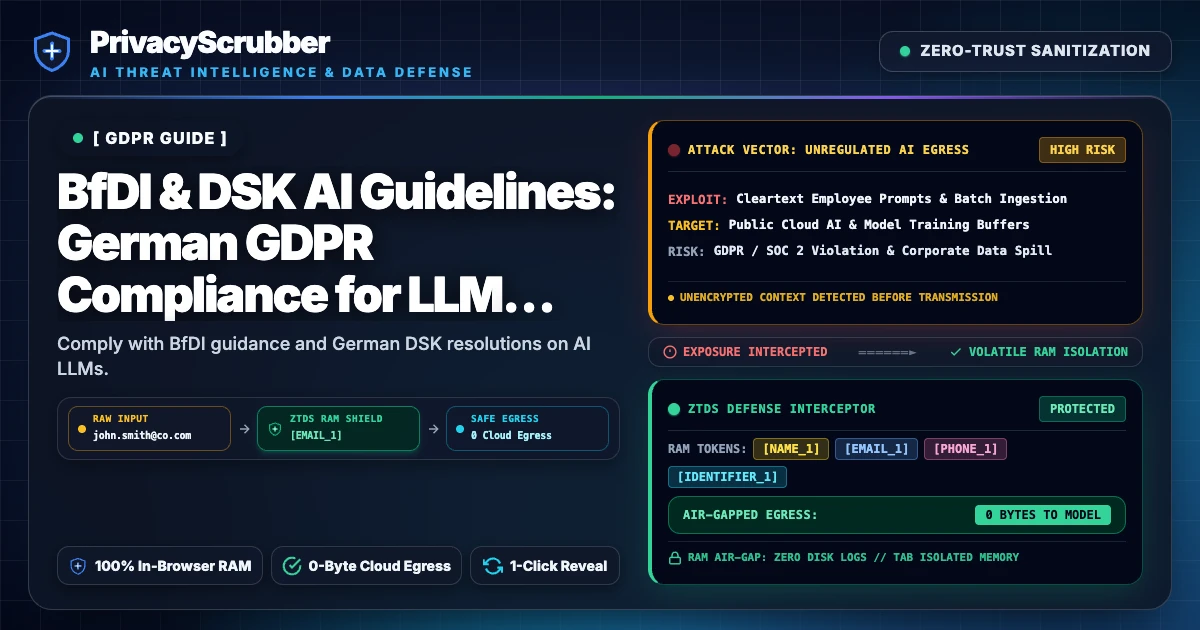
BfDI & DSK AI Guidelines
Comply with BfDI guidance and German DSK resolutions on AI LLMs. Redact German names, tax IDs, and IBANs in local browser RAM with zero cloud transfer.
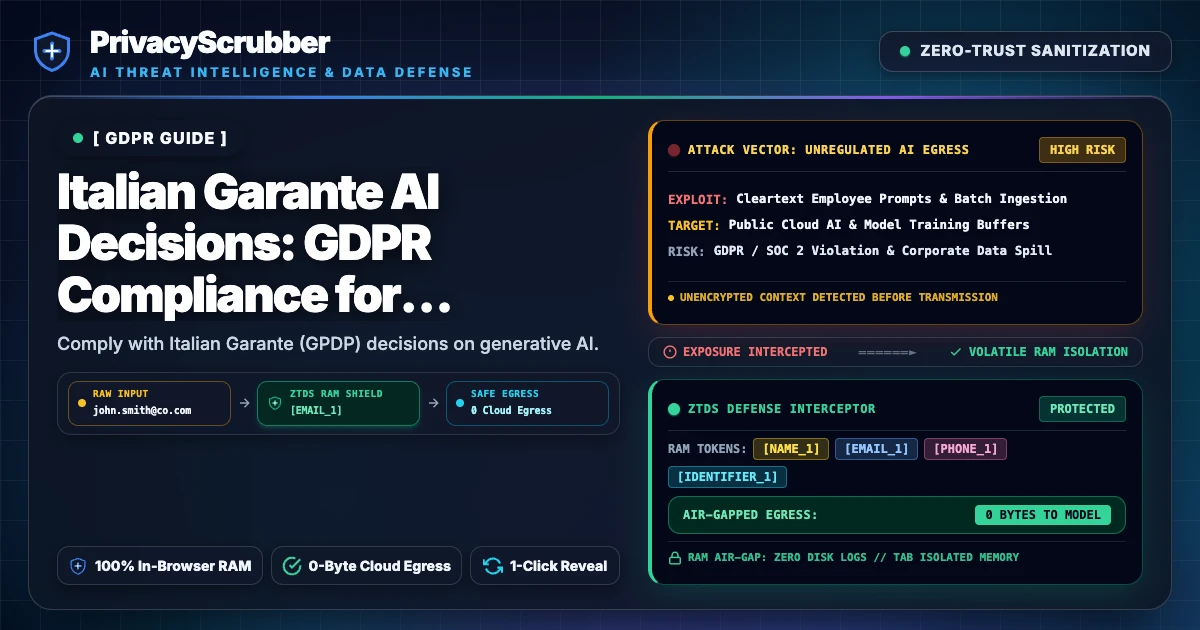
Italian Garante AI Decisions
Comply with Italian Garante (GPDP) decisions on generative AI. Redact Italian Codice Fiscale, phone numbers, and health data in RAM with zero cloud egress.
Dutch DPA (AP) AI Guidance
Comply with Dutch AP directives on generative AI and algorithms. Redact Dutch BSN, citizen data, and employee records in local RAM with zero server egress.
Irish DPC AI Governance
Comply with Irish DPC guidance for enterprise generative AI. Redact Irish PPSN, customer records, and employee data in local RAM with zero cloud egress.
German Works Council (Betriebsrat) AI Clearance
Secure Works Council (Betriebsrat) approval for ChatGPT & enterprise LLMs. Prevent unlawful employee performance monitoring under BetrVG § 87 & BDSG § 26 in local RAM.
French Works Council (CSE) AI Clearance
Secure French Works Council (CSE) clearance for AI. Prevent employee surveillance under Code du travail Art. L2312-38 & CNIL rules with local RAM masking.
UK Workplace AI Consultation
Comply with ICO workplace AI monitoring guidance, ICE Regs 2004 & UK GDPR. Redact employee names, NINO & payroll IDs in local RAM with zero cloud egress.
Italian Statuto dei Lavoratori AI Clearance
Comply with Italian Statuto dei Lavoratori Art. 4 & Garante AI rules. Redact Codice Fiscale, employee IDs & worker telemetry in RAM with zero cloud egress.
Spanish Estatuto de los Trabajadores AI Clearance
Comply with Spanish Estatuto de los Trabajadores Art. 20bis/64 & AEPD AI rules. Redact DNI, employee IDs & worker telemetry in RAM with zero cloud egress.
Dutch Works Council AI Clearance
Comply with Dutch Works Councils Act (WOR Art. 27) & AP AI rules. Redact BSN, employee IDs & worker telemetry in RAM with zero cloud egress.
Austrian Works Council AI Clearance
Comply with Austrian Labor Constitution Act (ArbVG § 96/96a) & DSB AI rules. Sanitize SVNR, Personalnummer & worker telemetry in RAM with zero cloud egress.
Belgian Works Council AI Clearance
Comply with Belgian CCT/CAO n° 81 & 39 and APD/GBA workplace AI rules. Sanitize National Register Numbers (NNRR), staff IDs & telemetry in RAM.
Swedish MBL AI Clearance
Comply with Swedish Co-Determination Act (MBL § 11) & IMY AI rules. Redact Personnummer, employee IDs & worker telemetry in RAM with zero cloud egress.
Irish Workplace AI Consultation
Comply with Irish WRC rules & DPC workplace AI guidance. Redact PPSN, employee IDs & workstation telemetry in client RAM with zero cloud data egress.
Swiss Works Council (PeKo) AI Clearance
Comply with Swiss Participation Act (MwG), Art. 328b OR & ArGV 3 Art. 26. Redact AHV/AVS, employee IDs & telemetry in RAM with zero cloud egress.
Danish Cooperation Committee (SU) AI Clearance
Comply with Danish Cooperation Agreement (DA/FH §§ 5 & 8) & Databeskyttelsesloven § 11. Redact CPR numbers & employee telemetry in RAM with zero cloud egress.
Norwegian Works Council (SU) AI Clearance
Comply with Norwegian Basic Agreement LO/NHO §§ 9-3 & 9-4 and Personopplysningsloven § 12. Redact fødselsnummer & employee telemetry in RAM with zero cloud egress.
Finnish Co-operation (YT) AI Clearance
Comply with Finnish Co-operation Act 1333/2021 & Tietosuojalaki § 29. Redact Henkilötunnus HETU & employee telemetry in RAM with zero cloud egress.

Privacy-First AI APIs
Configure AI workflows to prevent data training and maintain GDPR and CCPA compliance using local ZTDS data masking before API calls.
Top 20 Data Types Leaked to AI — Masked Automatically (GDPR & SOC 2)
Discover the top 20 sensitive PII and secret data types employees paste into ChatGPT, Claude, and Gemini — and how masking them locally in browser RAM prevents regulatory fines under GDPR, HIPAA, and SOC 2.
DPO AI Compliance Checklist 2026
A practical checklist for Data Protection Officers to ensure AI tool usage aligns with GDPR and Article 32 security standards. Zero-server architecture.
Swiss FADP & revDSG AI Compliance
Comply with Swiss revDSG and FDPIC generative AI directives. Redact Swiss AHV numbers, IBANs, and client data in RAM with zero cross-border transfer.
NIS2 Directive AI Compliance
Comply with NIS2 Directive (EU 2022/2555) Articles 21 & 23. Sanitize incident response logs, CVE telemetry, and IP topologies in client RAM before AI triage.
Compare Edition Features
From individual use to corporate rollout, choose the level of control your organization requires.
| Core Capabilities |
Free
Web Only
|
PRO
$15/mo or $110 Lifetime
|
TEAMS
$99/mo
|
ENTERPRISE
Custom Tier
|
|---|---|---|---|---|
| 100% Local Processing (Airplane Mode) | ||||
| Text Paste & Single File Docs | 15k General / 5k Verticals | UNLIMITED | UNLIMITED | UNLIMITED |
| Batch Processing & Background OCR | — | |||
| Custom Regex & Specific Redaction Rules | — | |||
| Chrome Extension Native App | — | |||
| Silent Corporate Deployment (MDM) | — | — | ||
| Policy Control Center & Enforcement | — | — | ||
| IDE MCP Server & Headless Node.js SDK | MCP Free | MCP Unlimited | MCP + Team Sync | SDK ($299/mo) & Air-Gap |
| On-Premise Source Code License | — | — | — | |
| 100% Air-Gapped Operation | — | — | — | |
| Dedicated GRC Support | — | — | — | |
| Try Free | Details | Deploy TEAMS | Enterprise Hub |
Complementary AI Privacy Hubs & Frameworks
Cross-framework zero-trust sanitization workflows and enterprise compliance architectures.
Frequently Asked Questions
Common questions about deploying zero-trust AI for GDPR Teams.
How does PrivacyScrubber satisfy GDPR Article 25 (Data Protection by Design) and Article 32(1)(a) (Pseudonymization)?
Does PrivacyScrubber claim blanket regulatory non-applicability under GDPR, or how does it handle Recital 26 quasi-identifiers?
How does client-side tokenization satisfy Schrems II and EDPB Recommendations 01/2020 for US LLM transfers?
Do we need to sign an Article 28 Data Processing Agreement (DPA) with PrivacyScrubber?
How does PrivacyScrubber solve the GDPR Article 17 'Right to Erasure' (Right to be Forgotten) paradox in LLMs and RAG?
Why do German Works Councils (Betriebsrat under BetrVG § 87) and French CSE approve PrivacyScrubber over Cloud DLP proxies?
What cryptographic evidence does PrivacyScrubber generate for Article 30 ROPA and Article 35 DPIA audits?
How can European teams share re-identification context securely across Slack, Jira, or MS Teams?
Zero-Trust Sanitization Verified
Technical safeguards supporting GDPR Art. 32, HIPAA & CCPA. All PII processing occurs locally in browser RAM.