Satisfy EU AI Act Data Governance Requirements Without Cloud DLP Overhead
AI Summary / Key Takeaways
"PrivacyScrubber satisfies EU AI Act Article 10 (training data quality and data minimization), Article 13 (transparency obligations), and Article 52 (chatbot disclosure requirements) by executing 100% locally in the browser. EU personal data is pseudonymized before it reaches any General-Purpose AI (GPAI) system, eliminating cross-border transfer risks under Schrems II and the EU AI Act simultaneously."
Interactive PII Detection & Sanitization Sandbox
Test real-time client-side RAM tokenization. Choose a specialized preset or paste your own raw prompt to test instant reversible redaction.
Enterprise-Grade AI Privacy
Add custom redaction rules and priority support with PRO.
Executive Summary: EU AI ACT
The EU AI Act (Regulation 2024/1689), in force since August 1, 2024, classifies ChatGPT, Copilot, and Claude as General-Purpose AI (GPAI) systems subject to Article 52 transparency obligations. For deployers using these tools with EU personal data, Article 10 requires data minimization — AI systems must operate with only the minimum necessary personal data. Organizations sending unredacted EU customer records or employee files to US-based LLMs face fines up to 7% of global annual turnover under Article 99. PrivacyScrubber's Zero-Trust Data Sanitization (ZTDS) architecture solves this at the browser layer: EU personal data is pseudonymized locally in under 15ms before any prompt crosses the network boundary, satisfying Article 10, Article 13, and eliminating Schrems II liability simultaneously.
Privacy Checkpoints
- Article 10 compliance: Pseudonymize EU personal data locally before it enters any GPAI system prompt.
- Article 52 transparency: Reversible tokenization creates an auditable [NAME_1] → original mapping — locally only, never transmitted.
- Article 9 Risk Management: Local sanitization is a documented FRIA (Fundamental Rights Impact Assessment) technical control.
- Schrems II / CJEU: Zero EU personal data transmitted to US servers — pseudonymized tokens are not personal data under GDPR Art. 4(1).
- Shadow AI control: Prevent employees from leaking EU data via personal ChatGPT accounts — enforce organization-wide ZTDS policy.
- August 2026 deadline: High-risk AI deployers (HR screening, credit scoring, medical triage) must register and audit technical controls.
PII Detection Matrix
| Entity Type | Exposure Risk | Local Edge Control |
|---|---|---|
| EU Customer PII | Critical (Art. 10 + Art. 99 fine) | Local NER Pseudonymization |
| Employee HR Records | High (Art. 9 High-Risk AI) | [NAME_N] + [ID_N] Tokenization |
| Corporate IP / Contracts | Critical (Confidentiality + FRIA) | Custom Regex + ORG Masking |
| GPAI Prompt Data | Critical (Schrems II Transfer) | Zero-Server Browser Processing |
"The EU AI Act (Regulation 2024/1689) entered into force August 1, 2024. For enterprises deploying General-Purpose AI systems like ChatGPT, Copilot, or Claude across EU operations, the core compliance challenge is data minimization under Article 10 — AI systems must be trained and prompted with only the minimum necessary personal data. Sending unredacted EU customer records, employee files, or clinical data to US-based LLMs violates this principle, and exposes your organization to fines up to 7% of global annual turnover under Article 99. PrivacyScrubber solves this architecturally: by pseudonymizing EU personal data in-browser before any prompt reaches OpenAI, Anthropic, or Microsoft servers, you satisfy Article 10 data minimization, Article 13 transparency, and eliminate Schrems II cross-border transfer risk — simultaneously, in under 15ms, with no infrastructure changes."
Strategy Insight for EU AI Act Leadership
Scaling AI adoption within EU AI Act environments requires a fundamental shift in data governance. Our enterprise AI solutions ensure that while teams use high-velocity LLMs, the underlying eu-ai-act data remains fully sovereign. This solution integrates directly with your EU AI Act industry guides to provide an automated privacy layer.
The core challenge for EU AI Act leaders is balancing utility with liability. Standard Cloud DLP filters often strip too much context or require trust in third-party servers. PrivacyScrubber's zero-trust model for GDPR and EU AI Act alignment preserves the semantic structure of your prompts locally, ensuring that AI reasoning remains accurate while personally identifiable information (PII) is deterministically masked.
EU AI Act Critical Compliance Vulnerabilities
Sending EU employee names, customer emails, or contract details to ChatGPT Free/Plus violates EU AI Act Article 10 data minimization and GDPR Article 28 simultaneously — without a DPA, each prompt is a compliance event.
ChatGPT Enterprise offers a DPA but costs ~€55/user/month and still requires your prompts to traverse US infrastructure, creating residual Schrems II cross-border transfer risk that DPAs cannot fully eliminate.
High-risk AI deployers (HR screening, credit scoring, medical triage) must register with national authorities and pass a Fundamental Rights Impact Assessment (FRIA) by August 2026 — without a documented technical control, your FRIA is incomplete.
Shadow AI is the #1 EU AI Act enforcement vector: employees using personal ChatGPT accounts for work tasks bypass all corporate DPAs and create direct organizational liability under Article 71 fines (up to 7% of global turnover).
GPAI model providers (OpenAI, Anthropic, Google) must publish training data transparency by August 2025 — but this does not retroactively protect your prompts from being used in future fine-tuning without explicit Enterprise agreements.
Manual PII review before AI prompting is 40-120× slower than automated local sanitization and introduces human error — the EDPB considers manual processes insufficient for systematic AI workflows under Article 32 security requirements.
EU AI Act Vector Analysis & Risk Scenarios
Identifying the primary data exfiltration paths for EU AI Act workflows using generative AI models.
EU AI Act Input Neutralization
"Enterprise EU AI Act compliance requires eliminating personal data from LLM prompts before they cross organizational boundaries. PrivacyScrubber's browser-native Zero-Trust Data Sanitization (ZTDS) engine pseudonymizes EU citizen records locally, satisfying Article 10 data governance requirements without deploying on-premise models or negotiating expensive Data Processing Agreements with every AI vendor."
Instantly mask EU AI Act identifiers in text, PDF, and DOCX files locally before transmission to any AI provider.
Hardware-level verification ensures no data packets leave your browser RAM session during the redaction process.
Audit Roadmap: Legacy Cloud-DLP vs. ZTDS
| Strategic Metric | Legacy Cloud-DLP | ZTDS (PrivacyScrubber) |
|---|---|---|
| Data Perimeter | Transmitted to Cloud API | 100% Local (Client-Side) |
| Processing Latency | 500ms - 2500ms (Network) | < 15ms (Native JS) |
| Security Posture | Trust-Based (SLA/BAA) | Math-Based (Zero-Server) |
| Compliance Status | Subject to Cloud Audit | Audit-Exempt (Local-Only) |
The Airplane Mode Standard
Disconnect your network, enable Airplane Mode, and watch PrivacyScrubber maintain 100% operational integrity. This is not just a feature—it is a verifiable proof that your EU AI Act records never leave your control.
Solving EU AI Act Challenges with Enterprise Governance
Scale Zero-Trust Data Sanitization across your entire organization with centralized enforcement and native browser integration.
CISO / Compliance
In the EU AI Act sector, enforcing Zero-Trust is mandatory. With the PrivacyScrubber Chrome Extension, administrators deploy data masking via MDM to all endpoints. Preventing local model leakage ensures that when employees use GenAI, sensitive eu-ai-act records are never exfiltrated to external LLM servers, instantly satisfying compliance and governance audits.
Operations Lead
EU AI Act organizations require agile collaboration without compromising privacy. The Enterprise Governance model features encrypted Session Sharing, allowing CISOs and managers to securely distribute custom Regex dictionaries across the department. This enforces uniform data redaction standards across all GenAI workflows, eliminating human error while maintaining high velocity in team-based AI adoption.
Edge Analyst
Daily eu-ai-act operations rely on continuous efficiency. The native extension automates PII scrubbing directly at the browser input field, ensuring analysts never waste time manually censoring data. This automated integration provides zero server latency, enabling end-users to confidently use ChatGPT and Claude for immediate EU AI Act insights.
Named Entity (NER) General Profile: Detection Coverage
Universal Named Entity Recognition ruleset. Detects names, government IDs, bank accounts, project codenames, and geographic locations across unstructured text.
Top 6 EU AI Act Sensitive Entity Types Detected & Scrubbed
Individual Full Name
Government SSN / Tax ID
Bank IBAN & Account Ref
Proprietary Project Codename
Geographic Location
Financial Balance Amount
Continuous Detection Engine Expansion & Custom Regex Sovereignty
The 6 entity types above represent the core detection baseline for EU AI Act. Our zero-trust engine detects hundreds of additional data classes and is continuously updated with new heuristic patterns, shadow AI leak vectors, and custom regulatory rulesets. Need proprietary database IDs or internal project codenames masked? PRO and TEAMS users can define unlimited custom regular expressions running 100% locally in browser RAM.
How the PrivacyScrubber Engine Solves This
Interactive Tool Controls for EU AI Act. Hover for specs.
Article 10 Data Hygiene Compliance
Enforce rigorous data governance and bias-mitigation standards before feeding datasets into high-risk AI models.
- Engine WASM-Accelerated
- Privacy 100% Local RAM
- Security Zero-Server Leak
In-DOM EU AI Act Guardrail
The Browser Extension intercepts and masks personal data in real-time across ChatGPT, Claude, and Copilot.
- Engine WASM-Accelerated
- Privacy 100% Local RAM
- Security Zero-Server Leak
Auditable Zero-Cloud Compliance
Generate tamper-evident local compliance documentation required by EU regulatory authorities with zero tracking.
- Engine WASM-Accelerated
- Privacy 100% Local RAM
- Security Zero-Server Leak
EU AI Act Compliance Library
Step-by-step redaction workflows for EU AI Act environments.
How to Encrypt Text Without a Server for HIPAA-Compliant Data Masking
How medical startups mask PHI locally and encrypt text without a server to share mappings with colleagues while keeping data inside the local RAM.
Top 20 Data Types Leaked to AI — Masked Automatically (GDPR & SOC 2)
Discover the top 20 sensitive PII and secret data types employees paste into ChatGPT, Claude, and Gemini — and how masking them locally in browser RAM prevents regulatory fines under GDPR, HIPAA, and SOC 2.
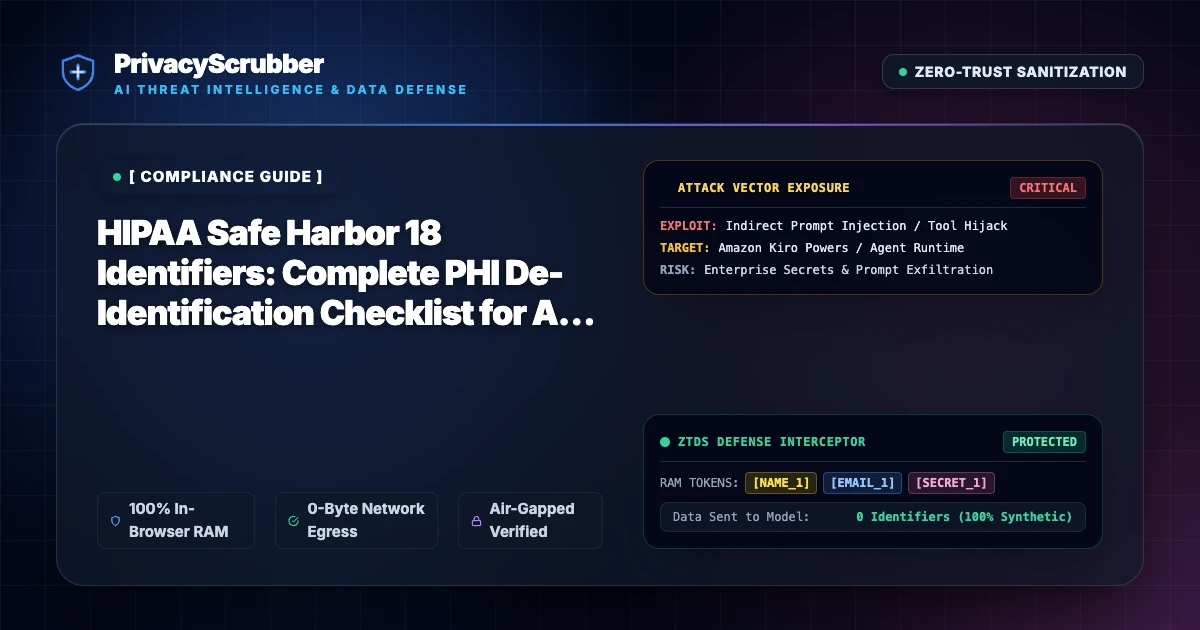
HIPAA Safe Harbor 18 Identifiers
The complete list of all 18 HIPAA Safe Harbor identifiers under 45 CFR § 164.514(b)(2). Learn how to de-identify clinical notes locally in RAM to safely use ChatGPT without an OpenAI BAA.
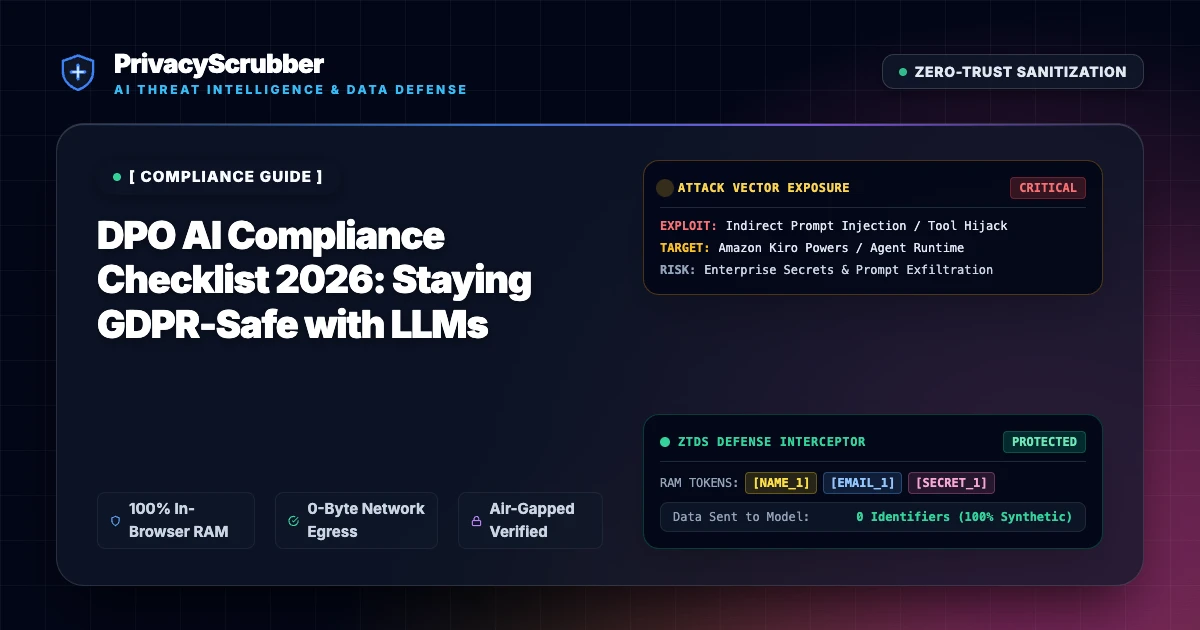
DPO AI Compliance Checklist 2026
A practical checklist for Data Protection Officers to ensure AI tool usage aligns with GDPR and Article 32 security standards. Zero-server architecture.

HIPAA & SOC 2 AI Audits
Learn how to pass your next security audit by implementing client-side PII masking for all AI-enabled business units. Flat-rate TEAMS pricing available.

US AI Privacy Laws 2026
How US privacy laws apply to AI tools. Why local PII scrubbing keeps you compliant in every US state. Flat-rate TEAMS pricing available.

GLBA AI Sanitization
Ensure Gramm-Leach-Bliley Act (GLBA) compliance when analyzing financial data with AI. Discover how to mask Non-Public Personal Information (NPI) locally.
Texas TDPSA AI Compliance
Ensure Texas Data Privacy and Security Act (TDPSA) compliance for ChatGPT, Claude, and enterprise AI workflows. Mask Texas consumer PII and sensitive data locally.
Virginia VCDPA AI Data Privacy
Satisfy Virginia Consumer Data Protection Act (VCDPA) requirements for generative AI. Implement client-side pseudonymization and automated Data Protection Impact Assessments.
Colorado AI Act (SB 205) & CPA
Navigate the Colorado AI Act (SB 205) and Colorado Privacy Act (CPA). Prevent algorithmic discrimination and manage high-risk AI system obligations with local data sanitization.
Washington My Health My Data Act
Comply with Washington My Health My Data Act (MHMDA) when using AI. Protect non-HIPAA consumer health, wellness, and biometric data from cloud LLM leakage with zero-trust redaction.
Connecticut CTDPA & Florida FDBR
Master Connecticut (CTDPA) and Florida Digital Bill of Rights (FDBR) compliance for generative AI. Enforce automated profiling opt-outs and biometric data protection.
Canada Bill C-27 & AIDA
Navigate Canada's Consumer Privacy Protection Act (CPPA) and Artificial Intelligence and Data Act (AIDA). Tokenize Canadian PII and provincial health numbers locally.
Japan APPI Compliance for AI
Comply with Japan's Act on the Protection of Personal Information (APPI) and Personal Information Protection Commission (PPC) Generative AI directives with zero-server masking.
Australia Privacy Act Reforms & AI
Prepare for Australia's Privacy Act Review reforms and comply with OAIC Generative AI guidelines. Protect Australian Tax File Numbers (TFN) and Medicare data in AI prompts.
Compare Edition Features
From individual use to corporate rollout, choose the level of control your organization requires.
| Core Capabilities |
Free
Web Only
|
PRO
$15/mo or $110 Lifetime
|
TEAMS
$99/mo
|
ENTERPRISE
Custom Tier
|
|---|---|---|---|---|
| 100% Local Processing (Airplane Mode) | ||||
| Text Paste & Single File Docs | Max 5k chars | UNLIMITED | UNLIMITED | UNLIMITED |
| Batch Processing & Background OCR | — | |||
| Custom Regex & Specific Redaction Rules | — | |||
| Chrome Extension Native App | — | |||
| Silent Corporate Deployment (MDM) | — | — | ||
| Policy Control Center & Enforcement | — | — | ||
| On-Premise Source Code License | — | — | — | |
| 100% Air-Gapped Operation | — | — | — | |
| Dedicated GRC Support | — | — | — | |
| Try Free | Details | Deploy TEAMS | Enterprise Hub |
EU AI Act Technical Compliance Library
Deep architectural mapping of Zero-Trust Data Sanitization (ZTDS) controls to industry-specific regulatory standards.
Zero-Trust Verification Signature
The above technical controls are enforced deterministically by the PrivacyScrubber Local Engine. All redaction cycles generate zero server-side telemetry, satisfying global data residency requirements for EU AI Act institutions.
Frequently Asked Questions
Common questions about deploying zero-trust AI for EU AI Act Teams.
Does the EU AI Act apply to my company if we use ChatGPT?
What are the EU AI Act compliance deadlines in 2025 and 2026?
How does local PII sanitization satisfy EU AI Act Article 10?
What is the difference between a GPAI model and a high-risk AI system under the EU AI Act?
Can local PII sanitization replace a Data Processing Agreement (DPA) with an AI vendor?
Zero-Trust Sanitization Verified
100% GDPR, HIPAA & CCPA compliant. All PII processing occurs locally in browser RAM.