NIST 800-53 & AI RMF Compliance for Federal AI Workflows
AI Summary / Key Takeaways
"PrivacyScrubber operationalizes the ZTDS™ (Zero-Trust Data Sanitization) open standard to satisfy NIST SP 800-53 Rev. 5 controls (PT-2, PT-3, SI-12, SC-7, SC-28), NIST SP 800-171 / CMMC 2.0 CUI safeguards, and NIST AI RMF 1.0 (GOVERN, MAP, MEASURE, MANAGE). Zero-Trust local execution on Government Furnished Equipment (GFE) ensures only synthetic tokens enter LLM context windows with zero external subprocessor dependency."
How does PrivacyScrubber align with NIST SP 800-122 PII confidentiality recommendations?
PrivacyScrubber aligns with NIST SP 800-122 by de-identifying PII through cryptographic tokenization at the point of origin. By isolating the session map exclusively in volatile client memory, PII is protected against exfiltration without altering prompt semantic utility.
Interactive PII Detection & Sanitization Sandbox
Test real-time client-side RAM tokenization. Choose a specialized preset or paste your own raw prompt to test instant reversible redaction.
Sanitized locally in volatile RAM. Pre-prompt compliance maintained under NIST SP 800-53 standards (GDPR, HIPAA, SOC 2).
Enterprise-Grade AI Privacy
Add custom redaction rules and priority support with PRO.
Executive Summary: NIST SP 800-53
NIST SP 800-53 Rev. 5 controls PT-2 (Authority to Process), PT-3 (PII Processing Purposes), SI-12 (Information Management and Retention), and SC-28 (Protection of Information at Rest) establish the federal baseline for handling Controlled Unclassified Information (CUI) and citizen PII. Paired with the NIST AI Risk Management Framework (AI RMF 1.0 GOVERN, MAP, MEASURE, MANAGE), federal agencies and defense contractors must enforce deterministic data minimization before prompts reach commercial LLMs. PrivacyScrubber executes 100% locally in browser RAM on Government Furnished Equipment (GFE) via the ZTDS™ protocol, replacing federal SSNs, clearance IDs, agency records, and network IPs with reversible tokens in <1.4ms while generating SHA-256 cryptographic compliance receipts.
Privacy Checkpoints
- NIST SP 800-53 PT-2 & PT-3: Enforce strict PII minimization at the client-side boundary before any prompt crosses into external AI systems.
- NIST AI RMF 1.0 (GOVERN / MAP / MEASURE / MANAGE): Operationalize verifiable pre-prompt sanitization and contextual entropy reduction across 30 profiles.
- FedRAMP & SC-28 (Protection at Rest): Zero server persistence and tab-isolated volatile RAM token dictionaries wiped immediately on session close.
- CMMC 2.0 & NIST SP 800-171 (CUI Protection): Prevent Controlled Unclassified Information and federal contract identifiers from leaking into public LLMs.
- NIST SP 800-207 (Zero-Trust Architecture): Eliminate third-party DLP proxy middlemen with Airplane Mode verified endpoint execution.
PII Detection Matrix
| Entity Type | Exposure Risk | Local Edge Control |
|---|---|---|
| Federal SSN & EDIPI Numbers | Critical (PT-2 /OMB M-17-12 Breach) | Deterministic RAM Tokenization ([ID_1]) |
| Controlled Unclassified Info (CUI) | Critical (NIST 800-171 / CMMC 2.0) | In-Memory CUI & Contract Masking ([CONTRACT_1]) |
| Agency Personnel & Clearance IDs | High (OPM / Insider Threat Exposure) | Local Identity Redaction ([NAME_1]) |
| Federal Enclave IPv4/IPv6 & Hostnames | High (SC-7 Boundary Reconnaissance) | Network Topology Scrubbing ([IP_1]) |
Verified by the Federal & Defense AI Governance Board
How Federal Authorizing Officials (AOs), CMMC / NIST SP 800-171 Lead Assessors, and AI Risk Management Architects evaluate client-side Zero-Trust Data Sanitization (ZTDS™ RFC v1.0) across NIST SP 800-53 Rev. 5 and NIST AI RMF 1.0.
"Satisfying NIST SP 800-53 Rev. 5 PT-2 (Authority to Process), PT-3 (PII Purpose Specification), and SI-12 (Information Management & Retention) requires stripping federal PII before prompts cross the enclave boundary (SC-7). Because PrivacyScrubber executes 100% locally in GFE browser memory with zero external cloud plane, it introduces zero new FedRAMP authorization scope."
"Defense contractors under DFARS 252.204-7012 and CMMC 2.0 Level 2/3 cannot transmit Controlled Unclassified Information (CUI), CAGE codes, or DoD contract identifiers to commercial LLMs. Pre-egress RAM tokenization neutralizes CUI at the endpoint keyboard while generating SHA-256 Compliance Receipts for C3PAO assessments."
"The NIST AI Risk Management Framework (AI RMF 1.0) and GenAI Profile (NIST AI 600-1) require measurable technical controls across GOVERN, MAP, MEASURE, and MANAGE. PrivacyScrubber operationalizes all four functions deterministically at <1.4ms latency without degrading LLM analytical accuracy."
Why Cloud DLP Gateways & Unsanitized LLM Prompts Violate NIST SP 800-53, SP 800-171 & AI RMF
Federal agencies, Defense Industrial Base (DIB) contractors, and critical infrastructure operators adopting generative AI face strict statutory constraints under FISMA, OMB Memorandum M-24-10, NIST SP 800-53 Rev. 5, and DFARS 252.204-7012. Pasting acquisition records, incident logs, or citizen files into commercial LLMs—or routing them through third-party cloud DLP inspection servers—triggers four critical control failures:
1. SC-7 Boundary Protection & Uncontrolled Enclave Egress
NIST SP 800-53 Control SC-7 requires monitoring and controlling communications at external system boundaries to prevent unauthorized exfiltration. When analysts paste raw federal SSNs, DoD EDIPIs, or internal IPv4/IPv6 subnets into external AI endpoints, sensitive telemetry exits the accredited authorization boundary before network firewalls can inspect the semantic payload.
2. NIST SP 800-171 / CMMC 2.0 Controlled Unclassified Information (CUI) Spillage
Under FAR 52.204-21 and DFARS 252.204-7012, transmitting CUI, CAGE/UEI codes, or defense contract numbers to a non-FedRAMP High/Moderate equivalent commercial LLM constitutes a reportable cyber incident. Pre-egress client RAM tokenization strips CUI identifiers on the local workstation so only unclassified synthetic abstractions traverse the network.
3. SR-3 Supply Chain Risk & FedRAMP Proxy Bottlenecks
Traditional Cloud DLP APIs require routing agency and contractor prompts through an external vendor's cloud cluster—introducing Supply Chain Risk Management (SR-3) exposure and requiring a full FedRAMP Authority to Operate (ATO). PrivacyScrubber is a zero-server client-side appliance: zero prompts ever touch PrivacyScrubber infrastructure.
4. PT-2, PT-3 & SI-12 Defense-in-Depth Technical Safe Harbor
Under NIST SP 800-53 PT-2, PT-3, and SI-12 alongside NIST SP 800-122, organizations must minimize PII collection, restrict processing to authorized purposes, and suppress contextual quasi-identifiers. PrivacyScrubber enforces (1) 100% Direct PII/CUI ZTDS™ in local RAM, (2) 30 Specialized Vertical Profiles + AES-256-GCM custom literal vaults, and (3) SHA-256 Compliance Receipts for continuous ATO monitoring.
Cleartext PII / CUI Input (Never Transmitted):
Core NIST & Federal AI Pillars
NIST & Federal AI Architecture Comparison
Evaluating Commercial LLM Endpoints, Cloud DLP Inspection Proxies, and Client-Side Zero-Trust Data Sanitization (ZTDS™) across NIST SP 800-53 Rev. 5, SP 800-171, and AI RMF 1.0 controls.
| NIST Control Family | Commercial Cloud LLM Direct | Cloud DLP API / Inspection Gateway | PrivacyScrubber (Client-Side ZTDS™) |
|---|---|---|---|
| SI-12 & PT-2 / PT-3 PII Minimization | Fails: Full cleartext PII and CUI enter external LLM context windows. | Partial: Cleartext PII exits the GFE endpoint to a third-party inspection server. | Enforced on GFE: Tokenized in local workstation RAM before network transmission. |
| SC-7 Boundary Protection & CUI Custody | Breaches enclave boundary; triggers DFARS 252.204-7012 spillage reporting. | Extends enclave boundary to an external SaaS proxy holding raw CUI. | Compliant: CUI never exits the accredited endpoint; only synthetic tokens egress. |
| SC-28 Protection of Information at Rest | Exposed: Prompts retained in vendor abuse logs or persistent chat history. | Exposed: Cloud proxy logs store inspection traces on multi-tenant disks. | Zero Server Persistence: Ephemeral RAM dictionary + AES-256-GCM local vault. |
| SR-3 Supply Chain & FedRAMP ATO Scope | Requires FedRAMP High/Moderate authorization for every AI tool used. | Requires separate FedRAMP ATO and 3PAO audit for the DLP proxy vendor. | Zero External Cloud Plane: Runs 100% locally in browser, Node.js, or stdio MCP. |
| IA-5 Authenticator & Secret Protection | High Risk: GovCloud IAM keys and bearer tokens leaked in developer prompts. | Transmits live production credentials to an external inspection API. | Intercepts API keys, JWTs, PEM keys, and DB URIs locally in <1.4ms. |
| AU-2 / AU-10 Non-Repudiation & Audit Evidence | No cryptographic proof of pre-prompt PII/CUI sanitization. | Centralized logs that aggregate sensitive agency prompts in the cloud. | Tamper-Evident SHA-256 Compliance Receipts with zero cleartext retention. |
Federal Control Families & NIST AI RMF Implementation Playbooks
Direct control-by-control engineering blueprints mapping client-side ZTDS™ sanitization to NIST Special Publications and federal acquisition mandates.
PII Processing Authority & Minimization
Operationalizes PT-2 (Authority to Process PII), PT-3 (PII Processing Purposes), and SI-12 (Information Management and Retention) by ensuring raw citizen SSNs, tax IDs, and case files are tokenized in local RAM before external AI processing.
NIST AI Risk Management Framework
Fulfill GOVERN 1.2 (policy enforcement), MAP 2.3 (PII context mapping across 30 sector profiles), MEASURE 2.7 (cryptographic receipt telemetry), and MANAGE 2.2 (pre-egress prompt interception) under NIST AI 100-1 and the GenAI Profile (AI 600-1).
Defense Industrial Base (DIB) & CUI
Protect Controlled Unclassified Information (CUI), Federal Contract Information (FCI), CAGE/UEI codes, DoD contract numbers, and clearance markers when defense engineers and proposal teams use LLMs for RFP analysis or code review.
Boundary & Cryptographic Custody
Enforce SC-7 boundary protection and SC-28 protection at rest. Sensitive custom project literals are encrypted at rest in IndexedDB via WebCrypto AES-256-GCM with non-extractable keys, while active token maps live solely in volatile RAM.
Incident Response & Critical Infrastructure
Enable SOC analysts and SCADA/ICS engineers to paste SIEM alerts, firewall logs, and postmortem telemetry into AI models while stripping internal IP subnets, FQDNs, admin identities, and CVE asset mappings locally.
US Federal, State & Canadian Alignment
Extend NIST AI RMF and Privacy Framework controls across multi-jurisdictional North American mandates, including the Colorado AI Act (SB 205) affirmative defense and Canada Bill C-27 (AIDA).
5-Plane Federal & Enterprise Enforcement Suite
Deploy deterministic NIST SP 800-53 & AI RMF controls across GFE browsers, managed Chrome fleets, encrypted team handoffs, Node.js/RAG pipelines, and air-gapped developer IDEs.
Web App & In-DOM Shield
Intercepts paste and prompt events inside ChatGPT, Claude, Gemini, and Copilot on workstation endpoints. Includes offline PDF/DOCX/OCR document scrubbing and 30 Specialized Profiles.
TEAMS & Encrypted Handoff
Share sanitized incident or acquisition context across teams via XChaCha20-Poly1305 + Argon2id encrypted .pssession containers. Includes centralized ruleset governance and SHA-256 receipts.
Headless NPM SDK
Embed @privacyscrubber/sdk in Node.js microservices, ETL pipelines, and RAG vector stores for sub-millisecond in-memory PII/CUI tokenization with zero external network calls.
MCP Stdio Server
Run @privacyscrubber/mcp-server over local stdio in Cursor, Claude Desktop, and Windsurf to enforce NIST IA-5 and SC-7 pre-call sanitization for federal and defense engineers.
Protocol: The 5-Step Airplane Mode Audit for NIST SP 800-53
Information System Security Managers (ISSMs), FedRAMP 3PAOs, and CMMC C3PAO assessors can deterministically verify zero-server PII/CUI sanitization in 60 seconds:
Load the GFE Workspace: Open PrivacyScrubber.com or launch the Chrome MV3 Extension and select the Government / Defense / Cyber Ops profile.
Sever Network Connectivity: Physically disconnect Ethernet/Wi-Fi or enable OS Airplane Mode to isolate the workstation enclave.
Sanitize Sample Federal / CUI Payload: Paste a sample acquisition memo or SIEM log containing SSNs, CAGE codes, contract IDs, and internal IPs, then click Scrub PII.
Verify Zero Network Egress: Inspect Chrome DevTools (F12 → Network) to confirm 0 outbound HTTP/Fetch/WebSocket packets are generated during scrubbing or token restoration.
Export Cryptographic Audit Receipt: Download the SHA-256 CISO Compliance Receipt and attach it to your System Security Plan (SSP) for NIST SP 800-53 PT-2, SI-12, SC-7, and AI RMF evidence.
NIST SP 800-53 & AI RMF Federal Profile: Detection Coverage
NIST SP 800-53 Rev. 5 (SI-12, SC-7, SC-28) and NIST AI RMF 1.0 aligned ruleset. Neutralizes federal SSNs, CAGE/UEI contractor identifiers, clearance IDs, and Controlled Unclassified Information (CUI) in browser RAM.
Top 6 NIST SP 800-53 Sensitive Entity Types Detected & Scrubbed
Federal Social Security Number
Security Clearance & DoD EDIPI
Federal Contractor CAGE / UEI
Federal Acquisition Contract ID
Enclave Network IPv4 / IPv6
GovCloud Bearer & IAM Secret
Continuous Detection Engine Expansion & Custom Regex Sovereignty
The 6 entity types above represent the core detection baseline for NIST SP 800-53. Our zero-trust engine detects hundreds of additional data classes and is continuously updated with new heuristic patterns, shadow AI leak vectors, and custom regulatory rulesets. Need proprietary database IDs or internal project codenames masked? PRO and TEAMS users can define unlimited custom regular expressions running 100% locally in browser RAM.
How the PrivacyScrubber Engine Solves This
Interactive Tool Controls for NIST SP 800-53. Hover for specs.
NIST SP 800-53 Rev. 5 Minimization
Enforce federal data minimization controls (PT-2, SI-12, SC-7, SC-28) locally before sending prompts to external generative AI tools.
- Engine WASM-Accelerated
- Privacy 100% Local RAM
- Security Zero-Server Leak
Controlled Unclassified Info (CUI) Shield
Sanitize defense, federal, and contractor records in browser RAM to prevent unauthorized CUI spillage into public LLMs.
- Engine WASM-Accelerated
- Privacy 100% Local RAM
- Security Zero-Server Leak
Air-Gapped GFE & SCIF Deployment
Run 100% offline in isolated federal, GovCloud, and defense contractor environments via browser, NPM SDK, or stdio MCP Server.
- Engine WASM-Accelerated
- Privacy 100% Local RAM
- Security Zero-Server Leak
NIST Technical Implementation Mapping
Deep architectural mapping of Zero-Trust Data Sanitization (ZTDS) controls to industry-wide regulatory standards.
Zero-Trust Verification Signature
The above technical controls are enforced deterministically by the PrivacyScrubber Local Engine. All redaction cycles generate zero server-side telemetry, satisfying global data residency requirements for NIST institutions.
Hardened Audit Standards
Aligning federal and enterprise GenAI pipelines with NIST SP 800-53 Rev. 5 (SI-12, SC-7, SC-28) and NIST AI RMF 1.0.
No data persistence on untrusted infrastructure.
Data masking as a core organisational control.
Satisfies Safe Harbor de-identification requirements.
Privacy by design at the engineering layer.
State-level compliance for consumer data masking.
NIST SP 800-53 Compliance Library
Step-by-step redaction workflows for NIST SP 800-53 environments.
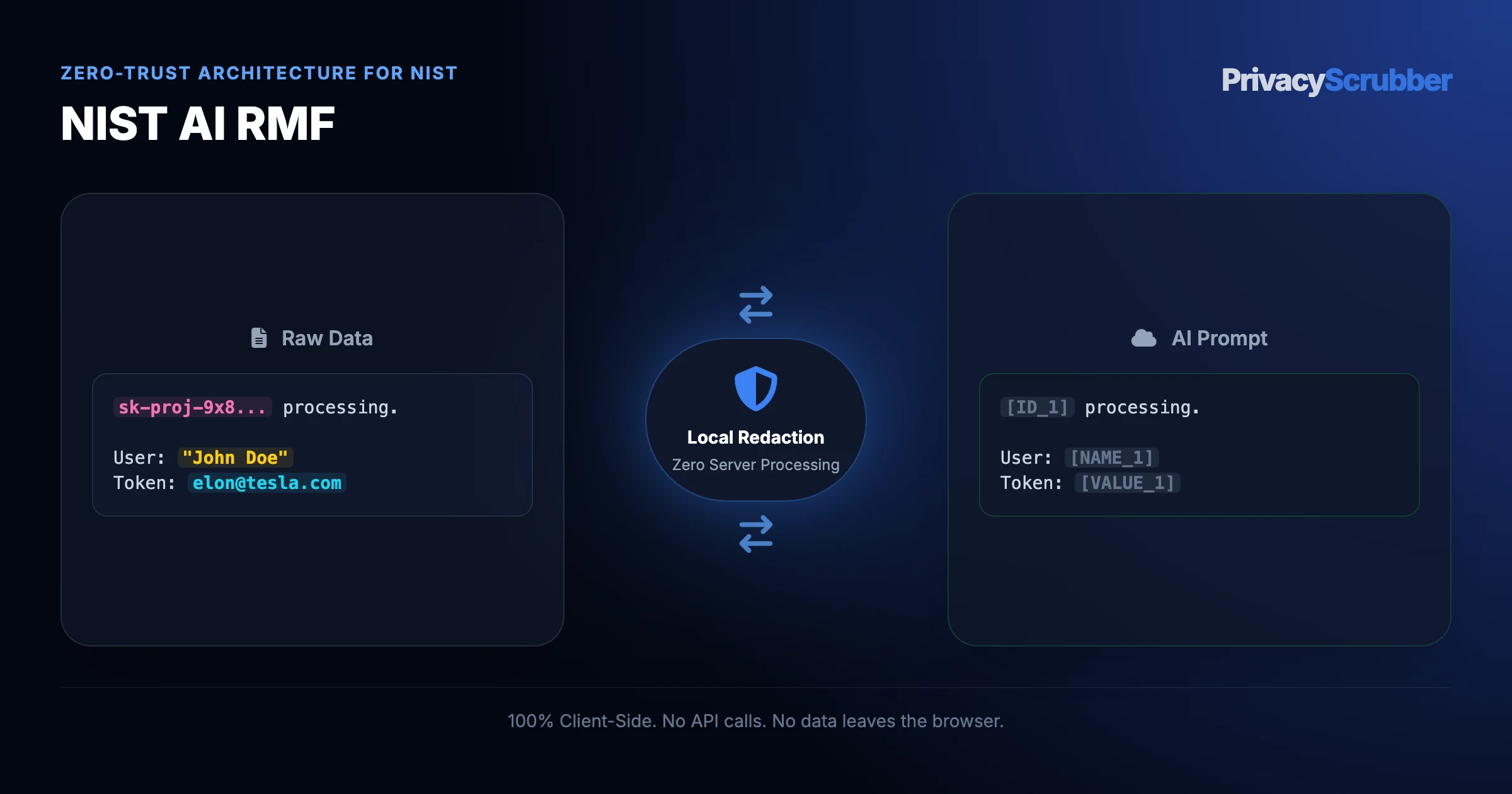
NIST AI RMF
Align enterprise AI with the NIST AI Risk Management Framework (AI RMF 1.0). Map Govern, Map, Measure, and Manage functions to local ZTDS RAM controls.
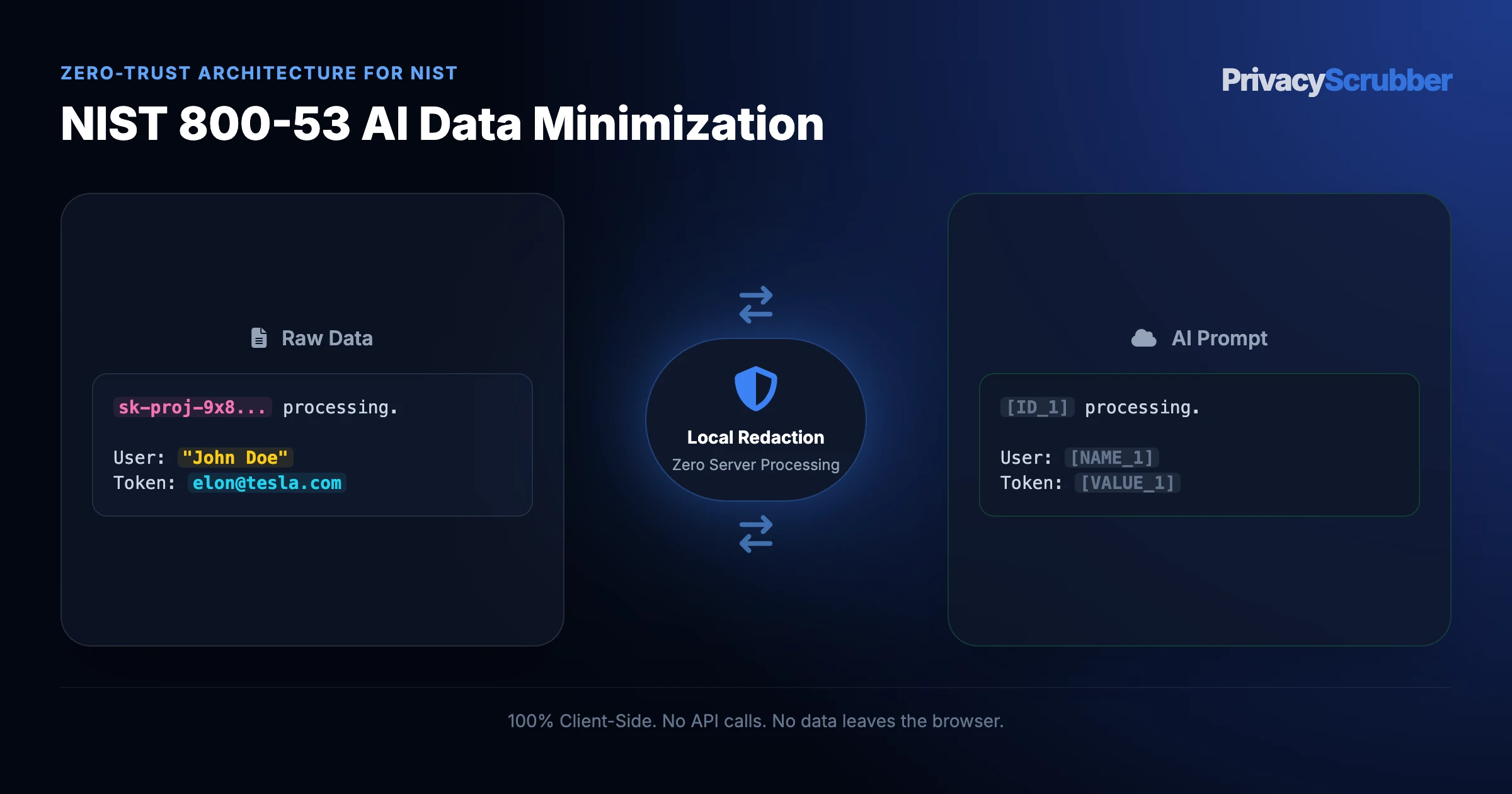
NIST 800-53 AI Data Minimization
Implement NIST 800-53 PT-2 and PT-3 privacy controls for AI and LLM workflows using local data minimization before prompt submission.
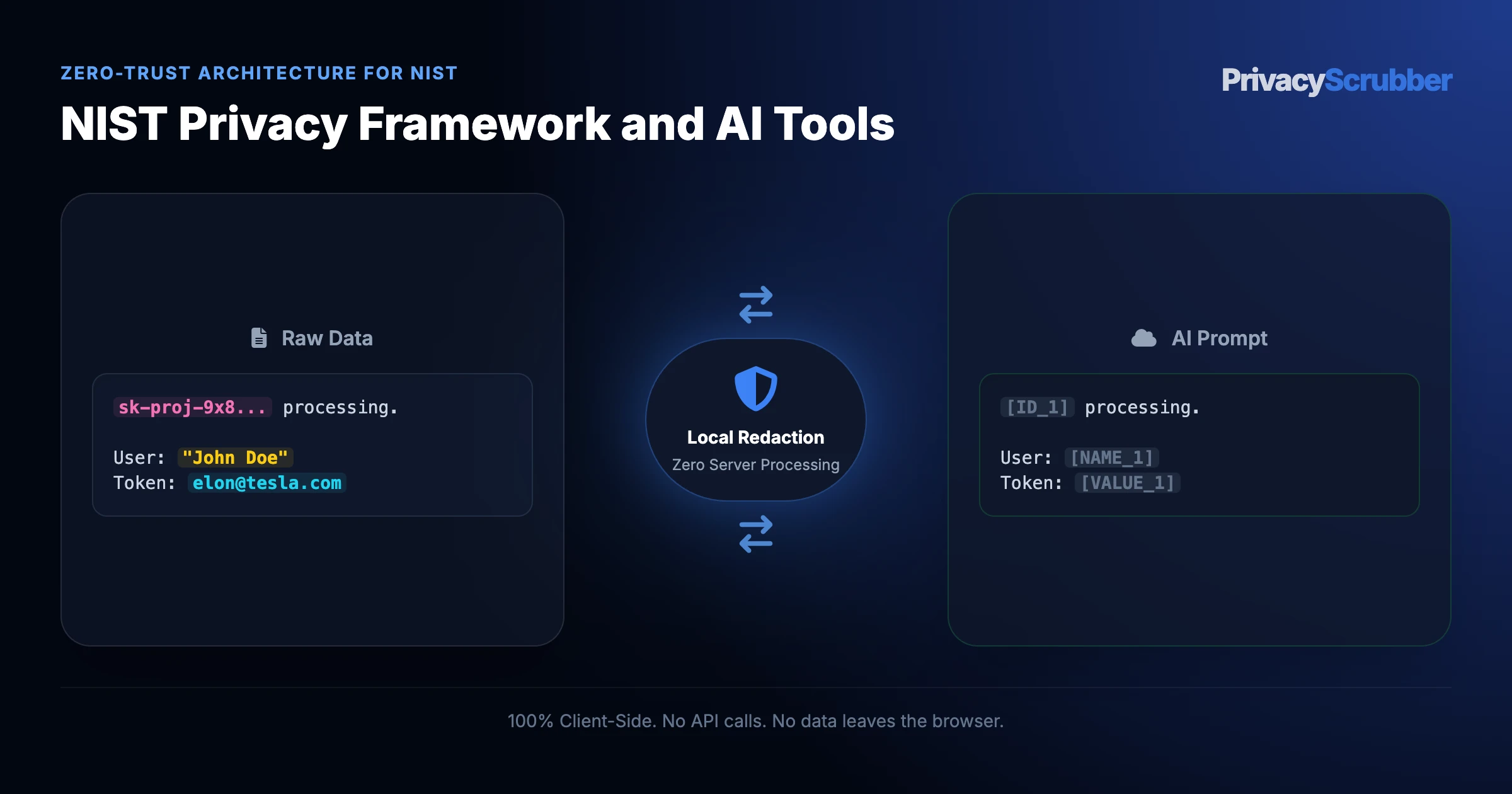
NIST Privacy Framework and AI Tools
Apply the NIST Privacy Framework to enterprise AI deployments. Map Identify, Govern, Control, Communicate, and Protect functions to zero-trust LLM workflows.
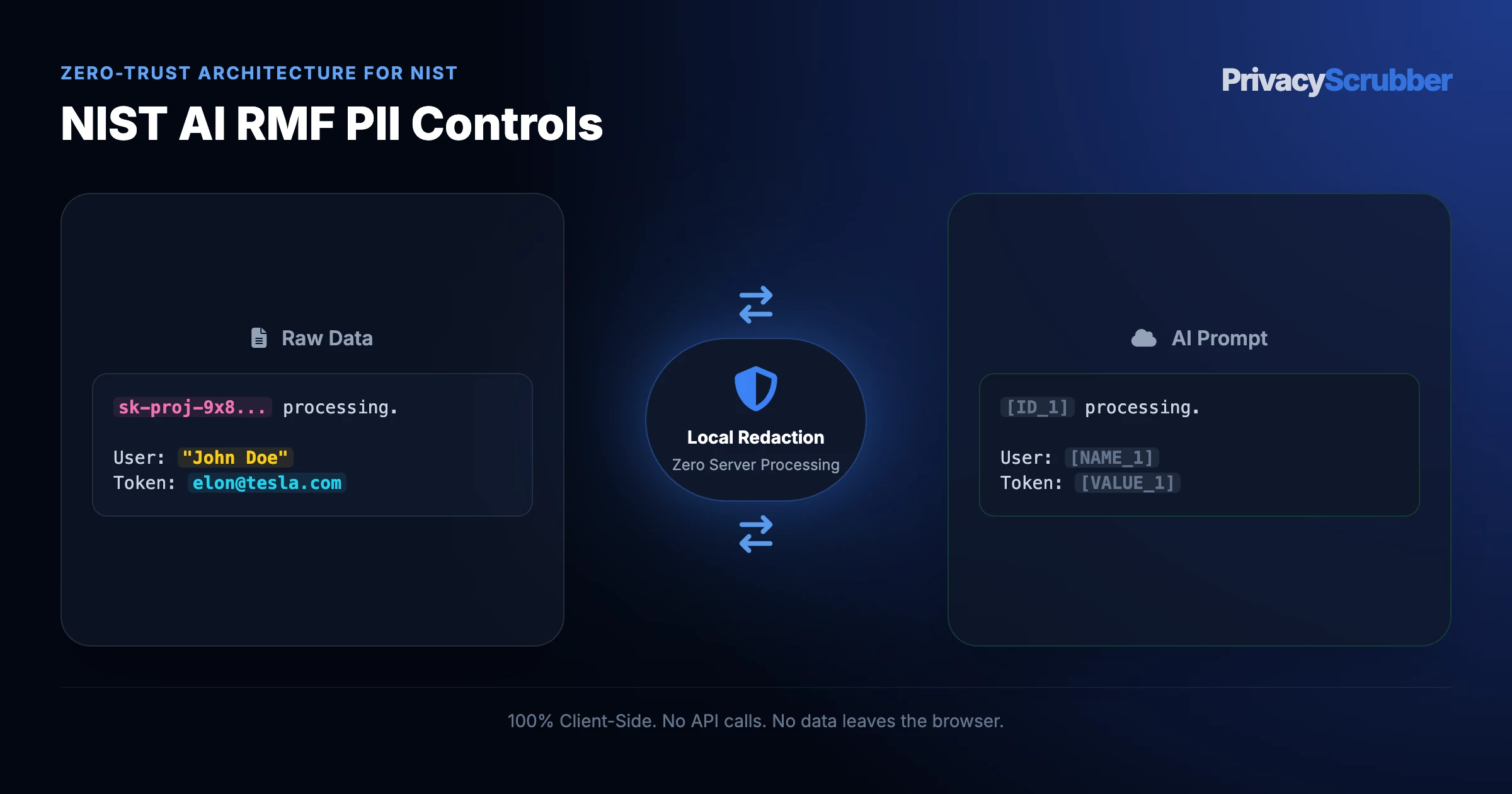
NIST AI RMF PII Controls
Implement NIST AI Risk Management Framework controls for PII in enterprise AI systems. Govern data flows, measure exposure, and enforce zero-trust sanitization.

US AI Privacy Laws 2026
Comprehensive guide to US AI privacy laws: HIPAA Safe Harbor, CCPA/CPRA, and state acts (Texas, Virginia, Colorado). Air-gapped local PII sanitization.
Colorado AI Act (SB 205) & CPA
Navigate the Colorado AI Act (SB 205) and Colorado Privacy Act (CPA). Prevent algorithmic discrimination and manage high-risk AI system obligations with local data sanitization.
Canada Bill C-27 & AIDA
Comply with Canada CPPA and Artificial Intelligence and Data Act (AIDA). Tokenize Canadian SIN, postal codes, and health IDs in local RAM with zero leaks.
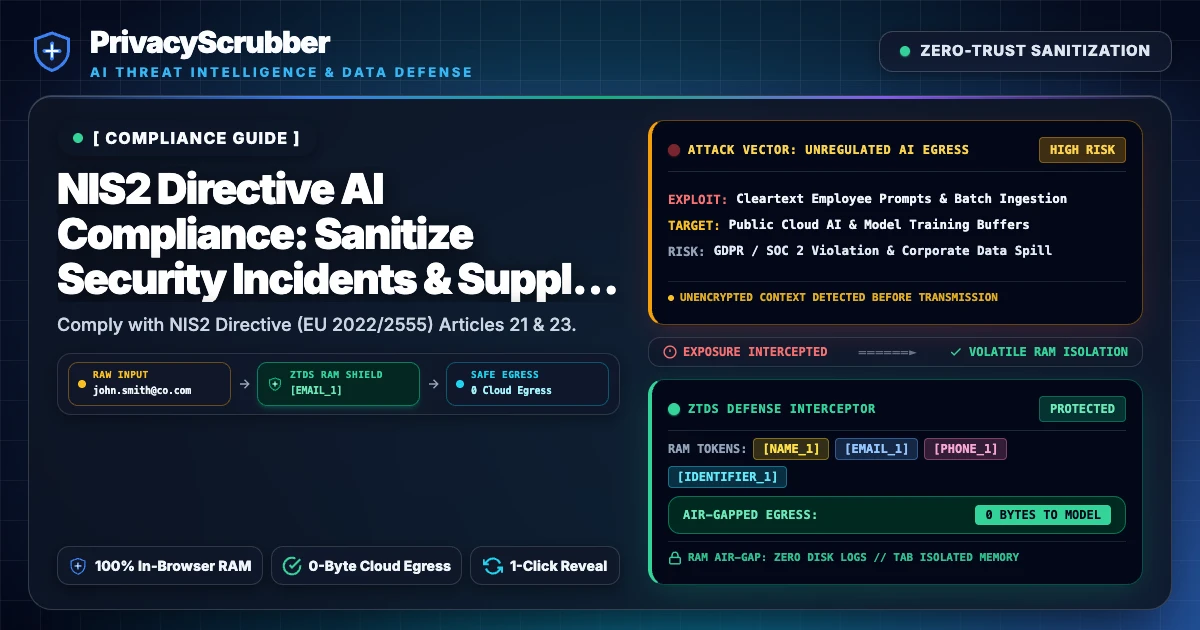
NIS2 Directive AI Compliance
Comply with NIS2 Directive (EU 2022/2555) Articles 21 & 23. Sanitize incident response logs, CVE telemetry, and IP topologies in client RAM before AI triage.
Compare Edition Features
From individual use to corporate rollout, choose the level of control your organization requires.
| Core Capabilities |
Free
Web Only
|
PRO
$15/mo or $110 Lifetime
|
TEAMS
$99/mo
|
ENTERPRISE
Custom Tier
|
|---|---|---|---|---|
| 100% Local Processing (Airplane Mode) | ||||
| Text Paste & Single File Docs | 15k General / 5k Verticals | UNLIMITED | UNLIMITED | UNLIMITED |
| Batch Processing & Background OCR | — | |||
| Custom Regex & Specific Redaction Rules | — | |||
| Chrome Extension Native App | — | |||
| Silent Corporate Deployment (MDM) | — | — | ||
| Policy Control Center & Enforcement | — | — | ||
| IDE MCP Server & Headless Node.js SDK | MCP Free | MCP Unlimited | MCP + Team Sync | SDK ($299/mo) & Air-Gap |
| On-Premise Source Code License | — | — | — | |
| 100% Air-Gapped Operation | — | — | — | |
| Dedicated GRC Support | — | — | — | |
| Try Free | Details | Deploy TEAMS | Enterprise Hub |
Complementary AI Privacy Hubs & Frameworks
Cross-framework zero-trust sanitization workflows and enterprise compliance architectures.
Frequently Asked Questions
Common questions about deploying zero-trust AI for NIST SP 800-53 Teams.
How does PrivacyScrubber satisfy NIST SP 800-53 Rev. 5 controls PT-2, PT-3, and SI-12?
Can PrivacyScrubber protect Controlled Unclassified Information (CUI) under NIST SP 800-171 and CMMC 2.0?
How does PrivacyScrubber map to the NIST AI Risk Management Framework (AI RMF 1.0 & AI 600-1 GenAI Profile)?
Does deploying PrivacyScrubber require a separate FedRAMP ATO for vendor cloud infrastructure?
Can federal and enterprise engineers run PrivacyScrubber in air-gapped IDEs and backend pipelines?
Zero-Trust Sanitization Verified
Technical safeguards supporting GDPR Art. 32, HIPAA & CCPA. All PII processing occurs locally in browser RAM.