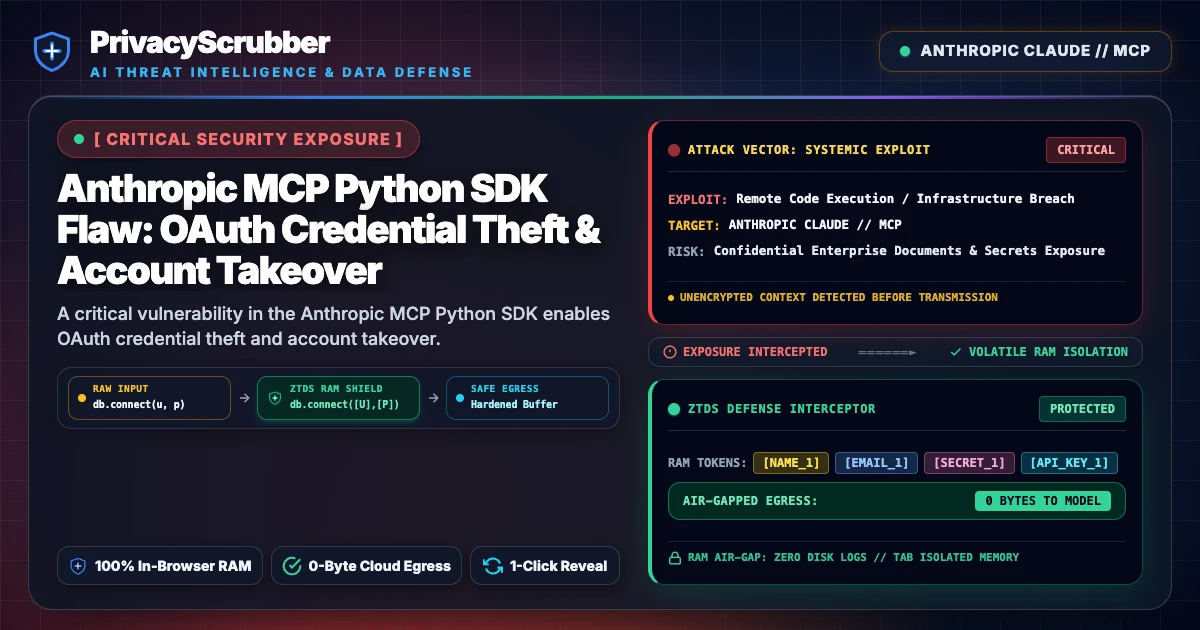
Anthropic MCP Python SDK Flaw: OAuth Credential Theft & Account Takeover
Anthropic MCP Python SDK Flaw: A critical vulnerability in the Anthropic MCP Python SDK enables OAuth credential theft and account takeover, risking enterprise integrations.

Technical Incident Analysis
The newly uncovered security flaw in the Anthropic Model Context Protocol (MCP) Python SDK highlights severe risks in automated developer toolchains. Attackers exploit improper handling of OAuth redirect flows and token storage mechanisms to extract high-privilege credentials. This mirrors broader architectural weaknesses across autonomous agent connectors. For a deeper look at defending against these vectors, review our AI Security Architecture guide, alongside our analysis of Related AI Security Incident threat intelligence.
Enterprise Blast Radius & Compliance Risks
Compromised OAuth credentials within enterprise MCP integrations grant malicious actors unrestricted access to connected SaaS platforms, cloud repositories, and customer databases. Such multi-tenant breaches violate strict data governance mandates under the European regulatory landscape. Organizations must align with strict oversight frameworks, as outlined in the EU AI Act Compliance Checklist for ChatGPT & Copilot Users (2026), to avoid severe penalties for unmonitored agent integrations.
Client-Side Mitigation via Zero-Trust Data Sanitization
Relying solely on perimeter defenses leaves developer toolchains vulnerable to API and SDK-level exploits. Zero-trust client-side masking intercepts data streams locally within the browser or developer workstation, stripping out sensitive authorization tokens and PII before transmission. By enforcing local session isolation and ephemerality, organizations can effectively neutralize interception attacks. Explore our recommended architecture in the CISO LLM Security Framework: Preventing Corporate Data Theft.
Step-by-Step Integration Guide: Anthropic MCP Python SDK Flaw
PrivacyScrubber operates entirely client-side. Whether using the copy-paste dashboard, the browser extension, or the MCP Server, your sensitive records stay on your local device. Follow these instructions to safely use Developer AI & IDE Agent Pipelines:
1 Method A: Instant Clipboard & Web Workspace
Fastest for ad-hoc debugging, server crash logs, or DB dumps:
- Paste the raw database dump, stack trace, or config payload into PrivacyScrubber.
- Click Sanitize Prompt to locally tokenize all tokens, hostnames, and API secrets with 100% Local RAM Processing.
- Copy the sanitized code and safely query ChatGPT, Claude, or Copilot.
- Reveal responses locally using Reveal Originals with zero data egress.
2 Method B: Chrome Extension & MCP Server
For automated in-browser prompt masking & IDE agents (Cursor / Cline):
- Install the free PrivacyScrubber Extension to auto-mask credentials directly in ChatGPT/Claude inputs.
- Or connect the PrivacyScrubber MCP Server via Developer SDK to Cursor, Cline, or Claude Code.
- Session token maps remain 100% in volatile RAM with zero telemetry.
- Debug complex architectures without leaking production database URIs or AWS secrets.
Local Redaction & Risk Matrix for Security
| Detection Entity | Token Placeholder | Risk Level | Security Action |
|---|---|---|---|
| User / Server IP Addresses | [IP_ADDRESS] | High (DLP / Location footprinting) | IPv4 / IPv6 format strip |
| AWS_KEY Details | [AWS_KEY] | Medium (PII Exposure) | Deterministic local swap |
| INTERNAL_HOSTNAME Details | [INTERNAL_HOSTNAME] | Medium (PII Exposure) | Deterministic local swap |
| MAC_ADDRESS Details | [MAC_ADDRESS] | Medium (PII Exposure) | Deterministic local swap |
| VULN_ID Details | [VULN_ID] | Medium (PII Exposure) | Deterministic local swap |
3-Step Zero-Trust AI Workflow Template
Role: Lead DevSecOps Engineer / Cloud Security Architect · Target: Developer AI & IDE Agent PipelinesAct as a principal cloud systems architect. Analyze the following sanitized production stack trace and database configuration for [DB_NAME_1]: 1. Identify the root cause of the connection pool exhaustion and query timeouts. 2. Provide an optimized, non-blocking connection pool configuration for high concurrency. 3. Draft a step-by-step remediation patch. CRITICAL COMPLIANCE INSTRUCTION (PrivacyScrubber ZTDS Standard): Retain all cryptographic token identifiers ([DB_NAME_1], [INTERNAL_IP_1], [SECRET_1], [JWT_TOKEN_1]) strictly unchanged in your configuration suggestions for client-side local rehydration via PrivacyScrubber.
[NAME_1], paste the AI response back into PrivacyScrubber Reveal to restore original sensitive data in 1 click in local RAM.Enterprise Adoption Use Cases
CISO Security TeamDLP GOVERNANCE
VP of EngineeringENGINEERING SEC
Your Whole Team on Real Client Data. Safely. $99/mo Flat.
No per-seat pricing. No DPA negotiation. No IT portal. Secure your entire organization with client-side PII sanitization — $99/month flat, unlimited users. SOC 2 & HIPAA ready. Works in Airplane Mode.
Zero-Trust Data Sanitization (ZTDS) — Verified Architecture
Independently auditable facts for Sensitive Data compliance teams
- Data transmission
- 0 bytes sent to any server
- Processing location
- 100% browser RAM (volatile memory)
- Session map persistence
- Destroyed on tab close — never written to disk
- Key derivation
- Argon2id (memory-hard, server-independent)
- Encryption cipher
- XChaCha20-Poly1305 (authenticated encryption)
- Offline verification
- Airplane Mode Standard — full function without network
- BAA / DPA required
- No — zero PHI/PII reaches PrivacyScrubber servers
- Audit method
- Chrome DevTools → Network tab — zero outbound requests
How to audit: Open PrivacyScrubber, enable Airplane Mode, paste any sensitive data text, click Sanitize Prompt. Open Chrome DevTools → Network tab. Zero outbound requests will confirm 100% local execution. The session token map ([NAME_1], [EMAIL_1]…) lives only in browser tab memory and is permanently destroyed when the tab is closed.
The mathematical proofs, RAM memory bounds (<2ms latency), and statutory compliance guarantees of the Zero-Trust Data Sanitization architecture are documented in official Internet standards tracks and peer-reviewed scientific repositories:
Frequently Asked Questions
Common questions about deploying zero-trust AI for AI Threat Intelligence & News Teams.