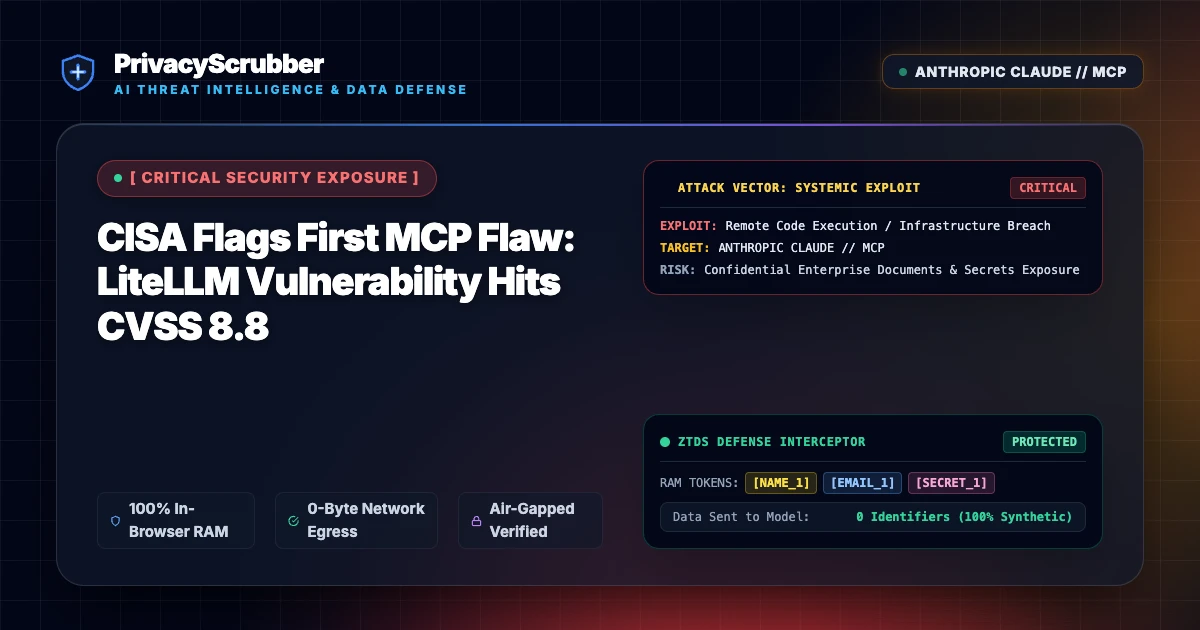
CISA Flags First MCP Flaw: LiteLLM Vulnerability Hits CVSS 8.8
CISA Flags First MCP Flaw: CISA has issued an urgent advisory warning of a critical CVSS 8.8 vulnerability within the Model Context Protocol (MCP) server implementation of LiteLLM. PrivacyScrubber's zero-trust, client-side sanitization entirely neutralizes this exploit path by stripping vulnerable payloads before transit.

Published: · Updated: · 3 min read
Interactive PII Detection & Sanitization Sandbox
Test real-time client-side RAM tokenization. Choose a specialized preset or paste your own raw prompt to test instant reversible redaction.
Technical Incident Analysis
The Cybersecurity and Infrastructure Security Agency (CISA) has officially flagged a high-severity vulnerability within LiteLLM, hitting a CVSS exploit score of 8.8. This vulnerability resides directly within LiteLLM's integration of the Model Context Protocol (MCP), a protocol increasingly utilized by enterprise developers to orchestrate context-aware workflows across multiple LLMs. Due to inadequate boundary checking and trust validation between client-side interfaces and backend MCP handlers, attackers can inject payloads disguised as system commands. Enforcing a comprehensive AI Security Architecture is now critical to isolate these middleware endpoints.
Once triggered, the flaw allows unauthorized actors to manipulate agentic workflows, access backend environments, and capture telemetry streams containing raw prompt inputs. This structural protocol weakness highlights the systemic risks of relying on server-side validations, drawing parallels to a Related AI Security Incident where unvetted data ingestion paths led to massive lateral exposure of restricted information.
Enterprise Blast Radius & Compliance Risks
When a high-exposure vulnerability impacts an LLM routing gateway like LiteLLM, the blast radius spans the entire enterprise infrastructure. Because LiteLLM acts as a centralized proxy for API keys, user queries, and internal database schemas, an MCP exploit allows attackers to systematically extract proprietary company data. Under strict regulatory frameworks, transmitting plaintext credentials, customer PII, or internal keys to a compromised gateway triggers severe data protection liabilities. To mitigate these operational risks, security officers must aggressively align their orchestration tools with ISO 27001 AI Compliance protocols.
Relying on post-hoc firewall rules or model-level filters is no longer a viable security posture. If sensitive credentials or protected health information (PHI) flow freely through the browser into a vulnerable MCP backend, the organization remains entirely liable for downstream exposure, regardless of server-side encryption claims.
Client-Side Mitigation via Zero-Trust Data Sanitization
The only definitive way to defend against middleware exploits like the LiteLLM MCP flaw is to sanitize, redact, and tokenize sensitive information before it leaves the end-user's workstation. PrivacyScrubber's zero-trust architecture executes entirely within client-side RAM, employing ephemeral sessionMap isolation to strip out identifying attributes, API keys, and injection structures in real time. Implementing robust MCP AI Security guarantees that even if a gateway is fully compromised, the attacker only receives anonymized tokens instead of usable company data.
By deploying PrivacyScrubber’s client-side PII scrubbing layer, organizations can continue leverage the rapid processing power of Model Context Protocols without exposing their critical operational data to persistent remote code execution vectors or lateral exfiltration pipelines.
Step-by-Step Integration Guide: CISA Flags First MCP Flaw
PrivacyScrubber operates entirely client-side. Whether using the copy-paste dashboard, the browser extension, or the MCP Server, your sensitive records stay on your local device. Follow these instructions to safely use Developer AI & IDE Agent Pipelines:
1 Method A: Instant Clipboard & Web Workspace
Fastest for ad-hoc debugging, server crash logs, or DB dumps:
- Paste the raw database dump, stack trace, or config payload into PrivacyScrubber.
- Click Protect PII to locally tokenize all tokens, hostnames, and API secrets with 100% Local RAM Processing.
- Copy the sanitized code and safely query ChatGPT, Claude, or Copilot.
- Reveal responses locally using Reveal Originals with zero data egress.
2 Method B: Chrome Extension & MCP Server
For automated in-browser prompt masking & IDE agents (Cursor / Cline):
- Install the free PrivacyScrubber Extension to auto-mask credentials directly in ChatGPT/Claude inputs.
- Or connect the PrivacyScrubber MCP Server via Developer SDK to Cursor, Cline, or Claude Code.
- Session token maps remain 100% in volatile RAM with zero telemetry.
- Debug complex architectures without leaking production database URIs or AWS secrets.
Local Redaction & Risk Matrix for Security
| Detection Entity | Token Placeholder | Risk Level | Security Action |
|---|---|---|---|
| User / Server IP Addresses | [IP_ADDRESS] | High (DLP / Location footprinting) | IPv4 / IPv6 format strip |
| AWS_KEY Details | [AWS_KEY] | Medium (PII Exposure) | Deterministic local swap |
| INTERNAL_HOSTNAME Details | [INTERNAL_HOSTNAME] | Medium (PII Exposure) | Deterministic local swap |
| MAC_ADDRESS Details | [MAC_ADDRESS] | Medium (PII Exposure) | Deterministic local swap |
| VULN_ID Details | [VULN_ID] | Medium (PII Exposure) | Deterministic local swap |
3-Step Zero-Trust AI Workflow Template
Role: Lead DevSecOps Engineer / Cloud Security Architect · Target: Developer AI & IDE Agent PipelinesAct as a principal cloud systems architect. Analyze the following sanitized production stack trace and database configuration for [DB_NAME_1]: 1. Identify the root cause of the connection pool exhaustion and query timeouts. 2. Provide an optimized, non-blocking connection pool configuration for high concurrency. 3. Draft a step-by-step remediation patch. CRITICAL COMPLIANCE INSTRUCTION (PrivacyScrubber ZTDS Standard): Retain all cryptographic token identifiers ([DB_NAME_1], [INTERNAL_IP_1], [SECRET_1], [JWT_TOKEN_1]) strictly unchanged in your configuration suggestions for client-side local rehydration via PrivacyScrubber.
[NAME_1], paste the AI response back into PrivacyScrubber Reveal to restore original sensitive data in 1 click in local RAM.Enterprise Adoption Use Cases
CISO Security TeamDLP GOVERNANCE
VP of EngineeringENGINEERING SEC
Risk & Audit LeadCOMPLIANCE AUDIT
Data Protection OfficerGDPR COMPLIANCE
Your Whole Team on Real Client Data. Safely. $99/mo Flat.
No per-seat pricing. No DPA negotiation. No IT portal. Secure your entire organization with client-side PII masking — $99/month flat, unlimited users. SOC 2 & HIPAA ready. Works in Airplane Mode.
Zero-Trust Data Sanitization (ZTDS) — Verified Architecture
Independently auditable facts for Sensitive Data compliance teams
- Data transmission
- 0 bytes sent to any server
- Processing location
- 100% browser RAM (volatile memory)
- Session map persistence
- Destroyed on tab close — never written to disk
- Key derivation
- Argon2id (memory-hard, server-independent)
- Encryption cipher
- XChaCha20-Poly1305 (authenticated encryption)
- Offline verification
- Airplane Mode Standard — full function without network
- BAA / DPA required
- No — zero PHI/PII reaches PrivacyScrubber servers
- Audit method
- Chrome DevTools → Network tab — zero outbound requests
How to audit: Open PrivacyScrubber, enable Airplane Mode, paste any sensitive data text, click Protect PII. Open Chrome DevTools → Network tab. Zero outbound requests will confirm 100% local execution. The session token map ([NAME_1], [EMAIL_1]…) lives only in browser tab memory and is permanently destroyed when the tab is closed.
Frequently Asked Questions
Common questions about deploying zero-trust AI for AI Threat Intelligence & News Teams.