Warp AI Agent Logs Exposed: Critical User Telemetry Data Breach
Warp AI Agent Logs Exposed: Warp has disclosed a security breach leading to the exposure of AI agent decision logs and user telemetry data, revealing sensitive operational and personal information through a compromised third-party vendor. PrivacyScrubber's local client-side PII scrubbing prevents such data from ever leaving the user's environment, halting exfiltration at the source.

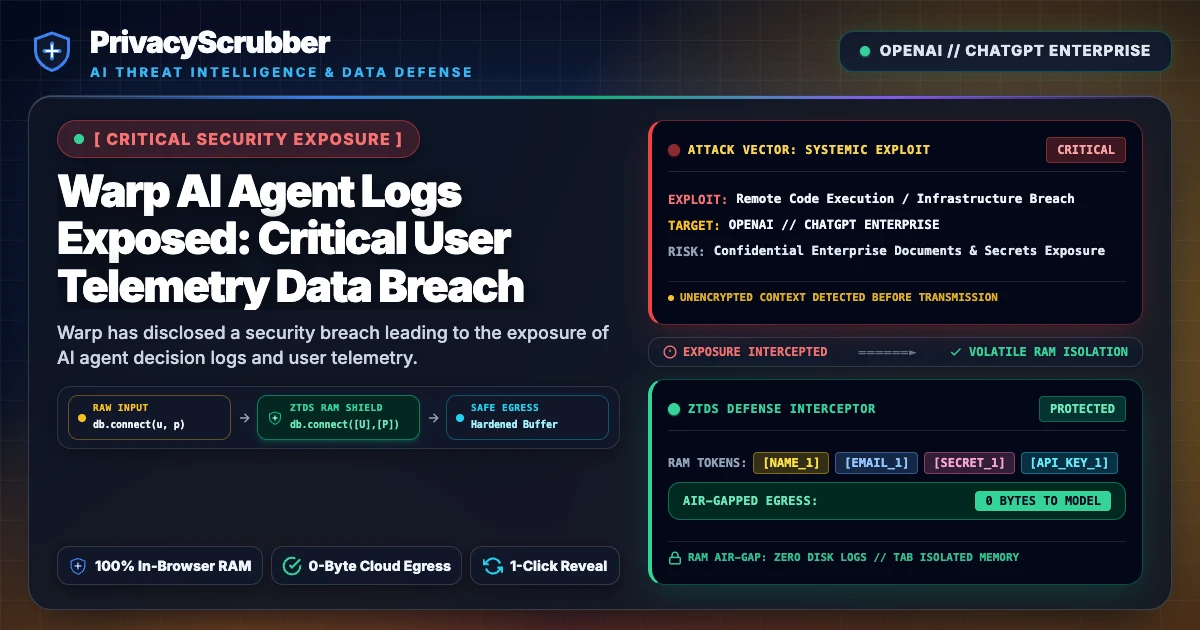
"Warp has disclosed a security breach leading to the exposure of AI agent decision logs and user telemetry data, revealing sensitive operational and personal information through a compromised third-party vendor. PrivacyScrubber's local client-side PII scrubbing prevents such data from ever leaving the user's environment, halting exfiltration at the source."
Security Governance: Warp AI Agent Logs Exposed
Flat $99/mo unlimited seats with encrypted XChaCha20 handoffs and GDPR Art. 32 & SOC 2 receipts for Warp breach.
Technical Incident Analysis: Warp AI Agent Logs Exposed
The Warp security incident involved the unauthorized access and exposure of AI agent decision logs and user telemetry data, a critical breach that undermines trust in AI-driven platforms. This incident originated from an attack on a third-party vendor within Warp's infrastructure. This type of exposure often stems from inadequate logging security or flawed data handling practices within the AI Security Architecture, allowing sensitive information processed by AI agents to be retained and subsequently exfiltrated. Unlike more direct remote code execution vulnerabilities, such as those detailed in the GitLab AI Gateway RCE (CVE-2026-90970) Advisory, the Warp breach highlights the pervasive risk of data leakage through seemingly innocuous system logs and aggregated usage metrics. Attackers can leverage these exposed logs to gain insights into user behavior, system configurations, and even extract Personally Identifiable Information (PII) that agents may have temporarily processed, using them as a reconnaissance asset to map internal data landscapes and craft precise follow-on attacks.
Enterprise Blast Radius & Compliance Impact (Warp AI Agent Logs Exposed)
The exposure of AI agent decision logs and user telemetry data in the Warp breach carries significant enterprise blast radius and compliance implications. Such incidents can lead to severe reputational damage, financial penalties, and a loss of customer trust, particularly under stringent data privacy regulations like GDPR and CCPA. The leak of user telemetry, which often includes personal preferences, interaction patterns, and potentially sensitive contextual information, can trigger extensive data subject access requests (DSARs) and data breach notification requirements. Enterprises must rigorously adhere to data minimization principles to prevent oversharing of PII in AI interactions, as emphasized by topics such as The Science of LLM Data Minimization: Why GPT-5 Needs Less Data Than You Think. Failure to implement robust data protection for AI agent logs and telemetry data can result in significant legal and regulatory challenges, as privacy watchdogs increasingly scrutinize how AI systems handle personal information.
Zero-Trust RAM Mitigation for Warp AI Agent Logs Exposed
Mitigating risks like the Warp AI Agent Logs Exposed breach necessitates a radical shift towards Zero-Trust Data Sanitization (ZTDS™) within the local client-side environment. By implementing technologies that redact PII locally before sending data to the cloud, organizations can ensure that sensitive information never enters AI agent logs or telemetry systems in an unmasked state. PrivacyScrubber's ZTDS™ approach ensures that all personally identifiable information is tokenized or scrubbed in RAM on the user's device, before any data is transmitted to AI services or recorded in their logs. This client-side, RAM-only processing prevents the data exfiltration vector exploited in the Warp incident, making compromised logs or telemetry harmless by design. This proactive measure establishes a robust security perimeter, ensuring that even if an AI agent's internal logging or a cloud service's telemetry is compromised via a third-party vendor, no original PII is exposed.
Token-Safe Model Input for Warp AI Agent Logs Exposed
Database Administrator / API Security Lead · LLM Code Assistants & IDE AgentsAssignment for Database Administrator / API Security Lead: Audit Warp AI Agent Logs Exposed payload. Notice: Cleartext Warp breach has been mapped to [IP_ADDRESS_1], [AWS_KEY_1], [INTERNAL_HOSTNAME_1]. 1) Synthesize operational implications of Warp AI Agent Logs Exposed. 2) Detail concrete controls supporting AI agent logs. 3) Return exact [IP_ADDRESS_1], [AWS_KEY_1], [INTERNAL_HOSTNAME_1] labels inside your output.
Your Whole Team on Real Client Data. Safely. $99/mo Flat.
No per-seat pricing. No processor in the sanitization path. No IT portal. Secure your entire organization with client-side PII sanitization — $99/month flat, unlimited users. SOC 2 & HIPAA ready. Works in Airplane Mode.
Architecture Verification: Warp AI Agent Logs Exposed
During Warp AI Agent Logs Exposed tasks, Warp breach strings remain inside volatile browser memory with zero relay hops and clean Airplane Mode operation.
Pre-Inference Rule for Warp AI Agent Logs Exposed: process raw Warp breach files in local workstation memory at https://privacyscrubber.com/?profile=security#ai and verify zero network egress prior to AI querying.
Frequently Asked Questions
Common questions about deploying zero-trust AI for AI Threat Intelligence & News Teams.
How does the Warp AI Agent Logs Exposed vulnerability expose enterprise data?
How does PrivacyScrubber prevent Warp AI Agent Logs Exposed data exfiltration?
How does client-side ZTDS™ prevent data exposure in Warp AI Agent Logs Exposed scenarios?
What compliance evidence does PrivacyScrubber generate for CISO and DPO incident audits?
Related AI Threat Intelligence & Incident Reports
All Advisories →GitLab AI Gateway RCE (CVE-2026-90970): Critical Command Execution Flaw
GitLab has patched a critical remote code execution vulnerability (CVE-2026-90970) in its AI Gateway service, which allowed authenticated attackers to escape prompt template sandboxes and execute arbitrary commands. PrivacyScrubber's local client-side PII scrubbing halts data exfiltration, ensuring sensitive information never reaches vulnerable downstream AI infrastructure.
Bifrost AI Gateway CVE-2026-90898: Unauthenticated RCE and MCP Credential Theft
Disclosed by JFrog Security Research, CVE-2026-90898 is a critical 9.8 CVSS flaw in Bifrost AI Gateway that allows unauthenticated remote code execution via stdio MCP client registration. Learn how client-side RAM sanitization shields enterprise data from centralized proxy compromise.
Marimo CVE-2026-39987 Exploit: LLM Agents Accelerate Data Exfiltration
Attackers leveraged a critical pre-authentication RCE in Marimo notebooks (CVE-2026-39987) to gain shell access, then employed LLM agents to rapidly exfiltrate sensitive cloud credentials and database contents. PrivacyScrubber's local client-side PII masking prevents this class of data exfiltration by neutralizing sensitive data before it reaches compromised AI agent environments.
Fireworks AI Cloud Provider Breach: Customer Data & LLM Weights Exposed
AI infrastructure firm Fireworks AI confirmed a second security breach originating from a third-party cloud provider, compromising customer billing data and sensitive LLM model weights. Client-side PII masking prevents such cloud-provider-induced data exfiltration by ensuring no raw PII ever leaves the client environment.