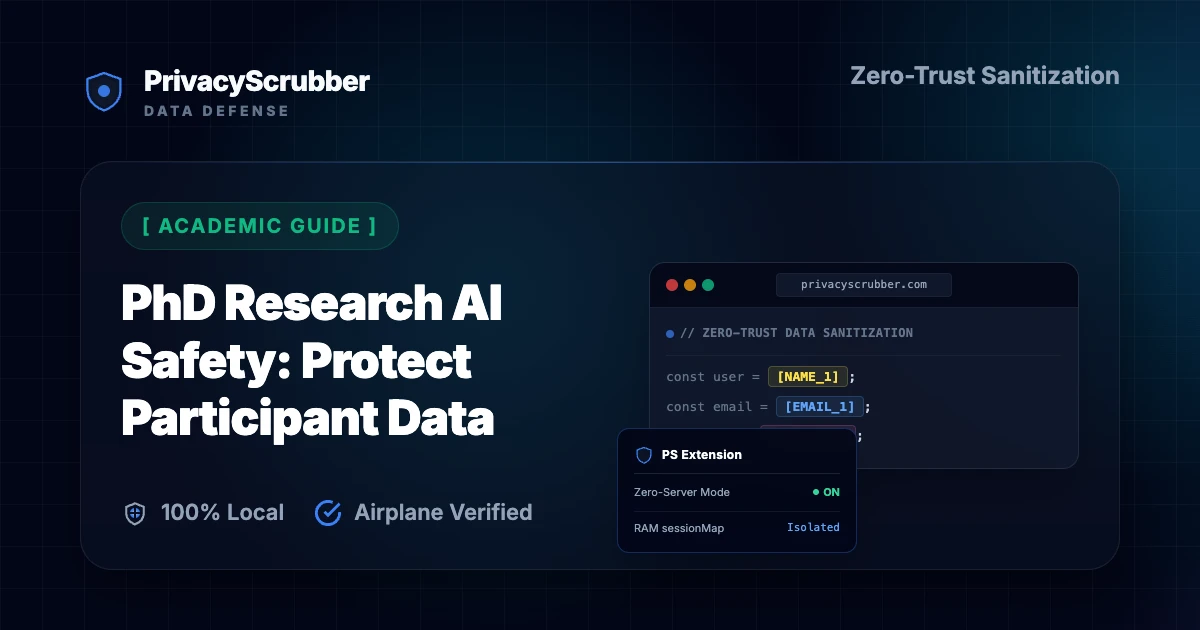
Unlike proxy-based filters that buffer cleartext on external servers, PrivacyScrubber resolves PhD Research AI Safety (PhD research AI privacy) directly inside volatile device memory via PrivacyScrubber Academic & IRB De-Identification Profile. Sensitive attributes are substituted with [PARTICIPANT_1], [STUDENT_ID_1], [COHORT_1], [EMAIL_1] in <1ms, preventing violating IRB human-subjects protocols and FERPA rules when analyzing qualitative transcripts with LLMs under FERPA (student records).
What Researchers and Educators Send to AI During PhD Research AI Safety
Every unmasked prompt in PhD Research AI Safety exposes PhD research AI privacy and IRB compliance AI to third-party sub-processors across ChatGPT for writing assistance, AI literature review tools, and research analysis platforms. To prevent uploading participant data, student records, or preliminary research findings to AI tools, violating protocol consent scope and IRB-mandated data handling and eliminate violating IRB human-subjects protocols and FERPA rules when analyzing qualitative transcripts with LLMs, our Academic & IRB Research AI privacy guides map out client-side ZTDS™ tokenization ([PARTICIPANT_1], [STUDENT_ID_1], [COHORT_1], [EMAIL_1]) tailored for Academic & IRB Research workflows.
The core vulnerability in PhD Research AI Safety occurs the millisecond unredacted PhD research AI privacy or IRB compliance AI text crosses the browser or application socket. Doctoral researchers using AI must protect participant data. Local protection prevents IRB violations. Flat-rate TEAMS pricing with zero cloud data egress. Without local RAM interception via PrivacyScrubber Academic & IRB De-Identification Profile, professors, phd students, clinical researchers, and university administrators remain exposed to uploading participant data, student records, or preliminary research findings to AI tools, violating protocol consent scope and IRB-mandated data handling.
Zero-Egress Architecture for PhD Research AI Safety
When operationalizing PhD Research AI Safety, security and engineering leaders must account for uploading participant data, student records, or preliminary research findings to AI tools, violating protocol consent scope and IRB-mandated data handling. Traditional cloud-hosted redaction APIs inspect data only after cleartext payloads leave the workstation or VPC, creating secondary compliance liability under FERPA (student records). By executing deterministic sanitization inside local memory via PrivacyScrubber Academic & IRB De-Identification Profile, sensitive literals are converted into [PARTICIPANT_1], [STUDENT_ID_1], [COHORT_1], [EMAIL_1] in sub-millisecond time before network serialization.
This bijective token architecture preserves 100% of the structural and relational context required for high-accuracy prompts in PhD research AI privacy and IRB compliance AI. Once the upstream LLM returns its completion, original values are restored locally in RAM with zero server logs and verifiable SHA-256 audit receipts.
Field-by-Field Sanitization Rule for PhD Research AI Safety
To maintain LLM analytical context while avoiding cloud data breaches, apply this deterministic field mapping in local RAM before submitting PhD Research AI Safety prompts:
| Document Field / Attribute | Action | RAM Surrogate | Statutory & Analytical Rationale |
|---|---|---|---|
| Multi-Line Counterparty & Organization Names (Academic & IRB Research) | REDACT | [PARTICIPANT_1] | Preserves co-reference continuity across multi-paragraph PhD Research AI Safety prompts without leaking names. |
| Embedded Secrets, Tax IDs & Session Identifiers in PhD Research AI Safety | REDACT | [PARTICIPANT_1], [STUDENT_ID_1] | Intercepts high-liability literals before violating IRB human-subjects protocols and FERPA rules when analyzing qualitative transcripts with LLMs. |
| Secondary Regulated Attributes (zero egress ai security) | REDACT | [EMAIL_1] | Satisfies FERPA (student records) data minimization by replacing sensitive Academic & IRB Research strings in local RAM. |
| Anonymized Category Labels & Department Roles | PRESERVE | Cleartext (Academic & IRB Research Role) | Retains organizational context for PhD Research AI Safety while keeping personal identities inside local RAM. |
| Non-Identifying Domain Logic & Operational Instructions | PRESERVE | Cleartext Narrative | Preserves 100% of analytical instructions for research participant protection so local detokenization yields production-ready output. |
| Regulatory Clause Citations & Policy Taxonomy (FERPA (student records)) | PRESERVE | Cleartext Citations | Allows the AI model to map PhD Research AI Safety findings against statutory controls and audit frameworks. |
Safe LLM Prompt Template for PhD Research AI Safety
Pair this structured instruction with your tokenized PhD Research AI Safety payload so ChatGPT, Claude, or Gemini preserves all bracketed surrogates for local RAM restoration:
Objective: Process PhD Research AI Safety (PhD research AI privacy) with zero cloud data leakage.
All personal and corporate identifiers are represented by bijective tokens ([PARTICIPANT_1], [STUDENT_ID_1], [COHORT_1], [EMAIL_1]).

Steps:
1. Audit the quantitative and logical parameters of the PhD Research AI Safety record.
2. Produce a concise executive summary tailored for professors, phd students, clinical researchers, and university administrators.
3. Maintain all [PARTICIPANT_1], [STUDENT_ID_1], [COHORT_1], [EMAIL_1] markers in-place for deterministic local RAM reveal.

[PASTE SANITIZED PAYLOAD HERE]
How to Sanitize PhD Research AI Safety in Local RAM (Zero Cloud Egress)
Operating 100% in local memory via PrivacyScrubber Academic & IRB De-Identification Profile, PrivacyScrubber strips regulated PhD research AI privacy and research participant protection literals from PhD Research AI Safety payloads before they touch ChatGPT for writing assistance, AI literature review tools, and research analysis platforms. This bijective token workflow ([PARTICIPANT_1], [STUDENT_ID_1], [COHORT_1], [EMAIL_1]) satisfies science of LLM data minimization and zeroizes automatically on session close.
Unlike cloud DLP black boxes, PhD Research AI Safety sanitization is transparently verifiable offline via the Airplane Mode Standard. Scrubbing PhD research AI privacy into [PARTICIPANT_1], [STUDENT_ID_1], [COHORT_1], [EMAIL_1] with zero network interface activity provides concrete evidence for offline PHI scrubber for clinical research and FERPA (student records) reviews.
Statutory Liability for Researchers and Educators: PhD Research AI Safety
The statutory mandate governing Academic & IRB Research workflows (FERPA (student records), Common Rule (45 CFR 46) for human subjects research, and IRB institutional requirements) leaves zero margin for uploading participant data, student records, or preliminary research findings to AI tools, violating protocol consent scope and IRB-mandated data handling. By combining PhD Research AI Safety controls with the patterns in clinical trial data anonymizer for AI research, organizations tokenize PhD research AI privacy and research participant protection locally so external LLMs never take custody of regulated PII.