Academic Workflows: Protecting Research Participant PII
Academic & Research: Ensure FERPA compliance when using AI for student records or clinical trials. Redact participant PII natively in the browser.

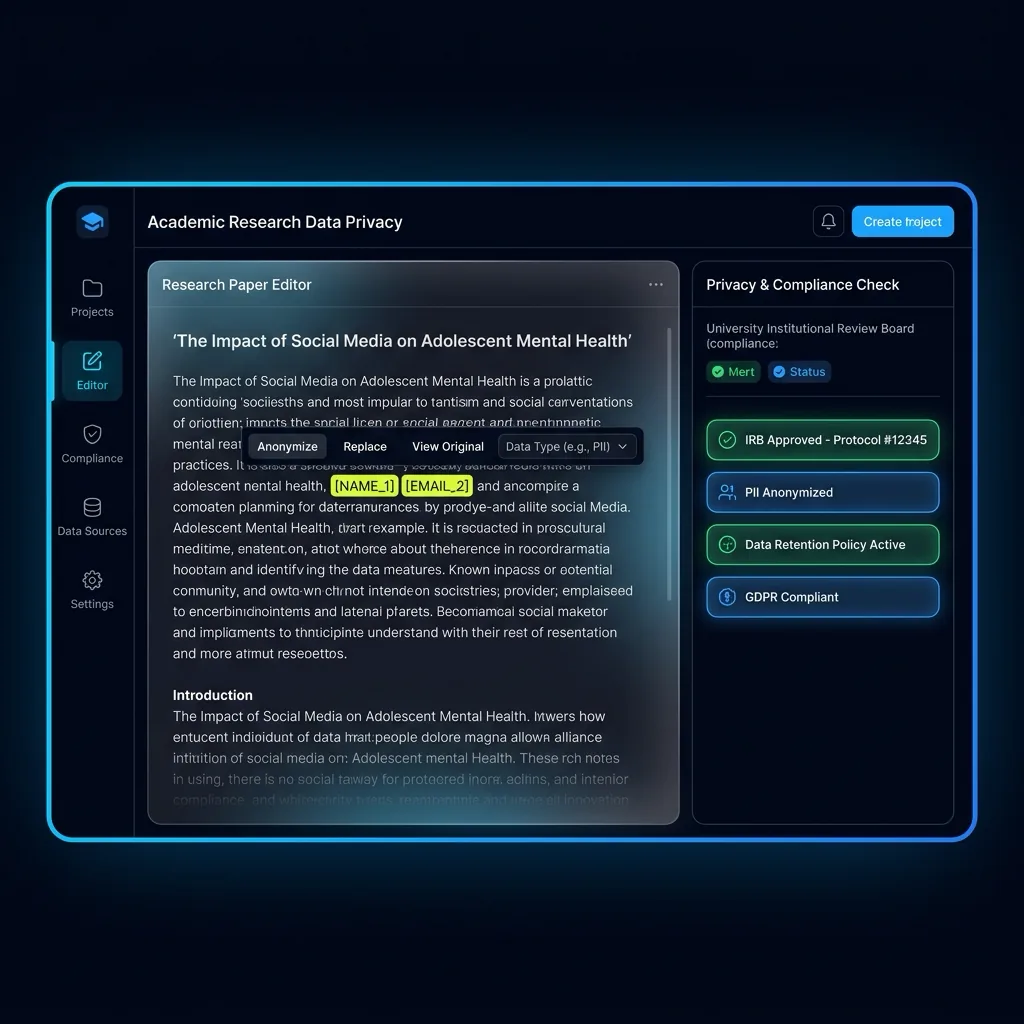
University researchers, professors, and lab directors use AI to analyze research interview transcripts, format clinical trial data, and review student evaluations. PrivacyScrubber's Academic Extension enforces FERPA and Institutional Review Board (IRB) privacy standards by anonymizing student and participant PII locally within the browser.
FERPA & IRB Human Participant De-Identification
Purges student names, student IDs, participant interview identities, and geographic survey locations in <2ms local browser memory.
Native Academic Sandbox for Research Integrity
Pasting qualitative research interviews or student grade disputes into commercial AI models violates IRB protocols and FERPA regulations. PrivacyScrubber's sandboxed browser extension intercepts research text in real-time, substituting participant names with [PARTICIPANT_1] and location details with [LOCATION_1], enabling researchers to utilize AI for coding and theme discovery with zero participant risk.
Qualitative Research Interview Analysis
-
1
Copy or Paste Unsanitized Content: Researcher pastes 10 qualitative interview transcripts containing participant names, workplace locations, and personal anecdotes.
-
2
Real-Time In-Browser Sanitization: The extension detects participant names and geographic indicators, replacing them with reversible tokens in local RAM.
-
3
Submit to LLM with Zero Cloud Exposure: Researcher prompts ChatGPT: "Identify recurring thematic patterns regarding workplace stress across [PARTICIPANT_1] through [PARTICIPANT_10]".
-
4
Instant Local Reversal (Contextual Reveal): Researcher uses 1-click in-page reveal to map thematic findings back to real participant codebooks stored securely on university servers.
FERPA (34 CFR Part 99) & IRB Ethics Compliance
Federal law strictly regulates the disclosure of Personally Identifiable Information from student education records without consent. Edge sanitization ensures student records never touch cloud training servers, matching our AI Privacy Guides framework.
Offline Document Parsing for Research Grants
Drop scanned survey forms and grant proposal drafts into the offline WASM OCR engine to extract and redact text without uploading unreleased academic discoveries to third-party servers, following PII protection basics and Zero-Trust AI frameworks.
IRB-Ready Compliance Verification
Generate audit receipts for university ethics boards proving that research prompt submissions contained zero raw human participant data, fulfilling GDPR/CCPA standards requirements.
Latest Capabilities: Multi-Line Stitching & Local OCR
The PrivacyScrubber Chrome Extension features a smart 3-Line Name-Stitching Lookahead to capture names split across lines (e.g. Firstname
MiddleInitial
Surname) in scanned medical/clinical records, NDAs, and PDFs. It also supports Local Wasm OCR & PDF Sanitization to redact text from screenshots/PDFs offline, and Zero-Trust Session Sync (Argon2id + XChaCha20-Poly1305) to share rules peer-to-peer securely.
Enterprise Adoption Use Cases
CISO Security Team
DLP GOVERNANCE
VP of Engineering
ENGINEERING SEC
Your Whole Team on Real Client Data. Safely. $99/mo Flat.
No per-seat pricing. No DPA negotiation. No IT portal. Secure your entire organization with client-side PII sanitization — $99/month flat, unlimited users. SOC 2 & HIPAA ready. Works in Airplane Mode.
Frequently Asked Questions
Common questions about deploying zero-trust AI for Chrome Extension Teams.