Zero-Trust Client-Side vs. Cloud APIs.
AI Summary / Key Takeaways
"Architectural comparison between zero-trust client-side sanitization and legacy cloud DLP APIs. PrivacyScrubber eliminates the transmission risk inherent in cloud-based scrubbers by redacting data locally, ensuring absolute data sovereignty and superior network performance with zero latency."
How to sanitize Zero-Trust Client-Side vs. Cloud APIs. data before submitting prompts to ChatGPT or Claude?
Sanitize sensitive records by tokenizing personal and confidential identifiers in browser RAM before prompt submission. PrivacyScrubber executes 100% locally with zero server egress, enabling professionals to leverage AI while maintaining complete data sovereignty and regulatory compliance.
Interactive PII Detection & Sanitization Sandbox
Test real-time client-side RAM tokenization. Choose a specialized preset or paste your own raw prompt to test instant reversible redaction.
Sanitized locally in volatile RAM. Pre-prompt compliance maintained under Comparisons standards (GDPR, HIPAA, SOC 2).
Enterprise-Grade AI Privacy
Add custom redaction rules and priority support with PRO.
Verified by the Enterprise Board
Our 10-persona AI team ensures Comparison compliance at every layer.
"PrivacyScrubber eliminates Shadow AI risk by intercepting PII at the edge. We've mapped this hub to SOC 2 Type II and ISO 27001 masking controls."
"Under GDPR Article 32 and HIPAA Safe Harbor, local anonymization removes the AI provider from the 'Data Processor' chain, negating complex DPA liabilities."
"A single GLBA or PCI-DSS violation costs 100x more than a site-wide license. We provide verifiable ROI through data loss prevention at the prompt level."
The Comparison AI Privacy Gap
Data Persistence
Raw sensitive inputs are often stored by AI vendors for model training.
Compliance Liability
Uploading unredacted PII violates industry-specific global privacy mandates.
Shadow AI Risk
Employees using unvetted AI tools create invisible data leakage vectors.
Raw Input: Client: Johnson & Associates, Account ID: ACCT-9914, Phone: (555) 234-5678
Sanitized: Client: [COMPANY_1], Account ID: [ID_1], Phone: [PHONE_1]
Secure Comparison AI Workflow
Enable high-performance AI without client data leaving your machine
Import Files
Upload documents locally into the PrivacyScrubber sandbox.
Local In-Memory Sanitization
Identify and tokenize sensitive strings entirely within browser memory.
Analyze with AI
Submit sanitized prompts to ChatGPT or Claude for processing.
Local RAM Reveal
Restore original values into the AI response locally for the final draft.
Protocol: The 5-Step Airplane Mode Audit
Don't trust us. Trust the laws of physics. Follow this audit procedure to verify zero-server PII sanitization for Comparison workflows.
Load the tool: Open PrivacyScrubber.com in your browser.
Go Offline: Disconnect your WiFi or enable Airplane Mode. The site remains fully functional.
Process Data: Paste a sensitive comparison document and click "Sanitize PII".
Inspect Network: Open Developer Tools (F12) and check the 'Network' tab. Verify 0 requests were made.
Verify Local RAM: All comparison identifiers stay in your transient browser memory—never stored, never logged.
General Universal Profile: Detection Coverage
Universal deterministic ZTDS™ detection ruleset. Detects names, government IDs, bank accounts, project codenames, and geographic locations across unstructured text.
Top 6 Comparisons Sensitive Entity Types Detected & Scrubbed
Individual Full Name
Government SSN / Tax ID
Bank IBAN & Account Ref
Proprietary Project Codename
Geographic Location
Financial Balance Amount
Continuous Detection Engine Expansion & Custom Regex Sovereignty
The 6 entity types above represent the core detection baseline for Comparisons. Our zero-trust engine detects hundreds of additional data classes and is continuously updated with new heuristic patterns, shadow AI leak vectors, and custom regulatory rulesets. Need proprietary database IDs or internal project codenames masked? PRO and TEAMS users can define unlimited custom regular expressions running 100% locally in browser RAM.
How the PrivacyScrubber Engine Solves This
Interactive Tool Controls for Comparisons. Hover for specs.
0ms Client-Side vs Cloud DLP
Eliminate the 2-5 second latency and data interception risks of cloud-based DLP proxies by tokenizing 100% in local browser RAM.
- Engine WASM-Accelerated
- Privacy 100% Local RAM
- Security Zero-Server Leak
Verifiable Airplane Mode
Disconnect Wi-Fi or inspect DevTools Network tab to prove zero outbound network calls are made during text and document sanitization.
- Engine WASM-Accelerated
- Privacy 100% Local RAM
- Security Zero-Server Leak
Predictable Flat-Rate Pricing
Replace predatory per-user enterprise seat pricing ($50+/user) with flat-rate TEAMS ($99/mo) for the entire organization.
- Engine WASM-Accelerated
- Privacy 100% Local RAM
- Security Zero-Server Leak
Comparison Technical Compliance Library
Deep architectural mapping of Zero-Trust Data Sanitization (ZTDS) controls to industry-specific regulatory standards.
Zero-Trust Verification Signature
The above technical controls are enforced deterministically by the PrivacyScrubber Local Engine. All redaction cycles generate zero server-side telemetry, satisfying global data residency requirements for Comparison institutions.
Hardened Audit Standards
Satisfying strict global security and privacy frameworks.
No data persistence on untrusted infrastructure.
Privacy by design at the engineering layer.
Data masking as a core organisational control.
Federal PII minimisation and transparency controls.
Satisfies Safe Harbor de-identification requirements.
Comparisons Compliance Library
Step-by-step redaction workflows for Comparisons environments.

PrivacyScrubber vs ChatGPT
Compare PrivacyScrubber local processing vs ChatGPT built-in privacy settings. Discover why browser-side de-identification beats OpenAI cloud filters.

Secure Workspace vs Browser Extension for AI Privacy
Compare web-based PII protectors against browser extensions for securing AI inputs. Learn why local browser sandboxing is safer than extension permissions.

ChatGPT Privacy Settings Explained
Step-by-step 2026 ChatGPT privacy settings guide: turn off model training, disable memory, use temporary chats, and mask PII locally before prompting.

Claude Code Privacy Guide
Claude Code reads your repo files. Configure the local MCP server to sanitize keys and credentials on your machine before they reach the model.

Google Gemini Data Privacy and Masking
Gemini settings control how Google handles chats, not what you send. Mask names, keys and IDs locally before prompting. Free browser extension.

Best Privacy-Focused AI Tools in 2026
Compare the best privacy-focused AI tools and zero-retention LLMs in 2026. Why local browser PII masking beats cloud privacy promises. Free to start.

Best Tool to Protect & Secure PII for LLMs
Cloud masking APIs inspect your text on their servers; local tools never receive it. Compare cost, vendor review and audit proof for LLM workflows.

PrivacyScrubber vs Nightfall AI
Compare PrivacyScrubber vs Nightfall AI for generative AI data protection. See why browser-side de-identification outpaces server-side cloud APIs.

PrivacyScrubber vs Microsoft Purview AI Hub
Microsoft Purview AI Hub requires complex E5 licensing and cloud syncing. Compare it with the lightweight, zero-trust PrivacyScrubber local engine.

Local vs Cloud PII Masking Workspace
Compare local browser de-identification vs cloud-based DLP APIs. Learn why a local PII masking workspace eliminates latency and data residency issues.

Open Source PII Masking Workspaces vs PrivacyScrubber
Analyzing Presidio, Amazon Comprehend, and other open-source PII masking workspaces versus the turn-key local PrivacyScrubber zero-trust engine.

Top 10 AI PII Redaction & DLP Tools (2026 Enterprise Comparison)
Compare Nightfall cloud DLP, Microsoft Presidio, and client-side RAM redaction on cost, latency, BAA/GDPR overhead, and audit proof. Free local tool.

PrivacyScrubber vs Amazon Macie for AI Prompts
Compare PrivacyScrubber local browser redaction vs Amazon Macie. Why scanning S3 buckets is too slow for real-time ChatGPT masking.

PrivacyScrubber vs Google Cloud DLP
How PrivacyScrubber local processing compares to Google Cloud DLP webhooks. Achieve Zero-Trust Data Sanitization without proxy latency.

PrivacyScrubber vs Microsoft Presidio
Compare Microsoft Presidio containerized Python microservices with PrivacyScrubber in-process Node.js SDK and zero-server browser DLP.

ChatGPT Enterprise vs Local PII Masking Workspace
Is ChatGPT Enterprise necessary for privacy? Compare OpenAI Enterprise data policies against 100% local, Zero-Trust data sanitization.

Claude for Work vs PrivacyScrubber (Zero-Trust PII Comparison)
A Claude work plan governs vendor handling of data. Local anonymization removes PII before it leaves your device. Compare cost, risk and audit proof.

PrivacyScrubber vs AWS Comprehend Medical
Compare PrivacyScrubber local PHI redaction vs AWS Comprehend Medical. Why zero-server architecture wins for clinical note AI safety.

PrivacyScrubber vs. Enterprise Cloud DLP
Compare PrivacyScrubber zero-trust local redaction vs Enterprise Cloud DLP (Nightfall, AWS Macie). Learn why browser-side processing is safer for AI.

Zero-Trust vs. Server-Side Data Masking
Understand the critical security difference between Zero-Trust client-side sanitization and traditional server-side data masking for LLMs.

ChatGPT Enterprise Data Controls vs. Client-Side Sanitization
Does ChatGPT Enterprise protect your PII? Compare OpenAI's enterprise privacy settings with 100% local, air-gapped data sanitization.

PrivacyScrubber vs OpenAI Privacy Filter
OpenAI released a built-in Privacy Filter. Compare it with PrivacyScrubber: 8 vs 20+ PII categories, ChatGPT-only vs 7 AI platforms, independent.

Synthetic Data vs Tokenization
Synthetic data requires ML infrastructure and expertise. Tokenization works instantly in your browser with zero setup. Compare both approaches for AI privacy.

Best ChatGPT Privacy Extensions Compared (2026)
Side-by-side comparison of Privacy Protector, GPT Privacy, Strac DLP, and PrivacyScrubber. Which Chrome extension actually keeps your data off OpenAI servers?
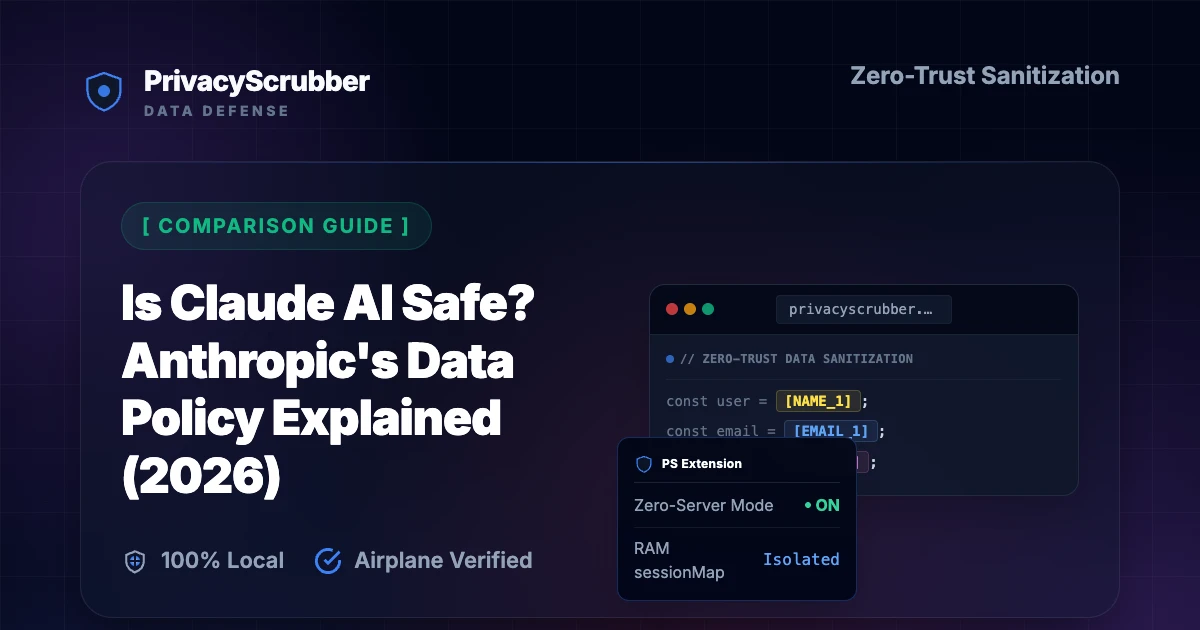
Is Claude AI Safe? Anthropic's Data Policy Explained (2026)
Is Claude safe for confidential enterprise data? Anthropic retains prompts for 30 days and may review them for safety. Here is what that means and how to protect your data.
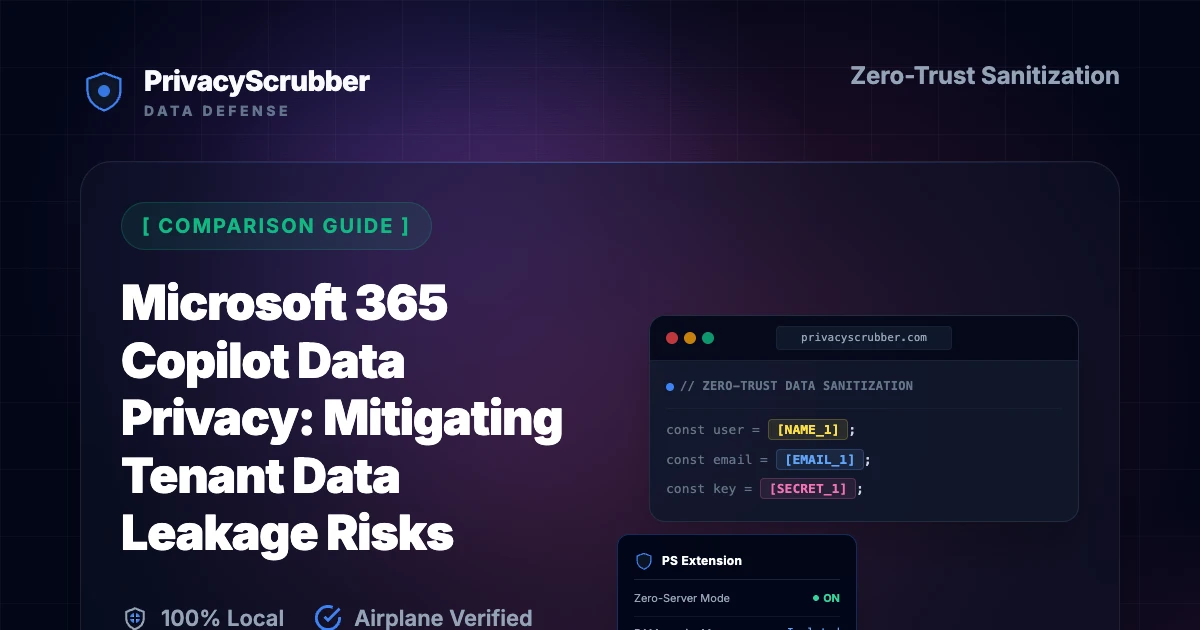
Microsoft 365 Copilot Data Privacy
Microsoft 365 Copilot accesses your entire SharePoint and OneDrive tenant. Learn how to mitigate internal PII exposure and shadow data risks locally.
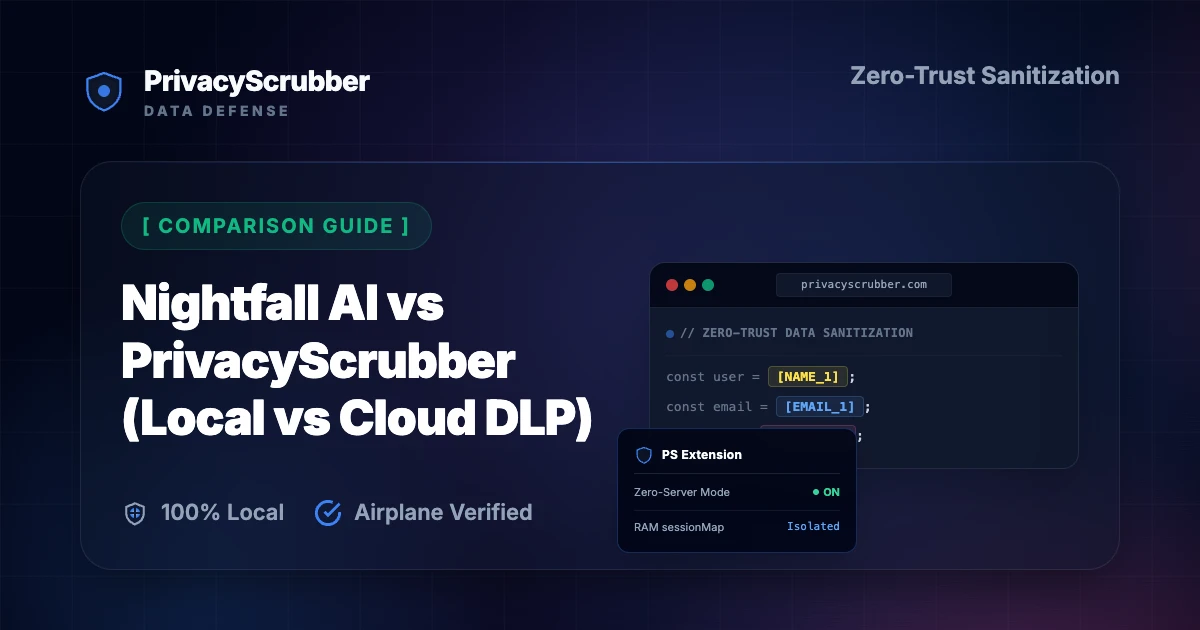
Nightfall AI vs PrivacyScrubber
Compare traditional cloud DLP solutions like Nightfall AI with PrivacyScrubber's zero-server, in-browser data sanitization for LLM protection.
Microsoft Presidio Alternative for Browser-Based Redaction
Looking for a Microsoft Presidio alternative? See how PrivacyScrubber delivers client-side PII masking without the heavy backend infrastructure.
Skyflow Alternative
Replace complex cloud privacy vault APIs with instant client-side PII sanitization. Eliminate API latency and vendor custody of sensitive tokens in AI workflows.
Lakera Guard Alternative
Protect enterprise ChatGPT and Claude prompts from PII leaks without sending raw prompts to third-party cloud AI firewall APIs. Zero latency, zero cloud transit.
Cyberhaven Alternative
Enable safe corporate AI adoption with lightweight in-browser prompt masking. Avoid invasive kernel-level endpoint agents, device slowdowns, and 6-figure enterprise minimums.

Local vs. Cloud PII Masking Workspaces
Compare local client-side PII masking workspaces with cloud DLP API proxies. Analyze security, latency, and cost differences.
Compare Edition Features
From individual use to corporate rollout, choose the level of control your organization requires.
| Core Capabilities |
Free
Web Only
|
PRO
$15/mo or $110 Lifetime
|
TEAMS
$99/mo
|
ENTERPRISE
Custom Tier
|
|---|---|---|---|---|
| 100% Local Processing (Airplane Mode) | ||||
| Text Paste & Single File Docs | 15k General / 5k Verticals | UNLIMITED | UNLIMITED | UNLIMITED |
| Batch Processing & Background OCR | — | |||
| Custom Regex & Specific Redaction Rules | — | |||
| Chrome Extension Native App | — | |||
| Silent Corporate Deployment (MDM) | — | — | ||
| Policy Control Center & Enforcement | — | — | ||
| IDE MCP Server & Headless Node.js SDK | MCP Free | MCP Unlimited | MCP + Team Sync | SDK ($299/mo) & Air-Gap |
| On-Premise Source Code License | — | — | — | |
| 100% Air-Gapped Operation | — | — | — | |
| Dedicated GRC Support | — | — | — | |
| Try Free | Details | Deploy TEAMS | Enterprise Hub |
Complementary AI Privacy Hubs & Frameworks
Cross-framework zero-trust sanitization workflows and enterprise compliance architectures.
Frequently Asked Questions
Common questions about deploying zero-trust AI for Comparisons Teams.
Why is a client-side architecture superior to cloud DLP proxying?
Can you be Airplane Mode verified?
How does 1-click Reveal work?
Zero-Trust Sanitization Verified
Technical safeguards supporting GDPR Art. 32, HIPAA & CCPA. All PII processing occurs locally in browser RAM.