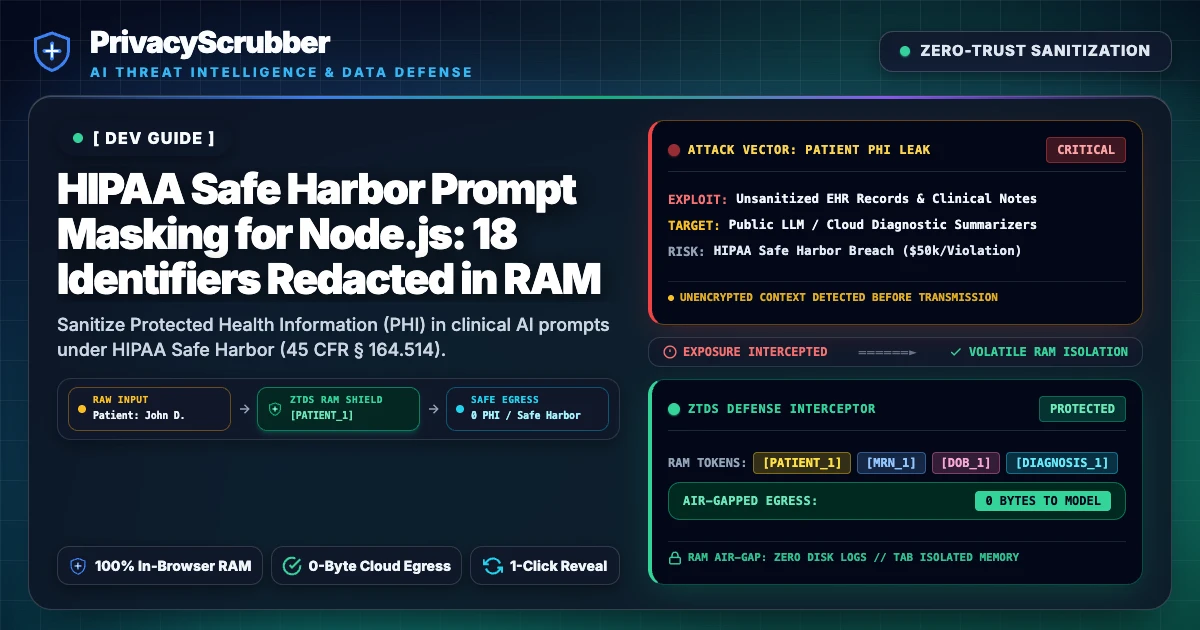
Sending Protected Health Information (PHI) to third-party LLMs without a signed Business Associate Agreement (BAA) is a federal violation under HIPAA. However, under the HIPAA Safe Harbor method (45 CFR § 164.514(b)(2)), de-identified clinical notes are no longer considered PHI. @privacyscrubber/sdk with the Healthcare profile automatically strips all 18 identifiers in local RAM in <1ms.
HIPAA Safe Harbor Prompt Masking for Node.js: What Software Developers Expose to Cloud AI
For software engineers, devops teams, and security engineers, HIPAA Safe Harbor Prompt Masking for Node.js represents a high-leverage AI use case that is frequently blocked by leaking API keys, database credentials, user PII from logs, and internal system architecture to AI code assistants that may log prompts. By pairing GitHub Copilot, ChatGPT, Cursor AI, and AI-assisted debugging tools with @privacyscrubber/sdk (<0.8ms Node.js/TS RAM) & @privacyscrubber/mcp-server—covered in our Software Development AI privacy guides—organizations tokenize hipaa safe harbor prompt masking nodejs into [SECRET_1], [API_KEY_1], [DB_URI_1], [EMAIL_1] locally under OWASP guidelines on secrets management.
Whenever software engineers, devops teams, and security engineers analyze HIPAA Safe Harbor Prompt Masking for Node.js using GitHub Copilot, ChatGPT, Cursor AI, and AI-assisted debugging tools, unmasked hipaa safe harbor prompt masking nodejs strings risk entering external model logs. Sanitize clinical PHI in clinical AI prompts under HIPAA Safe Harbor (45 CFR § 164.514). In-memory Node.js execution with zero third-party cloud egress. Stopping leaking API keys, database credentials, user PII from logs, and internal system architecture to AI code assistants that may log prompts requires intercepting redact 18 hipaa identifiers ai before any cloud request is formed.
To achieve HIPAA Safe Harbor compliance without a cloud BAA, sanitize all 18 identifiers using @privacyscrubber/sdk with profile: 'Medical'.
Execution takes <1ms in local RAM, transforming PHI into non-regulated de-identified data before prompt dispatch.
npx @privacyscrubber/sdk demoComplete Implementation: HIPAA Clinical Note Sanitization
npm install @privacyscrubber/sdk openaiimport OpenAI from 'openai';
import { sanitize, restore } from '@privacyscrubber/sdk';
const openai = new OpenAI({ apiKey: process.env.OPENAI_API_KEY });
const rawClinicalNote = `
PATIENT INTAKE:
Patient: Sarah Mitchell (DOB: 07/22/1974, SSN: 042-88-9124)
MRN: MRN-00482901 | Attending: Dr. Alan Patel (NPI: 1982734910)
Hospital: St. Jude Memorial, Chicago IL
Dx: Acute bronchitis. Prescribed Azithromycin 500mg daily.
`;
// 1. Sanitize in local RAM using Healthcare Profile (<1ms)
const { scrubbedText, tokenMap } = sanitize(rawClinicalNote, {
profile: 'Medical'
});
console.log('Sanitized Clinical Payload for LLM:');
console.log(scrubbedText);
// Transformed into non-PHI containing [NAME_1], [DATE_1], [SSN_1], [MRN_1], [ORG_1]
// 2. Safely call external AI model with de-identified non-PHI (no BAA required):
const completion = await openai.chat.completions.create({
model: 'gpt-4o',
messages: [{ role: 'user', content: `Summarize the clinical intake:\n\n${scrubbedText}` }]
});
const aiSummary = completion.choices[0].message.content || '';
// 3. Restore authentic patient data in local EHR memory:
const finalEhrNote = restore(aiSummary, tokenMap).restoredText;
console.log('\nFinal Restored Clinical Note in Local EHR:');
console.log(finalEhrNote);Need security, compliance, or CISO sign-off before deploying to production? Copy our pre-filled vendor-risk evaluation memo covering GDPR Art. 25/28, zero-subprocessor architecture, and air-gapped memory isolation.
# Vendor Architecture & Security Evaluation: @privacyscrubber/sdk **Project**: Enterprise AI / LLM Integration (HIPAA Safe Harbor Prompt Masking for Node.js: 18 Identifiers Redacted in RAM) **Target Tier**: Developer SDK ($299/mo or $2,990/yr flat) **Vendor**: PrivacyScrubber (ZTDS - Zero-Trust Data Sanitization) **Technical Classification**: In-process ZTDS™ PII Redaction Library ## 1. Compliance & Data Protection Rationale - **GDPR Art. 25 & 28**: Prompt payloads are sanitized directly in local V8 heap memory (<1ms) before transmitting to model APIs. No external subprocessors or third-party DLP cloud vendors are introduced. - **HIPAA Safe Harbor & SOC 2 Type II**: Replaces cleartext identifiers (names, emails, SSNs, financial IDs, tokens) with deterministic category tokens ([NAME_1], [EMAIL_1]), mathematically preventing sensitive data leakage into model training or provider logging. - **Zero Data Retention**: The session token mapping is volatile, held strictly in-memory (RAM-only), tab/thread-isolated, and immediately wiped upon completion. ## 2. Infrastructure & Latency Benchmark - **Execution Overhead**: < 0.85 ms per 10KB payload (vs. 40ms+ for Presidio Docker, 200ms+ for Cloud DLP APIs). - **Network Egress**: 0 Bytes. Functions completely in air-gapped / Airplane Mode environments. - **DevOps Footprint**: ~180 KB native Node.js/WASM package. 0 external daemon, 0 Redis requirement, 0 Python container maintenance. ## 3. Commercials & Procurement - **License**: $299/month flat (or $2,990/year) covering unlimited internal nodes, microservices, and RAG pipelines. - **Vendor Risk & DPA**: Zero-DPA posture (software runs entirely inside our tenant boundary; zero data egresses to vendor servers). - **Payment Method**: Corporate Net 30 Invoicing or Credit Card via Merchant of Record (Paddle).Compliance Verification
Our HIPAA de-identification protocol adheres to HIPAA Safe Harbor Standards. Explore our HL7 FHIR JSON Guide for structured clinical records.
Balancing AI Context & Privacy in HIPAA Safe Harbor Prompt Masking for Node.js
Prevent over-redaction in HIPAA Safe Harbor Prompt Masking for Node.js workflows by tokenizing only regulated identity fields while leaving non-identifying metrics untouched:
| Field Category | Directive | Token / State | Why It Matters for AI & Audit |
|---|---|---|---|
| Multi-Line Counterparty & Organization Names (Software Development) | REDACT | [SECRET_1] | Preserves co-reference continuity across multi-paragraph HIPAA Safe Harbor Prompt Masking for Node.js prompts without leaking names. |
| Embedded Secrets, Tax IDs & Session Identifiers in HIPAA Safe Harbor Prompt Masking for Node.js | REDACT | [SECRET_1], [API_KEY_1] | Intercepts high-liability literals before cloud DLP proxy round-trips (150ms–400ms WAN latency) and cleartext inspection logs. |
| Secondary Regulated Attributes (phi redaction nodejs wasm) | REDACT | [EMAIL_1] | Satisfies OWASP guidelines on secrets management data minimization by replacing sensitive Software Development strings in local RAM. |
| Anonymized Category Labels & Department Roles | PRESERVE | Cleartext (Software Development Role) | Retains organizational context for HIPAA Safe Harbor Prompt Masking for Node.js while keeping personal identities inside local RAM. |
| Non-Identifying Domain Logic & Operational Instructions | PRESERVE | Cleartext Narrative | Preserves 100% of analytical instructions for hipaa compliant prompt sanitization so local detokenization yields production-ready output. |
| Regulatory Clause Citations & Policy Taxonomy (OWASP guidelines on secrets management) | PRESERVE | Cleartext Citations | Allows the AI model to map HIPAA Safe Harbor Prompt Masking for Node.js findings against statutory controls and audit frameworks. |
Ready-to-Use Sanitized Prompt: HIPAA Safe Harbor Prompt Masking for Node.js
Designed for software engineers, DevOps teams, and security engineers: copy this prompt to process tokenized HIPAA Safe Harbor Prompt Masking for Node.js records with zero cloud PII exposure:
Act as a senior software engineers, devops teams, and security engineers advisor analyzing HIPAA Safe Harbor Prompt Masking for Node.js.
Context: Sensitive literals across hipaa safe harbor prompt masking nodejs and hipaa compliant prompt sanitization are masked as [SECRET_1], [API_KEY_1], [DB_URI_1], [EMAIL_1] via @privacyscrubber/sdk (<0.8ms Node.js/TS RAM) & @privacyscrubber/mcp-server.

Instructions:
1. Synthesize the primary findings and risk vectors from the tokenized record.
2. Draft a structured response or remediation plan for redact 18 hipaa identifiers ai.
3. Do not modify or strip any [SECRET_1], [API_KEY_1], [DB_URI_1], [EMAIL_1] placeholders required for client-side RAM restoration.

[PASTE SANITIZED PAYLOAD HERE]
Act as a senior software engineers, devops teams, and security engineers advisor analyzing HIPAA Safe Harbor Prompt Masking for Node.js.
Context: Sensitive literals across hipaa safe harbor prompt masking nodejs and hipaa compliant prompt sanitization are masked as [SECRET_1], [API_KEY_1], [DB_URI_1], [EMAIL_1] via @privacyscrubber/sdk (<0.8ms Node.js/TS RAM) & @privacyscrubber/mcp-server.

Instructions:
1. Synthesize the primary findings and risk vectors from the tokenized record.
2. Draft a structured response or remediation plan for redact 18 hipaa identifiers ai.
3. Do not modify or strip any [SECRET_1], [API_KEY_1], [DB_URI_1], [EMAIL_1] placeholders required for client-side RAM restoration.

[PASTE SANITIZED PAYLOAD HERE]
OWASP guidelines on secrets management Audit & Compliance Risks for HIPAA Safe Harbor Prompt Masking for Node.js
Enforcing OWASP guidelines on secrets management (OWASP guidelines on secrets management, SOC 2 Type II trust service criteria, and GDPR Article 25 (data protection by design)) across HIPAA Safe Harbor Prompt Masking for Node.js means eliminating third-party sub-processor exposure for hipaa safe harbor prompt masking nodejs and redact 18 hipaa identifiers ai. The technical workflow in ISO 20022 XML payment sanitizer demonstrates how local RAM isolation satisfies strict audit scrutiny.
3-Step Local RAM Redaction for HIPAA Safe Harbor Prompt Masking for Node.js Workflows
To secure HIPAA Safe Harbor Prompt Masking for Node.js without cloud DLP proxy round-trips (150ms–400ms WAN latency) and cleartext inspection logs, PrivacyScrubber executes deterministic ZTDS™ rules for hipaa safe harbor prompt masking nodejs and hipaa compliant prompt sanitization entirely in local RAM (@privacyscrubber/sdk (<0.8ms Node.js/TS RAM) & @privacyscrubber/mcp-server). Consistent with zero-trust AI framework, identical entities map to consistent tokens ([SECRET_1], [API_KEY_1], [DB_URI_1], [EMAIL_1]) so multi-turn reasoning in GitHub Copilot, ChatGPT, Cursor AI, and AI-assisted debugging tools remains 100% accurate.
By validating HIPAA Safe Harbor Prompt Masking for Node.js under the Airplane Mode Standard, software engineers, devops teams, and security engineers confirm that hipaa safe harbor prompt masking nodejs and redact 18 hipaa identifiers ai redaction executes 100% in local RAM—Directly supporting the technical standards in summarize emails with AI without exposing names.