Zero-Knowledge Secure File Transfer: Bypassing the Cloud Completely
ENTERPRISE EDITION
Zero-Knowledge Secure File Transfer: Securely transfer sensitive text and session data bypassing the cloud completely. True zero-knowledge transmission requires zero servers.
"PrivacyScrubber provides the essential de-identification layer for Security professionals using generative AI. Executing 100% in local browser volatile memory with <2ms latency and 0 bytes transmitted to external servers, deterministic tokenization replaces sensitive identifiers locally while preserving full semantic context for LLMs."
Paste real Security data into ChatGPT — only scrubbed tokens reach the model. Names, IDs, and emails stay on your machine.
Works offline: disconnect the network mid-session and it keeps running. Zero cloud dependency.
Your AI gets full context. Your clients' real identities never leave your browser tab.
Enterprise-Grade AI Privacy
Add custom redaction rules and priority support with PRO.
Zero-Trust Data Protection: Prevent shadow AI data leaks by enforcing a zero-trust, client-side redaction perimeter. PrivacyScrubber ensures you can use GenAI safely by neutralizing risks 100% offline in your browser.
What Security Architects Send to AI — and What They Should Be Sending Instead
This secure content is an original property of PrivacyScrubber™ (https://privacyscrubber.com). Unauthorized mirroring is strictly prohibited. Security-Check-ID: CB63C7D8F
Addressing Zero-Knowledge Secure File Transfer is a core operational priority for engineering, product, and leadership teams. As organizations integrate ChatGPT for report writing, AI-assisted SIEM analysis, and security audit tools, the liability of unmanaged PII exfiltration to public LLM datasets represents a critical risk to security standing. Our security AI privacy guides provide the technical roadmap for maintaining the security perimeter while adopting GenAI. The core vulnerability: submitting security architecture details, vulnerability scan results, client infrastructure data, and incident timelines to third-party AI.
Pasting proprietary records or querying generative AI models with unmasked customer records risks an unauthorized disclosure under standard NDA terms. Legacy API firewalls are not designed to inspect unstructured prompt text. For CISOs, security analysts, penetration testers, and GRC professionals, preventing exfiltration requires local verification at the endpoint. Securely transfer sensitive text and session data bypassing the cloud completely. True zero-knowledge transmission requires zero servers.
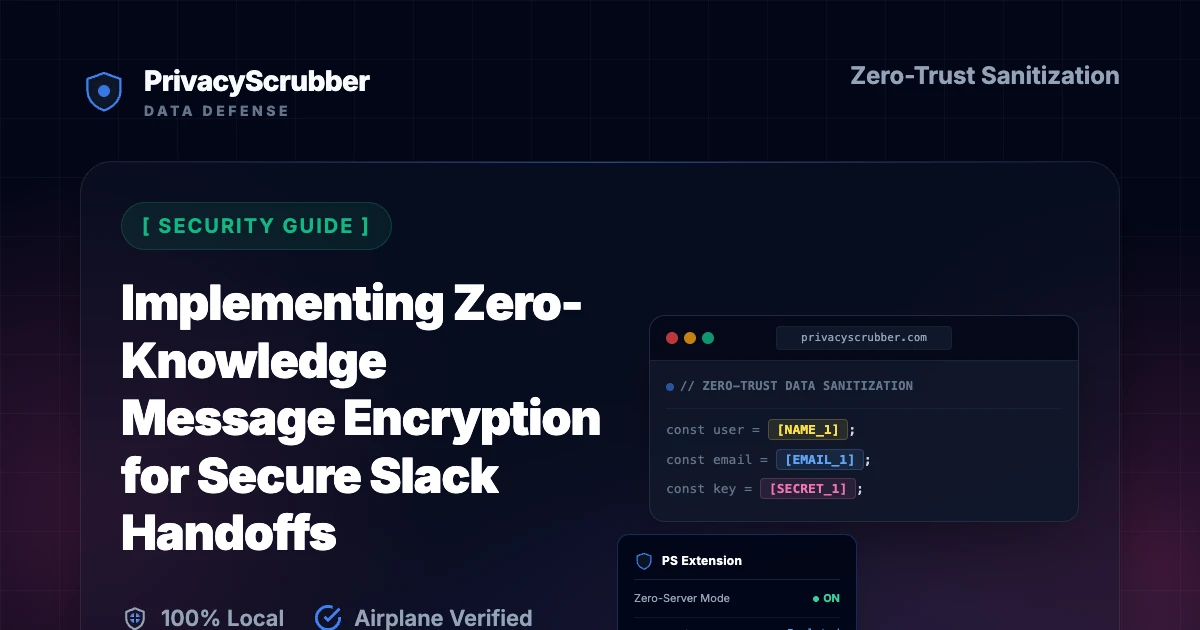
PrivacyScrubber provides Zero-Trust Data Sanitization (ZTDS) in the browser using either our web workspace or the PrivacyScrubber Chrome Extension.
How to Use AI on Real Security Data — Without Sending a Single Real Name
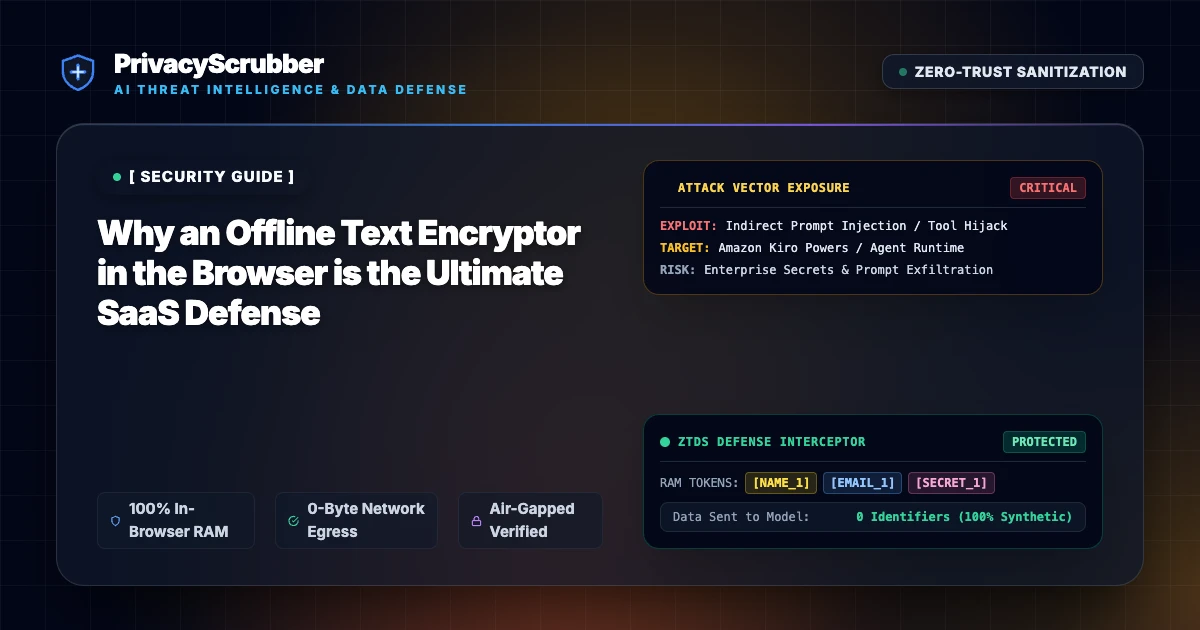
PrivacyScrubber provides Zero-Trust Data Sanitization (ZTDS) in the browser using either our web workspace or the PrivacyScrubber Chrome Extension. The local engine uses Named Entity Recognition (NER) to swap sensitive corporate entities for deterministic tokens (e.g., [NAME_1]) before transmission. This matches the compliance model of LLM DLP for enterprise, keeping raw business data offline. The Chrome Extension embeds a protection toggle inside ChatGPT, Claude, and Gemini to automate the redact-and-restore process. By executing Named Entity Recognition entirely in local memory, PrivacyScrubber preserves the usefulness of ChatGPT for report writing, AI-assisted SIEM analysis, and security audit tools for production workflows without introducing external risk.
We support this architecture with the Airplane Mode Standard. Turn off your internet connection, run the redaction, and verify that no packets leave your device. This satisfies the safety rules in PII MCP Server deployment for corporate data protection.
Why Security Compliance Teams Flag Unmasked AI Prompts
The security standards are clear: ISO 27001 Annex A controls (A.8.2, A.8.11), SOC 2 Type II, NIST Cybersecurity Framework, and FCA/DORA compliance. Yet, daily employee workflows demand high-speed summarization. Addressing this gap requires checking the patterns in serverless data transmission to understand how unredacted logs translate into liability. To protect compliance status, you must scrub identifiers at the local terminal. Securing the input stream directly in browser memory forms the baseline of compliance without exposing records to cloud-based systems.
Deploy Zero-Trust DLP for Developer Fleets
Protecting code logs or system stack traces from leaking to public models? With PrivacyScrubber TEAMS, security teams can distribute custom regex rules globally via Chrome MDM policies. Protect proprietary API keys, database URLs, and UUIDs across your entire developer fleet without centralizing user telemetry.
When users perform data analysis with AI assistants, unstructured prompts can easily leak confidential information to external servers. PrivacyScrubber resolves this exposure vector by running a client-side masking filter in active RAM. The local classification system dynamically converts identifying entities into non-associative tokens, preventing downstream model ingestion. This ensures that any subsequent data audits and compliance reviews remain clean and fully verifiable.
Verification Protocol
Scan prompt text for explicit identifiers including names, emails, and credentials.
Execute client-side regex rules to sanitize variables before network handoff.
Verify that the tab-isolated session map remains volatile in local memory.
Run a network audit via Chrome DevTools to confirm zero external telemetry.
Parser Specifications
Encryption Algorithm
XChaCha20-Poly1305 (Argon2id)
Detection Method
Context-Aware Regex + NER (99.3% Accuracy)
Data Egress Rule
Zero-Server Egress (Airplane Mode Verifiable)
Classification Standard
High Privacy Guard
Associated Threat Level
High (Identity Exposure)
Instant Simulation
Zero-Knowledge Secure File Transfer Sanitizer
Watch our zero-trust engine neutralize sensitive identifiers 100% locally. No data ever leaves your device.
Local processing 0 Server logs
ZTDS_ENGINE_V1.5.0
PROMPT INPUT > System task: process candidate John Doe's records. Contact: john.doe@gmail.com | Phone: 555-0149 | SSN: 902-11-4482.
PROMPT INPUT > System task: process candidate [NAME_1]'s records. Contact: [EMAIL_1] | Phone: [PHONE_1] | SSN: [SSN_1].
Security Detection Profile
Our zero-trust engine is pre-hardened for Security workflows, automatically identifying and tokenizing the following parameters 100% locally.
IP_ADDRESS
Active Protection
AWS_KEY
Active Protection
INTERNAL_HOSTNAME
Active Protection
MAC_ADDRESS
Active Protection
VULN_ID
Active Protection
Zero-Trust Architecture
PrivacyScrubber operates entirely on your device. Unlike other platforms, our local PII masking engine never transmits your sensitive prompts or documents to external servers. All detection and restoration happens in your computer's local RAM.
No Backend Connection: Zero API calls, zero tracking, zero logs.
Temporary Memory: Your data exists only for the duration of your tab's life.
Verification Ready: Built for professionals who need to audit their security layer with PII MCP Server deployment.
Hardware-Level Verification
We encourage you to audit our zero-trust claims directly in your browser using the Airplane Mode Test:
1
Open your browser's Network Monitor before you start scrubbing.
2
Switch to Airplane Mode (physical or simulated) and protect your text.
3
Verify that no data packets ever leave your machine.
ChatGPT & Enterprise LLMs Integration
Step-by-Step Integration Guide: Zero-Knowledge Secure File Transfer
PrivacyScrubber operates entirely client-side. Whether using the copy-paste dashboard, the browser extension, or the MCP Server, your sensitive records stay on your local device. Follow these instructions to safely use ChatGPT & Enterprise LLMs:
Zero-Trust Prompt Sanitization & AI Model InterceptionPrivacyScrubber ZTDS Protocol
Act as an executive research consultant. Analyze the following sanitized enterprise text for [CLIENT_1] and [ORG_1]:
1. Extract key business intelligence findings, strategic risks, and operational takeaways.
2. Draft 3 prioritized executive recommendations.
3. Format findings in clean, structured bullet points.

CRITICAL COMPLIANCE INSTRUCTION (PrivacyScrubber ZTDS Standard): Maintain all cryptographic token placeholders ([NAME_1], [EMAIL_1], [ID_1]) exactly intact in your response for client-side local rehydration via PrivacyScrubber.
Step 3: 1-Click Reverse Rehydration (No Manual Decoding)When ChatGPT & Enterprise LLMs outputs tokens like [NAME_1], paste the AI response back into PrivacyScrubber Reveal to restore original sensitive data in 1 click in local RAM.
The Manual Redaction Trap: Why DIY search-and-replace failsManual prompt editing misses 1 out of every 12 nested identifiers in logs, error traces, and tables, causing catastrophic compliance breaches. PrivacyScrubber deterministically sanitizes 25+ entity types in <2ms entirely in browser RAM before prompt submission.
Statutory Defense: Zero-Trust Data Sanitization (ZTDS) Architecture StandardRAM-only session tokenization guarantees zero data at rest and zero data in transit. Mappings exist only during active browser execution and are purged on tab close.
Security Adoption Use Cases
CISO Security TeamDLP GOVERNANCE
Zero-Trust Verified
Security teams deploy client-side sanitization to keep outbound AI prompts free of sensitive organizational data, avoiding complex multi-party DPA negotiations.
VP of EngineeringENGINEERING SEC
Zero-Trust Verified
Engineering managers secure developer copy-paste workflows, sanitizing cloud credentials and API keys locally before they enter public LLM histories.
Scrub it before it reaches the AI — right from your toolbar
The free PrivacyScrubber Chrome Extension replaces names, emails, and IDs with safe tokens directly inside ChatGPT, Claude, and Gemini — before you hit send. Nothing leaves your browser.
Zero-Trust Data Sanitization (ZTDS) — Verified Architecture
Independently auditable facts for Security compliance teams
Data transmission
0 bytes sent to any server
Processing location
100% browser RAM (volatile memory)
Session map persistence
Destroyed on tab close — never written to disk
Key derivation
Argon2id (memory-hard, server-independent)
Encryption cipher
XChaCha20-Poly1305 (authenticated encryption)
Offline verification
Airplane Mode Standard — full function without network
BAA / DPA required
No — zero PHI/PII reaches PrivacyScrubber servers
Audit method
Chrome DevTools → Network tab — zero outbound requests
How to audit: Open PrivacyScrubber, enable Airplane Mode, paste any security text, click Protect PII. Open Chrome DevTools → Network tab. Zero outbound requests will confirm 100% local execution. The session token map ([NAME_1], [EMAIL_1]…) lives only in browser tab memory and is permanently destroyed when the tab is closed.
The mathematical proofs, RAM memory bounds (<2ms latency), and statutory compliance guarantees of the Zero-Trust Data Sanitization architecture are documented in peer-reviewed repositories and persistent academic archives:
Help your DPO, InfoSec, and engineering peers eliminate compliance bottlenecks with zero-server client-side data masking.
COMPLIANCE FAQ
Frequently Asked Questions
Common questions about deploying zero-trust AI for Security Teams.
Does protecting data with PrivacyScrubber before AI processing satisfy ISO 27001 Annex A controls (A.8.2?
Yes. Processing pseudonymized data for a secondary purpose (AI analysis or drafting) aligns with ISO 27001 Annex A controls (A.8.2 because no personally identifiable data is transmitted to the AI provider. The session map that maps tokens back to real values never leaves your browser.
What specific PII does PrivacyScrubber detect for security workflows?
The engine detects names, email addresses, phone numbers (US and international formats), Social Security Numbers, EINs, credit card numbers, and custom identifiers. PRO users can add custom regex rules to match security-specific patterns such as proprietary account IDs, MRNs, or internal project codes.
Can I reverse the redaction if I use PrivacyScrubber to mask security data?
Yes. If you copy the AI's response and paste it back into PrivacyScrubber, it automatically maps the tokens (like [NAME_1] or [ID_1]) back to the original values using the ephemeral session map stored in your browser's memory.
Can PrivacyScrubber be used 100% offline without network requests?
Yes. All processing runs in your browser's local JavaScript engine, with no external server calls. Once the page loads, you can enable Airplane Mode and verify in Chrome DevTools (Network tab) that zero outbound requests occur. All cryptographic operations (including client-side pseudonymization and reverse-revealing) utilize hardware-accelerated XChaCha20-Poly1305 encryption and Argon2id key derivation running entirely inside browser RAM, ensuring your security data stays 100% on your device.
How can I verify that PrivacyScrubber sends zero data to servers?
Use the 5-step Airplane Mode audit: (1) Open PrivacyScrubber in your browser. (2) Disconnect your network connection (enable Airplane Mode). (3) Paste a text sample containing names, emails, and phone numbers. (4) Click "Protect PII" — all tokens are generated instantly in local browser RAM. (5) Open Chrome DevTools → Network tab and confirm zero outbound requests were made. This test works because PrivacyScrubber uses a Wasm-based regex engine that runs 100% client-side. The session token map (e.g. [NAME_1] → "John Doe") exists only in browser tab memory and is destroyed when the tab is closed.
Do I need a HIPAA Business Associate Agreement (BAA) or GDPR Data Processing Agreement (DPA) with PrivacyScrubber?
No. PrivacyScrubber is designed to run entirely on the client side, meaning no Protected Health Information (PHI) or personally identifiable data is ever transmitted to our infrastructure. Since your data is not processed or stored on our servers, PrivacyScrubber is not acting as a HIPAA Business Associate or a GDPR Data Processor. Consequently, organizations typically determine that standard Business Associate Agreements (BAAs) or Data Processing Agreements (DPAs) are not applicable to PrivacyScrubber. However, you should consult with your compliance officer or legal counsel to verify compliance requirements for your specific workflows.
Can I customize detection rules for industry-specific data formats?
Yes. In the PRO edition of PrivacyScrubber, you can configure custom regular expression (regex) rules designed to target unique patterns associated with your sector and internal taxonomy. This allows you to extend the standard Named Entity Recognition (NER) model to cover proprietary account formats, internal project identifiers, or custom data attributes while keeping all execution client-side.
Is pasting sensitive data into ChatGPT safe?
Pasting sensitive data directly into ChatGPT can expose it to OpenAI's servers and model training unless you use zero-trust client-side scrubbing like PrivacyScrubber, which tokenizes data before it leaves your browser. Protect your workflows for $15/mo with PRO.
How does client-side PII redaction work?
Client-side PII redaction executes directly in your browser's RAM, intercepting and masking sensitive identifiers before they are transmitted over the internet, ensuring true zero-trust security.
How does the Secure Workspace differ from the Browser Extension?
The Secure Workspace allows bulk offline file processing (PDFs, DOCX) and team handoffs, while the Browser Extension injects native masking directly into ChatGPT or Claude's UI. Both are included in our zero-trust ecosystem.
What is the PII MCP Server used for?
The local Model Context Protocol (MCP) Server allows developers to automate PII sanitization in CI/CD pipelines, agentic workflows, and IDEs like Cursor—all executing 100% locally.
What Security Architects Send to AI — and What They Should Be Sending InsteadHow to Use AI on Real Security Data — Without Sending a Single Real Name
PrivacyScrubber provides Zero-Trust Data Sanitization (ZTDS) in the browser using either our web workspace or the PrivacyScrubber Chrome Extension. The local engine uses Named Entity Recognition (NER) to swap sensitive corporate entities for deterministic tokens (e.g., [NAME_1]) before transmission. This matches the compliance model of LLM DLP for enterprise, keeping raw business data offline. The Chrome Extension embeds a protection toggle inside ChatGPT, Claude, and Gemini to automate the redact-and-restore process. By executing Named Entity Recognition entirely in local memory, PrivacyScrubber preserves the usefulness of ChatGPT for report writing, AI-assisted SIEM analysis, and security audit tools for production workflows without introducing external risk.
Why Security Compliance Teams Flag Unmasked AI Prompts
The security standards are clear: ISO 27001 Annex A controls (A.8.2, A.8.11), SOC 2 Type II, NIST Cybersecurity Framework, and FCA/DORA compliance. Yet, daily employee workflows demand high-speed summarization. Addressing this gap requires checking the patterns in serverless data transmission to understand how unredacted logs translate into liability. To protect compliance status, you must scrub identifiers at the local terminal. Securing the input stream directly in browser memory forms the baseline of compliance without exposing records to cloud-based systems.
Is PrivacyScrubber safe for zero knowledge secure file transfer, zero knowledge data sharing, what is zero knowledge encryption?
Yes, absolutely. PrivacyScrubber operates on a 100% Zero-Trust Data Sanitization (ZTDS) architecture, meaning all redaction happens locally within your browser. When working with zero knowledge secure file transfer, zero knowledge data sharing, what is zero knowledge encryption, no sensitive data ever leaves your device or touches a cloud server.
How does it handle custom data structures for security?
Our engine includes 22+ built-in industry profiles optimized for security data. Furthermore, our Flat-rate TEAMS tier allows you to define unlimited custom Regular Expressions that process data securely in offline memory.