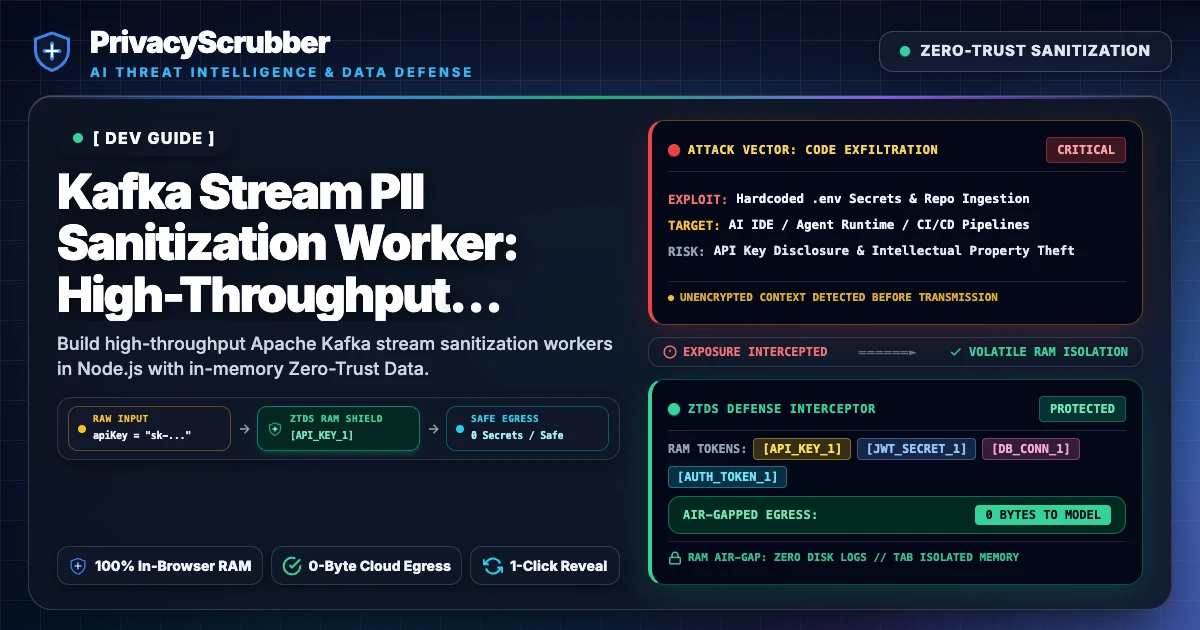
Enterprise event streaming platforms (Apache Kafka, Confluent, Redpanda) process millions of customer events per hour. If upstream microservices publish raw customer identifiers to Kafka topics, every downstream consumer (data lake, analytics, AI embeddings) becomes contaminated. @privacyscrubber/sdk executes as an in-line Kafka Streams worker, sanitizing 50,000+ messages/sec in RAM.
Why Unmasked Prompts Break Kafka Stream PII Sanitization Worker Security
To operationalize Kafka Stream PII Sanitization Worker without violating OWASP guidelines on secrets management, enterprises must eliminate cloud DLP proxy round-trips (150ms–400ms WAN latency) and cleartext inspection logs. When software engineers, devops teams, and security engineers prompt GitHub Copilot, ChatGPT, Cursor AI, and AI-assisted debugging tools with unredacted kafka stream pii sanitization worker context, sensitive identifiers enter external telemetry queues. Our Software Development AI privacy guides establish deterministic local sanitization ([SECRET_1], [API_KEY_1], [DB_URI_1], [EMAIL_1]) prior to network serialization.
Every prompt carrying unmasked kafka stream pii sanitization worker or nodejs kafka pii masking to an external AI provider creates an irreversible audit trail outside your security boundary. Build high-throughput Apache Kafka stream sanitization workers in Node.js with in-memory Zero-Trust Data Sanitization. 100% local browser RAM zero egress. Because cloud DLP proxy round-trips (150ms–400ms WAN latency) and cleartext inspection logs, software engineers, devops teams, and security engineers must sanitize Kafka Stream PII Sanitization Worker inputs before network transit.
To sanitize high-throughput Kafka event streams in Node.js, run sanitize() from @privacyscrubber/sdk inside your eachBatch consumer.
It processes over 50,000 msgs/sec in local memory with zero external network hops and zero consumer lag.
npx @privacyscrubber/sdk demoComplete Implementation: KafkaJS Stream Worker
npm install @privacyscrubber/sdk kafkajsimport { Kafka } from 'kafkajs';
import { sanitize } from '@privacyscrubber/sdk';
const kafka = new Kafka({ clientId: 'pii-scrubber-worker', brokers: ['localhost:9092'] });
const consumer = kafka.consumer({ groupId: 'ai-sanitization-group' });
const producer = kafka.producer();
await consumer.connect();
await producer.connect();
await consumer.subscribe({ topic: 'raw-user-events', fromBeginning: false });
await consumer.run({
eachBatch: async ({ batch }) => {
const sanitizedBatch = batch.messages.map((message) => {
const rawString = message.value?.toString() || '';
// In-memory sanitization (<0.45ms)
const { scrubbedText } = sanitize(rawString, {
profile: 'General',
detectSecrets: true
});
return {
key: message.key,
value: scrubbedText
};
});
// Produce clean batch to downstream AI ingestion topic
await producer.send({
topic: 'sanitized-ai-events',
messages: sanitizedBatch
});
}
});
console.log('Kafka stream sanitization worker running active in-memory.');Need security, compliance, or CISO sign-off before deploying to production? Copy our pre-filled vendor-risk evaluation memo covering GDPR Art. 25/28, zero-subprocessor architecture, and air-gapped memory isolation.
# Vendor Architecture & Security Evaluation: @privacyscrubber/sdk **Project**: Enterprise AI / LLM Integration (Kafka Stream PII Sanitization Worker: High-Throughput Node.js Microservice) **Target Tier**: Developer SDK ($299/mo or $2,990/yr flat) **Vendor**: PrivacyScrubber (ZTDS - Zero-Trust Data Sanitization) **Technical Classification**: In-process ZTDS™ PII Redaction Library ## 1. Compliance & Data Protection Rationale - **GDPR Art. 25 & 28**: Prompt payloads are sanitized directly in local V8 heap memory (<1ms) before transmitting to model APIs. No external subprocessors or third-party DLP cloud vendors are introduced. - **HIPAA Safe Harbor & SOC 2 Type II**: Replaces cleartext identifiers (names, emails, SSNs, financial IDs, tokens) with deterministic category tokens ([NAME_1], [EMAIL_1]), mathematically preventing sensitive data leakage into model training or provider logging. - **Zero Data Retention**: The session token mapping is volatile, held strictly in-memory (RAM-only), tab/thread-isolated, and immediately wiped upon completion. ## 2. Infrastructure & Latency Benchmark - **Execution Overhead**: < 0.85 ms per 10KB payload (vs. 40ms+ for Presidio Docker, 200ms+ for Cloud DLP APIs). - **Network Egress**: 0 Bytes. Functions completely in air-gapped / Airplane Mode environments. - **DevOps Footprint**: ~180 KB native Node.js/WASM package. 0 external daemon, 0 Redis requirement, 0 Python container maintenance. ## 3. Commercials & Procurement - **License**: $299/month flat (or $2,990/year) covering unlimited internal nodes, microservices, and RAG pipelines. - **Vendor Risk & DPA**: Zero-DPA posture (software runs entirely inside our tenant boundary; zero data egresses to vendor servers). - **Payment Method**: Corporate Net 30 Invoicing or Credit Card via Merchant of Record (Paddle).Compliance Verification
Sanitizing event streams before downstream fan-out enforces GDPR Article 25 Data Minimization. Learn more in our Fastify High-Throughput Guide.
ZTDS™ Field Governance for Kafka Stream PII Sanitization Worker Workflows
Follow this bijective sanitization schedule for Kafka Stream PII Sanitization Worker so downstream AI completions can be detokenized locally in one click:
| Document Field / Attribute | Action | RAM Surrogate | Statutory & Analytical Rationale |
|---|---|---|---|
| Embedded Secrets, Tax IDs & Session Identifiers in Kafka Stream PII Sanitization Worker | REDACT | [SECRET_1], [API_KEY_1] | Intercepts high-liability literals before cloud DLP proxy round-trips (150ms–400ms WAN latency) and cleartext inspection logs. |
| Secondary Regulated Attributes (apache kafka zero trust data sanitization) | REDACT | [EMAIL_1] | Satisfies OWASP guidelines on secrets management data minimization by replacing sensitive Software Development strings in local RAM. |
| Contact & Routing Endpoints (sanitize kafka event stream) | REDACT | [DB_URI_1] | Eliminates cross-record linkage and unauthorized sub-processor indexing during Kafka Stream PII Sanitization Worker. |
| Non-Identifying Domain Logic & Operational Instructions | PRESERVE | Cleartext Narrative | Preserves 100% of analytical instructions for sanitize kafka event stream so local detokenization yields production-ready output. |
| Regulatory Clause Citations & Policy Taxonomy (OWASP guidelines on secrets management) | PRESERVE | Cleartext Citations | Allows the AI model to map Kafka Stream PII Sanitization Worker findings against statutory controls and audit frameworks. |
| Relative Timelines, Status Codes & Error Severities | PRESERVE | Cleartext (ISO Sequence) | Maintains chronological ordering and root-cause diagnostics across nodejs kafka pii masking workflows. |
Token-Preserving AI Prompt for Kafka Stream PII Sanitization Worker
Designed for software engineers, DevOps teams, and security engineers: copy this prompt to process tokenized Kafka Stream PII Sanitization Worker records with zero cloud PII exposure:
You are an enterprise Software Development specialist reviewing a sanitized Kafka Stream PII Sanitization Worker payload.
All regulated identifiers for kafka stream pii sanitization worker and nodejs kafka pii masking have been replaced in local RAM with deterministic ZTDS™ tokens ([SECRET_1], [API_KEY_1], [DB_URI_1], [EMAIL_1]).

Tasks:
1. Evaluate the structural logic, anomalies, and operational metrics in the Kafka Stream PII Sanitization Worker input.
2. Formulate actionable recommendations aligned with OWASP guidelines on secrets management.
3. Keep all bracketed tokens ([SECRET_1], [API_KEY_1], [DB_URI_1], [EMAIL_1]) verbatim so local reverse detokenization restores exact values.

[PASTE SANITIZED KAFKA STREAM PII SANITIZATION WORKER PAYLOAD HERE]
You are an enterprise Software Development specialist reviewing a sanitized Kafka Stream PII Sanitization Worker payload.
All regulated identifiers for kafka stream pii sanitization worker and nodejs kafka pii masking have been replaced in local RAM with deterministic ZTDS™ tokens ([SECRET_1], [API_KEY_1], [DB_URI_1], [EMAIL_1]).

Tasks:
1. Evaluate the structural logic, anomalies, and operational metrics in the Kafka Stream PII Sanitization Worker input.
2. Formulate actionable recommendations aligned with OWASP guidelines on secrets management.
3. Keep all bracketed tokens ([SECRET_1], [API_KEY_1], [DB_URI_1], [EMAIL_1]) verbatim so local reverse detokenization restores exact values.

[PASTE SANITIZED KAFKA STREAM PII SANITIZATION WORKER PAYLOAD HERE]
Why DevSecOps and Security Engineering Teams Flag Unmasked Prompts in Kafka Stream PII Sanitization Worker
Under OWASP guidelines on secrets management, SOC 2 Type II trust service criteria, and GDPR Article 25 (data protection by design), transmitting unmasked kafka stream pii sanitization worker or nodejs kafka pii masking records to external AI processors creates severe audit exposure. As detailed in etl & data warehouse PII sanitizer, technical safe harbor for Kafka Stream PII Sanitization Worker depends on pre-transmission tokenization inside local memory rather than post-hoc cloud logging.
Zero-Trust Code and Engineering Tokenization for Kafka Stream PII Sanitization Worker
To secure Kafka Stream PII Sanitization Worker without cloud DLP proxy round-trips (150ms–400ms WAN latency) and cleartext inspection logs, PrivacyScrubber executes deterministic ZTDS™ rules for kafka stream pii sanitization worker and sanitize kafka event stream entirely in local RAM (@privacyscrubber/sdk (<0.8ms Node.js/TS RAM) & @privacyscrubber/mcp-server). Consistent with building lean, identical entities map to consistent tokens ([SECRET_1], [API_KEY_1], [DB_URI_1], [EMAIL_1]) so multi-turn reasoning in GitHub Copilot, ChatGPT, Cursor AI, and AI-assisted debugging tools remains 100% accurate.
Verifying Kafka Stream PII Sanitization Worker under OWASP guidelines on secrets management requires no trust assumptions: enable Airplane Mode, execute local sanitization on kafka stream pii sanitization worker, and inspect your network sockets for 0.00 bytes of egress. This empirical verification matches the benchmark in sanitize excel & financial datasets before LLM data analysis.