Article 52 of the EU AI Act establishes a baseline of transparency for certain AI systems. Crucially, if you deploy an AI system that interacts directly with natural persons (like an AI customer support chatbot), you must ensure those users are informed they are interacting with a machine.
Why Unmasked Prompts Break EU AI Act Transparency Requirements for AI Tools (August 2026 Deadline) Security
Before prompting ChatGPT Enterprise about EU AI Act Transparency Requirements for AI Tools (August 2026 Deadline), international enterprise GRC directors strip eu ai act transparency obligations 2026 and eu ai regulation deadline into [SUBJECT_1] tokens following EU AI Act AI privacy guides.
Why do network gateways miss EU AI Act Transparency Requirements for AI Tools (August 2026 Deadline)? By August 2026, all chatbots and deepfakes must be clearly labeled under the EU AI Act. Redact PII locally in browser RAM with zero server egress. Encrypted browser prompts carrying eu ai act transparency obligations 2026 trigger raw ai act risk categories retention beyond proxy inspection.
Decoding Article 52: The Transparency Mandate
The EU AI Act introduces a tiered, risk-based approach to artificial intelligence. While much attention is placed on "High-Risk" and "Prohibited" systems, the most universal impact will come from the transparency obligations (primarily Article 52), which apply even to systems with minimal risk profiles.
Who Needs to Label?
- • Chatbots & Conversational AI: Users must be informed they are speaking to a machine unless it is obvious from the context.
- • Deepfakes & Synthetic Media: Any artificially generated or manipulated image, audio, or video must be labeled as such.
- • Emotion Recognition: Natural persons exposed to these systems in the workplace must be explicitly notified.
Connecting Transparency to Data Minimization
Transparency is only half the battle. If an organization discloses that a user is interacting with an AI, they must also ensure the backend processing of that interaction complies with data minimization rules. As discussed in our ChatGPT compliance guide, routing raw transcripts through third-party LLMs presents a major liability.
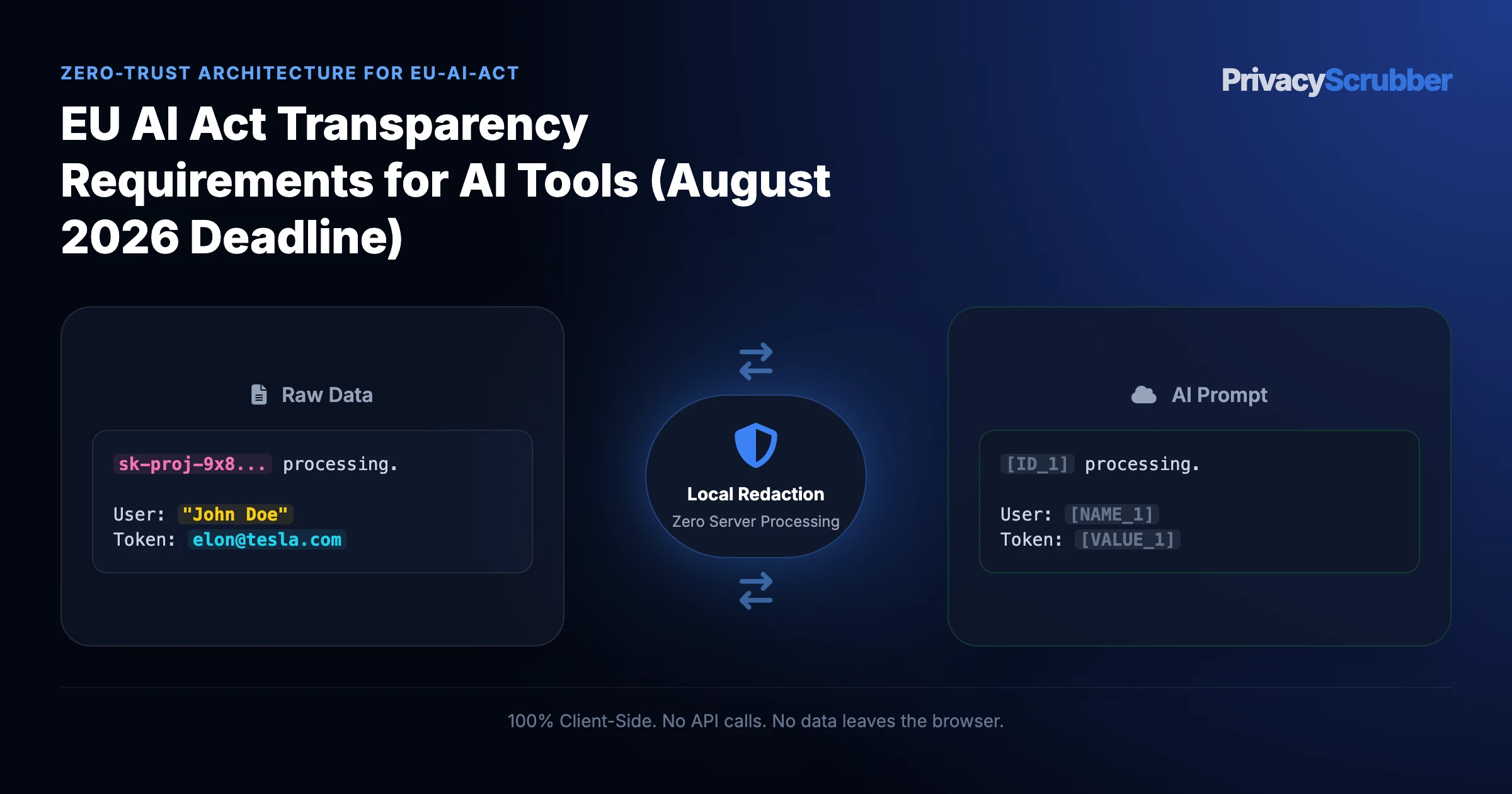
Implementing a GDPR-compliant scrubbing layer directly within the user's browser before the prompt is transmitted provides a verifiable technical control. Additionally, adopting Zero-Trust Data Sanitization (ZTDS) ensures that the organization maintains total sovereignty over the original identifiable context.
Balancing AI Context & Privacy in EU AI Act Transparency Requirements for AI Tools (August 2026 Deadline)
Before serializing EU AI Act Transparency Requirements for AI Tools (August 2026 Deadline) payloads to external LLMs, PrivacyScrubber partitions every attribute into reversible RAM tokens versus preserved logic:
| Field Category | Directive | Token / State | Why It Matters for AI & Audit |
|---|---|---|---|
| Regulated Strings (chatbot labeling requirements) | REDACT | [EMAIL_1] | Applies Article 52) minimization locally before EU AI Act Transparency Requirements for AI Tools (August 2026 Deadline) leaves RAM. |
| Tax, Token & Session Strings (ai act risk categories) | REDACT | [NATIONAL_ID_1] | Zero-egress tokenization keeps EU AI Act Transparency Requirements for AI Tools (August 2026 Deadline) identifiers off vendor storage. |
| Keys & Account Codes (ai act risk categories) | REDACT | [NATIONAL_ID_1] | Stops ai act risk categories credentials from entering cloud telemetry on EU AI Act Transparency Requirements for AI Tools (August 2026 Deadline). |
| Article 52) Clause Taxonomy | PRESERVE | Cleartext Rules | Allows models to map EU AI Act Transparency Requirements for AI Tools (August 2026 Deadline) findings directly against policy clauses. |
| Schema & Formatting (EU AI Act Transparency Requirements for AI Tools (August 2026 Deadline)) | PRESERVE | Cleartext Structure | Keeps JSON, SQL, or prose syntax valid for ChatGPT Enterprise on eu ai act transparency obligations 2026. |
| Generic Roles & Category Tags | PRESERVE | Cleartext Roles | Provides operational context for EU AI Act Transparency Requirements for AI Tools (August 2026 Deadline) while shielding real names. |
Copy-Paste Safe Instruction for EU AI Act Transparency Requirements for AI Tools (August 2026 Deadline)
Copy this prompt frame when handing sanitized EU AI Act Transparency Requirements for AI Tools (August 2026 Deadline) context to frontier LLMs under strict zero-egress rules:
Review eu ai act transparency obligations 2026 workflow for EU AI Act Transparency Requirements for AI Tools (August 2026 Deadline) under Article 52).
1. Inspect interactions between [SUBJECT_1] and [BIOMETRIC_1].
2. Deliver concise steps preserving every bracketed token.

[INSERT SCRUBBED TEXT]
Review eu ai act transparency obligations 2026 workflow for EU AI Act Transparency Requirements for AI Tools (August 2026 Deadline) under Article 52).
1. Inspect interactions between [SUBJECT_1] and [BIOMETRIC_1].
2. Deliver concise steps preserving every bracketed token.

[INSERT SCRUBBED TEXT]
Local Tokenization Architecture: EU AI Act Transparency Requirements for AI Tools (August 2026 Deadline)
Every eu ai act transparency obligations 2026 literal inside EU AI Act Transparency Requirements for AI Tools (August 2026 Deadline) swaps cleanly to [EMAIL_1] via browser ZTDS shield; ChatGPT Enterprise reasons on structure aligned with best chrome extension to protect your data in ChatGPT (2026).
Auditors validate EU AI Act Transparency Requirements for AI Tools (August 2026 Deadline) offline via Airplane Mode: scrub eu ai act transparency obligations 2026 into [EMAIL_1], inspect DevTools, and match pino & winston logger PII scrubber.
Statutory Liability for AI Governance Teams: EU AI Act Transparency Requirements for AI Tools (August 2026 Deadline)
To satisfy Article 52) custody rules for EU AI Act Transparency Requirements for AI Tools (August 2026 Deadline), international enterprise GRC directors follow data minimization in the EU AI act era and tokenize eu ai act transparency obligations 2026 using browser ZTDS shield.