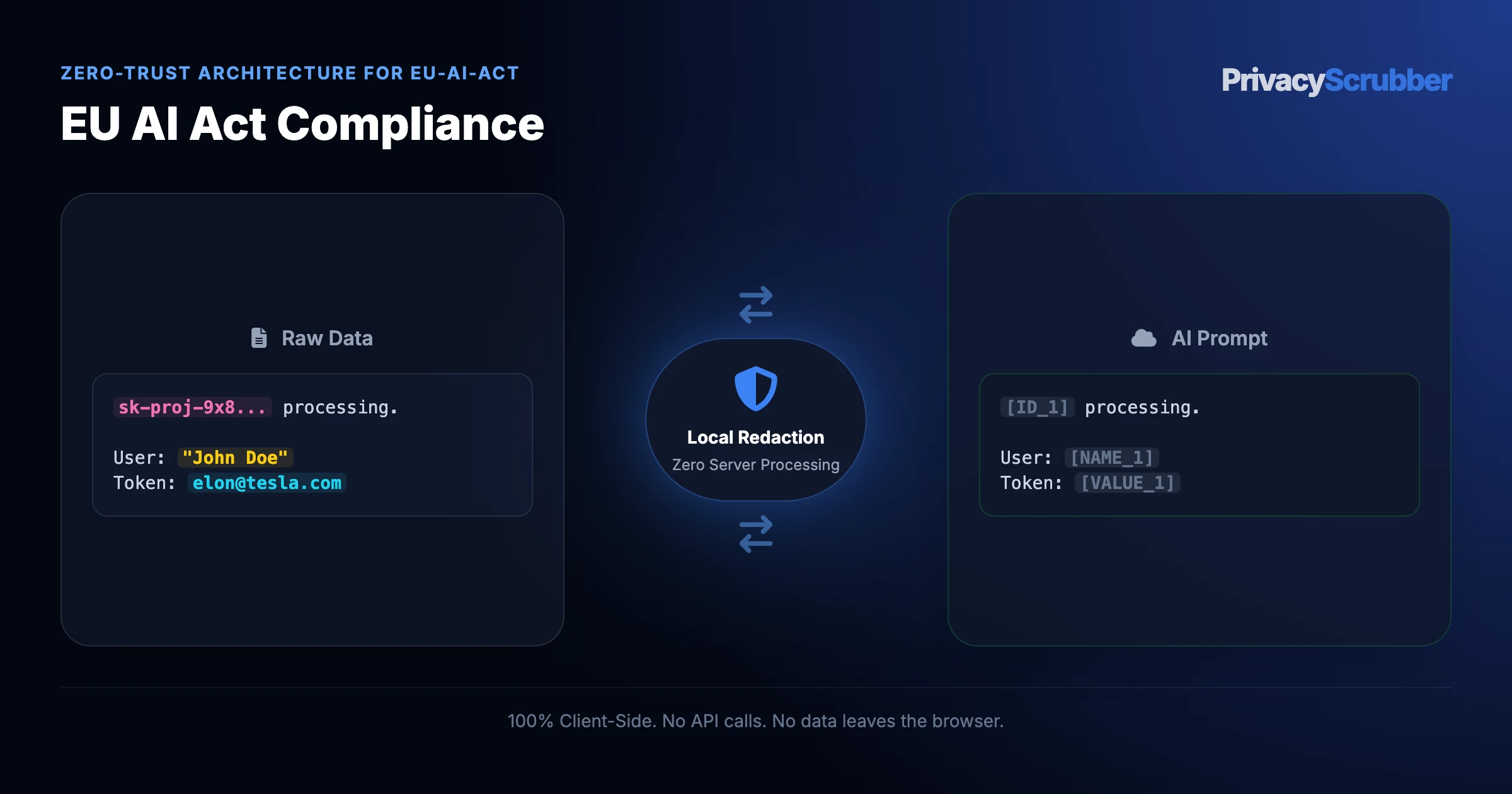
Under the EU AI Act, deploying ChatGPT for standard use-cases classifies your organization as a 'Deployer' of General-Purpose AI (GPAI). While not inherently 'High-Risk', processing EU personal data through these systems still triggers strict data minimization principles (Article 10). By scrubbing data before the prompt, you limit your regulatory exposure.
EU AI Act Compliance Exposure Surface for AI Governance Teams
Architecting EU AI Act Compliance for EU AI Act (Chapters II and IV means filtering eu ai act chatgpt compliance before network serialization. Our EU AI Act AI privacy guides document 0-byte egress via local RAM (EU AI Act).
Feeding eu ai act chatgpt compliance and ai act transparency requirements to external AI triggers high-risk training data governance leaks immediately. The EU AI Act categorizes ChatGPT and Claude as transparency-risk systems. Sanitize sensitive PII in local browser RAM before AI prompts with zero egress. Downstream filters never catch cleartext inside ChatGPT Enterprise.
Navigating the 2026 AI Regulatory Landscape
As the regulatory deadlines of the EU AI Act approach, enterprise legal and IT teams are scrutinizing their generative AI deployments. Systems like ChatGPT, Copilot, and Claude are broadly classified as General-Purpose AI (GPAI). While using them doesn't automatically trigger "High-Risk" obligations, the underlying data you feed into them remains subject to strict data governance principles.
Key Deadlines for Deployers
- • February 2025: Prohibited AI practices phased out.
- • August 2025: Obligations for General-Purpose AI (GPAI) models apply.
- • August 2026: Obligations for High-Risk AI systems (Annex III) apply.
The Danger of Over-Sharing Personal Data
A common pitfall is treating the LLM interface like an internal search engine. When employees paste unredacted customer complaints, HR files, or financial records, they risk violating the core data minimization tenets outlined in Article 10 of the Act. To mitigate this without stifling innovation, organizations are turning to transparency obligations and zero-trust enterprise frameworks. By enforcing a client-side masking layer, data is pseudonymized before transmission.
Unlike traditional server-based redaction APIs, which themselves become third-party sub-processors under GDPR regulations, browser-level sanitization guarantees that no intermediary ever reads or logs the sensitive payload.
Entity Handling Standard for EU AI Act Compliance
Effective sanitization of EU AI Act Compliance requires stripping direct identifiers while keeping structural and quantitative context intact for model reasoning:
| Data Attribute | Rule | In-Memory Output | Governance Justification |
|---|---|---|---|
| Internal IDs inside EU AI Act Compliance | REDACT | [SUBJECT_1] / [NATIONAL_ID_1] | Prevents high-risk training data governance leaks via pre-send local RAM (EU AI Act) substitution. |
| Private Records in EU AI Act Compliance | REDACT | [BIOMETRIC_1] | Replaces direct PII with [BIOMETRIC_1] inside volatile client memory. |
| Routing Endpoints (ai act transparency requirements) | REDACT | [BIOMETRIC_1] | Blocks contact linkage when international enterprise GRC directors analyze eu ai act chatgpt compliance batches. |
| Domain Instructions (EU AI Act) | PRESERVE | Cleartext Logic | Retains workflow intent so international enterprise GRC directors get actionable ai act transparency requirements outputs. |
| Numeric Totals & Ratios (eu ai act 2026) | PRESERVE | Cleartext ($ / %) | Enables accurate calculations across EU AI Act Compliance without revealing identities. |
| Aggregation Counts & Deltas | PRESERVE | Cleartext Metrics | Supports statistical analysis of eu ai act chatgpt compliance without linking individuals. |
Bijective Prompt Blueprint for EU AI Act Compliance
Copy this prompt frame when handing sanitized EU AI Act Compliance context to frontier LLMs under strict zero-egress rules:
Review eu ai act chatgpt compliance workflow for EU AI Act Compliance under EU AI Act (Chapters II and IV.
1. Inspect interactions between [SUBJECT_1] and [BIOMETRIC_1].
2. Deliver concise steps preserving every bracketed token.

[INSERT SCRUBBED TEXT]
Review eu ai act chatgpt compliance workflow for EU AI Act Compliance under EU AI Act (Chapters II and IV.
1. Inspect interactions between [SUBJECT_1] and [BIOMETRIC_1].
2. Deliver concise steps preserving every bracketed token.

[INSERT SCRUBBED TEXT]
EU AI Act (Chapters II and IV Mandate Checkpoints: EU AI Act Compliance
Because EU AI Act (Chapters II and IV restricts external eu ai act chatgpt compliance processing, EU AI act transparency requirements for AI tools (august 2026 deadline) outlines how [SUBJECT_1] substitution shields EU AI Act Compliance from unmasked eu ai act chatgpt compliance exposure.
Zero-Trust EU AI Act Tokenization for EU AI Act Compliance
During EU AI Act Compliance, local RAM (EU AI Act) locks ai act transparency requirements inside isolated RAM, assigning [SUBJECT_1] surrogates so ChatGPT Enterprise reflects hide your name before pasting into ChatGPT standards.
Sever internet access, tokenize eu ai act chatgpt compliance into [SUBJECT_1] for EU AI Act Compliance, and confirm zero sockets open under AI agent tool calling sanitizer.