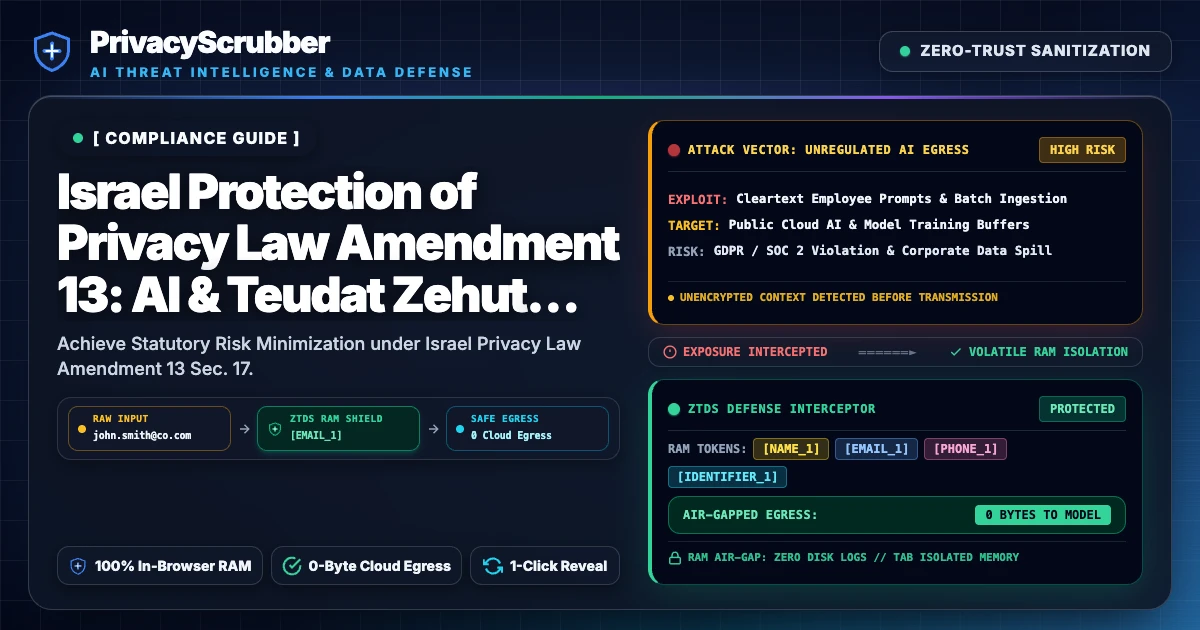
Israel's Protection of Privacy Law Amendment 13 (תיקון 13 לחוק הגנת הפרטיות) introduces statutory administrative fines and strict DPO oversight under Section 17 data security mandates. Submitting unmasked 9-digit Israeli National IDs (Teudat Zehut / ת.ז.), Israeli mobile numbers (+972-5X), IL IBANs, or clinical/financial records to foreign cloud LLMs creates cross-border data transfer and security liability. Tokenizing records in local RAM provides verifiable technical due diligence.
Why Unmasked Prompts Break Israel Protection of Privacy Law Amendment 13 Security
Architecting Israel Protection of Privacy Law Amendment 13 for SOC 2 Type II readiness means stopping raw israel privacy law amendment 13 ai compliance data at the ingestion layer. When compliance officers, dpos, grc managers, and legal counsel use PrivacyScrubber, local DLP rules, and compliance auditing tools, cross-border cleartext PII transfers violating statutory data minimization and security mandates creates an unmonitored egress path. Our Regulatory Compliance AI privacy guides show how PrivacyScrubber 30 Industry Profiles & Cryptographic SHA-256 Receipts enforces 0-byte server leakage for teudat zehut pii redaction.
Achieve Statutory Risk Minimization under Israel Privacy Law Amendment 13 Sec. 17. Redact 9-digit Teudat Zehut IDs and IL IBANs in local device RAM. Across Regulatory Compliance pipelines, Israel Protection of Privacy Law Amendment 13 combines free-text context with regulated identifiers (israel privacy law amendment 13 ai compliance, teudat zehut pii redaction). If left unredacted prior to API transit, cross-border cleartext PII transfers violating statutory data minimization and security mandates results in immediate compliance drift under SOC 2 Type II.
Defense-in-Depth for Israeli Enterprises, FinTechs, and Healthcare (Kupot Holim)
With Amendment 13 aligning Israeli privacy enforcement with European GDPR standards, Israeli technology enterprises, law firms, and financial institutions must demonstrate technical controls preventing unauthorized disclosure of database records to external AI sub-processors. Pairing local Teudat Zehut and IL-IBAN redaction with our GDPR & AI DPIA compliance framework gives Israeli DPOs a unified, zero-egress governance architecture.
Deterministic Token Mapping for Israel Protection of Privacy Law Amendment 13
Effective sanitization of Israel Protection of Privacy Law Amendment 13 requires stripping direct identifiers while keeping structural and quantitative context intact for model reasoning:
| Data Attribute | Rule | In-Memory Output | Governance Justification |
|---|---|---|---|
| Primary Identity & Subject Records (israel privacy law amendment 13 ai compliance) | REDACT | [NAME_1] | SOC 2 Type II direct identifier guard: prevents cloud LLMs from associating Israel Protection of Privacy Law Amendment 13 prompts with real individuals. |
| Multi-Line Counterparty & Organization Names (Regulatory Compliance) | REDACT | [NAME_1] | Preserves co-reference continuity across multi-paragraph Israel Protection of Privacy Law Amendment 13 prompts without leaking names. |
| Embedded Secrets, Tax IDs & Session Identifiers in Israel Protection of Privacy Law Amendment 13 | REDACT | [NAME_1], [ID_1] | Intercepts high-liability literals before cross-border cleartext PII transfers violating statutory data minimization and security mandates. |
| Structural Schema, Keys & Israel Protection of Privacy Law Amendment 13 Syntax | PRESERVE | Cleartext Structure | Required so the LLM can parse israel privacy law amendment 13 ai compliance hierarchy, JSON/SQL grammar, and document formatting. |
| Anonymized Category Labels & Department Roles | PRESERVE | Cleartext (Regulatory Compliance Role) | Retains organizational context for Israel Protection of Privacy Law Amendment 13 while keeping personal identities inside local RAM. |
| Non-Identifying Domain Logic & Operational Instructions | PRESERVE | Cleartext Narrative | Preserves 100% of analytical instructions for תיקון 13 לחוק הגנת הפרטיות ai so local detokenization yields production-ready output. |
Token-Preserving AI Prompt for Israel Protection of Privacy Law Amendment 13
Submit this prompt wrapper with your masked Israel Protection of Privacy Law Amendment 13 input so the AI reasons over symbolic tokens without altering placeholder tags:
System Role: Regulatory Compliance Compliance & Technical Analyst for Israel Protection of Privacy Law Amendment 13.
Input State: Pre-sanitized in volatile memory under SOC 2 Type II safeguards ([NAME_1], [ID_1], [EMAIL_1], [ADDRESS_1]).

Deliverables:
1. Analyze relationships between [NAME_1] and [ID_1] within the israel privacy law amendment 13 ai compliance workflow.
2. Highlight any policy, schema, or execution gaps related to תיקון 13 לחוק הגנת הפרטיות ai.
3. Preserve every [NAME_1], [ID_1], [EMAIL_1], [ADDRESS_1] tag intact in your output for 1-click local re-hydration.

[PASTE SANITIZED PAYLOAD HERE]
System Role: Regulatory Compliance Compliance & Technical Analyst for Israel Protection of Privacy Law Amendment 13.
Input State: Pre-sanitized in volatile memory under SOC 2 Type II safeguards ([NAME_1], [ID_1], [EMAIL_1], [ADDRESS_1]).

Deliverables:
1. Analyze relationships between [NAME_1] and [ID_1] within the israel privacy law amendment 13 ai compliance workflow.
2. Highlight any policy, schema, or execution gaps related to תיקון 13 לחוק הגנת הפרטיות ai.
3. Preserve every [NAME_1], [ID_1], [EMAIL_1], [ADDRESS_1] tag intact in your output for 1-click local re-hydration.

[PASTE SANITIZED PAYLOAD HERE]
Why GRC and Compliance Officers Flag Unmasked Prompts in Israel Protection of Privacy Law Amendment 13
Enforcing SOC 2 Type II (SOC 2 Type II, ISO 27001, HIPAA PHI de-identification standards, and the EU AI Act 2026) across Israel Protection of Privacy Law Amendment 13 means eliminating third-party sub-processor exposure for israel privacy law amendment 13 ai compliance and teudat zehut pii redaction. The technical workflow in india DPDP act 2026 AI compliance demonstrates how local RAM isolation satisfies strict audit scrutiny.
Zero-Trust Compliance and Regulatory Tokenization for Israel Protection of Privacy Law Amendment 13
PrivacyScrubber enforces Zero-Trust Data Sanitization (ZTDS™) for Israel Protection of Privacy Law Amendment 13 via PrivacyScrubber 30 Industry Profiles & Cryptographic SHA-256 Receipts. Sensitive israel privacy law amendment 13 ai compliance and teudat zehut pii redaction fields are replaced in <1ms of local RAM with bijective tokens ([NAME_1], [ID_1], [EMAIL_1], [ADDRESS_1]) prior to prompting PrivacyScrubber, local DLP rules, and compliance auditing tools. This aligns with secure board meeting AI, allowing compliance officers, dpos, grc managers, and legal counsel to restore authentic values locally in 1 click once the model responds.
Verifying Israel Protection of Privacy Law Amendment 13 under SOC 2 Type II requires no trust assumptions: enable Airplane Mode, execute local sanitization on israel privacy law amendment 13 ai compliance, and inspect your network sockets for 0.00 bytes of egress. This empirical verification matches the benchmark in prevent SOC 2 audit trail & evidence log leakage to cloud.