How to Use AI on Real SOC 2 Data — Without Sending a Single Real Name
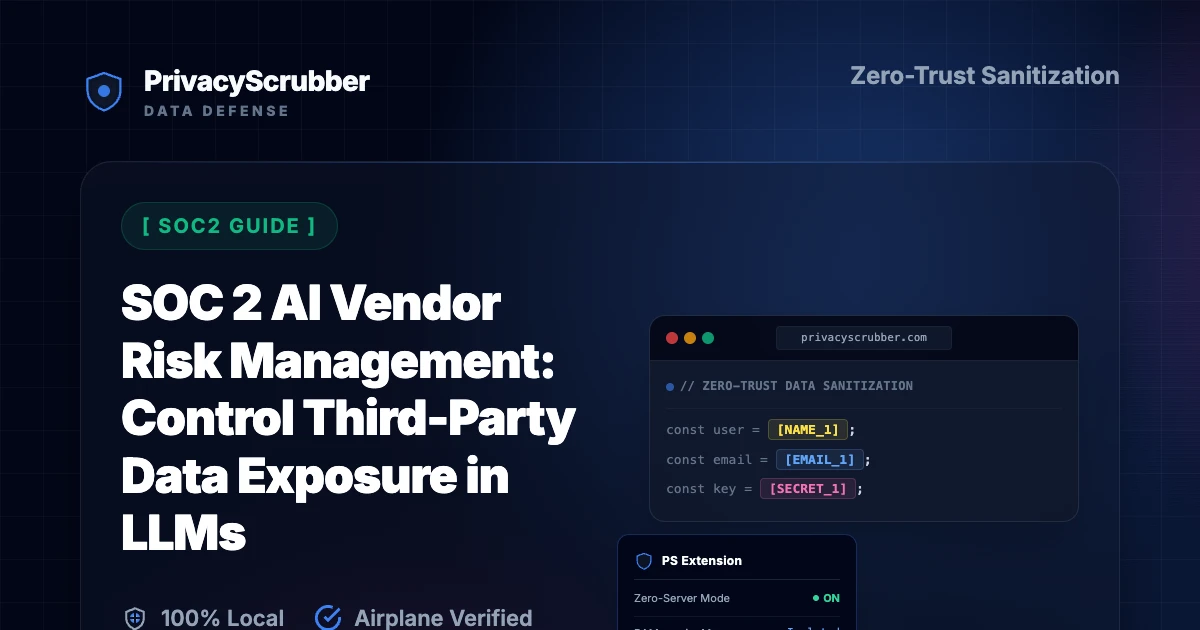
PrivacyScrubber delivers client-side protection through local Zero-Trust Data Sanitization (ZTDS), operating as a manual copy-paste board and via the PrivacyScrubber Chrome Extension. The in-browser processor automatically maps and replaces identifying information with secure, non-associative tokens (like [NAME_1]) before cloud dispatch. This satisfies the requirements of vendor risk elimination frameworks, allowing teams to utilize cloud engines without sending raw patient, customer, or employee identities. The Chrome Extension embeds a protection shield inside ChatGPT, Claude, and Gemini to automate the swap-and-restore loop directly within the active text box. Running Named Entity Recognition locally ensures that teams can continue leveraging Vanta, Drata, and AI-powered auditing tools for "soc 2 data masking evidence" queries without any third-party data collection.
Our client-side architecture is verifiable using the Airplane Mode Standard. Turn off your Wi-Fi, run the sanitization, and confirm that all processing remains offline. This corresponds with the requirements of cyber insurance AI controls, validating that no PII is ever exposed to external networks.