AI Engineering: Secure RAG & Agent Memory Streams
AI Agents & RAG: Stop PII from entering autonomous agent memory and RAG databases. Implement zero-trust DLP for Agentic AI workflows natively.

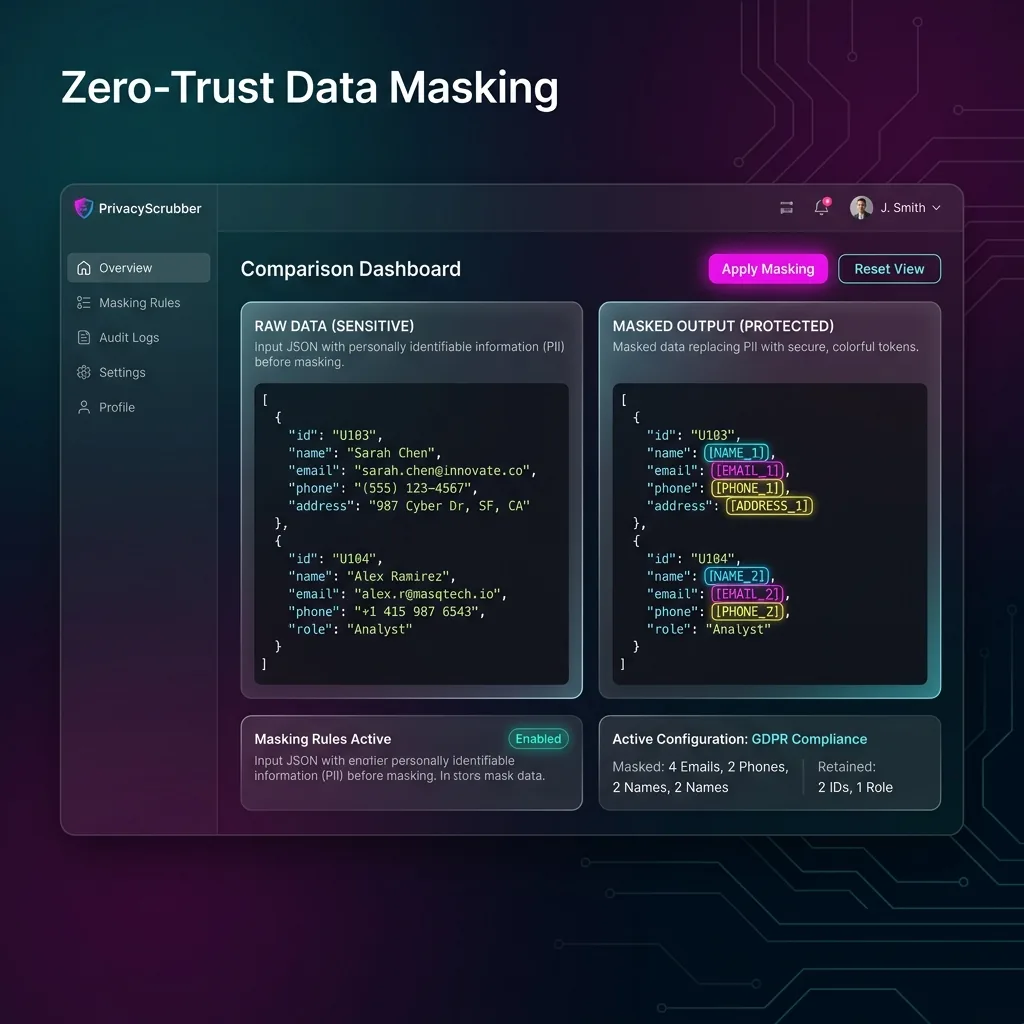
Autonomous agent frameworks (LangChain, AutoGen, CrewAI) and Retrieval-Augmented Generation (RAG) pipelines ingest unstructured user data that can permanently pollute vector embeddings and agent memory with PII. PrivacyScrubber's Agent Shield sanitizes data streams before they reach embedding models and agent memory stores.
Vector Store & Agent Memory De-Identification
Sanitizes prompts, tool outputs, and document chunks in under 2ms RAM, preventing PII from persisting in Pinecone, Weaviate, or Chroma vector databases.
Zero-Trust Sanitization for Autonomous Agent Loops
When AI agents execute multi-step planning loops, intermediate tool calls frequently expose customer identities and API credentials across execution steps. PrivacyScrubber intercepts data at the browser interface and developer IDE layer, replacing sensitive variables with structured tokens, ensuring downstream vector embeddings remain 100% anonymized.
RAG Pipeline Testing & Prompt Debugging
-
1
Copy or Paste Unsanitized Content: AI Engineer tests user query containing customer name, account number, and private transaction history.
-
2
Real-Time In-Browser Sanitization: The extension masks user identifiers into [USER_ID] and [ACCOUNT_TOKEN] in local RAM before vector retrieval simulation.
-
3
Submit to LLM with Zero Cloud Exposure: Engineer submits prompt to ChatGPT/Claude to test RAG prompt synthesis: "Retrieve relevant policy documents for [USER_ID]".
-
4
Instant Local Reversal (Contextual Reveal): Engineer restores customer context locally with 1-click reveal to verify synthesis accuracy without logging real PII in test logs.
Eliminating GDPR Article 17 "Right to be Forgotten" Conflicts in Vector Stores
Deleting individual PII entries from trained LLM weights or high-dimensional vector indexes is technically challenging and costly. By sanitizing data before indexing, teams avoid vector re-indexing liabilities, adhering to our AI Agent Security architecture.
Developer SDK & MCP Server Parity
Our Chrome Extension shares 100% regex engine and token mapping parity with our @privacyscrubber/mcp-server for AI IDEs (Cursor, Windsurf), providing automated developer workflows as detailed in securing agent pipelines and log protection.
Verifiable AI Pipeline Compliance
Generate cryptographic audit receipts confirming that vector embeddings and agent prompt context remained free of raw PII, meeting prompt security compliance benchmarks.
Latest Capabilities: Multi-Line Stitching & Local OCR
The PrivacyScrubber Chrome Extension features a smart 3-Line Name-Stitching Lookahead to capture names split across lines (e.g. Firstname
MiddleInitial
Surname) in scanned medical/clinical records, NDAs, and PDFs. It also supports Local Wasm OCR & PDF Sanitization to redact text from screenshots/PDFs offline, and Zero-Trust Session Sync (Argon2id + XChaCha20-Poly1305) to share rules peer-to-peer securely.
Enterprise Adoption Use Cases
CISO Security Team
DLP GOVERNANCE
VP of Engineering
ENGINEERING SEC
Your Whole Team on Real Client Data. Safely. $99/mo Flat.
No per-seat pricing. No DPA negotiation. No IT portal. Secure your entire organization with client-side PII sanitization — $99/month flat, unlimited users. SOC 2 & HIPAA ready. Works in Airplane Mode.
Frequently Asked Questions
Common questions about deploying zero-trust AI for Chrome Extension Teams.