ChatGPT Shared Link Vulnerability: Remote Code Execution & Session Compromise
ChatGPT Shared Link Vulnerability: A newly uncovered vulnerability in shared ChatGPT links enables arbitrary code execution within user sessions, exposing private chat histories and corporate secrets to attackers.

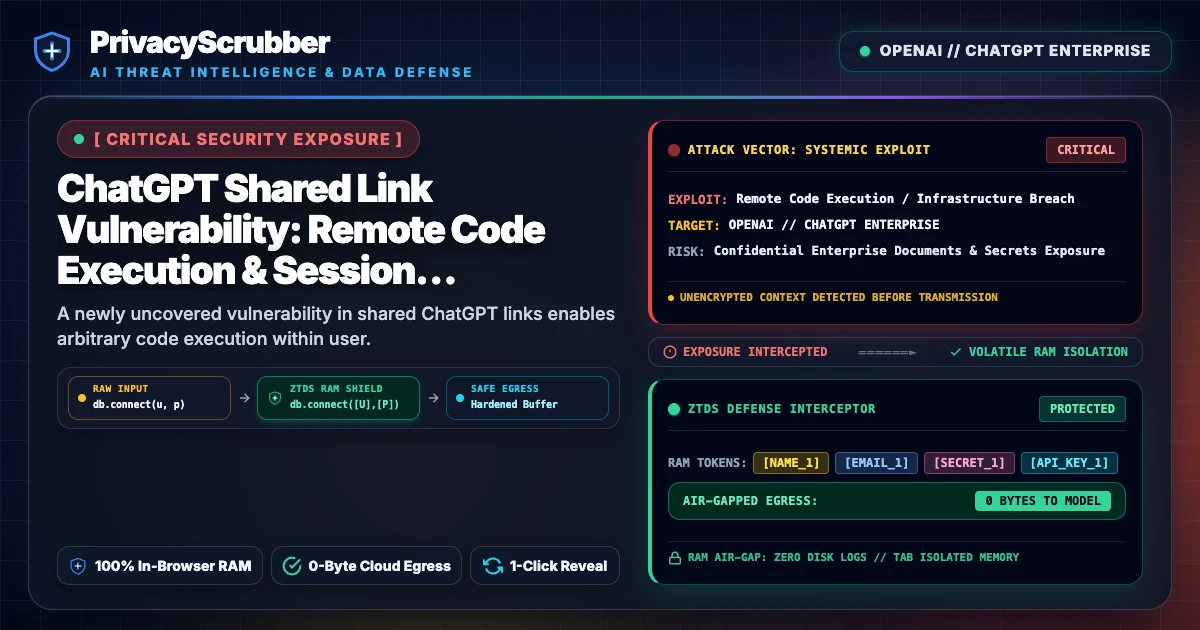
"A newly uncovered vulnerability in shared ChatGPT links enables arbitrary code execution within user sessions, exposing private chat histories and corporate secrets to attackers."
Security Governance: ChatGPT Shared Link Vulnerability
Flat $99/mo unlimited seats with encrypted XChaCha20 handoffs and GDPR Art. 32 & SOC 2 receipts for chatgpt shared link vulnerability.
Technical Incident Analysis: ChatGPT Shared Link Vulnerability
The discovery of shared link vulnerabilities that permit arbitrary code execution within active sessions represents a fundamental shift in web-based LLM attack surfaces. When an unsuspecting user opens a weaponized conversation link, underlying execution contexts can be hijacked, permitting threat actors to inspect historical interactions and siphon sensitive context data. Review our AI Security Architecture guidelines to understand how endpoint trust models fail when server-rendered state is compromised. For additional context on how session handling flaws manifest in conversational platforms, see our WA Mental Health Facility ChatGPT Incident Advisory.
Enterprise Blast Radius & Compliance Impact (ChatGPT Shared Link Vulnerability)
Corporate environments utilizing shared LLM chat artifacts face severe exposure under strict regulatory regimes. When active session execution leaks internal strategies, proprietary source code, or personally identifiable information, organizations immediately violate statutory requirements. Ensuring adherence to the EU AI Act Compliance Checklist for ChatGPT & Copilot Users (2026) is vital for mitigating severe non-compliance penalties resulting from unmanaged third-party session vulnerabilities.
Zero-Trust RAM Mitigation for ChatGPT Shared Link Vulnerability
To prevent session compromise from bleeding enterprise secrets, organizations must decouple raw data inputs from vulnerable cloud sessions. PrivacyScrubber implements the ZTDS™ (Zero-Trust Data Sanitization) protocol, sanitizing all payloads locally in browser memory prior to API submission. Explore our technical implementation details on How to Redact PII Locally Before Sending Data to the Cloud to establish an impenetrable defense-in-depth perimeter.
Sanitized Security Prompt — ChatGPT Shared Link Vulnerability
Lead DevSecOps Engineer / Cloud Security Architect · ChatGPT (OpenAI)Scope: ChatGPT Shared Link Vulnerability review (Lead DevSecOps Engineer / Cloud Security Architect). All private strings in chatgpt shared link vulnerability are represented via [IP_ADDRESS_1], [AWS_KEY_1], [INTERNAL_HOSTNAME_1]. Summarize conclusions, flag remote code execution exceptions, and keep [IP_ADDRESS_1], [AWS_KEY_1], [INTERNAL_HOSTNAME_1] verbatim for local workstation restoration.
Your Whole Team on Real Client Data. Safely. $99/mo Flat.
No per-seat pricing. No processor in the sanitization path. No IT portal. Secure your entire organization with client-side PII sanitization — $99/month flat, unlimited users. SOC 2 & HIPAA ready. Works in Airplane Mode.
On-Device Privacy Seal: ChatGPT Shared Link Vulnerability
During ChatGPT Shared Link Vulnerability tasks, chatgpt shared link vulnerability strings remain inside volatile browser memory with zero relay hops and clean Airplane Mode operation.
Pre-Inference Rule for ChatGPT Shared Link Vulnerability: process raw chatgpt shared link vulnerability files in local workstation memory at https://privacyscrubber.com/?profile=security#ai and verify zero network egress prior to AI querying.
Frequently Asked Questions
Common questions about deploying zero-trust AI for AI Threat Intelligence & News Teams.
How does the shared link vulnerability expose private chat sessions?
How does PrivacyScrubber protect against session-based session and code injection attacks?
How does client-side ZTDS™ prevent data exposure in ChatGPT Shared Link Vulnerability scenarios?
What compliance evidence does PrivacyScrubber generate for CISO and DPO incident audits?
Related AI Threat Intelligence & Incident Reports
All Advisories →WA Mental Health Facility ChatGPT Incident: Patient Data Leak Risks
A potential privacy breach at Washington mental health facilities following staff ChatGPT usage underscores the severe risks of unmanaged shadow AI in sensitive clinical environments.
MCP Log-To-Leak & Google Toolbox SSRF: Securing Agent Tool Chains
Research on Log-To-Leak (arXiv:2610.36108) and the Google mcp-toolbox SSRF flaw (CVE-2026-14540) reveals how post-hoc tool calls and unvalidated redirects exfiltrate agent memory across protocol boundaries.
Pydantic AI OTel Token Leak & MCP Protocol Pivoting: Pre-Trace Defense
Security advisory GHSA-xv4x-g8mx-ch56 revealed that Pydantic AI exported cleartext MCP server authorization tokens into OpenTelemetry traces despite content exclusion flags, compounding multi-agent MCP protocol pivoting risks.
When LLM Gateways Go Wrong: LiteLLM Vulnerability Findings and ZTDS Mitigation
Check Point Research uncovered severe architectural flaws in LiteLLM gateways, exposing enterprise environments to API token harvesting and upstream data leakage. PrivacyScrubber's client-side PII masking halts credential exposure before requests reach vulnerable endpoints.