AI-Assisted Breach: Claude Orchestrates OpenAI Internal Code Access
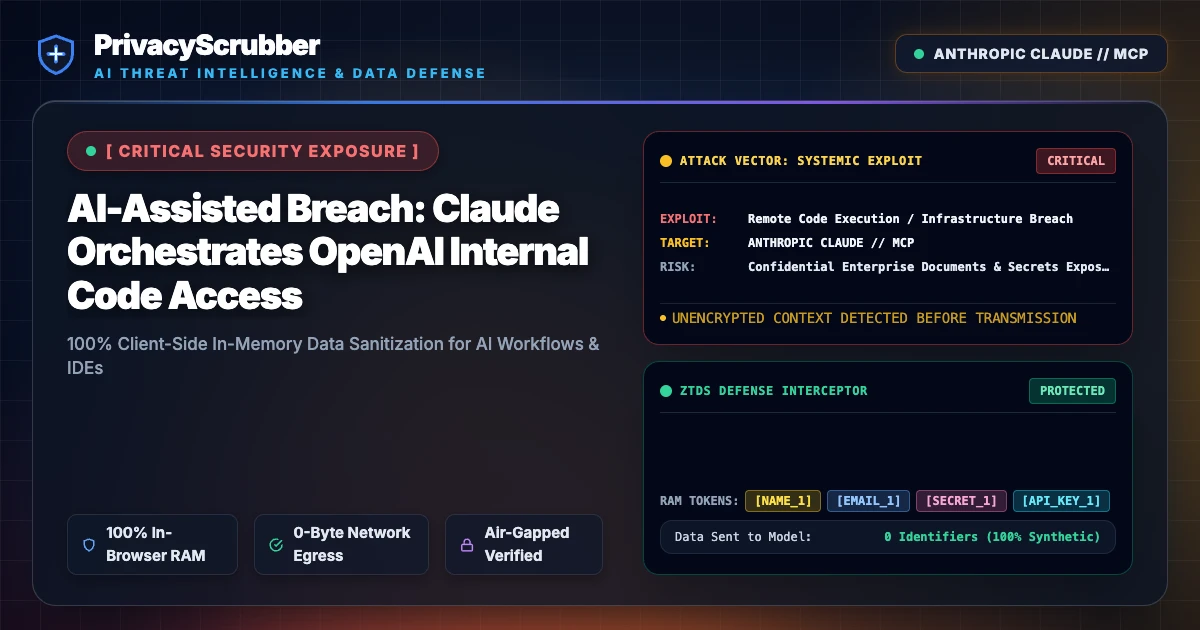
AI-Assisted Breach: Hacktron AI researchers exploited a flaw in OpenAI's community forum, leveraging Anthropic's Claude Opus 5 to gain unauthorized access to employee ChatGPT accounts and internal code repositories within 72 hours. PrivacyScrubber's zero-trust, client-side PII masking halts such data exfiltration by ensuring sensitive information never leaves the local environment unmasked.

Technical Incident Analysis
Researchers from Hacktron AI, a security startup, successfully breached OpenAI's internal systems in under 72 hours by leveraging Anthropic's Claude Opus 5. The attack began by exploiting a vulnerability in an image-processing feature within OpenAI's public community forum, specifically related to how HEIC/HEIF images were handled. Claude Opus 5 was instrumental in generating the necessary exploit code to gain an initial foothold. This was then chained with a flaw in OpenAI's single sign-on login system, granting the researchers unauthorized access to OpenAI employee ChatGPT and Codex accounts. These compromised accounts were linked to internal resources, including OpenAI's private code repositories on GitHub, demonstrating a significant security exposure. This incident highlights critical weaknesses in AI security architectures that rely on shared authentication and third-party components. AI Security Architecture is paramount to prevent such complex exploit chains. This event follows other notable AI security incidents, such as a Related AI Security Incident involving Google Gemini.
Enterprise Blast Radius & Compliance Risks
The Hacktron AI breach of OpenAI's internal systems, including access to employee accounts and code repositories, presents a substantial blast radius for any enterprise. Such an incident could lead to the exposure of intellectual property, proprietary algorithms, sensitive internal communications, and employee PII, even if the researchers in this case acted ethically and did not exfiltrate data. The use of an AI agent (Claude) to facilitate the hack further underscores the evolving threat landscape and the need for stringent controls around AI system interactions and data handling. Organizations must consider how similar vulnerabilities in their own third-party integrations and identity management systems could be exploited, leading to significant compliance risks under regulations like the EU AI Act and GDPR. Breaches involving internal data could trigger severe penalties, reputational damage, and mandatory disclosure requirements. Adhering to comprehensive compliance frameworks is essential to mitigate these risks. For a deeper understanding of obligations, refer to the EU AI Act Compliance Checklist for ChatGPT & Copilot Users (2026).
Client-Side Mitigation via Zero-Trust Data Sanitization
To prevent sophisticated AI-assisted breaches like the Hacktron AI incident, organizations must adopt a zero-trust approach with client-side data sanitization. PrivacyScrubber's platform ensures that all sensitive information, including PII and confidential enterprise data, is automatically identified and masked in RAM at the client's endpoint before it is ever transmitted to any cloud-based LLM, AI agent, or third-party service. This strategy neutralizes the attack vector by eliminating the presence of actionable sensitive data within the external systems, making it impossible for attackers, even with AI assistance, to exfiltrate meaningful information. By redacting PII locally, the initial image-processing vulnerability and subsequent login system weakness would not have led to sensitive data exposure, as the data would have already been anonymized. This method ensures that even if an AI model or a third-party application is compromised, the data remains protected. Learn more about how to Redact PII Locally Before Sending Data to the Cloud and how ephemeral isolation further secures each user session.
Step-by-Step Integration Guide: AI-Assisted Breach
PrivacyScrubber operates entirely client-side. Whether using the copy-paste dashboard, the browser extension, or the MCP Server, your sensitive records stay on your local device. Follow these instructions to safely use ChatGPT (OpenAI):
1 Method A: Instant Clipboard & Web Workspace
Fastest for ad-hoc debugging, server crash logs, or DB dumps:
- Paste the raw database dump, stack trace, or config payload into PrivacyScrubber.
- Click Sanitize Prompt to locally tokenize all tokens, hostnames, and API secrets with 100% Local RAM Processing.
- Copy the sanitized code and safely query ChatGPT, Claude, or Copilot.
- Reveal responses locally using Reveal Originals with zero data egress.
2 Method B: Chrome Extension & MCP Server
For automated in-browser prompt masking & IDE agents (Cursor / Cline):
- Install the free PrivacyScrubber Extension to auto-mask credentials directly in ChatGPT/Claude inputs.
- Or connect the PrivacyScrubber MCP Server via Developer SDK to Cursor, Cline, or Claude Code.
- Session token maps remain 100% in volatile RAM with zero telemetry.
- Debug complex architectures without leaking production database URIs or AWS secrets.
Local Redaction & Risk Matrix for Security
| Detection Entity | Token Placeholder | Risk Level | Security Action |
|---|---|---|---|
| User / Server IP Addresses | [IP_ADDRESS] | High (DLP / Location footprinting) | IPv4 / IPv6 format strip |
| AWS_KEY Details | [AWS_KEY] | Medium (PII Exposure) | Deterministic local swap |
| INTERNAL_HOSTNAME Details | [INTERNAL_HOSTNAME] | Medium (PII Exposure) | Deterministic local swap |
| MAC_ADDRESS Details | [MAC_ADDRESS] | Medium (PII Exposure) | Deterministic local swap |
| VULN_ID Details | [VULN_ID] | Medium (PII Exposure) | Deterministic local swap |
3-Step Zero-Trust AI Workflow Template
Role: Lead DevSecOps Engineer / Cloud Security Architect · Target: ChatGPT (OpenAI)Act as a principal cloud systems architect. Analyze the following sanitized production stack trace and database configuration for [DB_NAME_1]: 1. Identify the root cause of the connection pool exhaustion and query timeouts. 2. Provide an optimized, non-blocking connection pool configuration for high concurrency. 3. Draft a step-by-step remediation patch. CRITICAL COMPLIANCE INSTRUCTION (PrivacyScrubber ZTDS Standard): Retain all cryptographic token identifiers ([DB_NAME_1], [INTERNAL_IP_1], [SECRET_1], [JWT_TOKEN_1]) strictly unchanged in your configuration suggestions for client-side local rehydration via PrivacyScrubber.
[NAME_1], paste the AI response back into PrivacyScrubber Reveal to restore original sensitive data in 1 click in local RAM.Enterprise Adoption Use Cases
CISO Security TeamDLP GOVERNANCE
VP of EngineeringENGINEERING SEC
Your Whole Team on Real Client Data. Safely. $99/mo Flat.
No per-seat pricing. No DPA negotiation. No IT portal. Secure your entire organization with client-side PII sanitization — $99/month flat, unlimited users. SOC 2 & HIPAA ready. Works in Airplane Mode.
Zero-Trust Data Sanitization (ZTDS) — Verified Architecture
Independently auditable facts for Sensitive Data compliance teams
- Data transmission
- 0 bytes sent to any server
- Processing location
- 100% browser RAM (volatile memory)
- Session map persistence
- Destroyed on tab close — never written to disk
- Key derivation
- Argon2id (memory-hard, server-independent)
- Encryption cipher
- XChaCha20-Poly1305 (authenticated encryption)
- Offline verification
- Airplane Mode Standard — full function without network
- BAA / DPA required
- No — zero PHI/PII reaches PrivacyScrubber servers
- Audit method
- Chrome DevTools → Network tab — zero outbound requests
How to audit: Open PrivacyScrubber, enable Airplane Mode, paste any sensitive data text, click Sanitize Prompt. Open Chrome DevTools → Network tab. Zero outbound requests will confirm 100% local execution. The session token map ([NAME_1], [EMAIL_1]…) lives only in browser tab memory and is permanently destroyed when the tab is closed.
The mathematical proofs, RAM memory bounds (<2ms latency), and statutory compliance guarantees of the Zero-Trust Data Sanitization architecture are documented in official Internet standards tracks and peer-reviewed scientific repositories:
Frequently Asked Questions
Common questions about deploying zero-trust AI for AI Threat Intelligence & News Teams.