LangChain Framework Security Flaws: Enterprise LLM Data Leak Risks
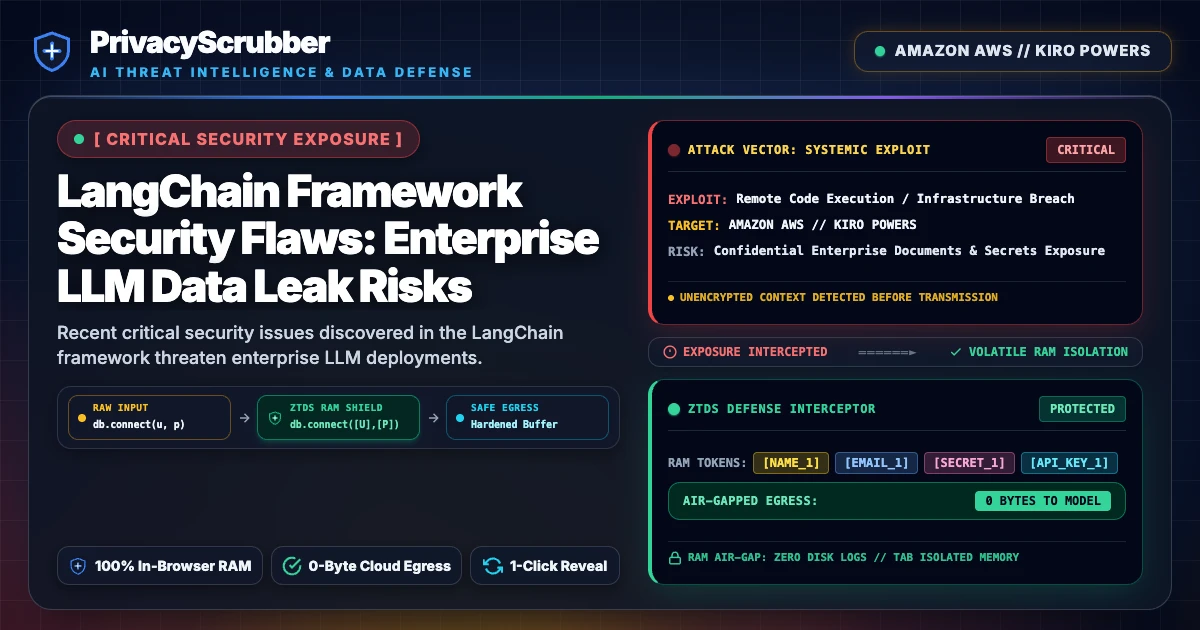
LangChain Framework Security Flaws: Recent critical security issues discovered in the LangChain framework threaten enterprise LLM deployments with unauthorized data exposure. PrivacyScrubber's zero-trust, client-side PII masking neutralizes these framework-level vulnerabilities before sensitive data enters the pipeline.

Technical Incident Analysis
Recent security advisories highlighting critical vulnerabilities in the LangChain framework demonstrate the severe risks associated with complex LLM orchestration layers. When framework components fail to properly isolate execution environments, downstream API calls and retrieval mechanisms can inadvertently siphon proprietary enterprise secrets. Implementing robust AI Security Architecture is essential for hardening these pipelines against injection and data leakage. This incident mirrors previous supply chain and integration compromises, such as those detailed in the Related AI Security Incident analysis.
Enterprise Blast Radius & Compliance Risks
Unsanitized enterprise pipelines that rely on vulnerable orchestration frameworks risk severe regulatory penalties under modern data protection mandates. When sensitive customer data or internal source code leaks through framework bugs, organizations immediately trigger non-compliance provisions under major regulatory frameworks. Ensuring adherence to the ISO 27001 AI Compliance: Secure Data Before LLMs guidelines helps mitigate these systemic operational exposures.
Client-Side Mitigation via Zero-Trust Data Sanitization
To effectively neutralize framework-level vulnerabilities, organizations must adopt a zero-trust model where data is sanitized at the client boundary before ingestion by any agentic workflow. PrivacyScrubber processes text entirely within local RAM-only memory using ephemeral session maps, ensuring that zero plaintext secrets or PII are exposed to underlying orchestration components. Review our Zero-Trust LLM Gateways: Why Client-Side Scrubbing Beats API Proxies whitepaper to learn how local preprocessing completely eliminates third-party transmission risks.
Step-by-Step Integration Guide: LangChain Framework Security Flaws
PrivacyScrubber operates entirely client-side. Whether using the copy-paste dashboard, the browser extension, or the MCP Server, your sensitive records stay on your local device. Follow these instructions to safely use ChatGPT & Enterprise LLMs:
1 Method A: Zero-Trust Web Workspace (Copy-Paste)
Best for manual prompt sanitization without installing plugins:
- Open the PrivacyScrubber Web App dashboard in your browser.
- Paste the raw prompt or text containing sensitive details of LangChain Framework Security Flaws.
- Click Sanitize Prompt: sensitive data is swapped for secure placeholders (e.g.,
[NAME_1]). - Submit the sanitized prompt to ChatGPT & Enterprise LLMs.
- Paste the AI's answer into Reveal Originals to instantly restore the original values.
2 Method B: Chrome Extension (In-Context Redaction)
For automated, inline de-identification within chat interfaces:
- Install the free PrivacyScrubber Chrome Extension from the Web Store.
- Navigate to your AI chat interface. A PrivacyScrubber shield button will appear inline.
- Paste your raw prompt. Click the shield button to sanitize all identifiers instantly in-place.
- Send the prompt to the AI chatbot.
- The extension automatically intercepts and detokenizes the response, displaying raw values to you.
Local Redaction & Risk Matrix for Security
| Detection Entity | Token Placeholder | Risk Level | Security Action |
|---|---|---|---|
| User / Server IP Addresses | [IP_ADDRESS] | High (DLP / Location footprinting) | IPv4 / IPv6 format strip |
| AWS_KEY Details | [AWS_KEY] | Medium (PII Exposure) | Deterministic local swap |
| INTERNAL_HOSTNAME Details | [INTERNAL_HOSTNAME] | Medium (PII Exposure) | Deterministic local swap |
| MAC_ADDRESS Details | [MAC_ADDRESS] | Medium (PII Exposure) | Deterministic local swap |
| VULN_ID Details | [VULN_ID] | Medium (PII Exposure) | Deterministic local swap |
3-Step Zero-Trust AI Workflow Template
Role: Enterprise AI Governance Lead / Security Officer · Target: ChatGPT & Enterprise LLMsAct as an executive research consultant. Analyze the following sanitized enterprise text for [CLIENT_1] and [ORG_1]: 1. Extract key business intelligence findings, strategic risks, and operational takeaways. 2. Draft 3 prioritized executive recommendations. 3. Format findings in clean, structured bullet points. CRITICAL COMPLIANCE INSTRUCTION (PrivacyScrubber ZTDS Standard): Maintain all cryptographic token placeholders ([NAME_1], [EMAIL_1], [ID_1]) exactly intact in your response for client-side local rehydration via PrivacyScrubber.
[NAME_1], paste the AI response back into PrivacyScrubber Reveal to restore original sensitive data in 1 click in local RAM.Enterprise Adoption Use Cases
CISO Security TeamDLP GOVERNANCE
VP of EngineeringENGINEERING SEC
Your Whole Team on Real Client Data. Safely. $99/mo Flat.
No per-seat pricing. No DPA negotiation. No IT portal. Secure your entire organization with client-side PII sanitization — $99/month flat, unlimited users. SOC 2 & HIPAA ready. Works in Airplane Mode.
Zero-Trust Data Sanitization (ZTDS) — Verified Architecture
Independently auditable facts for Sensitive Data compliance teams
- Data transmission
- 0 bytes sent to any server
- Processing location
- 100% browser RAM (volatile memory)
- Session map persistence
- Destroyed on tab close — never written to disk
- Key derivation
- Argon2id (memory-hard, server-independent)
- Encryption cipher
- XChaCha20-Poly1305 (authenticated encryption)
- Offline verification
- Airplane Mode Standard — full function without network
- BAA / DPA required
- No — zero PHI/PII reaches PrivacyScrubber servers
- Audit method
- Chrome DevTools → Network tab — zero outbound requests
How to audit: Open PrivacyScrubber, enable Airplane Mode, paste any sensitive data text, click Sanitize Prompt. Open Chrome DevTools → Network tab. Zero outbound requests will confirm 100% local execution. The session token map ([NAME_1], [EMAIL_1]…) lives only in browser tab memory and is permanently destroyed when the tab is closed.
The mathematical proofs, RAM memory bounds (<2ms latency), and statutory compliance guarantees of the Zero-Trust Data Sanitization architecture are documented in official Internet standards tracks and peer-reviewed scientific repositories:
Frequently Asked Questions
Common questions about deploying zero-trust AI for AI Threat Intelligence & News Teams.