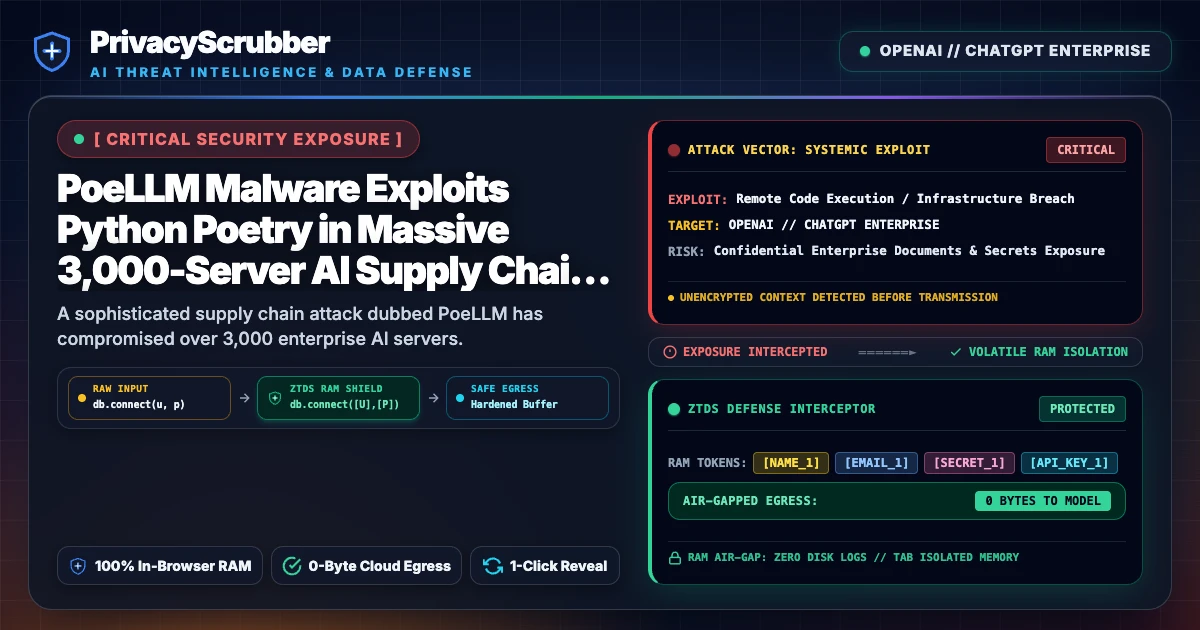
PoeLLM Malware Exploits Python Poetry in Massive 3,000-Server AI Supply Chain Breach
PoeLLM Malware Exploits Python Poetry in Massive 3,000-Server AI Supply Chain Breach: A sophisticated supply chain attack dubbed PoeLLM has compromised over 3,000 enterprise AI servers by weaponizing Python Poetry dependency configuration files to exfiltrate LLM credentials and environment variables. PrivacyScrubber prevents catastrophic secret exfiltration by sanitizing developer environments before model submission.

Technical Incident Analysis
Cybersecurity researchers have uncovered a widespread supply chain attack campaign designated PoeLLM, which has silently infected over 3,000 enterprise AI development nodes and server deployments. The campaign exploits malicious post-installation scripts embedded in modified Python Poetry package manifests. Once deployed, the malware initiates memory inspection routines that siphon high-privilege credentials—including OpenAI, Anthropic, and Hugging Face API tokens, database connectionURIs, and cloud infrastructure service keys—directly out of environment buffers.
Because modern LLM frameworks rely heavily on Python environments managed by Poetry, threat actors were able to propagate the payload across corporate build pipelines rapidly. Enterprise systems building custom AI agents and agentic workflows were disproportionately impacted. Organizations must evaluate their underlying AI Security Architecture to block rogue third-party packages from harvesting system tokens. This threat closely follows recent agentic supply chain breaches analyzed in our Related AI Security Incident report.
Enterprise Blast Radius & Compliance Risks
The blast radius of PoeLLM extends beyond local developer workstations to production environments hosting proprietary training data and proprietary RAG vector indexes. Compromised tokens allow attackers to query enterprise vector stores, bypass organizational access boundaries, and steal fine-tuning data containing protected personally identifiable information (PII) and corporate trade secrets.
Under strict regulatory mandates such as the EU General Data Protection Regulation (GDPR) and the European Union's NIS2 AI Cybersecurity Incident Reporting Directive, organizations face mandatory breach disclosures and severe monetary fines if credential theft leads to unencrypted PII exfiltration. Security teams must enforce strict supply chain inspection and client-side payload sanitization to insulate core business assets from compromised developer tools.
Client-Side Mitigation via Zero-Trust Data Sanitization
Traditional perimeter firewalls and server-side gateways are insufficient against supply chain compromises like PoeLLM because the malicious payload executes internally within developer workflows before data hits network gateways. Mitigating this risk requires neutralizing sensitive data directly at the source—within the browser or local client application runtime.
PrivacyScrubber implements the ZTDS™ (Zero-Trust Data Sanitization) methodology directly within local RAM environments. By executing client-side redaction and tokenization before text, code, or context vectors leave the local machine, PrivacyScrubber strips out API keys, access credentials, and protected personal data before an LLM prompt or agent workflow is generated. Implementing automated OWASP Top 10 for LLMs Data Controls ensures that even if local build tools are compromised, no enterprise secrets or PII are ever exposed to host-level exfiltration scripts.
Local Redaction & Risk Matrix for Security
| Detection Entity | Token Placeholder | Risk Level | Security Action |
|---|---|---|---|
| User / Server IP Addresses | [IP_ADDRESS] | High (DLP / Location footprinting) | IPv4 / IPv6 format strip |
| AWS_KEY Details | [AWS_KEY] | Medium (PII Exposure) | Deterministic local swap |
| INTERNAL_HOSTNAME Details | [INTERNAL_HOSTNAME] | Medium (PII Exposure) | Deterministic local swap |
| MAC_ADDRESS Details | [MAC_ADDRESS] | Medium (PII Exposure) | Deterministic local swap |
| VULN_ID Details | [VULN_ID] | Medium (PII Exposure) | Deterministic local swap |
Safe AI Prompt Template: PoeLLM Malware Exploits Python Poetry in Massive 3,000-Server AI Supply Chain Breach
Role: Enterprise AI Governance Lead / Security Officer · Target: ChatGPT & Enterprise LLMsAct as an executive research consultant. Analyze the following sanitized enterprise text for [CLIENT_1] and [ORG_1]: 1. Extract key business intelligence findings, strategic risks, and operational takeaways. 2. Draft 3 prioritized executive recommendations. 3. Format findings in clean, structured bullet points. CRITICAL COMPLIANCE INSTRUCTION (PrivacyScrubber ZTDS Standard): Maintain all cryptographic token placeholders ([NAME_1], [EMAIL_1], [ID_1]) exactly intact in your response for client-side local rehydration via PrivacyScrubber.
Your Whole Team on Real Client Data. Safely. $99/mo Flat.
No per-seat pricing. No processor in the sanitization path. No IT portal. Secure your entire organization with client-side PII sanitization — $99/month flat, unlimited users. SOC 2 & HIPAA ready. Works in Airplane Mode.
Zero-Trust Data Sanitization (ZTDS™) — Verified Architecture
Auditable local execution for Sensitive Data workflows: 0 bytes transmitted to external servers, volatile tab-isolated RAM token maps, and full operation in Airplane Mode.
Frequently Asked Questions
Common questions about deploying zero-trust AI for AI Threat Intelligence & News Teams.