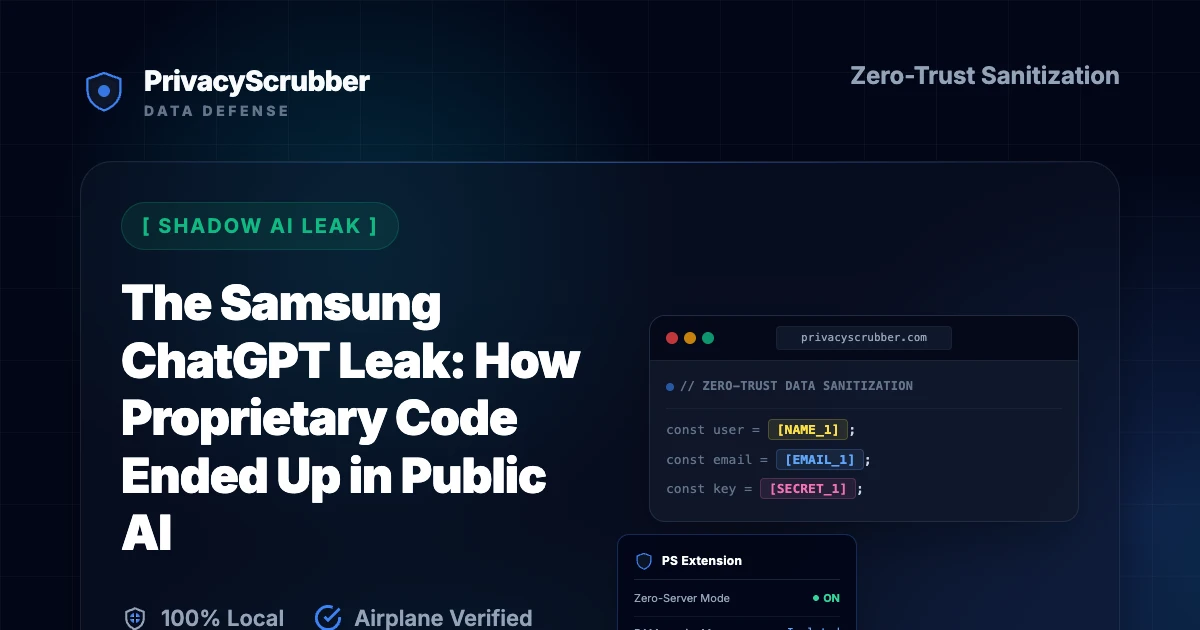
The Samsung ChatGPT Leak: How Proprietary Code Ended Up in Public AI
The Samsung ChatGPT Leak: An inside look at the Samsung ChatGPT incident where engineers accidentally exposed semiconductor database source code, and how local data sanitization prevents code leaks.

What Happened at Samsung?
It started with a simple shortcut. Engineers in Samsung's semiconductor division wanted to optimize their database scripts and clean up proprietary code errors quickly. Instead of auditing the code internally, they turned to ChatGPT. They pasted sensitive chip database optimization logic, private meeting notes, and internal code snippets directly into the prompt box. Developing safe habits in IT requires establishing clear Developer Data Security guidelines across the organization.
Because public AI models store input history to train future iterations, those private semiconductor blueprints were absorbed into OpenAI's systems. The incident had a cascading effect, similar to the Microsoft 38TB AI Dataset Exposure, raising alarm bells regarding the vulnerability of shared cloud buckets and training data.
Why Standard Policies Fail to Protect IP
Many companies attempt to solve "Shadow AI" by writing long compliance policies or outright banning ChatGPT. But developers will always seek the fastest way to debug. Banning AI only pushes usage underground. Under regulations like the EU AI Act, failing to govern client data transmissions is a major compliance violation, potentially triggering GDPR Fines and Penalties of up to 4% of global annual turnover.
The real issue isn't the AI tool itself—it is the transmission of unscrubbed, raw data containing internal IP, database credentials, and hostnames.
The Solution: Neutralize the Data Locally First
If you want your team to debug code with AI safely, you must remove the risk *before* the code leaves the user's computer. This is what we call Zero-Trust Data Sanitization (ZTDS). Implementing a dedicated Zero-Trust Data Sanitization Strategy makes it safe for developers to debug logs in real-time without cloud leaks.
Using PrivacyScrubber, developers sanitize database dumps and source code blocks locally. The tool scans text in browser RAM with 0ms network latency, replacing DB connection strings and API keys with generic placeholders. Using libsodium-wrappers-sumo to manage tab-level sessionMap, it restores original credentials on-screen after the LLM completes its tasks. Even if the AI provider's storage is compromised, your code secrets remain secure.
Offline Redaction by Design
PrivacyScrubber runs 100% locally. Test it yourself: disconnect your Wi-Fi, run the scrubber, and watch it sanitize files without a single network call.
Step-by-Step Integration Guide: The Samsung ChatGPT Leak
PrivacyScrubber operates entirely client-side. Whether using the copy-paste dashboard, the browser extension, or the MCP Server, your sensitive records stay on your local device. Follow these instructions to safely use ChatGPT (OpenAI):
1 Method A: Instant Clipboard & Web Workspace
Fastest for ad-hoc debugging, server crash logs, or DB dumps:
- Paste the raw database dump, stack trace, or config payload into PrivacyScrubber.
- Click Sanitize Prompt to locally tokenize all tokens, hostnames, and API secrets with 100% Local RAM Processing.
- Copy the sanitized code and safely query ChatGPT, Claude, or Copilot.
- Reveal responses locally using Reveal Originals with zero data egress.
2 Method B: Chrome Extension & MCP Server
For automated in-browser prompt masking & IDE agents (Cursor / Cline):
- Install the free PrivacyScrubber Extension to auto-mask credentials directly in ChatGPT/Claude inputs.
- Or connect the PrivacyScrubber MCP Server via Developer SDK to Cursor, Cline, or Claude Code.
- Session token maps remain 100% in volatile RAM with zero telemetry.
- Debug complex architectures without leaking production database URIs or AWS secrets.
Local Redaction & Risk Matrix for Security
| Detection Entity | Token Placeholder | Risk Level | Security Action |
|---|---|---|---|
| User / Server IP Addresses | [IP_ADDRESS] | High (DLP / Location footprinting) | IPv4 / IPv6 format strip |
| AWS_KEY Details | [AWS_KEY] | Medium (PII Exposure) | Deterministic local swap |
| INTERNAL_HOSTNAME Details | [INTERNAL_HOSTNAME] | Medium (PII Exposure) | Deterministic local swap |
| MAC_ADDRESS Details | [MAC_ADDRESS] | Medium (PII Exposure) | Deterministic local swap |
| VULN_ID Details | [VULN_ID] | Medium (PII Exposure) | Deterministic local swap |
3-Step Zero-Trust AI Workflow Template
Role: Lead DevSecOps Engineer / Cloud Security Architect · Target: ChatGPT (OpenAI)Act as a principal cloud systems architect. Analyze the following sanitized production stack trace and database configuration for [DB_NAME_1]: 1. Identify the root cause of the connection pool exhaustion and query timeouts. 2. Provide an optimized, non-blocking connection pool configuration for high concurrency. 3. Draft a step-by-step remediation patch. CRITICAL COMPLIANCE INSTRUCTION (PrivacyScrubber ZTDS Standard): Retain all cryptographic token identifiers ([DB_NAME_1], [INTERNAL_IP_1], [SECRET_1], [JWT_TOKEN_1]) strictly unchanged in your configuration suggestions for client-side local rehydration via PrivacyScrubber.
[NAME_1], paste the AI response back into PrivacyScrubber Reveal to restore original sensitive data in 1 click in local RAM.Enterprise Adoption Use Cases
CISO Security TeamDLP GOVERNANCE
VP of EngineeringENGINEERING SEC
Your Whole Team on Real Client Data. Safely. $99/mo Flat.
No per-seat pricing. No DPA negotiation. No IT portal. Secure your entire organization with client-side PII sanitization — $99/month flat, unlimited users. SOC 2 & HIPAA ready. Works in Airplane Mode.
Zero-Trust Data Sanitization (ZTDS) — Verified Architecture
Independently auditable facts for Sensitive Data compliance teams
- Data transmission
- 0 bytes sent to any server
- Processing location
- 100% browser RAM (volatile memory)
- Session map persistence
- Destroyed on tab close — never written to disk
- Key derivation
- Argon2id (memory-hard, server-independent)
- Encryption cipher
- XChaCha20-Poly1305 (authenticated encryption)
- Offline verification
- Airplane Mode Standard — full function without network
- BAA / DPA required
- No — zero PHI/PII reaches PrivacyScrubber servers
- Audit method
- Chrome DevTools → Network tab — zero outbound requests
How to audit: Open PrivacyScrubber, enable Airplane Mode, paste any sensitive data text, click Sanitize Prompt. Open Chrome DevTools → Network tab. Zero outbound requests will confirm 100% local execution. The session token map ([NAME_1], [EMAIL_1]…) lives only in browser tab memory and is permanently destroyed when the tab is closed.
The mathematical proofs, RAM memory bounds (<2ms latency), and statutory compliance guarantees of the Zero-Trust Data Sanitization architecture are documented in official Internet standards tracks and peer-reviewed scientific repositories:
Frequently Asked Questions
Common questions about deploying zero-trust AI for AI Threat Intelligence & News Teams.