SurrealDB MCP Server SQL Injection (CVE-2026-134293): Pre-Ingestion ZTDS™ Defense
SurrealDB MCP Server SQL Injection (CVE-2026-134293): SurrealDB 3.1.0 prior to 4.0.0 contains an unauthenticated SQL injection flaw (CVSS 8.8) in its Model Context Protocol (MCP) server identifier validator. Upgrade to SurrealDB 4.0.0 and enforce pre-ingestion ZTDS™ tokenization in local RAM so even compromised MCP queries encounter surrogate tokens instead of cleartext PII.

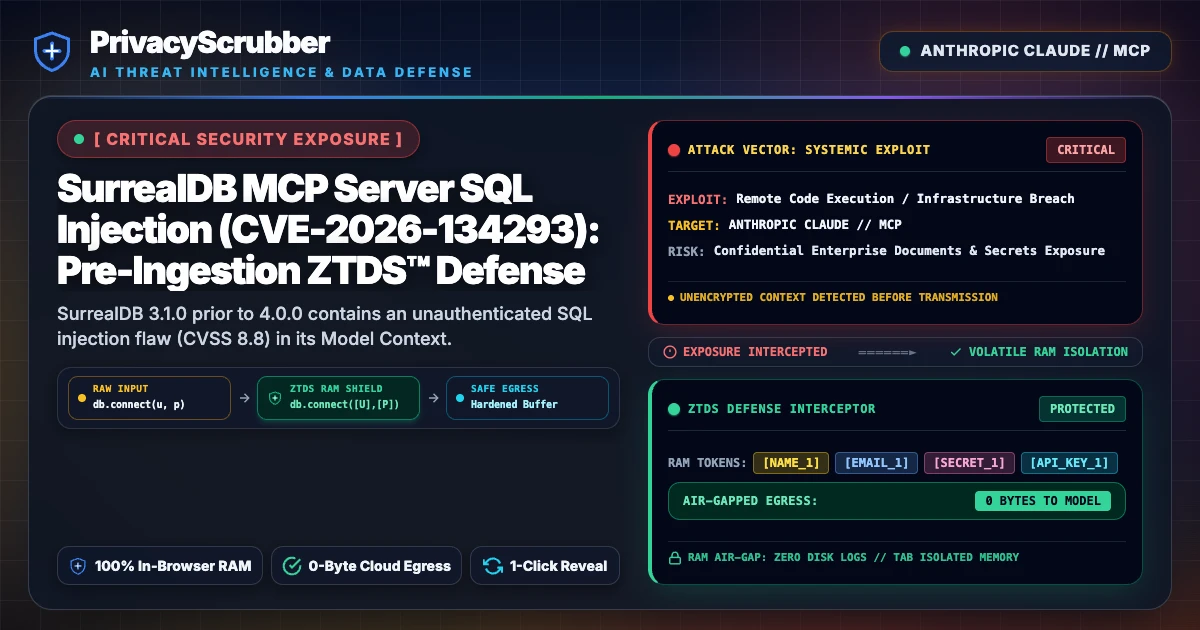
"SurrealDB 3.1.0 prior to 4.0.0 contains an unauthenticated SQL injection flaw (CVSS 8.8) in its Model Context Protocol (MCP) server identifier validator. Upgrade to SurrealDB 4.0.0 and enforce pre-ingestion ZTDS™ tokenization in local RAM so even compromised MCP queries encounter surrogate tokens instead of cleartext PII."
Zero-Hop Security Developer Pipeline
Intercept cve-2026-134293 directly inside tenant V8 RAM in <0.85ms via @privacyscrubber/sdk.
Technical Incident Analysis: SurrealDB MCP Server SQL Injection (CVE-2026-134293)
Published on November 21, 2026, CVE-2026-134293 (GHSA-cr79-9p8r-p5wx, CVSS v4.0 8.8 High) exposes a parser-differential SQL injection vulnerability inside the native Model Context Protocol (MCP) server bundled with SurrealDB 3.1.0 prior to 4.0.0. The flaw stems from a mismatch between the MCP server's identifier validator (consume_backtick_ident and validate_identifier) and the underlying SurrealQL execution engine: the validator terminates at the first backtick while disregarding escape characters that the SurrealQL parser honors. Consequently, an unauthenticated network caller or an AI agent manipulated via indirect prompt injection can supply MCP tool arguments containing an escaped backtick, escape the quoted identifier boundary, and run arbitrary SurrealQL statements. This failure highlights why AI Security Architecture must assume untrusted tool boundaries—mirroring privilege-escalation patterns observed in the Microsoft Agent Framework Hijack Advisory.
Enterprise Blast Radius & Compliance Impact (CVE-2026-134293)
Because SurrealDB is widely adopted as a unified operational, graph, and vector backend for enterprise RAG and agentic workflows, arbitrary SurrealQL execution over an exposed MCP interface threatens direct confidentiality compromise (VC:H) across customer records, corporate secrets, and embedded knowledge bases. Under GDPR Article 32 technical and organizational safeguards and Israel Protection of Privacy Law Amendment 13 Section 17 security duties, retaining cleartext direct identifiers inside agent-accessible stores magnifies statutory breach exposure and officer accountability when a query layer fails. Aligning RAG pipelines with our GDPR DSAR & RAG Compliance Guide provides a technical safe-harbor defense-in-depth layer alongside vendor patching, minimizing breach impact without falsely claiming legal exemption.
Zero-Trust RAM Mitigation for SurrealDB MCP Server SQL Injection (CVE-2026-134293)
Immediate remediation requires upgrading SurrealDB instances to version 4.0.0 or later and restricting network exposure of MCP endpoints. To neutralize the data-exfiltration blast radius across unpatched or future parser flaws, engineering teams should enforce the ZTDS™ (Zero-Trust Data Sanitization) black-box boundary at ingestion and tool invocation time. Using the headless PrivacyScrubber Developer SDK (@privacyscrubber/sdk, $299/mo or $2,990/yr) in backend ETL/RAG pipelines, teams tokenize sensitive PII, financial identifiers, and secrets in local volatile RAM before rows or embeddings ever enter SurrealDB. For interactive developer and analyst teams, PrivacyScrubber TEAMS ($99/mo flat) and our local Zero-Trust MCP Data Sanitization workflow ensure zero network egress of cleartext fields, while air-gapped Enterprise deployments operate entirely inside isolated VPCs.
Token-Safe Model Input for SurrealDB MCP Server SQL Injection (CVE-2026-134293)
Principal AI Systems Architect / MCP & Agentic Security Lead · ChatGPT & Enterprise LLMsInstruction (Principal AI Systems Architect / MCP & Agentic Security Lead): Process a client-tokenized dataset covering SurrealDB MCP Server SQL Injection (CVE-2026-134293). 1. Track entity relationships among [IP_ADDRESS_1], [AWS_KEY_1], [INTERNAL_HOSTNAME_1] inside this cve-2026-134293 record. 2. Spot operational or statutory gaps affecting surrealdb mcp sql injection. 3. Preserve all [IP_ADDRESS_1], [AWS_KEY_1], [INTERNAL_HOSTNAME_1] tokens verbatim to permit local RAM recovery.
Your Whole Team on Real Client Data. Safely. $99/mo Flat.
No per-seat pricing. No processor in the sanitization path. No IT portal. Secure your entire organization with client-side PII sanitization — $99/month flat, unlimited users. SOC 2 & HIPAA ready. Works in Airplane Mode.
Local RAM Proof for SurrealDB MCP Server SQL Injection (CVE-2026-134293)
Auditable workstation processing for SurrealDB MCP Server SQL Injection (CVE-2026-134293) (cve-2026-134293): 0 outbound bytes, isolated tab token dictionaries, and offline continuity.
ZTDS™ Routing Policy (SurrealDB MCP Server SQL Injection (CVE-2026-134293)): avoid transmitting unmasked cve-2026-134293 payloads; neutralize fields offline using https://privacyscrubber.com/?profile=security#ai, the Chrome Shield, or @privacyscrubber/mcp-server.
Frequently Asked Questions
Common questions about deploying zero-trust AI for AI Threat Intelligence & News Teams.
How does the SurrealDB MCP Server SQL Injection (CVE-2026-134293) expose enterprise data?
How does PrivacyScrubber reduce blast radius from CVE-2026-134293 alongside patching to SurrealDB 4.0.0?
How does client-side ZTDS™ prevent data exposure in SurrealDB MCP Server SQL Injection (CVE-2026-134293) scenarios?
What compliance evidence does PrivacyScrubber generate for CISO and DPO incident audits?
Related AI Threat Intelligence & Incident Reports
All Advisories →Microsoft Agent Framework Hijack: Stealing Azure & CI/CD Credentials
Malicious PyPI releases (1.26.1 and 1.26.2) of Microsoft's agent-framework package abused Python startup hooks to steal Azure Managed Identity tokens and CI/CD secrets. PrivacyScrubber's ZTDS™ local RAM architecture strips sensitive PII and inline credentials before data enters agent pipelines.
Cursor Coding Agent Trace Leak: Credential Pivot & Trojanized Extension
Cursor disclosed that a compromised vendor access key exposed historical coding agent traces containing unredacted API credentials, enabling an attacker to pivot into internal SaaS tools and distribute trojanized Claude Code extensions (2.1.312 and 2.1.313). Pre-inference ZTDS™ client-side RAM tokenization ensures developer prompts and agent logs never carry cleartext secrets to external storage.
AWS MCP Gateway Registry Flaws: Privilege Escalation & SSRF
AWS issued security bulletins 2026-179-AWS (CVE-2026-100307) and 2026-180-AWS (CVE-2026-125926) for mcp-gateway-registry, warning of registry administrator privilege escalation and non-blind SSRF reaching internal services. Pre-gateway ZTDS™ client-side RAM tokenization ensures compromised MCP control planes never hold cleartext PII or credentials.
GitBook AI Agent Security Breach: Crypto Docs Exposed
An AI agent exploited GitBook, leading to a significant security breach and exposure of sensitive cryptocurrency documentation. PrivacyScrubber halts such data exfiltration by enforcing client-side PII scrubbing within a zero-trust environment.