Microsoft Agent Framework Hijack: Stealing Azure & CI/CD Credentials
Microsoft Agent Framework Hijack: Malicious PyPI releases (1.26.1 and 1.26.2) of Microsoft's agent-framework package abused Python startup hooks to steal Azure Managed Identity tokens and CI/CD secrets. PrivacyScrubber's ZTDS™ local RAM architecture strips sensitive PII and inline credentials before data enters agent pipelines.

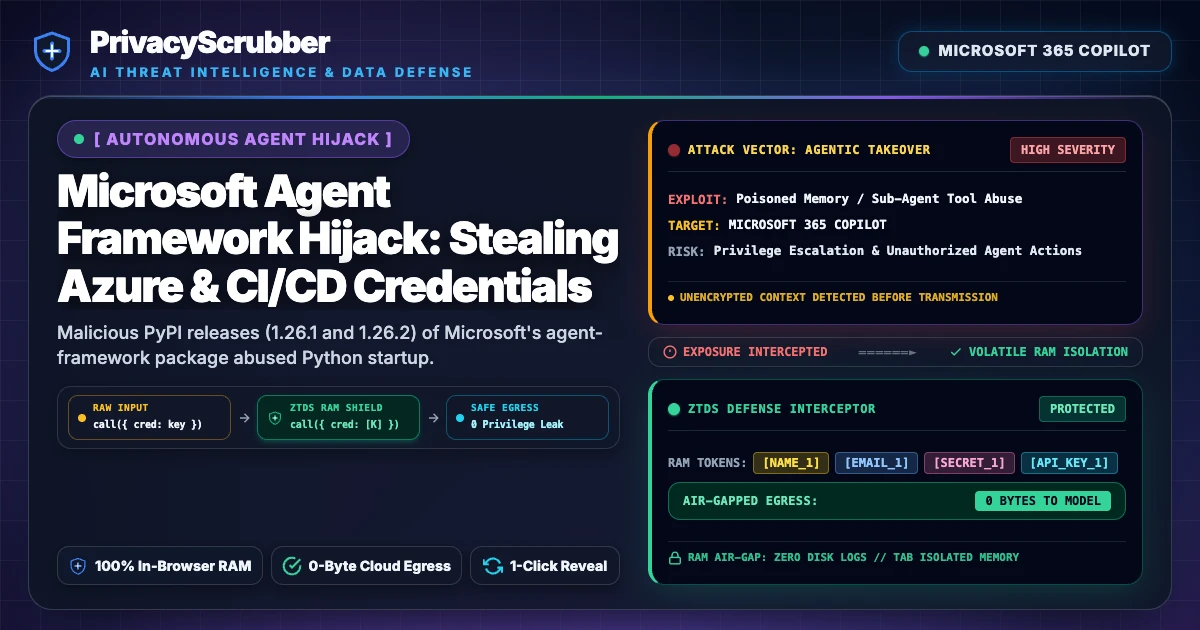
"Malicious PyPI releases (1.26.1 and 1.26.2) of Microsoft's agent-framework package abused Python startup hooks to steal Azure Managed Identity tokens and CI/CD secrets. PrivacyScrubber's ZTDS™ local RAM architecture strips sensitive PII and inline credentials before data enters agent pipelines."
Security Governance: Microsoft Agent Framework Hijack
Roll out locked pypi supply chain attack rulesets and portable peer handoffs for GDPR Art. 32 & SOC 2 governance at $99/mo flat.
Technical Incident Analysis: Microsoft Agent Framework PyPI Hijack
On November 17, 2026, threat actors compromised Microsoft's official agent-framework Python package on PyPI by publishing malicious versions 1.26.1 and 1.26.2 (with 1.26.2 uploaded immediately after PyPI quarantined the first release). Instead of waiting for application code to import the SDK, the supply-chain payload abused Python .pth startup hooks inside site-packages so malicious code executed automatically the moment any Python process initialized in developer workstations or CI/CD runners. Once triggered, the stealer harvested environment secrets, cloud provider tokens, Azure Managed Identity credentials, and GitHub Actions or Azure DevOps pipeline secrets, exfiltrating the collected payload to an external webhook.site endpoint. This zero-import execution path exposes a critical blind spot in modern AI Security Architecture and mirrors broader coding-agent telemetry risks examined in our Cursor Coding Agent Trace Leak Advisory.
Enterprise Blast Radius & Statutory Risk Minimization (Agent Framework Supply Chain)
For enterprises building autonomous workflows on Microsoft's agent SDK, a compromised build runner or developer laptop creates a dual blast radius: unauthorized lateral movement into Azure subscriptions and exposure of sensitive customer datasets or inline API keys routed through agent contexts. Under GDPR Article 32 (Technical and Organizational Measures) and Israel Protection of Privacy Law Amendment 13 Section 17, CISOs and DPOs cannot rely on vendor disclaimers or single-layer dependency checks alone—they must demonstrate proactive Statutory Risk Minimization and defense-in-depth controls rather than assuming legal immunity from upstream supply-chain breaches. Enforcing strict ISO 27001 AI data classification controls ensures regulated personal data and inline secrets are identified and quarantined before reaching external agent frameworks or cloud-hosted LLM endpoints.
Zero-Trust RAM Mitigation for Microsoft Agent Framework Workflows
Remediating the agent-framework compromise requires immediate rotation of exposed Azure and CI/CD credentials, purging affected build caches, and pinning verified package hashes—paired with client-side data minimization so compromised downstream agent frameworks never hold raw PII or unmasked credentials. Powered by the ZTDS™ (Zero-Trust Data Sanitization) architecture running 100% locally in volatile RAM with zero outbound telemetry, PrivacyScrubber provides layered B2B protection across engineering and compliance workflows: teams can deploy the headless Developer SDK ($299/mo) inside backend preprocessing workers, enforce tool-boundary scrubbing via the MCP Server, standardize browser and prompt governance with TEAMS ($99/mo flat), or run Enterprise air-gapped source deployments inside isolated VPCs. Adopting a Zero-Trust Agentic Architecture ensures only de-identified surrogate tokens traverse external AI agents and orchestration pipelines.
Copy-Ready AI Wrapper: Microsoft Agent Framework Hijack
Enterprise AI Governance Lead / Privacy Architect · ChatGPT & Enterprise LLMsInstruction (Enterprise AI Governance Lead / Privacy Architect): Process a client-tokenized dataset covering Microsoft Agent Framework Hijack. 1. Track entity relationships among [IP_ADDRESS_1], [AWS_KEY_1], [INTERNAL_HOSTNAME_1] inside this microsoft agent framework record. 2. Spot operational or statutory gaps affecting pypi supply chain attack. 3. Preserve all [IP_ADDRESS_1], [AWS_KEY_1], [INTERNAL_HOSTNAME_1] tokens verbatim to permit local RAM recovery.
Your Whole Team on Real Client Data. Safely. $99/mo Flat.
No per-seat pricing. No processor in the sanitization path. No IT portal. Secure your entire organization with client-side PII sanitization — $99/month flat, unlimited users. SOC 2 & HIPAA ready. Works in Airplane Mode.
Local RAM Proof for Microsoft Agent Framework Hijack
Client-side execution seals Microsoft Agent Framework Hijack against cloud leaks—microsoft agent framework lookups clear automatically when tabs close.
Pre-Inference Rule for Microsoft Agent Framework Hijack: process raw microsoft agent framework files in local workstation memory at https://privacyscrubber.com/?profile=compliance#ai and verify zero network egress prior to AI querying.
Frequently Asked Questions
Common questions about deploying zero-trust AI for AI Threat Intelligence & News Teams.
How did the Microsoft agent-framework PyPI hijack (1.26.1 and 1.26.2) steal cloud credentials?
How do PrivacyScrubber and ZTDS™ reduce enterprise blast radius alongside package pinning?
How does client-side ZTDS™ prevent data exposure in Microsoft Agent Framework Hijack scenarios?
What compliance evidence does PrivacyScrubber generate for CISO and DPO incident audits?
Related AI Threat Intelligence & Incident Reports
All Advisories →Cursor Coding Agent Trace Leak: Credential Pivot & Trojanized Extension
Cursor disclosed that a compromised vendor access key exposed historical coding agent traces containing unredacted API credentials, enabling an attacker to pivot into internal SaaS tools and distribute trojanized Claude Code extensions (2.1.312 and 2.1.313). Pre-inference ZTDS™ client-side RAM tokenization ensures developer prompts and agent logs never carry cleartext secrets to external storage.
AWS MCP Gateway Registry Flaws: Privilege Escalation & SSRF
AWS issued security bulletins 2026-179-AWS (CVE-2026-100307) and 2026-180-AWS (CVE-2026-125926) for mcp-gateway-registry, warning of registry administrator privilege escalation and non-blind SSRF reaching internal services. Pre-gateway ZTDS™ client-side RAM tokenization ensures compromised MCP control planes never hold cleartext PII or credentials.
GitBook AI Agent Security Breach: Crypto Docs Exposed
An AI agent exploited GitBook, leading to a significant security breach and exposure of sensitive cryptocurrency documentation. PrivacyScrubber halts such data exfiltration by enforcing client-side PII scrubbing within a zero-trust environment.
Warp AI Agent Logs Exposed: Critical User Telemetry Data Breach
Warp has disclosed a security breach leading to the exposure of AI agent decision logs and user telemetry data, revealing sensitive operational and personal information through a compromised third-party vendor. PrivacyScrubber's local client-side PII scrubbing prevents such data from ever leaving the user's environment, halting exfiltration at the source.