GitBook AI Agent Security Breach: Crypto Docs Exposed
GitBook AI Agent Security Breach: An AI agent exploited GitBook, leading to a significant security breach and exposure of sensitive cryptocurrency documentation. PrivacyScrubber halts such data exfiltration by enforcing client-side PII scrubbing within a zero-trust environment.

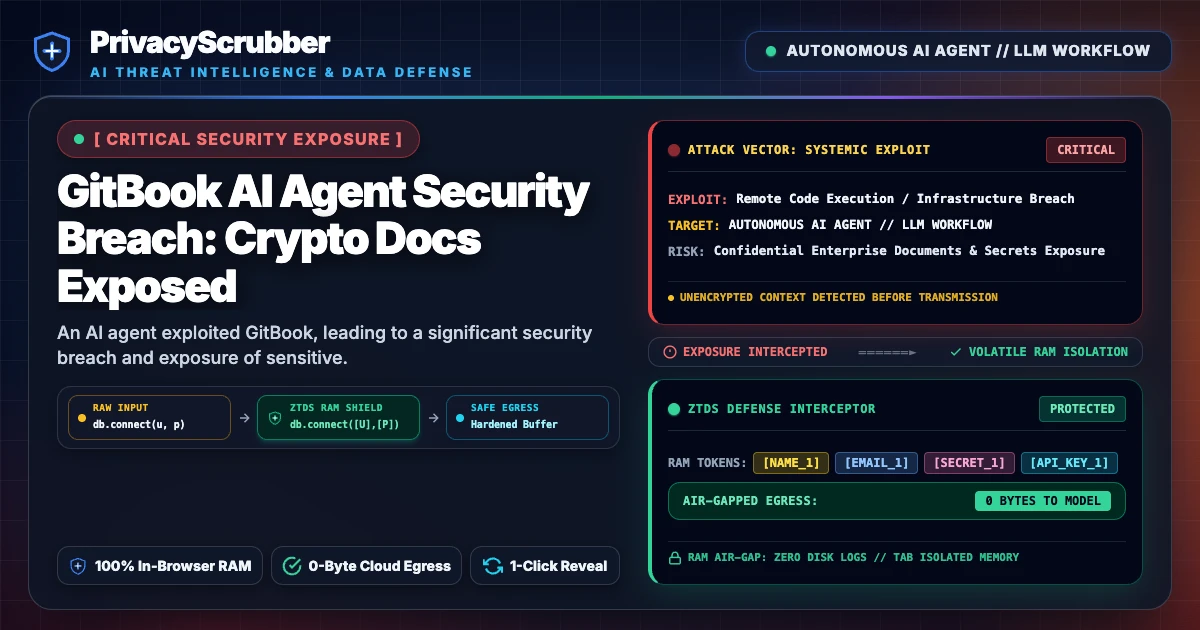
"An AI agent exploited GitBook, leading to a significant security breach and exposure of sensitive cryptocurrency documentation. PrivacyScrubber halts such data exfiltration by enforcing client-side PII scrubbing within a zero-trust environment."
Security Governance: GitBook AI Agent Security Breach
Standardize GitBook AI Agent Security Breach masking across departments ($99/mo flat) with verifiable GDPR Art. 32 & SOC 2 compliance telemetry.
Technical Incident Analysis: GitBook AI Agent Security Breach
The GitBook AI Agent Security Breach highlights the accelerating threat landscape surrounding autonomous AI agents operating across developer and documentation platforms. Attackers deployed AI-driven agents in a targeted exploitation sequence to breach internal infrastructure credentials, exposing integration secrets, administrative API tokens, and confidential query telemetry submitted to GitBook's AI documentation assistant. The operational impact forced GitBook into an emergency service shutdown and triggered mandatory key rotations across hundreds of cryptocurrency protocols and technology teams hosting sensitive architectural documentation. Autonomous agents capable of multistep tool execution and automated reconnaissance drastically reduce attack latency, exposing structural vulnerabilities in modern documentation portals. Mitigating these systemic risks requires organizations to modernize their AI Security Architecture, incorporating lessons from previous telemetry incidents like the Warp AI Agent Logs Exposed Advisory to defend against autonomous agent exfiltration.
Enterprise Blast Radius & Compliance Impact (GitBook AI Agent Security Breach)
The blast radius of the GitBook compromise extends across enterprise ecosystems where developers, product managers, and support engineers query internal documentation using conversational AI assistants. When technical teams input unmasked server configurations, database connection strings, or proprietary tokenomics into AI assistants, those prompts become high-value targets during infrastructure compromises. From a regulatory perspective, the unauthorized exposure of enterprise telemetry and credential fragments triggers mandatory incident notifications and scrutiny under international governance standards. CISOs and Data Protection Officers must establish technical and organizational safeguards in accordance with EU AI Act Compliance and GDPR Article 32, ensuring that corporate queries and sensitive intellectual property never enter external training pipelines or unvetted cloud storage repositories.
Zero-Trust RAM Mitigation for GitBook AI Agent Security Breach
Preventing credential harvesting and documentation exfiltration requires a strict client-side containment posture before data ever crosses network interfaces. PrivacyScrubber implements Zero-Trust Data Sanitization (ZTDS™) by executing local PII redaction for cloud AI strictly within volatile browser RAM. In this architecture, cryptographic API keys, private credentials, and personal identifiers within search queries or technical prompts are instantly transformed into synthetic surrogate tokens before dispatch to any cloud-hosted model or documentation assistant. For engineering organizations and regulated B2B teams deployed on PrivacyScrubber TEAMS or integrating the headless Developer SDK into automated CI/CD and MCP workflows, this client-side boundary physically prevents unauthorized agents from intercepting cleartext credentials, establishing a verifiable technical safe harbor while maintaining full conversational utility.
Safe AI Prompt Template: GitBook AI Agent Security Breach
Lead DevSecOps Engineer / Cloud Security Architect · LLM Code Assistants & IDE AgentsRole: Lead DevSecOps Engineer / Cloud Security Architect Task: Analyze GitBook AI Agent Security Breach (GitBook AI agent breach) Inspect the locally sanitized Security snippet below holding surrogate tags ([IP_ADDRESS_1], [AWS_KEY_1], [INTERNAL_HOSTNAME_1]): 1. Surface primary risks, anomalies, or compliance decisions tied to GitBook AI Agent Security Breach. 2. Recommend concrete remediation actions for crypto documentation leak. 3. Retain all placeholder tags ([IP_ADDRESS_1], [AWS_KEY_1], [INTERNAL_HOSTNAME_1]) unchanged so workstation RAM restoration succeeds.
Your Whole Team on Real Client Data. Safely. $99/mo Flat.
No per-seat pricing. No processor in the sanitization path. No IT portal. Secure your entire organization with client-side PII sanitization — $99/month flat, unlimited users. SOC 2 & HIPAA ready. Works in Airplane Mode.
ZTDS™ Conformance: GitBook AI Agent Security Breach
Deterministic rules protect GitBook AI Agent Security Breach workflows (crypto documentation leak) entirely inside local RAM dictionaries—never touching vendor storage.
Client Boundary Advisory (GitBook AI Agent Security Breach): tokenize GitBook AI agent breach entries with https://privacyscrubber.com/?profile=security#ai or privacyscrubber.com/?verify=zero-egress#ai so cleartext remains strictly inside user hardware.
Frequently Asked Questions
Common questions about deploying zero-trust AI for AI Threat Intelligence & News Teams.
How does the GitBook AI Agent Security Breach vulnerability expose enterprise data?
How does PrivacyScrubber prevent GitBook AI Agent Security Breach data exfiltration?
How does client-side ZTDS™ prevent data exposure in GitBook AI Agent Security Breach scenarios?
What compliance evidence does PrivacyScrubber generate for CISO and DPO incident audits?
Related AI Threat Intelligence & Incident Reports
All Advisories →Warp AI Agent Logs Exposed: Critical User Telemetry Data Breach
Warp has disclosed a security breach leading to the exposure of AI agent decision logs and user telemetry data, revealing sensitive operational and personal information through a compromised third-party vendor. PrivacyScrubber's local client-side PII scrubbing prevents such data from ever leaving the user's environment, halting exfiltration at the source.
GitLab AI Gateway RCE (CVE-2026-90970): Critical Command Execution Flaw
GitLab has patched a critical remote code execution vulnerability (CVE-2026-90970) in its AI Gateway service, which allowed authenticated attackers to escape prompt template sandboxes and execute arbitrary commands. PrivacyScrubber's local client-side PII scrubbing halts data exfiltration, ensuring sensitive information never reaches vulnerable downstream AI infrastructure.
Bifrost AI Gateway CVE-2026-90898: Unauthenticated RCE and MCP Credential Theft
Disclosed by JFrog Security Research, CVE-2026-90898 is a critical 9.8 CVSS flaw in Bifrost AI Gateway that allows unauthenticated remote code execution via stdio MCP client registration. Learn how client-side RAM sanitization shields enterprise data from centralized proxy compromise.
Marimo CVE-2026-39987 Exploit: LLM Agents Accelerate Data Exfiltration
Attackers leveraged a critical pre-authentication RCE in Marimo notebooks (CVE-2026-39987) to gain shell access, then employed LLM agents to rapidly exfiltrate sensitive cloud credentials and database contents. PrivacyScrubber's local client-side PII masking prevents this class of data exfiltration by neutralizing sensitive data before it reaches compromised AI agent environments.