VS Code MCP Elicitation Code Injection (CVE-2026-120779): Zero-Trust Agent Defense
VS Code MCP Elicitation Code Injection (CVE-2026-120779): Microsoft Visual Studio Code versions prior to 1.145.3 contain a critical code injection vulnerability (CVE-2026-120779, CVSS 9.6, CWE-94) in Model Context Protocol (MCP) elicitation fallback notifications. Upgrade immediately to VS Code 1.145.3+ and enforce local RAM ZTDS™ tokenization across MCP Server, Developer SDK, and TEAMS workflows.

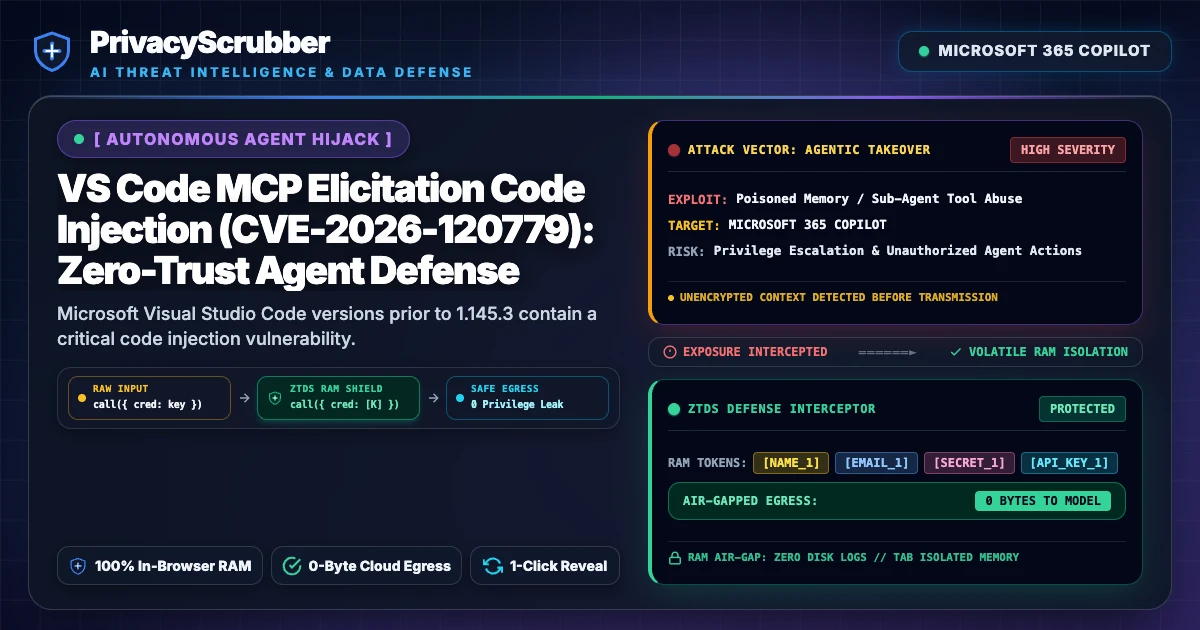
"Microsoft Visual Studio Code versions prior to 1.145.3 contain a critical code injection vulnerability (CVE-2026-120779, CVSS 9.6, CWE-94) in Model Context Protocol (MCP) elicitation fallback notifications. Upgrade immediately to VS Code 1.145.3+ and enforce local RAM ZTDS™ tokenization across MCP Server, Developer SDK, and TEAMS workflows."
Embeddable Node/WASM Guard for VS Code MCP Elicitation Code Injection (CVE-2026-120779)
Deploy reversible CVE-2026-120779 masking inside Node.js, TypeScript, and RAG chunkers at zero egress cost.
Technical Incident Analysis: VS Code MCP Elicitation Code Injection (CVE-2026-120779)
Published in November 2026 and updated November 19, 2026, CVE-2026-120779 (CVSS 9.6 Critical, CWE-94) exposes an arbitrary code execution pathway inside Microsoft Visual Studio Code versions prior to 1.145.3. The vulnerability targets the fallback notification handling for Model Context Protocol (MCP) elicitation requests—the protocol mechanism allowing an MCP server to prompt a developer for supplementary input during an agent workflow. Because untrusted server-supplied message strings were not strictly sanitized as literal text in the fallback UI path, a malicious or compromised remote MCP server could embed crafted command links directly inside workbench notifications; clicking the prompt triggers local code execution under the user's workstation privileges. This attack chain demonstrates why AI Security Architecture must treat every external MCP server response as untrusted input—reinforcing the server-side parser risks documented in our SurrealDB MCP Server SQL Injection (CVE-2026-134293) Advisory.
Enterprise Blast Radius & Statutory Safe Harbor (CVE-2026-120779)
Modern software engineering workstations routinely hold local environment files, cloud IAM sessions, customer support dumps, and production schemas alongside active MCP tool connections. A single compromised third-party MCP endpoint abusing elicitation notifications can pivot directly from an IDE prompt into lateral enterprise credential theft and regulated data exposure. Under GDPR Article 32 Technical and Organizational Measures and Israel Protection of Privacy Law Amendment 13 Section 17 information-security obligations, CISOs and DPOs cannot rely solely on reactive IDE patch cycles or claim legal exemption from developer-endpoint incidents; they must document proactive Statutory Risk Minimization and defense-in-depth controls. Enforcing verifiable pre-transmission controls aligned with ISO 27001 A.8.11 generative AI data masking minimizes cleartext personal data and secrets residing inside agent-accessible IDE contexts.
Zero-Trust RAM Mitigation for VS Code MCP Elicitation Workflows (CVE-2026-120779)
Immediate remediation requires updating all developer workstations to Visual Studio Code 1.145.3 or later—which renders MCP elicitation fallback messages strictly as literal text—and auditing active remote MCP server allowlists. As a complementary zero-egress boundary, ZTDS™ (Zero-Trust Data Sanitization) operates as an autonomous black-box protection layer strictly in local volatile RAM with zero outbound network transmission. Engineering organizations enforce Zero-Trust MCP Data Sanitization locally via the PrivacyScrubber MCP Server, instrument automated CI/CD and RAG workers with the headless Developer SDK ($299/mo or $2,990/yr), standardize browser and prompt governance across engineering squads with TEAMS ($99/mo flat, unlimited seats), or isolate regulated environments using air-gapped Enterprise deployments.
Sanitized Security Prompt — VS Code MCP Elicitation Code Injection (CVE-2026-120779)
Principal AI Systems Architect / MCP & Agentic Security Lead · ChatGPT & Enterprise LLMsAct as a Principal AI Systems Architect / MCP & Agentic Security Lead evaluating VS Code MCP Elicitation Code Injection (CVE-2026-120779). Context: Sensitive CVE-2026-120779 and Visual Studio Code MCP vulnerability identifiers were isolated locally ([IP_ADDRESS_1], [AWS_KEY_1], [INTERNAL_HOSTNAME_1]). 1. Distill the central findings inside the redacted excerpt. 2. Outline a structured response plan for VS Code MCP Elicitation Code Injection (CVE-2026-120779). 3. Keep every bracketed token ([IP_ADDRESS_1], [AWS_KEY_1], [INTERNAL_HOSTNAME_1]) intact for 1-click detokenization.
Your Whole Team on Real Client Data. Safely. $99/mo Flat.
No per-seat pricing. No processor in the sanitization path. No IT portal. Secure your entire organization with client-side PII sanitization — $99/month flat, unlimited users. SOC 2 & HIPAA ready. Works in Airplane Mode.
Zero-Egress Verification — VS Code MCP Elicitation Code Injection (CVE-2026-120779)
By holding VS Code MCP Elicitation Code Injection (CVE-2026-120779) token dictionaries strictly inside tab memory, Visual Studio Code MCP vulnerability compliance avoids subprocessor transfers entirely.
Local Handling Invariant (VS Code MCP Elicitation Code Injection (CVE-2026-120779)): isolate CVE-2026-120779 inside browser memory first via https://privacyscrubber.com/?profile=security#ai or privacyscrubber.com/?verify=zero-egress#ai before sending tokenized text upstream.
Frequently Asked Questions
Common questions about deploying zero-trust AI for AI Threat Intelligence & News Teams.
How does the VS Code MCP Elicitation Code Injection (CVE-2026-120779) exploit developer workstations?
How does PrivacyScrubber reduce blast radius alongside patching CVE-2026-120779 in VS Code 1.145.3?
How does client-side ZTDS™ prevent data exposure in VS Code MCP Elicitation Code Injection (CVE-2026-120779) scenarios?
What compliance evidence does PrivacyScrubber generate for CISO and DPO incident audits?
Related AI Threat Intelligence & Incident Reports
All Advisories →SurrealDB MCP Server SQL Injection (CVE-2026-134293): Pre-Ingestion ZTDS™ Defense
SurrealDB 3.1.0 prior to 4.0.0 contains an unauthenticated SQL injection flaw (CVSS 8.8) in its Model Context Protocol (MCP) server identifier validator. Upgrade to SurrealDB 4.0.0 and enforce pre-ingestion ZTDS™ tokenization in local RAM so even compromised MCP queries encounter surrogate tokens instead of cleartext PII.
Microsoft Agent Framework Hijack: Stealing Azure & CI/CD Credentials
Malicious PyPI releases (1.26.1 and 1.26.2) of Microsoft's agent-framework package abused Python startup hooks to steal Azure Managed Identity tokens and CI/CD secrets. PrivacyScrubber's ZTDS™ local RAM architecture strips sensitive PII and inline credentials before data enters agent pipelines.
Cursor Coding Agent Trace Leak: Credential Pivot & Trojanized Extension
Cursor disclosed that a compromised vendor access key exposed historical coding agent traces containing unredacted API credentials, enabling an attacker to pivot into internal SaaS tools and distribute trojanized Claude Code extensions (2.1.312 and 2.1.313). Pre-inference ZTDS™ client-side RAM tokenization ensures developer prompts and agent logs never carry cleartext secrets to external storage.
AWS MCP Gateway Registry Flaws: Privilege Escalation & SSRF
AWS issued security bulletins 2026-179-AWS (CVE-2026-100307) and 2026-180-AWS (CVE-2026-125926) for mcp-gateway-registry, warning of registry administrator privilege escalation and non-blind SSRF reaching internal services. Pre-gateway ZTDS™ client-side RAM tokenization ensures compromised MCP control planes never hold cleartext PII or credentials.