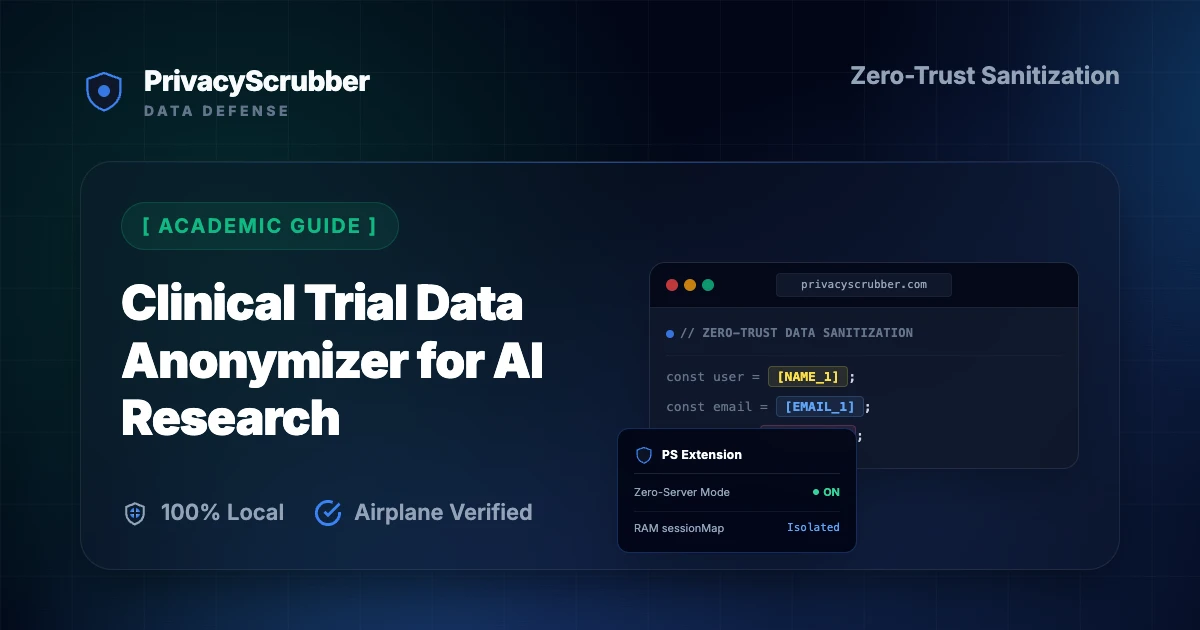
Every unmasked prompt involving Clinical Trial Data Anonymizer for AI Research risks violating IRB human-subjects protocols and FERPA rules when analyzing qualitative transcripts with LLMs, exposing professors, phd students, clinical researchers, and university administrators to FERPA (student records) audit findings. Deploying PrivacyScrubber Academic & IRB De-Identification Profile isolates clinical trial AI privacy in volatile memory, mapping sensitive literals to [PARTICIPANT_1], [STUDENT_ID_1], [COHORT_1], [EMAIL_1] in sub-millisecond CPU time with zero sub-processor custody.
Data Leakage Risks in Clinical Trial Data Anonymizer for AI Research for Researchers and Educators
Securing Clinical Trial Data Anonymizer for AI Research requires intercepting clinical trial AI privacy and patient research AI safety before a single packet leaves the workstation or VPC. As professors, phd students, clinical researchers, and university administrators adopt ChatGPT for writing assistance, AI literature review tools, and research analysis platforms, violating IRB human-subjects protocols and FERPA rules when analyzing qualitative transcripts with LLMs undermines traditional perimeter DLP. Our Academic & IRB Research AI privacy guides provide the architectural blueprint for keeping Academic & IRB Research identifiers strictly in volatile memory.
Uploading or prompting with raw clinical trial AI privacy datasets exposes Academic & IRB Research records to third-party retention and inspection logs. De-identify clinical trial participant data locally before AI-assisted analysis. Redact sensitive PII in local browser RAM with zero server cloud egress. Because violating IRB human-subjects protocols and FERPA rules when analyzing qualitative transcripts with LLMs, professors, phd students, clinical researchers, and university administrators need deterministic pre-prompt masking for Clinical Trial Data Anonymizer for AI Research.
Deterministic RAM Redaction Blueprint: Clinical Trial Data Anonymizer for AI Research
To scale Clinical Trial Data Anonymizer for AI Research without triggering FERPA (student records) audit exceptions, organizations must eliminate uploading participant data, student records, or preliminary research findings to AI tools, violating protocol consent scope and IRB-mandated data handling. PrivacyScrubber enforces pre-prompt sanitization for clinical trial AI privacy using PrivacyScrubber Academic & IRB De-Identification Profile, mapping regulated fields to [PARTICIPANT_1], [STUDENT_ID_1], [COHORT_1], [EMAIL_1] in local RAM.
Unlike destructive masking that ruins prompt coherence, deterministic ZTDS™ tokens preserve entity co-reference across trial data anonymization and zero egress ai security. Output detokenization happens instantaneously on the local device with 0.00 bytes of cloud storage.
ZTDS™ Field Governance for Clinical Trial Data Anonymizer for AI Research Workflows
Use the classification table below to separate high-liability Clinical Trial Data Anonymizer for AI Research attributes (tokenized in RAM) from safe analytical parameters (kept in cleartext):
| Document Field / Attribute | Action | RAM Surrogate | Statutory & Analytical Rationale |
|---|---|---|---|
| Contact & Routing Endpoints (patient research AI safety) | REDACT | [COHORT_1] | Eliminates cross-record linkage and unauthorized sub-processor indexing during Clinical Trial Data Anonymizer for AI Research. |
| Authentication, Account & Reference Keys (trial data anonymization) | REDACT | [STUDENT_ID_1] | Blocks credential, account, or case-number exfiltration across Academic & IRB Research telemetry and vendor logs. |
| Primary Identity & Subject Records (clinical trial AI privacy) | REDACT | [PARTICIPANT_1] | FERPA (student records) direct identifier guard: prevents cloud LLMs from associating Clinical Trial Data Anonymizer for AI Research prompts with real individuals. |
| Relative Timelines, Status Codes & Error Severities | PRESERVE | Cleartext (ISO Sequence) | Maintains chronological ordering and root-cause diagnostics across trial data anonymization workflows. |
| Quantitative Metrics, Ratios & Aggregated Totals | PRESERVE | Cleartext ($ / % / Deltas) | Enables accurate mathematical reasoning and variance analysis for Clinical Trial Data Anonymizer for AI Research without identity exposure. |
| Structural Schema, Keys & Clinical Trial Data Anonymizer for AI Research Syntax | PRESERVE | Cleartext Structure | Required so the LLM can parse clinical trial AI privacy hierarchy, JSON/SQL grammar, and document formatting. |
Bijective Prompt Blueprint for Clinical Trial Data Anonymizer for AI Research
Use this persona template alongside your ZTDS™ sanitized text to prevent model refusal and ensure 1-click local detokenization:
You are an enterprise Academic & IRB Research specialist reviewing a sanitized Clinical Trial Data Anonymizer for AI Research payload.
All regulated identifiers for clinical trial AI privacy and trial data anonymization have been replaced in local RAM with deterministic ZTDS™ tokens ([PARTICIPANT_1], [STUDENT_ID_1], [COHORT_1], [EMAIL_1]).

Tasks:
1. Evaluate the structural logic, anomalies, and operational metrics in the Clinical Trial Data Anonymizer for AI Research input.
2. Formulate actionable recommendations aligned with FERPA (student records).
3. Keep all bracketed tokens ([PARTICIPANT_1], [STUDENT_ID_1], [COHORT_1], [EMAIL_1]) verbatim so local reverse detokenization restores exact values.

[PASTE SANITIZED CLINICAL TRIAL DATA ANONYMIZER FOR AI RESEARCH PAYLOAD HERE]
How Institutional Review Boards (IRBs) Enforce Zero-Egress on Clinical Trial Data Anonymizer for AI Research
For professors, phd students, clinical researchers, and university administrators operating under FERPA (student records), Common Rule (45 CFR 46) for human subjects research, and IRB institutional requirements, Clinical Trial Data Anonymizer for AI Research demands verifiable zero-egress controls. Referencing FERPA & AI allows teams to standardize clinical trial AI privacy tokenization ([PARTICIPANT_1], [STUDENT_ID_1], [COHORT_1], [EMAIL_1]) without slowing down daily Academic & IRB Research execution.
Running AI on Clinical Trial Data Anonymizer for AI Research Without Sending Real Identifiers
Through PrivacyScrubber Academic & IRB De-Identification Profile, PrivacyScrubber provides a zero-egress firewall for Clinical Trial Data Anonymizer for AI Research. Before any clinical trial AI privacy or trial data anonymization text reaches ChatGPT for writing assistance, AI literature review tools, and research analysis platforms, deterministic tokenization substitutes sensitive strings with [PARTICIPANT_1], [STUDENT_ID_1], [COHORT_1], [EMAIL_1] in volatile memory, fulfilling handling LLM hallucinations in reversible PII scrubbing with zero external server dependencies.
To prove 0-byte network leakage for Clinical Trial Data Anonymizer for AI Research, run PrivacyScrubber Academic & IRB De-Identification Profile with Airplane Mode active. All clinical trial AI privacy and trial data anonymization identifiers convert to [PARTICIPANT_1], [STUDENT_ID_1], [COHORT_1], [EMAIL_1] in local RAM, meeting the technical verification criteria of redact claim numbers and policy ids for AI.