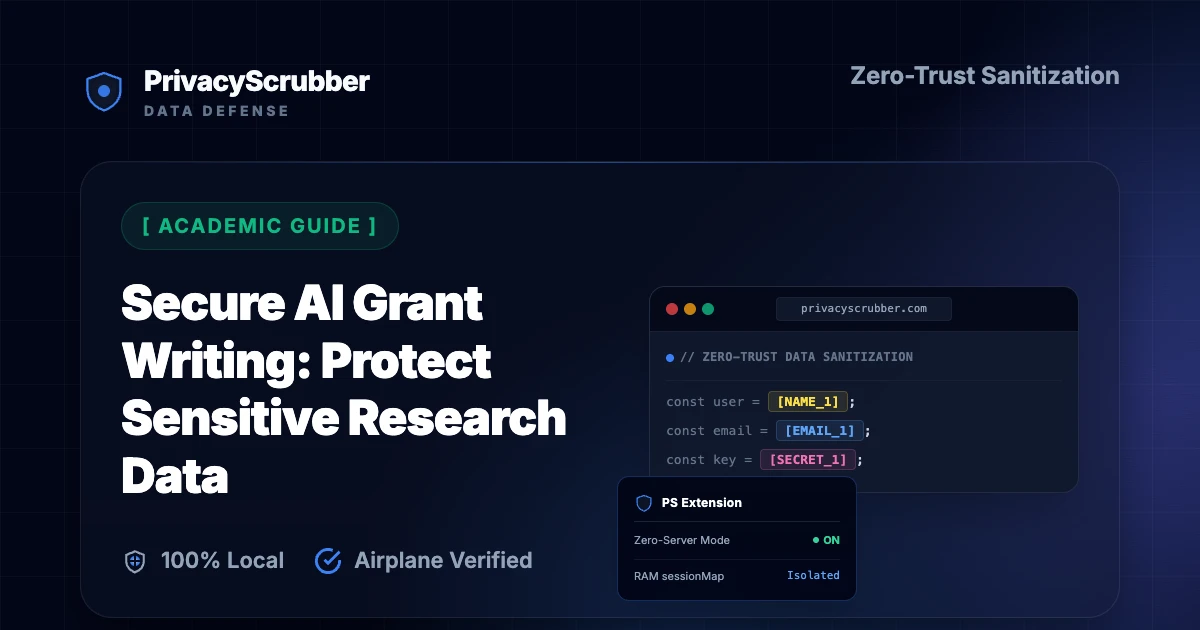
When professors, phd students, clinical researchers, and university administrators handle Secure AI Grant Writing, relying on violating IRB human-subjects protocols and FERPA rules when analyzing qualitative transcripts with LLMs leaves raw identifiers exposed before policy controls can fire. Executing deterministic ZTDS™ tokenization via PrivacyScrubber Academic & IRB De-Identification Profile converts sensitive fields into reversible surrogates ([PARTICIPANT_1], [STUDENT_ID_1], [COHORT_1], [EMAIL_1]) in <1ms of local RAM under FERPA (student records) risk-minimization safeguards.
Why Unmasked Prompts Break Secure AI Grant Writing Security
Architecting Secure AI Grant Writing for FERPA (student records) readiness means stopping raw grant writing AI privacy data at the ingestion layer. When professors, phd students, clinical researchers, and university administrators use ChatGPT for writing assistance, AI literature review tools, and research analysis platforms, violating IRB human-subjects protocols and FERPA rules when analyzing qualitative transcripts with LLMs creates an unmonitored egress path. Our Academic & IRB Research AI privacy guides show how PrivacyScrubber Academic & IRB De-Identification Profile enforces 0-byte server leakage for research grant AI tool.
Whenever professors, phd students, clinical researchers, and university administrators analyze Secure AI Grant Writing using ChatGPT for writing assistance, AI literature review tools, and research analysis platforms, unmasked grant writing AI privacy strings risk entering external model logs. Use AI for grant writing without exposing preliminary research data. Redact sensitive PII in local browser RAM with zero server egress or cloud leaks. Stopping uploading participant data, student records, or preliminary research findings to AI tools, violating protocol consent scope and IRB-mandated data handling requires intercepting research grant AI tool before any cloud request is formed.
Deterministic RAM Redaction Blueprint: Secure AI Grant Writing
To scale Secure AI Grant Writing without triggering FERPA (student records) audit exceptions, organizations must eliminate uploading participant data, student records, or preliminary research findings to AI tools, violating protocol consent scope and IRB-mandated data handling. PrivacyScrubber enforces pre-prompt sanitization for grant writing AI privacy using PrivacyScrubber Academic & IRB De-Identification Profile, mapping regulated fields to [PARTICIPANT_1], [STUDENT_ID_1], [COHORT_1], [EMAIL_1] in local RAM.
Unlike destructive masking that ruins prompt coherence, deterministic ZTDS™ tokens preserve entity co-reference across research grant AI tool and zero egress ai security. Output detokenization happens instantaneously on the local device with 0.00 bytes of cloud storage.
Field-by-Field Sanitization Rule for Secure AI Grant Writing
This field-level specification ensures Secure AI Grant Writing prompts retain 100% mathematical and semantic accuracy with zero cleartext PII egress:
| Document Field / Attribute | Action | RAM Surrogate | Statutory & Analytical Rationale |
|---|---|---|---|
| Primary Identity & Subject Records (grant writing AI privacy) | REDACT | [PARTICIPANT_1] | FERPA (student records) direct identifier guard: prevents cloud LLMs from associating Secure AI Grant Writing prompts with real individuals. |
| Multi-Line Counterparty & Organization Names (Academic & IRB Research) | REDACT | [PARTICIPANT_1] | Preserves co-reference continuity across multi-paragraph Secure AI Grant Writing prompts without leaking names. |
| Embedded Secrets, Tax IDs & Session Identifiers in Secure AI Grant Writing | REDACT | [PARTICIPANT_1], [STUDENT_ID_1] | Intercepts high-liability literals before violating IRB human-subjects protocols and FERPA rules when analyzing qualitative transcripts with LLMs. |
| Structural Schema, Keys & Secure AI Grant Writing Syntax | PRESERVE | Cleartext Structure | Required so the LLM can parse grant writing AI privacy hierarchy, JSON/SQL grammar, and document formatting. |
| Anonymized Category Labels & Department Roles | PRESERVE | Cleartext (Academic & IRB Research Role) | Retains organizational context for Secure AI Grant Writing while keeping personal identities inside local RAM. |
| Non-Identifying Domain Logic & Operational Instructions | PRESERVE | Cleartext Narrative | Preserves 100% of analytical instructions for NSF NIH AI safety so local detokenization yields production-ready output. |
Token-Preserving AI Prompt for Secure AI Grant Writing
Pair this structured instruction with your tokenized Secure AI Grant Writing payload so ChatGPT, Claude, or Gemini preserves all bracketed surrogates for local RAM restoration:
You are an enterprise Academic & IRB Research specialist reviewing a sanitized Secure AI Grant Writing payload.
All regulated identifiers for grant writing AI privacy and research grant AI tool have been replaced in local RAM with deterministic ZTDS™ tokens ([PARTICIPANT_1], [STUDENT_ID_1], [COHORT_1], [EMAIL_1]).

Tasks:
1. Evaluate the structural logic, anomalies, and operational metrics in the Secure AI Grant Writing input.
2. Formulate actionable recommendations aligned with FERPA (student records).
3. Keep all bracketed tokens ([PARTICIPANT_1], [STUDENT_ID_1], [COHORT_1], [EMAIL_1]) verbatim so local reverse detokenization restores exact values.

[PASTE SANITIZED SECURE AI GRANT WRITING PAYLOAD HERE]
Why Institutional Review Boards (IRBs) Flag Unmasked Prompts in Secure AI Grant Writing
The statutory mandate governing Academic & IRB Research workflows (FERPA (student records), Common Rule (45 CFR 46) for human subjects research, and IRB institutional requirements) leaves zero margin for uploading participant data, student records, or preliminary research findings to AI tools, violating protocol consent scope and IRB-mandated data handling. By combining Secure AI Grant Writing controls with the patterns in translate and process academic interviews with privacy, organizations tokenize grant writing AI privacy and NSF NIH AI safety locally so external LLMs never take custody of regulated PII.
Zero-Trust Academic & Research Tokenization for Secure AI Grant Writing
PrivacyScrubber hardens Secure AI Grant Writing by combining 30 specialized industry profiles with PrivacyScrubber Academic & IRB De-Identification Profile. Every grant writing AI privacy identifier is tokenized into [PARTICIPANT_1], [STUDENT_ID_1], [COHORT_1], [EMAIL_1] inside volatile RAM before network dispatch—paralleling NIST 800-53 AI data minimization—and restored locally via 1-Click Reveal or SDK detokenization.
Our Airplane Mode Standard gives CISOs and DPOs deterministic proof for Secure AI Grant Writing: sever network access, tokenize grant writing AI privacy into [PARTICIPANT_1], [STUDENT_ID_1], [COHORT_1], [EMAIL_1] in <1ms, and confirm zero outbound traffic in accordance with anonymize loss amounts and settlement reserves.