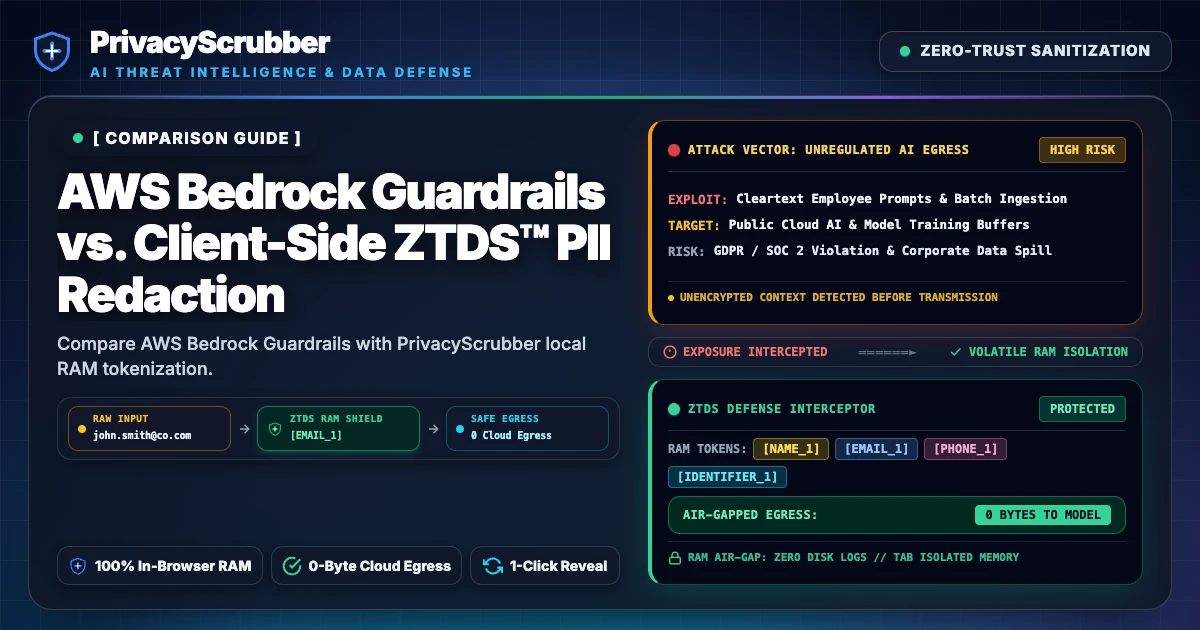
AWS Bedrock Guardrails charges per 1,000 text units inspected, only executes after your sensitive payload has already traversed the network into AWS cloud infrastructure, and performs one-way masking that permanently destroys entity relationships needed for downstream code or contract generation. PrivacyScrubber executes in <1ms in local browser or Node.js RAM for a flat rate, preventing raw PII from ever leaving your endpoint while providing 100% reversible detokenization.
What Security and Platform Evaluators Send to AI During AWS Bedrock Guardrails vs. Client-Side ZTDS™ PII Redaction
Managing sensitive workflows around AWS Bedrock Guardrails vs. Client-Side ZTDS™ PII Redaction dictates how modern AI Privacy Architecture organizations scale generative AI. Feeding raw aws bedrock guardrails pii redaction vs local or bedrock guardrails pricing alternative records into ChatGPT, Claude, Gemini, OpenAI/Anthropic SDKs, LangChain, CrewAI, and RAG pipelines introduces routing cleartext prompts to cloud DLP proxies or maintaining heavy 500MB+ Python/Docker microservices instead of <1ms in-memory sanitization. Through our AI Privacy Architecture AI privacy guides, security and engineering leads enforce a zero-egress client boundary using @privacyscrubber/sdk (<0.8ms RAM), Python MCP & Chrome Extension.
Why do conventional security gateways fail on AWS Bedrock Guardrails vs. Client-Side ZTDS™ PII Redaction? Compare AWS Bedrock Guardrails with PrivacyScrubber local RAM tokenization. Eliminate per-token cloud inspection fees and enable reversible unscrubbing. When ctos, cisos, software engineers, ai architects, and data protection officers handle aws bedrock guardrails pii redaction vs local and reversible pii masking aws bedrock, destructive one-way [REDACTED] masking and heavy 500MB+ NLP sidecar containers leaves sensitive context vulnerable to routing cleartext prompts to cloud DLP proxies or maintaining heavy 500MB+ Python/Docker microservices instead of <1ms in-memory sanitization.
Architectural Comparison: AWS Bedrock Guardrails vs. Local ZTDS™
| Capability | PrivacyScrubber (ZTDS™ Local RAM) | AWS Bedrock Guardrails |
|---|---|---|
| Execution Boundary | 100% Client / Local Node RAM (0 Egress) | Server-Side inside AWS Cloud Region |
| Reversible Detokenization | Yes ([NAME_1] ↔ Original in RAM) | No (Destructive one-way masking/blocking) |
| Multi-Cloud / Multi-LLM | Works with OpenAI, Claude, Gemini, Bedrock | Locked to AWS Bedrock endpoints only |
| Pricing Model | Flat-rate ($99 TEAMS / $299 SDK) | Metered per 1,000 text units inspected |
Field-by-Field Sanitization Rule for AWS Bedrock Guardrails vs. Client-Side ZTDS™ PII Redaction
Use the classification table below to separate high-liability AWS Bedrock Guardrails vs. Client-Side ZTDS™ PII Redaction attributes (tokenized in RAM) from safe analytical parameters (kept in cleartext):
| Document Field / Attribute | Action | RAM Surrogate | Statutory & Analytical Rationale |
|---|---|---|---|
| Multi-Line Counterparty & Organization Names (AI Privacy Architecture) | REDACT | [NAME_1] | Preserves co-reference continuity across multi-paragraph AWS Bedrock Guardrails vs. Client-Side ZTDS™ PII Redaction prompts without leaking names. |
| Embedded Secrets, Tax IDs & Session Identifiers in AWS Bedrock Guardrails vs. Client-Side ZTDS™ PII Redaction | REDACT | [NAME_1], [ID_1] | Intercepts high-liability literals before destructive one-way [REDACTED] masking and heavy 500MB+ NLP sidecar containers. |
| Secondary Regulated Attributes (client side ztds vs bedrock dlp) | REDACT | [SECRET_1] | Satisfies GDPR Article 25 & 32 data minimization by replacing sensitive AI Privacy Architecture strings in local RAM. |
| Anonymized Category Labels & Department Roles | PRESERVE | Cleartext (AI Privacy Architecture Role) | Retains organizational context for AWS Bedrock Guardrails vs. Client-Side ZTDS™ PII Redaction while keeping personal identities inside local RAM. |
| Non-Identifying Domain Logic & Operational Instructions | PRESERVE | Cleartext Narrative | Preserves 100% of analytical instructions for reversible pii masking aws bedrock so local detokenization yields production-ready output. |
| Regulatory Clause Citations & Policy Taxonomy (GDPR Article 25 & 32) | PRESERVE | Cleartext Citations | Allows the AI model to map AWS Bedrock Guardrails vs. Client-Side ZTDS™ PII Redaction findings against statutory controls and audit frameworks. |
Safe LLM Prompt Template for AWS Bedrock Guardrails vs. Client-Side ZTDS™ PII Redaction
Pair this structured instruction with your tokenized AWS Bedrock Guardrails vs. Client-Side ZTDS™ PII Redaction payload so ChatGPT, Claude, or Gemini preserves all bracketed surrogates for local RAM restoration:
Objective: Process AWS Bedrock Guardrails vs. Client-Side ZTDS™ PII Redaction (aws bedrock guardrails pii redaction vs local) with zero cloud data leakage.
All personal and corporate identifiers are represented by bijective tokens ([NAME_1], [ID_1], [EMAIL_1], [SECRET_1]).

Steps:
1. Audit the quantitative and logical parameters of the AWS Bedrock Guardrails vs. Client-Side ZTDS™ PII Redaction record.
2. Produce a concise executive summary tailored for ctos, cisos, software engineers, ai architects, and data protection officers.
3. Maintain all [NAME_1], [ID_1], [EMAIL_1], [SECRET_1] markers in-place for deterministic local RAM reveal.

[PASTE SANITIZED PAYLOAD HERE]
Objective: Process AWS Bedrock Guardrails vs. Client-Side ZTDS™ PII Redaction (aws bedrock guardrails pii redaction vs local) with zero cloud data leakage.
All personal and corporate identifiers are represented by bijective tokens ([NAME_1], [ID_1], [EMAIL_1], [SECRET_1]).

Steps:
1. Audit the quantitative and logical parameters of the AWS Bedrock Guardrails vs. Client-Side ZTDS™ PII Redaction record.
2. Produce a concise executive summary tailored for ctos, cisos, software engineers, ai architects, and data protection officers.
3. Maintain all [NAME_1], [ID_1], [EMAIL_1], [SECRET_1] markers in-place for deterministic local RAM reveal.

[PASTE SANITIZED PAYLOAD HERE]
Statutory Liability for Security and Platform Evaluators: AWS Bedrock Guardrails vs. Client-Side ZTDS™ PII Redaction
Legal and GRC reviews of AWS Bedrock Guardrails vs. Client-Side ZTDS™ PII Redaction focus on GDPR Article 25 & 32, HIPAA Safe Harbor (45 CFR § 164.514), SOC 2 Type II, and ZTDS™ RFC v1.0. To prevent routing cleartext prompts to cloud DLP proxies or maintaining heavy 500MB+ Python/Docker microservices instead of <1ms in-memory sanitization while preserving AI utility for aws bedrock guardrails pii redaction vs local and bedrock guardrails pricing alternative, enterprises implement the client-side redaction controls outlined in google Vertex AI & cloud DLP vs. local RAM PII sanitization.
How to Sanitize AWS Bedrock Guardrails vs. Client-Side ZTDS™ PII Redaction in Local RAM (Zero Cloud Egress)
Instead of routing AWS Bedrock Guardrails vs. Client-Side ZTDS™ PII Redaction through high-latency cloud proxies, PrivacyScrubber sanitizes aws bedrock guardrails pii redaction vs local and bedrock guardrails pricing alternative locally via @privacyscrubber/sdk (<0.8ms RAM), Python MCP & Chrome Extension. Surrogate tokens ([NAME_1], [ID_1], [EMAIL_1], [SECRET_1]) preserve full syntactic structure for ChatGPT, Claude, Gemini, OpenAI/Anthropic SDKs, LangChain, CrewAI, and RAG pipelines, adhering to the zero-trust design in secure proposal AI.
To prove 0-byte network leakage for AWS Bedrock Guardrails vs. Client-Side ZTDS™ PII Redaction, run @privacyscrubber/sdk (<0.8ms RAM), Python MCP & Chrome Extension with Airplane Mode active. All aws bedrock guardrails pii redaction vs local and bedrock guardrails pricing alternative identifiers convert to [NAME_1], [ID_1], [EMAIL_1], [SECRET_1] in local RAM, meeting the technical verification criteria of deploy AI for enterprise teams securely.