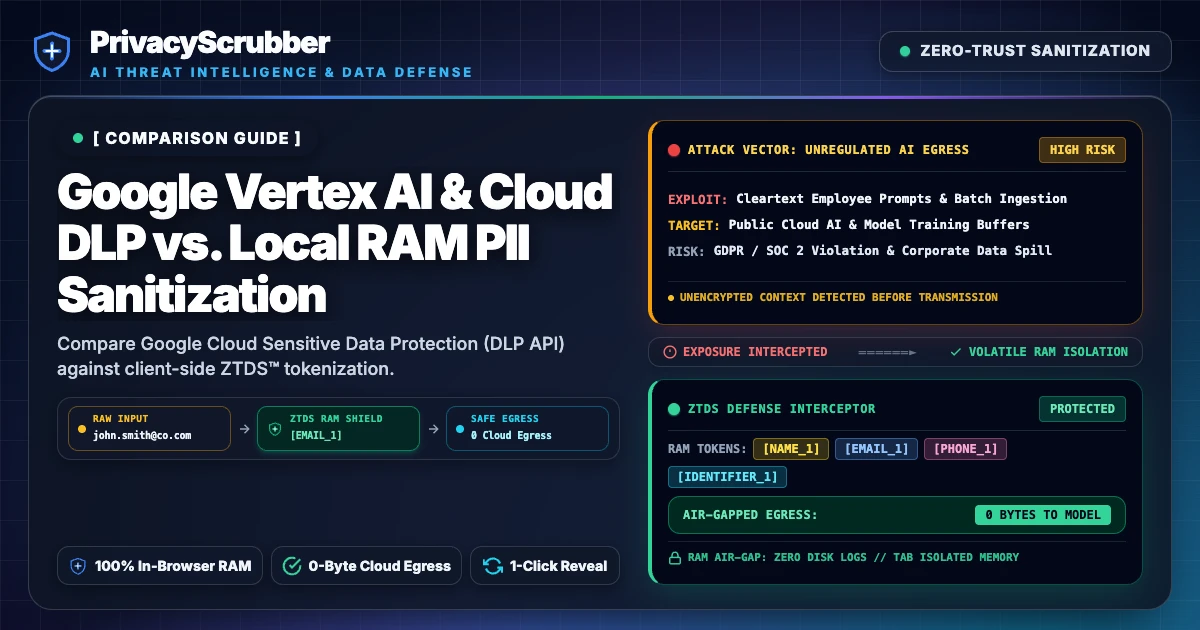
Calling Google Cloud Sensitive Data Protection (projects.content.deidentify) before every LLM prompt requires transmitting raw cleartext PII over the network to a GCP regional endpoint, adding 100ms–250ms of HTTP round-trip latency and metered per-gigabyte inspection costs. Executing deterministic ZTDS™ tokenization in local browser or Node.js RAM eliminates the extra network hop entirely (<1ms execution) and keeps cleartext PII off external cloud infrastructure.
What Security and Platform Evaluators Send to AI During Google Vertex AI & Cloud DLP vs. Local RAM PII Sanitization
Managing sensitive workflows around Google Vertex AI & Cloud DLP vs. Local RAM PII Sanitization dictates how modern AI Privacy Architecture organizations scale generative AI. Feeding raw google cloud dlp vs local pii scrubber or vertex ai sensitive data protection alternative records into ChatGPT, Claude, Gemini, OpenAI/Anthropic SDKs, LangChain, CrewAI, and RAG pipelines introduces routing cleartext prompts to cloud DLP proxies or maintaining heavy 500MB+ Python/Docker microservices instead of <1ms in-memory sanitization. Through our AI Privacy Architecture AI privacy guides, security and engineering leads enforce a zero-egress client boundary using @privacyscrubber/sdk (<0.8ms RAM), Python MCP & Chrome Extension.
Processing google cloud dlp vs local pii scrubber and deidentifycontent api latency in third-party LLMs without endpoint tokenization directly triggers routing cleartext prompts to cloud DLP proxies or maintaining heavy 500MB+ Python/Docker microservices instead of <1ms in-memory sanitization. Compare Google Cloud Sensitive Data Protection (DLP API) against client-side ZTDS™ tokenization. Cut network latency from 150ms to <1ms in local memory. For ctos, cisos, software engineers, ai architects, and data protection officers, relying on downstream API promises fails to address destructive one-way [REDACTED] masking and heavy 500MB+ NLP sidecar containers.
Why Cloud DLP Proxies Fail the Zero-Egress Standard
For DPOs and CISOs operating under strict data sovereignty mandates, transmitting cleartext healthcare or financial records to an external Cloud DLP REST endpoint still constitutes network egress of regulated data. By shifting sanitization into the client browser or local application memory—just as detailed in our Enterprise Cloud DLP comparison—organizations achieve true zero-egress compliance at a fraction of the cost.
Field-by-Field Sanitization Rule for Google Vertex AI & Cloud DLP vs. Local RAM PII Sanitization
This field-level specification ensures Google Vertex AI & Cloud DLP vs. Local RAM PII Sanitization prompts retain 100% mathematical and semantic accuracy with zero cleartext PII egress:
| Document Field / Attribute | Action | RAM Surrogate | Statutory & Analytical Rationale |
|---|---|---|---|
| Authentication, Account & Reference Keys (vertex ai sensitive data protection alternative) | REDACT | [ID_1] | Blocks credential, account, or case-number exfiltration across AI Privacy Architecture telemetry and vendor logs. |
| Primary Identity & Subject Records (google cloud dlp vs local pii scrubber) | REDACT | [NAME_1] | GDPR Article 25 & 32 direct identifier guard: prevents cloud LLMs from associating Google Vertex AI & Cloud DLP vs. Local RAM PII Sanitization prompts with real individuals. |
| Multi-Line Counterparty & Organization Names (AI Privacy Architecture) | REDACT | [NAME_1] | Preserves co-reference continuity across multi-paragraph Google Vertex AI & Cloud DLP vs. Local RAM PII Sanitization prompts without leaking names. |
| Quantitative Metrics, Ratios & Aggregated Totals | PRESERVE | Cleartext ($ / % / Deltas) | Enables accurate mathematical reasoning and variance analysis for Google Vertex AI & Cloud DLP vs. Local RAM PII Sanitization without identity exposure. |
| Structural Schema, Keys & Google Vertex AI & Cloud DLP vs. Local RAM PII Sanitization Syntax | PRESERVE | Cleartext Structure | Required so the LLM can parse google cloud dlp vs local pii scrubber hierarchy, JSON/SQL grammar, and document formatting. |
| Anonymized Category Labels & Department Roles | PRESERVE | Cleartext (AI Privacy Architecture Role) | Retains organizational context for Google Vertex AI & Cloud DLP vs. Local RAM PII Sanitization while keeping personal identities inside local RAM. |
Safe LLM Prompt Template for Google Vertex AI & Cloud DLP vs. Local RAM PII Sanitization
Pair this structured instruction with your tokenized Google Vertex AI & Cloud DLP vs. Local RAM PII Sanitization payload so ChatGPT, Claude, or Gemini preserves all bracketed surrogates for local RAM restoration:
Objective: Process Google Vertex AI & Cloud DLP vs. Local RAM PII Sanitization (google cloud dlp vs local pii scrubber) with zero cloud data leakage.
All personal and corporate identifiers are represented by bijective tokens ([NAME_1], [ID_1], [EMAIL_1], [SECRET_1]).

Steps:
1. Audit the quantitative and logical parameters of the Google Vertex AI & Cloud DLP vs. Local RAM PII Sanitization record.
2. Produce a concise executive summary tailored for ctos, cisos, software engineers, ai architects, and data protection officers.
3. Maintain all [NAME_1], [ID_1], [EMAIL_1], [SECRET_1] markers in-place for deterministic local RAM reveal.

[PASTE SANITIZED PAYLOAD HERE]
Statutory Liability for Security and Platform Evaluators: Google Vertex AI & Cloud DLP vs. Local RAM PII Sanitization
Legal and GRC reviews of Google Vertex AI & Cloud DLP vs. Local RAM PII Sanitization focus on GDPR Article 25 & 32, HIPAA Safe Harbor (45 CFR § 164.514), SOC 2 Type II, and ZTDS™ RFC v1.0. To prevent routing cleartext prompts to cloud DLP proxies or maintaining heavy 500MB+ Python/Docker microservices instead of <1ms in-memory sanitization while preserving AI utility for google cloud dlp vs local pii scrubber and vertex ai sensitive data protection alternative, enterprises implement the client-side redaction controls outlined in privacyscrubber vs ChatGPT.
How to Sanitize Google Vertex AI & Cloud DLP vs. Local RAM PII Sanitization in Local RAM (Zero Cloud Egress)
Operating 100% in local memory via @privacyscrubber/sdk (<0.8ms RAM), Python MCP & Chrome Extension, PrivacyScrubber strips regulated google cloud dlp vs local pii scrubber and deidentifycontent api latency literals from Google Vertex AI & Cloud DLP vs. Local RAM PII Sanitization payloads before they touch ChatGPT, Claude, Gemini, OpenAI/Anthropic SDKs, LangChain, CrewAI, and RAG pipelines. This bijective token workflow ([NAME_1], [ID_1], [EMAIL_1], [SECRET_1]) satisfies chat log safety and zeroizes automatically on session close.
Our Airplane Mode Standard gives CISOs and DPOs deterministic proof for Google Vertex AI & Cloud DLP vs. Local RAM PII Sanitization: sever network access, tokenize google cloud dlp vs local pii scrubber into [NAME_1], [ID_1], [EMAIL_1], [SECRET_1] in <1ms, and confirm zero outbound traffic in accordance with centralized AI governance.