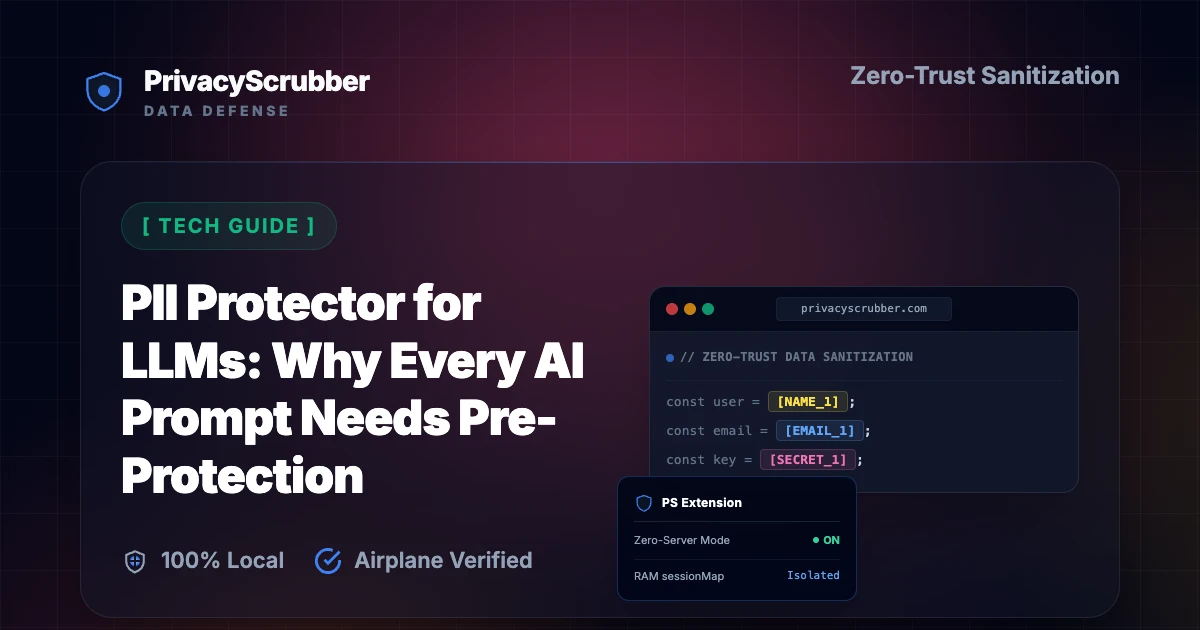
Why does PII Sanitization & PII Protector for LLMs trigger GDPR Article 25 (privacy by design) scrutiny? Because browser-based AI copilots and workspace plugins indexing internal runbooks and customer identifiers. Using PrivacyScrubber Chrome Extension & @privacyscrubber/sdk, ctos, privacy engineers, dpos, and technical compliance professionals tokenize pii sanitization and pii scrubber for llm into format-preserving surrogates ([EMAIL_1], [IP_1], [SECRET_1], [NAME_1]) inside local RAM before any cloud LLM request is serialized.
Data Leakage Risks in PII Sanitization & PII Protector for LLMs for Technology Teams
Achieving verifiable data protection for PII Sanitization & PII Protector for LLMs is a foundational requirement when ctos, privacy engineers, dpos, and technical compliance professionals integrate ChatGPT API, Claude API, LangChain, and custom LLM integrations. Because browser-based AI copilots and workspace plugins indexing internal runbooks and customer identifiers, unmasked pii sanitization payloads create immediate exposure across AI Privacy Engineering perimeters. Our AI Privacy Engineering AI privacy guides detail how to isolate pii scrubber for llm in local RAM before any cloud API call occurs.
Passing unmasked pii sanitization payloads into ChatGPT API, Claude API, LangChain, and custom LLM integrations bypasses traditional endpoint controls and creates technical misconfigurations that allow PII to enter AI systems through logs, APIs, regex mismatches, or vector store indexing. Client-side PII sanitization and PII scrubber for LLM inputs prevents data leaks before prompts reach ChatGPT or Claude with zero cloud egress. Eliminating this exposure for PII Sanitization & PII Protector for LLMs requires replacing raw literals with [EMAIL_1], [IP_1], [SECRET_1], [NAME_1] in local memory.
Enforcing GDPR Article 25 (privacy by design) Technical Safeguards on PII Sanitization & PII Protector for LLMs
Client-side PII sanitization and PII scrubber for LLM inputs prevents data leaks before prompts reach ChatGPT or Claude with zero cloud egress. Standard perimeter firewalls cannot parse unstructured pii sanitization text pasted into browser chat boxes or serialized into agent tool calls, leading to browser-based AI copilots and workspace plugins indexing internal runbooks and customer identifiers. PrivacyScrubber resolves this at the source with PrivacyScrubber Chrome Extension & @privacyscrubber/sdk.
Every sensitive attribute across pii scrubber for llm and PII protector for LLM is substituted with format-preserving tokens ([EMAIL_1], [IP_1], [SECRET_1], [NAME_1]) in volatile RAM (~0.4ms). Upstream LLMs reason over clean symbolic structures, and authentic identifiers are re-hydrated locally on response under GDPR Article 25 (privacy by design).
What to Redact vs. Preserve in PII Sanitization & PII Protector for LLMs
To maintain LLM analytical context while avoiding cloud data breaches, apply this deterministic field mapping in local RAM before submitting PII Sanitization & PII Protector for LLMs prompts:
| Payload Element | Policy | ZTDS™ Token | Compliance & Reasoning Impact |
|---|---|---|---|
| Primary Identity & Subject Records (pii sanitization) | REDACT | [EMAIL_1] | GDPR Article 25 (privacy by design) direct identifier guard: prevents cloud LLMs from associating PII Sanitization & PII Protector for LLMs prompts with real individuals. |
| Multi-Line Counterparty & Organization Names (AI Privacy Engineering) | REDACT | [EMAIL_1] | Preserves co-reference continuity across multi-paragraph PII Sanitization & PII Protector for LLMs prompts without leaking names. |
| Embedded Secrets, Tax IDs & Session Identifiers in PII Sanitization & PII Protector for LLMs | REDACT | [EMAIL_1], [IP_1] | Intercepts high-liability literals before browser-based AI copilots and workspace plugins indexing internal runbooks and customer identifiers. |
| Structural Schema, Keys & PII Sanitization & PII Protector for LLMs Syntax | PRESERVE | Cleartext Structure | Required so the LLM can parse pii sanitization hierarchy, JSON/SQL grammar, and document formatting. |
| Anonymized Category Labels & Department Roles | PRESERVE | Cleartext (AI Privacy Engineering Role) | Retains organizational context for PII Sanitization & PII Protector for LLMs while keeping personal identities inside local RAM. |
| Non-Identifying Domain Logic & Operational Instructions | PRESERVE | Cleartext Narrative | Preserves 100% of analytical instructions for PII protector for LLM so local detokenization yields production-ready output. |
Zero-Trust System Prompt: PII Sanitization & PII Protector for LLMs
Pair this structured instruction with your tokenized PII Sanitization & PII Protector for LLMs payload so ChatGPT, Claude, or Gemini preserves all bracketed surrogates for local RAM restoration:
System Role: AI Privacy Engineering Compliance & Technical Analyst for PII Sanitization & PII Protector for LLMs.
Input State: Pre-sanitized in volatile memory under GDPR Article 25 (privacy by design) safeguards ([EMAIL_1], [IP_1], [SECRET_1], [NAME_1]).

Deliverables:
1. Analyze relationships between [EMAIL_1] and [IP_1] within the pii sanitization workflow.
2. Highlight any policy, schema, or execution gaps related to PII protector for LLM.
3. Preserve every [EMAIL_1], [IP_1], [SECRET_1], [NAME_1] tag intact in your output for 1-click local re-hydration.

[PASTE SANITIZED PAYLOAD HERE]
How IT and InfoSec Governance Teams Enforce Zero-Egress on PII Sanitization & PII Protector for LLMs
Auditors evaluating PII Sanitization & PII Protector for LLMs under GDPR Article 25 (privacy by design) look for verifiable technical safeguards (GDPR Article 25 (privacy by design), NIST Privacy Framework, and emerging AI governance standards (EU AI Act)). Following the architecture in use AI without fear ensures that ctos, privacy engineers, dpos, and technical compliance professionals eliminate browser-based AI copilots and workspace plugins indexing internal runbooks and customer identifiers by keeping raw pii sanitization dictionaries isolated on the endpoint.
Running AI on PII Sanitization & PII Protector for LLMs Without Sending Real Identifiers
PrivacyScrubber hardens PII Sanitization & PII Protector for LLMs by combining 30 specialized industry profiles with PrivacyScrubber Chrome Extension & @privacyscrubber/sdk. Every pii sanitization identifier is tokenized into [EMAIL_1], [IP_1], [SECRET_1], [NAME_1] inside volatile RAM before network dispatch—paralleling sanitize excel & financial datasets before LLM data analysis—and restored locally via 1-Click Reveal or SDK detokenization.
Verifying PII Sanitization & PII Protector for LLMs under GDPR Article 25 (privacy by design) requires no trust assumptions: enable Airplane Mode, execute local sanitization on pii sanitization, and inspect your network sockets for 0.00 bytes of egress. This empirical verification matches the benchmark in kafka stream PII sanitization worker.