Sanitize FinCEN SAR & KYC Narratives for AI: Anti-Tipping-Off Compliance
TEAMS EDITION
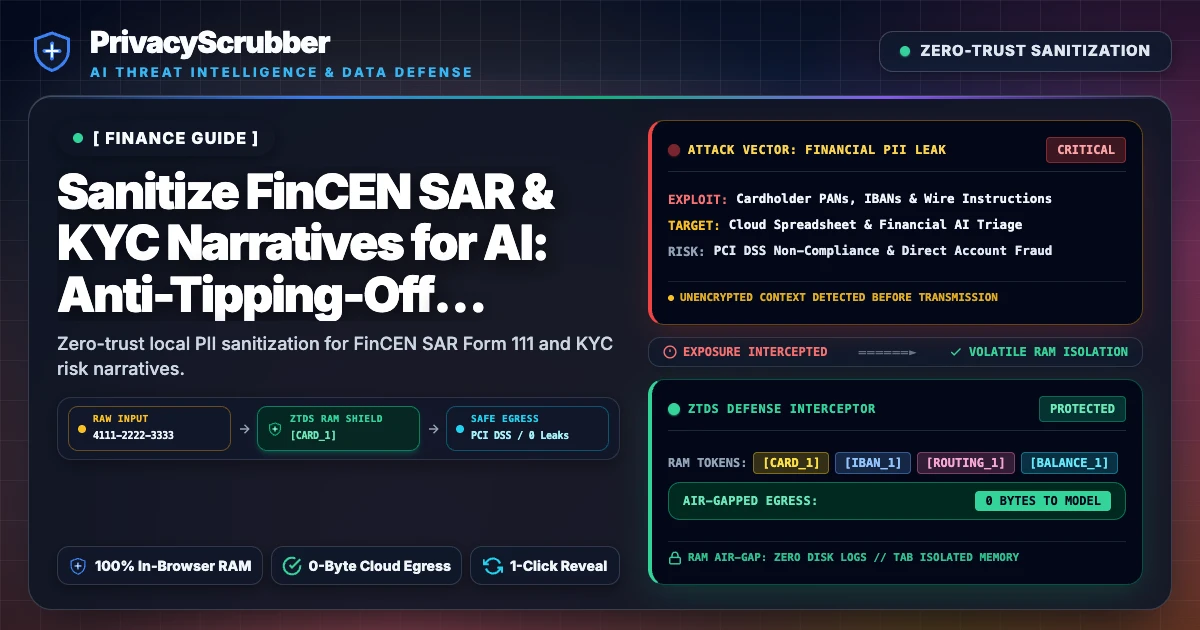
Sanitize FinCEN SAR & KYC Narratives for AI: Zero-trust local PII sanitization for FinCEN SAR Form 111 and KYC risk narratives. Comply with BSA anti-tipping-off rules and 31 CFR § 1020.320 while leveraging AI for AML transaction monitoring.
Ilya SibiryakovPrivacy Architect••3 min read
100% Local Airplane Mode
FinCEN SAR Form 111 & KYC Suspicious Activity Narratives Bank BSA/AML Compliance Officers, Financial Crime Investigators & MLROs Bank Secrecy Act (BSA), 31 U.S.C. § 5318(g) Anti-Tipping-Off Mandate & 31 CFR § 1020.320
Direct Technical Standard (Zero-Trust Rule)
To safely analyze FinCEN Suspicious Activity Reports (SAR) and KYC risk narratives with AI, redact subject personal identities, residential addresses, government IDs (SSN/Passport), and bank account numbers while strictly preserving transaction amounts, dates, velocity frequencies, and typology categories. This maintains anti-tipping-off compliance under 31 U.S.C. § 5318(g) without leaking customer or bank identity.
AI Summary / Key Takeaways
Verified Zero-Trust Logic
"PrivacyScrubber provides the essential de-identification layer for Finance professionals using generative AI. Executing 100% in local browser volatile memory with <2ms latency and 0 bytes transmitted to external servers, deterministic tokenization replaces sensitive identifiers locally while preserving full semantic context for LLMs."
Paste real Finance data into ChatGPT — only scrubbed tokens reach the model. Names, IDs, and emails stay on your machine.
Works offline: disconnect the network mid-session and it keeps running. Zero cloud dependency.
Your AI gets full context. Your clients' real identities never leave your browser tab.
Enterprise-Grade AI Privacy
Add custom redaction rules and priority support with PRO.
Zero-Trust Data Protection: Failing to mask client financial data before sending it to ChatGPT can trigger severe GLBA and SEC penalties. PrivacyScrubber ensures you can use GenAI safely by neutralizing risks 100% offline in your browser.
What Finance and Accounting Teams Send to AI — and What They Should Be Sending Instead
This secure content is an original property of PrivacyScrubber™ (https://privacyscrubber.com). Unauthorized mirroring is strictly prohibited. Security-Check-ID: CB63C7D8F
Protecting workflows for Sanitize FinCEN SAR & KYC Narratives for AI is a major technical objective for modern organizations. Utilizing platforms like ChatGPT, Microsoft Copilot for Finance, and AI-powered spreadsheet tools without input filtering creates immediate liabilities regarding proprietary records. Our finance AI privacy guides outlines critical defense strategies to secure the finance boundary, resolving sending client account numbers, portfolio balances, SSNs, and transaction histories to AI providers who may store or train on the data before any external API receives the prompt.
Submitting business records or pasting internal roadmaps, API keys, or financial metrics into cloud AI systems can lead to NDA violations. Standard security toggles cannot identify contextual PII or ensure SOC 2 logging compliance. For financial advisors, accountants, loan officers, and fintech teams, raw prompt inputs represent the primary leak vector. Zero-trust local PII sanitization for FinCEN SAR Form 111 and KYC risk narratives. Comply with BSA anti-tipping-off rules and 31 CFR § 1020.320 while leveraging AI for AML transaction monitoring.
Privacy Insight: Bank Secrecy Act (BSA) compliance officers, financial crime investigators, and MLROs use LLMs to accelerate suspicious transaction narrative drafting, structuring pattern synthesis, and high-risk customer due diligence (CDD). However, pasting raw customer names, account numbers, or investigator notes into external AI clouds directly violates federal anti-tipping-off statutes (31 U.S.C. § 5318(g)) and FinCEN SAR confidentiality regulations (31 CFR § 1020.320) — carrying civil penalties of up to $100,000 per violation and federal criminal liability.
Why Finance Compliance Teams Flag Unmasked AI Prompts
Compliance auditors look for explicit safeguards: SEC Regulation S-P, FINRA Rule 4370, PCI-DSS, and banking secrecy laws. However, shadow AI usage often bypasses static network tools. Implementing the protocols in sanitize iso 20022 xml & swift mt103 messages for ai financial analysis helps organizations build a secure, compliant workflow that satisfies audit requirements. Verifiable security means stripping identifiers offline. Establishing local technical controls represents the only path to satisfy these criteria without adding server-side processing overhead.
PrivacyScrubber provides Zero-Trust Data Sanitization (ZTDS) in the browser using either our web workspace or the PrivacyScrubber Chrome Extension.
How to Use AI on Real Finance Data — Without Sending a Single Real Name
PrivacyScrubber provides Zero-Trust Data Sanitization (ZTDS) in the browser using either our web workspace or the PrivacyScrubber Chrome Extension. The local engine uses deterministic AST lookaround rules to swap sensitive corporate entities for deterministic tokens (e.g., [NAME_1]) before transmission. This matches the compliance model of centralized AI governance, keeping raw business data offline. The Chrome Extension embeds a protection toggle inside ChatGPT, Claude, and Gemini to automate the redact-and-restore process. Processing data through browser-based deterministic AST lookaround tokenization allows safe integration of ChatGPT, Microsoft Copilot for Finance, and AI-powered spreadsheet tools for complex tasks while preserving client privacy.
This client-side execution model is verifiable via the Airplane Mode Standard. Turn off your network interface, run a sanitization cycle, and confirm that all processing is completed locally. This aligns with financial SOC 2 compliance, proving that no database or server logs receive unmasked data.
Enterprise Finance Data Redaction
Auditing transaction ledgers or sanitizing bank records? Avoid the predatory 'per-seat' pricing models of legacy DLP systems. PrivacyScrubber TEAMS costs a flat $99/month for unlimited employees, supporting offline OCR document scrubbing and local re-hydration of tokenized bank statements.
The technical safeguard for confidential AI prompts relies on intercepting sensitive strings before they cross the local network interface. By replacing actual values with deterministic placeholders (e.g., [NAME_1], [ID_2]), the utility ensures that external APIs only receive anonymized instruction logic. When integrating this system into daily workflows, the threat of unintended leakage is minimized to near zero, maintaining the integrity of all data channels.
Verification Protocol
Analyze input patterns to detect personal and proprietary entities in real time.
Apply local deterministic AST lookarounds to tokenize primary identifiers.
Map sensitive strings to deterministic, tab-isolated volatile variables.
Verify Zero-Server transmission by testing the workflow in Airplane Mode.
Federal regulations governing Bank Secrecy Act (BSA) compliance impose the highest confidentiality standards in the financial system. Under 31 U.S.C. § 5318(g)(2) and 31 CFR § 1020.320, no financial institution, director, officer, or employee may disclose a Suspicious Activity Report (SAR) or any information that would reveal the existence of a SAR to any person involved in the transaction. When financial intelligence units (FIUs) paste unredacted transaction logs or draft narratives into external cloud AI models like ChatGPT or Claude, they create an irreversible third-party disclosure that violates federal anti-tipping-off laws. Implementing zero-trust client-side sanitization through our Financial Data Protection Hub ensures that transaction monitoring workflows remain fully compliant while empowering investigators with modern AI analytical speed.
SAR Regulatory Invariants: Preserving Typology Signal Without Personal Identity
The core objective of an AI-assisted SAR review is synthesizing complex financial crime typologies—such as smurfing, funnel accounts, round-tripping, and layering. AI models require clean chronological sequences and monetary values, but have zero analytical need for real consumer names or tax identifiers. By following our Bank Statement Sanitization Standards, compliance analysts redact direct personal identifiers while preserving mathematical liquidity indicators.
Zero-Server Security Architecture for High-Volume FIUs
Financial crime investigations demand verified operational security. PrivacyScrubber operates with zero cloud retention, zero telemetry egress, and complete tab isolation in volatile client RAM. Enterprise institutions subject to rigorous regulatory audits satisfy both SOC 2 Type II AI Privacy Controls and FINRA requirements. By deploying Zero-Trust Data Sanitization Architecture, compliance teams maintain defensible regulatory boundaries across every AI investigation plane.
Instant Simulation
Sanitize FinCEN SAR & KYC Narratives for AI Sanitizer
Watch our zero-trust engine neutralize sensitive identifiers 100% locally. No data ever leaves your device.
Local processing 0 Server logs
ZTDS_ENGINE_V1.5.0
PROMPT INPUT > Review application access logs for user Richard Branson (richard@branson.co.uk), phone number: 555-0111.
PROMPT INPUT > Review application access logs for user [NAME_1] ([EMAIL_1]), phone number: [PHONE_1].
Finance Detection Profile
Our zero-trust engine is pre-hardened for Finance workflows, automatically identifying and tokenizing the following parameters 100% locally.
BORROWER_NAME
Active Protection
SSN
Active Protection
EMPLOYER_NAME
Active Protection
FEIN
Active Protection
ACCOUNT_NUMBER
Active Protection
ROUTING_NUMBER
Active Protection
ADDRESS
Active Protection
Zero-Trust Architecture
PrivacyScrubber operates entirely on your device. Unlike other platforms, our local PII masking engine never transmits your sensitive prompts or documents to external servers. All detection and restoration happens in your computer's local RAM.
No Backend Connection: Zero API calls, zero tracking, zero logs.
Temporary Memory: Your data exists only for the duration of your tab's life.
Verification Ready: Built for professionals who need to audit their security layer with financial SOC 2 compliance.
Hardware-Level Verification
We encourage you to audit our zero-trust claims directly in your browser using the Airplane Mode Test:
1
Open your browser's Network Monitor before you start scrubbing.
2
Switch to Airplane Mode (physical or simulated) and protect your text.
3
Verify that no data packets ever leave your machine.
Compliance Decision Matrix
Field-by-Field Sanitization Rule for FinCEN SAR Form 111 & KYC Suspicious Activity Narratives
To maintain LLM analytical context while avoiding cloud data breaches, follow this deterministic mapping before submitting prompts to third-party AI models:
Document Field / Box
Required Action
Deterministic Token
Statutory & AI Rationale
Subject Full Legal Name (Part I, Box 4-6)
REDACT
[NAME_1]
Primary subject personal identity; disclosure violates BSA anti-tipping-off provisions
Social Security Number / ITIN (Part I, Box 15)
REDACT
[SSN_1]
Federal tax identifier; severe statutory identity theft risk under federal privacy acts
Passport / Driver's License Number (Part I, Box 17-18)
REDACT
[ID_1]
Government-issued credential; directly re-identifies the investigated party
Subject Residential / Business Street Address
REDACT
[ADDRESS_1]
Physical domicile or office location subject to re-identification and profiling
Financial Institution Account Numbers (Part I, Box 21)
REDACT
[ACCOUNT_1]
Specific commercial bank ledger routing; vulnerable to balance enumeration
Filing Institution & Law Enforcement Contact Names
REDACT
[ORG_1], [AGENT_1]
Bank entity and investigator identities protected under SAR confidentiality rules
Suspicious Cash / Wire Amounts ($142,500.00)
PRESERVE
Cleartext ($142,500.00)
Quantitative metric essential for AI pattern recognition and BSA threshold modeling
Transaction Timestamps & Velocity Frequency
PRESERVE
Cleartext (2026-04-12 14:22 UTC)
Required for AI chronological sequencing, structuring detection, and velocity audit
Legal classification required for automated SAR narrative drafting and risk ranking
1-Click Persona Prompt
Safe LLM Prompt Template for FinCEN SAR Form 111 & KYC Suspicious Activity Narratives
Copy and paste this structured prompt into ChatGPT, Claude, or Gemini alongside your tokenized text to prevent LLM rejection:
You are a Principal Financial Crime & BSA/AML Analytics Specialist. Review the following sanitized FinCEN Suspicious Activity Report (SAR) narrative where subject names, bank accounts, investigator contacts, and government IDs have been replaced with deterministic tokens ([NAME_1], [NAME_2], [NAME_3], [ORG_1], [SSN_1], [ACCOUNT_1], [ID_1], [ID_2], [ADDRESS_1]).

Tasks:
1. Analyze the structuring velocity and reconcile total deposited liquidity against CTR thresholds ($10,000).
2. Categorize the AML typology (e.g., structuring, rapid movement of funds, layering) based strictly on quantitative amounts and timestamps.
3. Draft a formal FinCEN SAR Part V investigative narrative summary suitable for filing. Do not speculate on or attempt to uncover original subject identities.

[PASTE SANITIZED TEXT HERE]
You are a Principal Financial Crime & BSA/AML Analytics Specialist. Review the following sanitized FinCEN Suspicious Activity Report (SAR) narrative where subject names, bank accounts, investigator contacts, and government IDs have been replaced with deterministic tokens ([NAME_1], [NAME_2], [NAME_3], [ORG_1], [SSN_1], [ACCOUNT_1], [ID_1], [ID_2], [ADDRESS_1]).

Tasks:
1. Analyze the structuring velocity and reconcile total deposited liquidity against CTR thresholds ($10,000).
2. Categorize the AML typology (e.g., structuring, rapid movement of funds, layering) based strictly on quantitative amounts and timestamps.
3. Draft a formal FinCEN SAR Part V investigative narrative summary suitable for filing. Do not speculate on or attempt to uncover original subject identities.

[PASTE SANITIZED TEXT HERE]
ChatGPT & Enterprise LLMs Integration
Step-by-Step Integration Guide: Sanitize FinCEN SAR & KYC Narratives for AI
PrivacyScrubber operates entirely client-side. Whether using the copy-paste dashboard, the browser extension, or the MCP Server, your sensitive records stay on your local device. Follow these instructions to safely use ChatGPT & Enterprise LLMs:
Underwriting & Loan Income Analysis (Wage-Preserving DTI Calculation)PrivacyScrubber ZTDS Protocol
Act as a senior mortgage underwriter and compliance officer. Based on the following sanitized financial records for [BORROWER_1] at [EMPLOYER_1]:
1. Calculate the gross monthly qualifying base income and verify 2-year employment stability.
2. Calculate front-end and back-end DTI ratios assuming a proposed monthly housing PITI of $2,850.00.
3. Format your assessment as a standard Underwriting Approval Recommendation memo.

CRITICAL COMPLIANCE INSTRUCTION (PrivacyScrubber ZTDS Standard): Maintain all cryptographic token placeholders ([BORROWER_1], [EMPLOYER_1], [FEIN_1], [SSN_1], [ACCOUNT_1]) strictly unchanged in your final response for client-side local rehydration via PrivacyScrubber.
Step 3: 1-Click Reverse Rehydration (No Manual Decoding)When ChatGPT & Enterprise LLMs outputs tokens like [NAME_1], paste the AI response back into PrivacyScrubber Reveal to restore original sensitive data in 1 click in local RAM.
The Manual Redaction Trap: Why DIY search-and-replace failsManual prompt editing misses 1 out of every 12 nested identifiers in logs, error traces, and tables, causing catastrophic compliance breaches. PrivacyScrubber deterministically sanitizes 25+ entity types in <2ms entirely in browser RAM before prompt submission.
Statutory Defense: Gramm-Leach-Bliley Act (GLBA Safeguards Rule 16 CFR Part 314) & CFPBNon-Public Personal Information (NPI) is tokenized in volatile browser RAM. Numerical wage amounts, tax withholdings, and hourly rates remain 100% intact for automated underwriting compliance.
Finance Adoption Use Cases
Chief Risk OfficerGLBA & FINRA
Zero-Trust Verified
Masks account numbers, SSNs, and credit reports locally, ensuring financial analysts stay fully compliant with SEC and FINRA AI governance mandates.
Head of Private Wealth OperationsWEALTH MANAGEMENT
Zero-Trust Verified
Enables wealth managers to draft personalized portfolio reports without exposing High-Net-Worth client balances or tax IDs to cloud AI.
Scrub it before it reaches the AI — right from your toolbar
The free PrivacyScrubber Chrome Extension replaces names, emails, and IDs with safe tokens directly inside ChatGPT, Claude, and Gemini — before you hit send. Nothing leaves your browser.
Your Whole Team on Real Client Data. Safely. $99/mo Flat.
No per-seat pricing. No DPA negotiation. No IT portal. Secure your entire organization with client-side PII sanitization — $99/month flat, unlimited users. SOC 2 & HIPAA ready. Works in Airplane Mode.
Zero-Trust Data Sanitization (ZTDS) — Verified Architecture
Independently auditable facts for Finance compliance teams
Data transmission
0 bytes sent to any server
Processing location
100% browser RAM (volatile memory)
Session map persistence
Destroyed on tab close — never written to disk
Key derivation
Argon2id (memory-hard, server-independent)
Encryption cipher
XChaCha20-Poly1305 (authenticated encryption)
Offline verification
Airplane Mode Standard — full function without network
BAA / DPA required
No — zero PHI/PII reaches PrivacyScrubber servers
Audit method
Chrome DevTools → Network tab — zero outbound requests
How to audit: Open PrivacyScrubber, enable Airplane Mode, paste any finance text, click Sanitize Prompt. Open Chrome DevTools → Network tab. Zero outbound requests will confirm 100% local execution. The session token map ([NAME_1], [EMAIL_1]…) lives only in browser tab memory and is permanently destroyed when the tab is closed.
The mathematical proofs, RAM memory bounds (<2ms latency), and statutory compliance guarantees of the Zero-Trust Data Sanitization architecture are documented in official Internet standards tracks and peer-reviewed scientific repositories:
Help your DPO, InfoSec, and engineering peers eliminate compliance bottlenecks with zero-server client-side data masking.
COMPLIANCE FAQ
Frequently Asked Questions
Common questions about deploying zero-trust AI for Finance Teams.
Why does using AI for FinCEN SAR drafting create anti-tipping-off liability?
Under 31 U.S.C. § 5318(g)(2) and 31 CFR § 1020.320, financial institutions and their employees are strictly prohibited from disclosing that a Suspicious Activity Report (SAR) has been prepared, drafted, or filed. Transmitting unmasked subject names, account numbers, and investigative notes to cloud-hosted LLMs constitutes an unauthorized disclosure to a commercial third party, legally triggering anti-tipping-off statutory penalties and potential regulatory enforcement.
What PII must be redacted from SAR Form 111 before AI analysis?
All identifying information in Part I (Subject Information) must be redacted, including subject legal names, dates of birth, residential addresses, Social Security Numbers (SSNs), ITINs, passport numbers, driver's license IDs, bank account numbers, and filing institution officer contact details. Quantitative amounts, timestamps, structuring frequencies, and AML typology tags must remain intact in cleartext.
Can LLMs effectively detect structuring and smurfing without raw customer names?
Yes. Quantitative pattern analysis in AI depends entirely on transaction amounts, velocity, timestamps, and branch location counts — not on customer identities. Tokenizing 'David Mikhailov' as [NAME_1] and checking account '4491-0028-1942' as [ACCOUNT_1] preserves 100% of the mathematical signal required for LLMs to identify smurfing patterns below the $10,000 CTR threshold.
How does PrivacyScrubber enable air-gapped BSA/AML investigations?
PrivacyScrubber runs 100% locally in browser memory or via headless Node.js microservices (@privacyscrubber/sdk). Zero bytes leave the analyst's workstation. Compliance teams can tokenize SAR narratives offline in Airplane Mode, query local or private LLMs for narrative structuring, and detokenize results locally before submitting the final filing through FinCEN BSA E-Filing System.
Does protecting data with PrivacyScrubber before AI processing satisfy SEC Regulation S-P?
Yes. Processing pseudonymized data for a secondary purpose (AI analysis or drafting) aligns with SEC Regulation S-P because no personally identifiable data is transmitted to the AI provider. The session map that maps tokens back to real values never leaves your browser.
What specific PII does PrivacyScrubber detect for finance workflows?
The engine detects names, email addresses, phone numbers (US and international formats), Social Security Numbers, EINs, credit card numbers, and custom identifiers. PRO users can add custom regex rules to match finance-specific patterns such as proprietary account IDs, MRNs, or internal project codes.
Can I reverse the redaction if I use PrivacyScrubber to mask finance data?
Yes. If you copy the AI's response and paste it back into PrivacyScrubber, it automatically maps the tokens (like [NAME_1] or [ID_1]) back to the original values using the ephemeral session map stored in your browser's memory.
Can PrivacyScrubber be used 100% offline without network requests?
Yes. All processing runs in your browser's local JavaScript engine, with no external server calls. Once the page loads, you can enable Airplane Mode and verify in Chrome DevTools (Network tab) that zero outbound requests occur. All cryptographic operations (including client-side pseudonymization and reverse-revealing) utilize hardware-accelerated XChaCha20-Poly1305 encryption and Argon2id key derivation running entirely inside browser RAM, ensuring your finance data stays 100% on your device.
How can I verify that PrivacyScrubber sends zero data to servers?
Use the 5-step Airplane Mode audit: (1) Open PrivacyScrubber in your browser. (2) Disconnect your network connection (enable Airplane Mode). (3) Paste a text sample containing names, emails, and phone numbers. (4) Click "Sanitize Prompt" — all tokens are generated instantly in local browser RAM. (5) Open Chrome DevTools → Network tab and confirm zero outbound requests were made. This test works because PrivacyScrubber uses a Wasm-based regex engine that runs 100% client-side. The session token map (e.g. [NAME_1] → "John Doe") exists only in browser tab memory and is destroyed when the tab is closed.
Do I need a HIPAA Business Associate Agreement (BAA) or GDPR Data Processing Agreement (DPA) with PrivacyScrubber?
No. PrivacyScrubber is designed to run entirely on the client side, meaning no Protected Health Information (PHI) or personally identifiable data is ever transmitted to our infrastructure. Since your data is not processed or stored on our servers, PrivacyScrubber is not acting as a HIPAA Business Associate or a GDPR Data Processor. Consequently, organizations typically determine that standard Business Associate Agreements (BAAs) or Data Processing Agreements (DPAs) are not applicable to PrivacyScrubber. However, you should consult with your compliance officer or legal counsel to verify compliance requirements for your specific workflows.
Can I customize detection rules for industry-specific data formats?
Yes. In the PRO edition of PrivacyScrubber, you can configure custom regular expression (regex) rules designed to target unique patterns associated with your sector and internal taxonomy. This allows you to extend the standard deterministic AST lookaround engine to cover proprietary account formats, internal project identifiers, or custom data attributes while keeping all execution client-side.
How can banks safely use Generative AI?
Banks must prevent NPI (Non-Public Personal Information) from reaching external LLMs. Client-side scrubbing tools intercept account numbers, SSNs, and financial data at the cursor level. Ensure firm-wide compliance with our $99/mo TEAMS plan.
Is pasting sensitive data into ChatGPT safe?
Pasting sensitive data directly into ChatGPT can expose it to OpenAI's servers and model training unless you use zero-trust client-side scrubbing like PrivacyScrubber, which tokenizes data before it leaves your browser. Protect your workflows for $15/mo with PRO.
How does client-side PII redaction work?
Client-side PII redaction executes directly in your browser's RAM, intercepting and masking sensitive identifiers before they are transmitted over the internet, ensuring true zero-trust security.
How does the Secure Workspace differ from the Browser Extension?
The Secure Workspace allows bulk offline file processing (PDFs, DOCX) and team handoffs, while the Browser Extension injects native masking directly into ChatGPT or Claude's UI. Both are included in our zero-trust ecosystem.
What is the PII MCP Server used for?
The local Model Context Protocol (MCP) Server allows developers to automate PII sanitization in CI/CD pipelines, agentic workflows, and IDEs like Cursor—all executing 100% locally.
Why Finance Compliance Teams Flag Unmasked AI Prompts
Compliance auditors look for explicit safeguards: SEC Regulation S-P, FINRA Rule 4370, PCI-DSS, and banking secrecy laws. However, shadow AI usage often bypasses static network tools. Implementing the protocols in sanitize iso 20022 xml & swift mt103 messages for ai financial analysis helps organizations build a secure, compliant workflow that satisfies audit requirements. Verifiable security means stripping identifiers offline. Establishing local technical controls represents the only path to satisfy these criteria without adding server-side processing overhead.
How to Use AI on Real Finance Data — Without Sending a Single Real Name
PrivacyScrubber provides Zero-Trust Data Sanitization (ZTDS) in the browser using either our web workspace or the PrivacyScrubber Chrome Extension. The local engine uses deterministic AST lookaround rules to swap sensitive corporate entities for deterministic tokens (e.g., [NAME_1]) before transmission. This matches the compliance model of centralized AI governance, keeping raw business data offline. The Chrome Extension embeds a protection toggle inside ChatGPT, Claude, and Gemini to automate the redact-and-restore process. Processing data through browser-based deterministic AST lookaround tokenization allows safe integration of ChatGPT, Microsoft Copilot for Finance, and AI-powered spreadsheet tools for complex tasks while preserving client privacy.
Is PrivacyScrubber safe for fincen sar redaction, kyc narrative ai sanitization, bank secrecy act ai privacy, anti-tipping-off llm compliance, suspicious activity report pii masking, bsa aml ai data protection, aml transaction monitoring privacy?
Yes, absolutely. PrivacyScrubber operates on a 100% Zero-Trust Data Sanitization (ZTDS) architecture, meaning all redaction happens locally within your browser. When working with fincen sar redaction, kyc narrative ai sanitization, bank secrecy act ai privacy, anti-tipping-off llm compliance, suspicious activity report pii masking, bsa aml ai data protection, aml transaction monitoring privacy, no sensitive data ever leaves your device or touches a cloud server.
How does it handle custom data structures for finance?
Our engine includes 30 specialized industry profiles optimized for finance data. Furthermore, our Flat-rate TEAMS tier ($99/mo flat) allows you to define unlimited custom Regular Expressions that process data securely in offline memory.