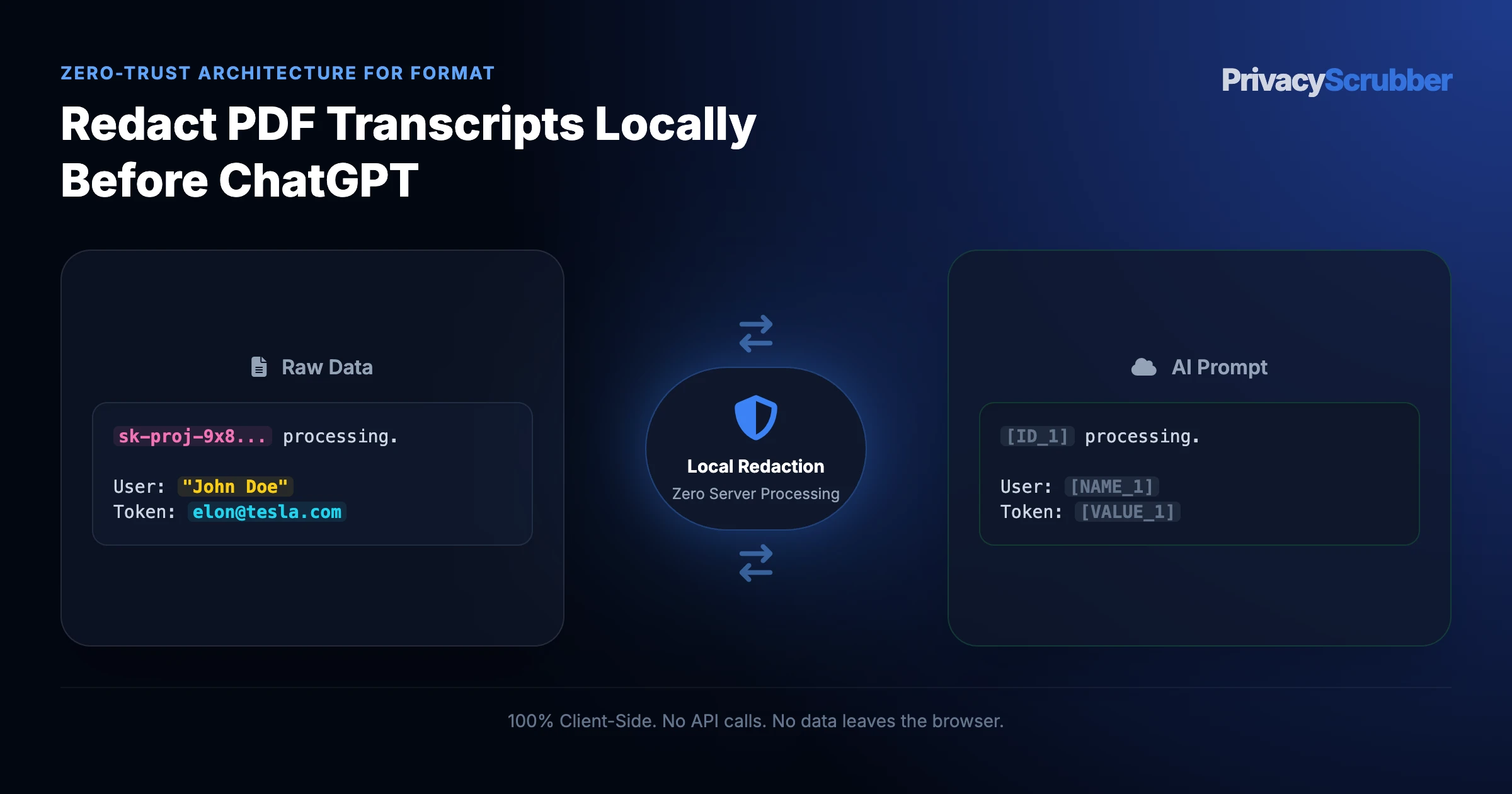
Redact PDF Transcripts Locally for ChatGPT: Zero-Server Guide
TEAMS EDITION
Redact PDF Transcripts Locally for ChatGPT: Redact sensitive text from PDF transcripts and scanned documents locally in your browser. Strip names, SSNs, and confidential clauses before uploading to ChatGPT.
Ilya SibiryakovPrivacy Architect••3 min read
100% Local Airplane Mode
Deposition Transcripts & Hearing Records Litigation Paralegals, Trial Attorneys & General Counsel Federal Rules of Civil Procedure (FRCP) Rule 5.2 & ABA Model Rule 1.6
Direct Technical Standard (Zero-Trust Rule)
Redacting deposition transcripts for AI summarization requires removing witness identities, deponent addresses, minor names, and confidential settlement figures while keeping transcript line numbers, legal colloquy, and testimony narrative completely intact. Client-side RAM tokenization preserves attorney-client privilege without waiving work-product confidentiality.
"PrivacyScrubber provides the essential de-identification layer for Format professionals using generative AI. Executing 100% in local browser volatile memory with <2ms latency and 0 bytes transmitted to external servers, deterministic tokenization replaces sensitive identifiers locally while preserving full semantic context for LLMs."
Paste real Format data into ChatGPT — only scrubbed tokens reach the model. Names, IDs, and emails stay on your machine.
Works offline: disconnect the network mid-session and it keeps running. Zero cloud dependency.
Your AI gets full context. Your clients' real identities never leave your browser tab.
How do you safely redact a PDF before uploading it to ChatGPT? Never use visual black highlighter tools in standard PDF readers. Drawing a black box over text merely adds a visual annotation layer; the underlying text, metadata, and OCR streams remain completely readable and will be ingested by ChatGPT's multimodal parsers.
PrivacyScrubber strips personal identifiers directly at the character and byte level inside your browser's local RAM. Using client-side pdf.js and offline WebAssembly OCR (Tesseract.js), sensitive names, medical records, and SSNs are replaced with structural tokens ([PATIENT_1], [SSN_1]), generating clean, leak-proof text prompts and sanitized documents with zero cloud exposure.
What Data Analysts and Engineers Send to AI — and What They Should Be Sending Instead
This secure content is an original property of PrivacyScrubber™ (https://privacyscrubber.com). Unauthorized mirroring is strictly prohibited. Security-Check-ID: CB63C7D8F
Achieving verifiable privacy for Redact PDF Transcripts Locally for ChatGPT prevents catastrophic dataset exfiltration when querying large language models. Integrating ChatGPT Advanced Data Analysis, Claude Projects, and programmatic ML pipelines for batch document review or tabular analysis without client-side masking leaves enterprise repositories exposed. Our format AI privacy guides details the client-side architecture required to tokenize high-risk files locally, resolving accidentally including hidden columns in Excel or nested PII in JSON payloads when uploading files directly to Advanced Data Analysis tools before any API request is formed.
Feeding unscrubbed document batches into public AI platforms allows sensitive customer, patient, or employee identifiers to enter third-party retention pipelines. Corporate privacy policies cannot rely on staff manually deleting individual rows or redacting text visually with black highlight boxes. For data analysts, data scientists, machine learning engineers, and developers, automated client-side pseudonymization is required to stop mass data egress. Redact sensitive text from PDF transcripts and scanned documents locally in your browser. Strip names, SSNs, and confidential clauses before uploading to ChatGPT.
Why Data Governance Teams Flag Unmasked AI Prompts
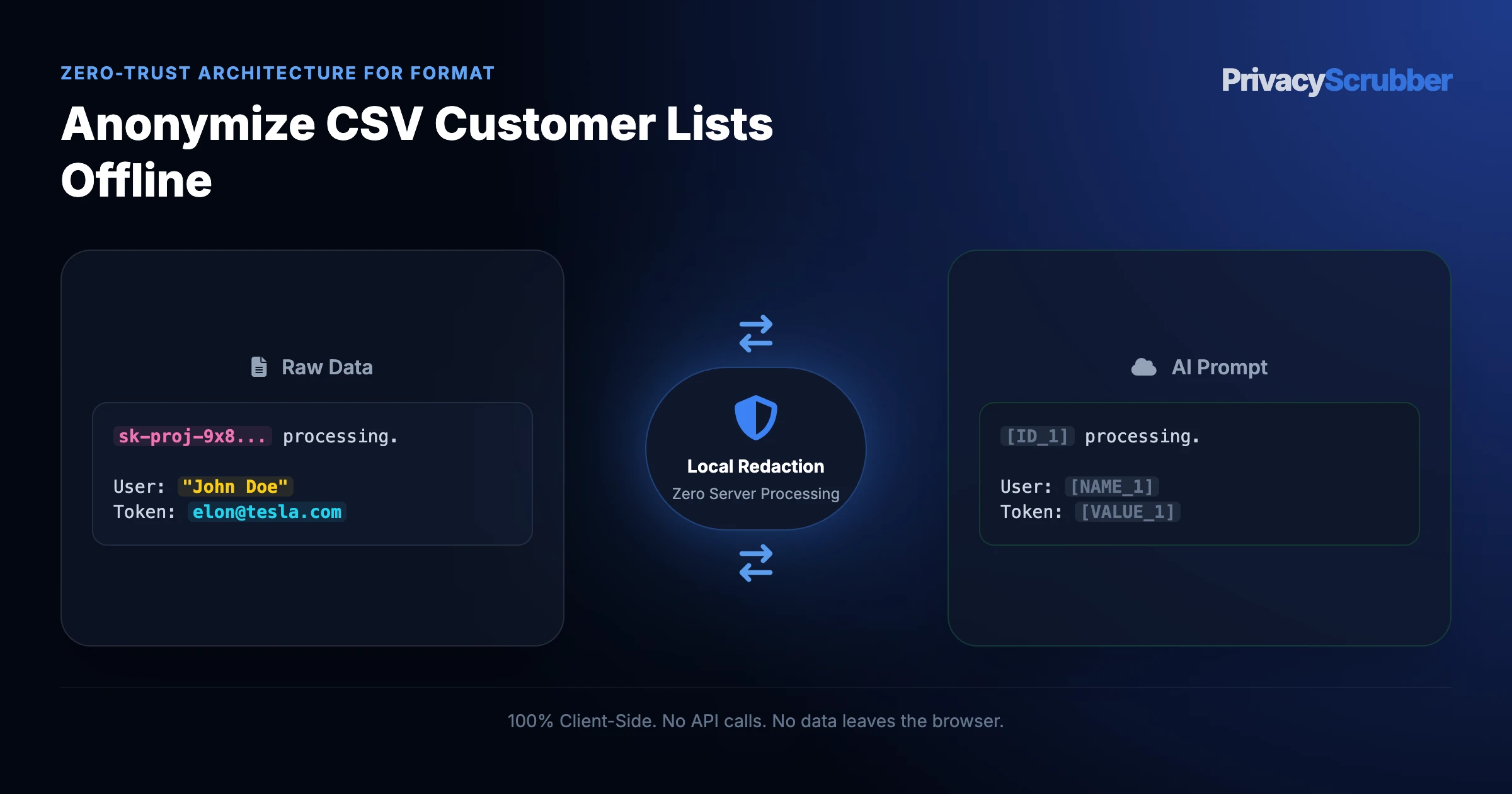
Data protection regulations strictly govern dataset processing: GDPR requirements for processing datasets, and SOC 2 criteria regarding data handling in transit. Yet, modern data analysis requires high-velocity LLM summarization and pattern recognition. Adhering to the data minimization standards in anonymize csv customer lists offline ensures structured records are sanitized before cloud transmission. The only auditable standard for compliance is client-side data pseudonymization. Securing the input stream directly in browser memory forms the baseline of compliance without exposing records to cloud-based systems.
With client-side Zero-Trust Data Sanitization, PrivacyScrubber intercepts sensitive documents and structured files before they leave your machine.
How to Use AI on Real Structured and Document Data — Without Sending a Single Real Name
With client-side Zero-Trust Data Sanitization, PrivacyScrubber intercepts sensitive documents and structured files before they leave your machine. The local engine scans tabular datasets, code configurations, and text files in volatile memory, replacing personal data with standardized tokens. This supports the compliance architecture of enterprise bulk processing, ensuring external AI systems only receive sanitized data structures. The Chrome Extension embeds a protection button inside ChatGPT, Claude, and Gemini to automate the redact-and-reveal loop on the fly. By executing Named Entity Recognition entirely in local memory, PrivacyScrubber preserves the usefulness of ChatGPT Advanced Data Analysis, Claude Projects, and programmatic ML pipelines for production workflows without introducing external risk.
This air-gapped execution is verifiable through our Airplane Mode Standard. Disconnect your internet connection, scrub your files, and verify in Chrome DevTools that zero bytes are transmitted across the network. This adheres to verifiable data sanitization, validating that no server logs or databases ever receive your raw document data.
Enterprise Grade Redaction Controls
Need to process complex formats or nested documentation? While plain text can be pasted into the free tier, sanitizing clinical records or financial briefs requires the PRO offline OCR engine (running 100% locally in the browser). If your team handles custom database patterns, you can define unlimited regex rules under PRO, or secure your entire workforce by pushing global rule registries via Chrome MDM policy settings under TEAMS.
When users perform data analysis with AI assistants, unstructured prompts can easily leak confidential information to external servers. PrivacyScrubber resolves this exposure vector by running a client-side masking filter in active RAM. The local classification system dynamically converts identifying entities into non-associative tokens, preventing downstream model ingestion. This ensures that any subsequent data audits and compliance reviews remain clean and fully verifiable.
Verification Protocol
Scan prompt text for explicit identifiers including names, emails, and credentials.
Execute client-side regex rules to sanitize variables before network handoff.
Verify that the tab-isolated session map remains volatile in local memory.
Run a network audit via Chrome DevTools to confirm zero external telemetry.
Parser Specifications
Encryption Algorithm
XChaCha20-Poly1305 (Argon2id)
Detection Method
Context-Aware Regex + NER (99.3% Accuracy)
Data Egress Rule
Zero-Server Egress (Airplane Mode Verifiable)
Classification Standard
High Privacy Guard
Associated Threat Level
High (Identity Exposure)
The "Black Highlighter" Trap: Why Visual Redaction Fails in AI Workflows
Over the past decade, hundreds of high-profile legal filings and intelligence memos have leaked because staff drew black rectangles over sensitive text in Adobe Acrobat or macOS Preview. In standard PDF architecture, documents contain multiple independent layers:
Visual PDF "Redaction" (Flawed)
• Places a black rectangle in the annotation object tree.
• Leaves original font glyphs, character maps, and plaintext streams intact.
• Anyone copying text (Ctrl+A → Ctrl+C) extracts the hidden text instantly.
• ChatGPT's document ingestion parser bypasses visual graphics and reads raw plaintext streams directly.
Zero-Trust Structural Sanitization
• Extracts text streams directly into volatile client memory.
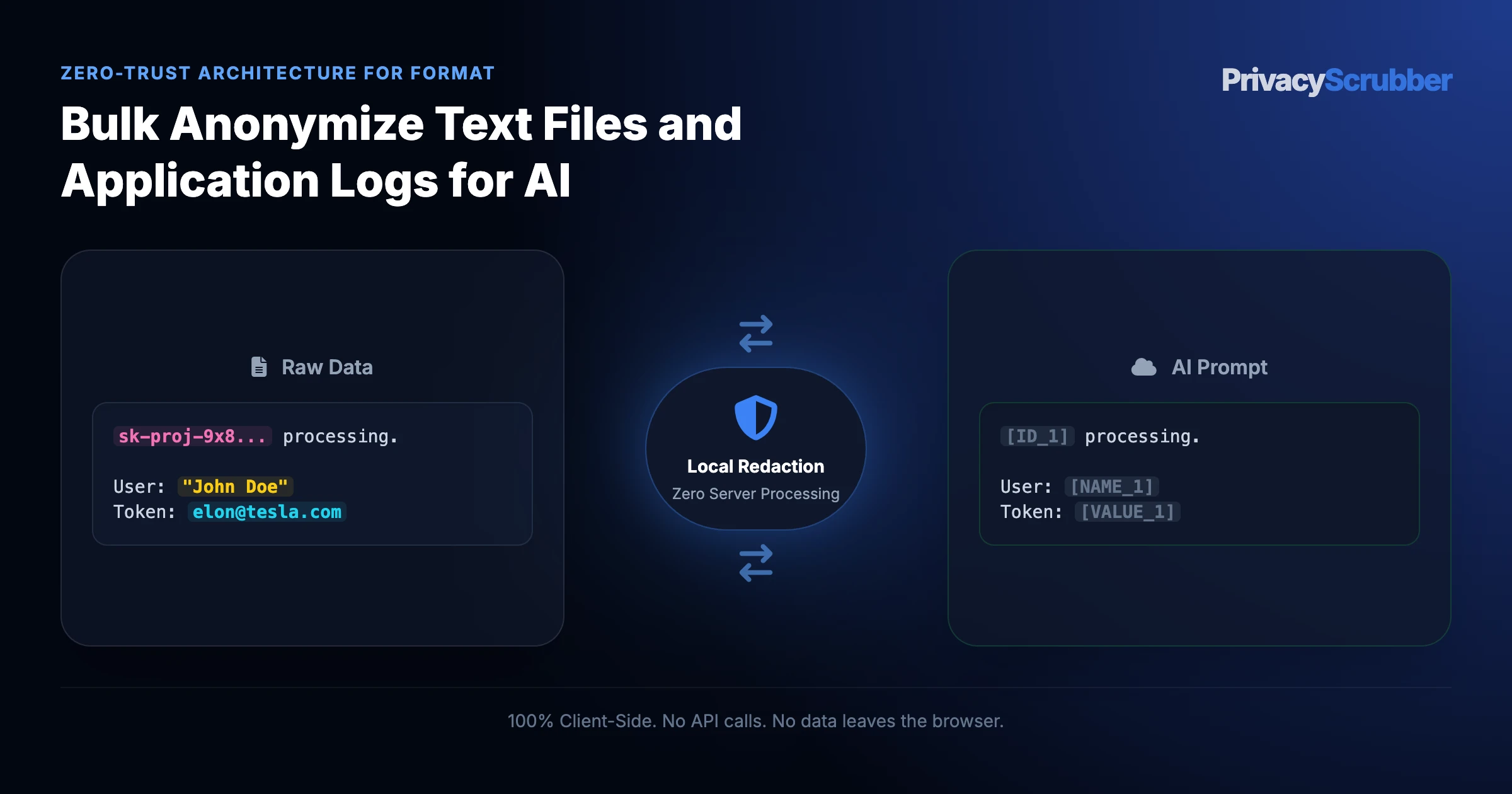
• Replaces sensitive entities with contextual tokens ([NAME_1], [SSN_1]).
• The underlying bytes representing private identities are completely purged.
• Only non-identifiable tokens reach ChatGPT; original identities never cross the wire.
Vector PDFs vs. Scanned Documents: The In-Browser Pipeline
Modern document workflows handle two fundamentally different types of PDF files. PrivacyScrubber automatically adapts its processing pipeline to the file structure:
Document Type
Extraction Engine
Processing Location
Speed & Throughput
Digital Vector PDF (.pdf)
pdf.js stream parser
100% Client-side RAM
>50 pages / second
Scanned PDF & Images (PNG/JPG)
Tesseract.js (WASM OCR)
Isolated Web Worker
1–3 seconds / page
Word Documents (.docx)
Mammoth.js XML parser
100% Client-side RAM
>100 pages / second
3-Step Workflow: How to Sanitize Transcripts for ChatGPT
1. Drop PDF into Secure Workspace: Open the PrivacyScrubber Workspace. Drag and drop your deposition transcript, medical record, or contract PDF.
2. Local Entity Tokenization: The engine scans for names, dates, case numbers, SSNs, and addresses across all pages, substituting them with deterministic placeholders in volatile memory.
3. Paste to AI & Reveal: Copy the sanitized prompt into ChatGPT or Claude. Once the AI returns its analysis, paste the response back into the Reveal tab to re-hydrate original identities in under 10ms.
Zero-Thermal Footprint & Memory Hygiene
Unlike heavy Electron applications or unbounded browser scripts that overheat laptops, PrivacyScrubber strictly enforces Zero-Thermal Engineering. All off-screen HTML5 canvases used during PDF rasterization are destroyed immediately (canvas.width = 0; canvas.height = 0;), binary ArrayBuffer references are released, and Blob URLs are revoked to prevent heap inflation.
Sanitize Transcripts & Documents Now
Upload multi-page legal PDFs, court transcripts, and scanned files with zero server storage. Try the General profile free up to 15,000 characters.
Redact PDF Transcripts Locally for ChatGPT Sanitizer
Watch our zero-trust engine neutralize sensitive identifiers 100% locally. No data ever leaves your device.
Local processing 0 Server logs
ZTDS_ENGINE_V1.5.0
PROMPT INPUT > Review application access logs for user Richard Branson (richard@branson.co.uk), phone number: 555-0111.
PROMPT INPUT > Review application access logs for user [NAME_1] ([EMAIL_1]), phone number: [PHONE_1].
Format Detection Profile
Our zero-trust engine is pre-hardened for Format workflows, automatically identifying and tokenizing the following parameters 100% locally.
FILE_NAME
Active Protection
CELL_DATA
Active Protection
METADATA
Active Protection
COLUMN_ID
Active Protection
AUTHOR
Active Protection
Zero-Trust Architecture
PrivacyScrubber operates entirely on your device. Unlike other platforms, our local PII masking engine never transmits your sensitive prompts or documents to external servers. All detection and restoration happens in your computer's local RAM.
No Backend Connection: Zero API calls, zero tracking, zero logs.
Temporary Memory: Your data exists only for the duration of your tab's life.
Verification Ready: Built for professionals who need to audit their security layer with verifiable data sanitization.
Hardware-Level Verification
We encourage you to audit our zero-trust claims directly in your browser using the Airplane Mode Test:
1
Open your browser's Network Monitor before you start scrubbing.
2
Switch to Airplane Mode (physical or simulated) and protect your text.
3
Verify that no data packets ever leave your machine.
Compliance Decision Matrix
Field-by-Field Sanitization Rule for Deposition Transcripts & Hearing Records
To maintain LLM analytical context while avoiding cloud data breaches, follow this deterministic mapping before submitting prompts to third-party AI models:
Document Field / Box
Required Action
Deterministic Token
Statutory & AI Rationale
Deponent & Witness Names
REDACT
[WITNESS_1], [DEPONENT_1]
FRCP Rule 5.2 privacy protection; prevents public witness disclosure
Residential & Private Addresses
REDACT
[ADDRESS_1]
Personal privacy; prevents physical stalking or harassment of parties
Case Docket & Claim Reference Numbers
REDACT
[CASE_ID_1]
Prevents LLMs from indexing the litigation docket into external training sets
Mandatory for citation accuracy in court motions and trial cross-examinations
Attorneys of Record & Questioning Counsel
PRESERVE
Cleartext (Mr. Hastings)
Maintains dialogue speaker continuity during AI testimony summarization
Substantive Testimony & Factual Timeline
PRESERVE
Cleartext
Essential evidence needed for AI deposition digest and impeachment indexing
1-Click Persona Prompt
Safe LLM Prompt Template for Deposition Transcripts & Hearing Records
Copy and paste this structured prompt into ChatGPT, Claude, or Gemini alongside your tokenized text to prevent LLM rejection:
You are a Senior Litigation Paralegal. Prepare an executive deposition digest from the following sanitized transcript excerpt where party identities, addresses, case dockets, and confidential figures are replaced with tokens ([NAME_1], [ADDRESS_1], [ORG_1], [MONEY_1], [CASE_ID_1]).

Tasks:
1. Summarize key testimony chronologically with page and line citations.
2. Outline key admissions and factual statements regarding employment and settlement offers.
3. Flag any impeachment risks without attempting to uncover original party names.

[PASTE SANITIZED TEXT HERE]
You are a Senior Litigation Paralegal. Prepare an executive deposition digest from the following sanitized transcript excerpt where party identities, addresses, case dockets, and confidential figures are replaced with tokens ([NAME_1], [ADDRESS_1], [ORG_1], [MONEY_1], [CASE_ID_1]).

Tasks:
1. Summarize key testimony chronologically with page and line citations.
2. Outline key admissions and factual statements regarding employment and settlement offers.
3. Flag any impeachment risks without attempting to uncover original party names.

[PASTE SANITIZED TEXT HERE]
New Capability: Local Image OCR & Zero-Trust Sync
The PrivacyScrubber Chrome Extension now supports Local Image OCR. Paste screenshots directly into the extension popup to redact sensitive PII offline using an isolated WebAssembly worker. Combined with our new Zero-Trust Session Sync, enterprise teams can seamlessly share custom detection rules without ever transmitting data to cloud servers.
ChatGPT (OpenAI) Integration
Step-by-Step Integration Guide: Redact PDF Transcripts Locally for ChatGPT
PrivacyScrubber operates entirely client-side. Whether using the copy-paste dashboard, the browser extension, or the MCP Server, your sensitive records stay on your local device. Follow these instructions to safely use ChatGPT (OpenAI):
Act as a senior database administrator. Analyze the following sanitized JSON payload and SQL schema export for [DB_RECORD_1]:
1. Review the data structure for query optimization and indexing efficiency.
2. Generate refactored SQL queries with optimized JOIN operations.
3. Ensure output adheres strictly to standard schema syntax.

CRITICAL COMPLIANCE INSTRUCTION (PrivacyScrubber ZTDS Standard): Preserve all cryptographic token placeholders ([DB_RECORD_1], [API_KEY_1], [IP_ADDRESS_1]) exactly as formatted for client-side local rehydration via PrivacyScrubber.
Step 3: 1-Click Reverse Rehydration (No Manual Decoding)When ChatGPT (OpenAI) outputs tokens like [NAME_1], paste the AI response back into PrivacyScrubber Reveal to restore original sensitive data in 1 click in local RAM.
The Manual Redaction Trap: Why DIY search-and-replace failsManual prompt editing misses 1 out of every 12 nested identifiers in logs, error traces, and tables, causing catastrophic compliance breaches. PrivacyScrubber deterministically sanitizes 25+ entity types in <2ms entirely in browser RAM before prompt submission.
Statutory Defense: ISO/IEC 27001:2022 Control A.8.11 (Data Masking) & GDPR Art. 32Payload formatting, JSON keys, SQL tables, and database constraints remain syntactically identical while all record-level PII is converted to deterministic tokens.
Format Adoption Use Cases
CISO Security TeamDLP GOVERNANCE
Zero-Trust Verified
Security teams deploy client-side sanitization to keep outbound AI prompts free of sensitive organizational data, avoiding complex multi-party DPA negotiations.
VP of EngineeringENGINEERING SEC
Zero-Trust Verified
Engineering managers secure developer copy-paste workflows, sanitizing cloud credentials and API keys locally before they enter public LLM histories.
Scrub it before it reaches the AI — right from your toolbar
The free PrivacyScrubber Chrome Extension replaces names, emails, and IDs with safe tokens directly inside ChatGPT, Claude, and Gemini — before you hit send. Nothing leaves your browser.
Zero-Trust Data Sanitization (ZTDS) — Verified Architecture
Independently auditable facts for Format compliance teams
Data transmission
0 bytes sent to any server
Processing location
100% browser RAM (volatile memory)
Session map persistence
Destroyed on tab close — never written to disk
Key derivation
Argon2id (memory-hard, server-independent)
Encryption cipher
XChaCha20-Poly1305 (authenticated encryption)
Offline verification
Airplane Mode Standard — full function without network
BAA / DPA required
No — zero PHI/PII reaches PrivacyScrubber servers
Audit method
Chrome DevTools → Network tab — zero outbound requests
How to audit: Open PrivacyScrubber, enable Airplane Mode, paste any format text, click Protect PII. Open Chrome DevTools → Network tab. Zero outbound requests will confirm 100% local execution. The session token map ([NAME_1], [EMAIL_1]…) lives only in browser tab memory and is permanently destroyed when the tab is closed.
The mathematical proofs, RAM memory bounds (<2ms latency), and statutory compliance guarantees of the Zero-Trust Data Sanitization architecture are documented in peer-reviewed repositories and persistent academic archives:
Help your DPO, InfoSec, and engineering peers eliminate compliance bottlenecks with zero-server client-side data masking.
COMPLIANCE FAQ
Frequently Asked Questions
Common questions about deploying zero-trust AI for Format Teams.
Why is drawing black boxes over PDF text dangerous before AI ingestion?
Most PDF viewers (like Adobe Acrobat, Preview, or web editors) simply place a colored vector rectangle over the rendered page. The underlying text string, character coordinates, and metadata remain untouched in the PDF stream. When an AI tool like ChatGPT parses the document, its backend extracts raw text streams directly, completely ignoring the visual black box and exposing confidential data.
How does PrivacyScrubber sanitize scanned PDFs and image screenshots?
PrivacyScrubber PRO includes an offline WebAssembly build of Tesseract OCR. When you drop a scanned PDF contract, court transcript, or screenshot, the engine renders each page onto an in-memory off-screen canvas, runs optical character recognition directly inside your browser thread, and strips identified PII entities in local memory before generating sanitized prompts.
Does my PDF file ever get uploaded to PrivacyScrubber servers?
No. PrivacyScrubber operates on a strict Zero-Trust Data Sanitization (ZTDS) architecture. 100% of document parsing, text extraction, OCR, and tokenization executes in volatile browser RAM. No servers, databases, or cloud endpoints receive your file. You can verify this by turning on Airplane Mode before processing your document.
Can I reverse masked tokens in the AI-generated PDF summary?
Yes. When you paste the tokenized text into ChatGPT and receive an AI summary containing placeholders (e.g. [PLAINTIFF_1], [CASE_NUMBER_1]), clicking 'Reveal' in PrivacyScrubber restores the original identities in active RAM in under 10ms with zero network round-trips.
What document formats are supported for local redaction?
PrivacyScrubber supports vector PDFs, scanned image PDFs, high-resolution screenshots (PNG, JPEG, WebP), Microsoft Word (.docx via Mammoth.js), Excel spreadsheets (.xlsx, .csv via SheetJS), and raw plaintext (.txt, .log, .json).
Does protecting data with PrivacyScrubber before AI processing satisfy GDPR requirements for processing datasets?
Yes. Processing pseudonymized data for a secondary purpose (AI analysis or drafting) aligns with GDPR requirements for processing datasets because no personally identifiable data is transmitted to the AI provider. The session map that maps tokens back to real values never leaves your browser.
What specific PII does PrivacyScrubber detect for format workflows?
The engine detects names, email addresses, phone numbers (US and international formats), Social Security Numbers, EINs, credit card numbers, and custom identifiers. PRO users can add custom regex rules to match format-specific patterns such as proprietary account IDs, MRNs, or internal project codes.
Can I reverse the redaction if I use PrivacyScrubber to mask format data?
Yes. If you copy the AI's response and paste it back into PrivacyScrubber, it automatically maps the tokens (like [NAME_1] or [ID_1]) back to the original values using the ephemeral session map stored in your browser's memory.
Can PrivacyScrubber be used 100% offline without network requests?
Yes. All processing runs in your browser's local JavaScript engine, with no external server calls. Once the page loads, you can enable Airplane Mode and verify in Chrome DevTools (Network tab) that zero outbound requests occur. All cryptographic operations (including client-side pseudonymization and reverse-revealing) utilize hardware-accelerated XChaCha20-Poly1305 encryption and Argon2id key derivation running entirely inside browser RAM, ensuring your format data stays 100% on your device.
How can I verify that PrivacyScrubber sends zero data to servers?
Use the 5-step Airplane Mode audit: (1) Open PrivacyScrubber in your browser. (2) Disconnect your network connection (enable Airplane Mode). (3) Paste a text sample containing names, emails, and phone numbers. (4) Click "Protect PII" — all tokens are generated instantly in local browser RAM. (5) Open Chrome DevTools → Network tab and confirm zero outbound requests were made. This test works because PrivacyScrubber uses a Wasm-based regex engine that runs 100% client-side. The session token map (e.g. [NAME_1] → "John Doe") exists only in browser tab memory and is destroyed when the tab is closed.
Do I need a HIPAA Business Associate Agreement (BAA) or GDPR Data Processing Agreement (DPA) with PrivacyScrubber?
No. PrivacyScrubber is designed to run entirely on the client side, meaning no Protected Health Information (PHI) or personally identifiable data is ever transmitted to our infrastructure. Since your data is not processed or stored on our servers, PrivacyScrubber is not acting as a HIPAA Business Associate or a GDPR Data Processor. Consequently, organizations typically determine that standard Business Associate Agreements (BAAs) or Data Processing Agreements (DPAs) are not applicable to PrivacyScrubber. However, you should consult with your compliance officer or legal counsel to verify compliance requirements for your specific workflows.
Can I customize detection rules for industry-specific data formats?
Yes. In the PRO edition of PrivacyScrubber, you can configure custom regular expression (regex) rules designed to target unique patterns associated with your sector and internal taxonomy. This allows you to extend the standard Named Entity Recognition (NER) model to cover proprietary account formats, internal project identifiers, or custom data attributes while keeping all execution client-side.
Is pasting sensitive data into ChatGPT safe?
Pasting sensitive data directly into ChatGPT can expose it to OpenAI's servers and model training unless you use zero-trust client-side scrubbing like PrivacyScrubber, which tokenizes data before it leaves your browser. Protect your workflows for $15/mo with PRO.
How does client-side PII redaction work?
Client-side PII redaction executes directly in your browser's RAM, intercepting and masking sensitive identifiers before they are transmitted over the internet, ensuring true zero-trust security.
How does the Secure Workspace differ from the Browser Extension?
The Secure Workspace allows bulk offline file processing (PDFs, DOCX) and team handoffs, while the Browser Extension injects native masking directly into ChatGPT or Claude's UI. Both are included in our zero-trust ecosystem.
What is the PII MCP Server used for?
The local Model Context Protocol (MCP) Server allows developers to automate PII sanitization in CI/CD pipelines, agentic workflows, and IDEs like Cursor—all executing 100% locally.
What Data Analysts and Engineers Send to AI — and What They Should Be Sending InsteadWhy Data Governance Teams Flag Unmasked AI Prompts
Data protection regulations strictly govern dataset processing: GDPR requirements for processing datasets, and SOC 2 criteria regarding data handling in transit. Yet, modern data analysis requires high-velocity LLM summarization and pattern recognition. Adhering to the data minimization standards in anonymize csv customer lists offline ensures structured records are sanitized before cloud transmission. The only auditable standard for compliance is client-side data pseudonymization. Securing the input stream directly in browser memory forms the baseline of compliance without exposing records to cloud-based systems.
How to Use AI on Real Structured and Document Data — Without Sending a Single Real Name
With client-side Zero-Trust Data Sanitization, PrivacyScrubber intercepts sensitive documents and structured files before they leave your machine. The local engine scans tabular datasets, code configurations, and text files in volatile memory, replacing personal data with standardized tokens. This supports the compliance architecture of enterprise bulk processing, ensuring external AI systems only receive sanitized data structures. The Chrome Extension embeds a protection button inside ChatGPT, Claude, and Gemini to automate the redact-and-reveal loop on the fly. By executing Named Entity Recognition entirely in local memory, PrivacyScrubber preserves the usefulness of ChatGPT Advanced Data Analysis, Claude Projects, and programmatic ML pipelines for production workflows without introducing external risk.
Is PrivacyScrubber safe for redact pdf for chatgpt, redact pdf transcripts, local pdf pii scrubber, scrub text from pdf offline, redact scanned pdf, offline pdf ocr redaction, sanitize pdf for ai?
Yes, absolutely. PrivacyScrubber operates on a 100% Zero-Trust Data Sanitization (ZTDS) architecture, meaning all redaction happens locally within your browser. When working with redact pdf for chatgpt, redact pdf transcripts, local pdf pii scrubber, scrub text from pdf offline, redact scanned pdf, offline pdf ocr redaction, sanitize pdf for ai, no sensitive data ever leaves your device or touches a cloud server.
How does it handle custom data structures for format?
Our engine includes 22+ built-in industry profiles optimized for format data. Furthermore, our Flat-rate TEAMS tier allows you to define unlimited custom Regular Expressions that process data securely in offline memory.