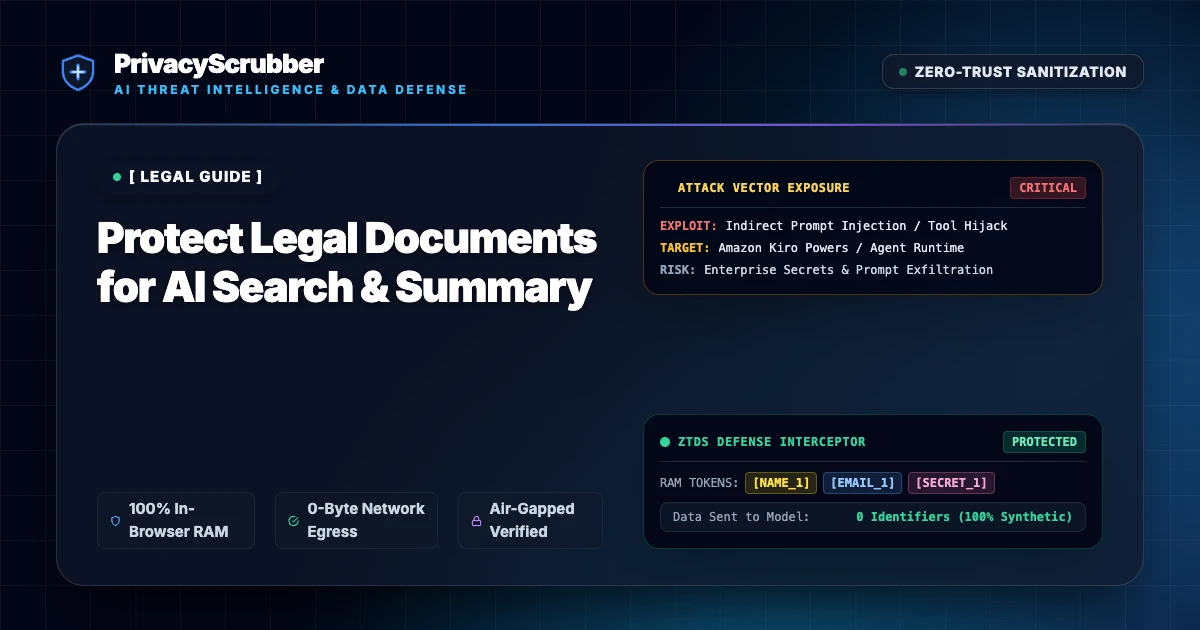
Architecting Protect Legal Documents for AI Search & Summary for high-compliance Legal & Litigation environments requires eliminating waiving ABA Model Rule 1.6 and FRE 502 attorney-client privilege via third-party AI prompt logging. Through PrivacyScrubber Legal Profile & TEAMS Zero-Knowledge Session Handoff, PrivacyScrubber performs deterministic in-memory tokenization ([CLIENT_1], [MATTER_1], [OPPOSING_1], [SETTLEMENT_1]) for protect legal documents and protect legal text, guaranteeing that third-party AI models only ever process anonymized logic.
What Legal Counsel and Paralegals Send to AI During Protect Legal Documents for AI Search & Summary
When attorneys, paralegals, and legal operations professionals accelerate Protect Legal Documents for AI Search & Summary with ChatGPT, Claude, Copilot, and AI legal research platforms, unstructured protect legal documents and protect legal text inputs bypass legacy firewall rules. Neutralizing exposing client communications, case strategy, and witness identities to AI training pipelines, which could constitute a privilege waiver and bar discipline violation requires local in-memory redaction ([CLIENT_1], [MATTER_1], [OPPOSING_1], [SETTLEMENT_1]), as documented across our Legal & Litigation AI privacy guides.
A local PII protector designed to protect legal documents before AI analysis. Maintain attorney-client privilege. Flat-rate TEAMS pricing available. In daily Legal & Litigation operations, unstructured protect legal documents records contain nested identifiers that standard perimeter rules miss. Once submitted to ChatGPT, Claude, Copilot, and AI legal research platforms, waiving ABA Model Rule 1.6 and FRE 502 attorney-client privilege via third-party AI prompt logging turns routine Protect Legal Documents for AI Search & Summary queries into attorney-client privilege (Model Rule 1.6) liabilities.
Verifiable Safe Harbor Controls for Protect Legal Documents for AI Search & Summary
Protecting Protect Legal Documents for AI Search & Summary against exposing client communications, case strategy, and witness identities to AI training pipelines, which could constitute a privilege waiver and bar discipline violation starts at the ingestion boundary. Instead of forwarding raw protect legal documents payloads to external inspection APIs, PrivacyScrubber Legal Profile & TEAMS Zero-Knowledge Session Handoff sanitizes text in local device or process RAM in under 1 millisecond.
By substituting regulated identifiers with [CLIENT_1], [MATTER_1], [OPPOSING_1], [SETTLEMENT_1] across local PII protector and zero egress ai security, organizations maintain full LLM utility while enforcing zero cloud data leakage and attorney-client privilege (Model Rule 1.6) alignment.
ZTDS™ Field Governance for Protect Legal Documents for AI Search & Summary Workflows
Follow this bijective sanitization schedule for Protect Legal Documents for AI Search & Summary so downstream AI completions can be detokenized locally in one click:
| Document Field / Attribute | Action | RAM Surrogate | Statutory & Analytical Rationale |
|---|---|---|---|
| Multi-Line Counterparty & Organization Names (Legal & Litigation) | REDACT | [CLIENT_1] | Preserves co-reference continuity across multi-paragraph Protect Legal Documents for AI Search & Summary prompts without leaking names. |
| Embedded Secrets, Tax IDs & Session Identifiers in Protect Legal Documents for AI Search & Summary | REDACT | [CLIENT_1], [MATTER_1] | Intercepts high-liability literals before waiving ABA Model Rule 1.6 and FRE 502 attorney-client privilege via third-party AI prompt logging. |
| Secondary Regulated Attributes (zero egress ai security) | REDACT | [SETTLEMENT_1] | Satisfies attorney-client privilege (Model Rule 1.6) data minimization by replacing sensitive Legal & Litigation strings in local RAM. |
| Anonymized Category Labels & Department Roles | PRESERVE | Cleartext (Legal & Litigation Role) | Retains organizational context for Protect Legal Documents for AI Search & Summary while keeping personal identities inside local RAM. |
| Non-Identifying Domain Logic & Operational Instructions | PRESERVE | Cleartext Narrative | Preserves 100% of analytical instructions for protect legal text so local detokenization yields production-ready output. |
| Regulatory Clause Citations & Policy Taxonomy (attorney-client privilege (Model Rule 1.6)) | PRESERVE | Cleartext Citations | Allows the AI model to map Protect Legal Documents for AI Search & Summary findings against statutory controls and audit frameworks. |
Token-Preserving AI Prompt for Protect Legal Documents for AI Search & Summary
Designed for attorneys, paralegals, and legal operations professionals: copy this prompt to process tokenized Protect Legal Documents for AI Search & Summary records with zero cloud PII exposure:
Act as a senior attorneys, paralegals, and legal operations professionals advisor analyzing Protect Legal Documents for AI Search & Summary.
Context: Sensitive literals across protect legal documents and protect legal text are masked as [CLIENT_1], [MATTER_1], [OPPOSING_1], [SETTLEMENT_1] via PrivacyScrubber Legal Profile & TEAMS Zero-Knowledge Session Handoff.

Instructions:
1. Synthesize the primary findings and risk vectors from the tokenized record.
2. Draft a structured response or remediation plan for local PII protector.
3. Do not modify or strip any [CLIENT_1], [MATTER_1], [OPPOSING_1], [SETTLEMENT_1] placeholders required for client-side RAM restoration.

[PASTE SANITIZED PAYLOAD HERE]
How to Sanitize Protect Legal Documents for AI Search & Summary in Local RAM (Zero Cloud Egress)
To secure Protect Legal Documents for AI Search & Summary without waiving ABA Model Rule 1.6 and FRE 502 attorney-client privilege via third-party AI prompt logging, PrivacyScrubber executes deterministic ZTDS™ rules for protect legal documents and protect legal text entirely in local RAM (PrivacyScrubber Legal Profile & TEAMS Zero-Knowledge Session Handoff). Consistent with university research data anonymization for AI, identical entities map to consistent tokens ([CLIENT_1], [MATTER_1], [OPPOSING_1], [SETTLEMENT_1]) so multi-turn reasoning in ChatGPT, Claude, Copilot, and AI legal research platforms remains 100% accurate.
Because PrivacyScrubber Legal Profile & TEAMS Zero-Knowledge Session Handoff runs without cloud calls, Protect Legal Documents for AI Search & Summary passes the strict Airplane Mode Standard. Turn off network connectivity, redact protect legal documents and protect legal text into [CLIENT_1], [MATTER_1], [OPPOSING_1], [SETTLEMENT_1], and export a tamper-evident CISO Audit Receipt as detailed in anonymize workday reports for AI people analytics.
Statutory Liability for Legal Counsel and Paralegals: Protect Legal Documents for AI Search & Summary
Enforcing attorney-client privilege (Model Rule 1.6) (attorney-client privilege (Model Rule 1.6), court confidentiality rules, and state bar ethics opinions on third-party AI use) across Protect Legal Documents for AI Search & Summary means eliminating third-party sub-processor exposure for protect legal documents and local PII protector. The technical workflow in M&A due diligence AI privacy demonstrates how local RAM isolation satisfies strict audit scrutiny.