CCPA & CPRA Compliance for Generative AI
AI Summary / Key Takeaways
"PrivacyScrubber enforces CCPA/CPRA (Cal. Civ. Code § 1798.100–1798.199) and CPPA Automated Decisionmaking Technology (ADMT) regulations through Zero-Trust local tokenization. By de-identifying California resident records and Sensitive Personal Information (SPI under § 1798.140(ae)) in browser RAM before AI transmission, organizations satisfy § 1798.140(m) de-identification standards, prevent unauthorized third-party 'sharing,' and mitigate § 1798.150 statutory class-action exposure."
How to prevent CCPA / CPRA personal data sale and sharing penalties when utilizing AI models?
Avoid CPRA 'sale' and 'sharing' liabilities by de-identifying California consumer records before submitting data to third-party AI APIs. PrivacyScrubber strips consumer identifiers locally, ensuring data sent to LLMs does not constitute consumer personal information under Cal. Civ. Code § 1798.140.
Interactive PII Detection & Sanitization Sandbox
Test real-time client-side RAM tokenization. Choose a specialized preset or paste your own raw prompt to test instant reversible redaction.
Sanitized locally in volatile RAM. Pre-prompt compliance maintained under CCPA / CPRA standards (GDPR, HIPAA, SOC 2).
Enterprise-Grade AI Privacy
Add custom redaction rules and priority support with PRO.
Executive Summary: CCPA / CPRA
The California Consumer Privacy Act (CCPA) and its amendment, the CPRA, mandate that businesses implement strict data minimization and provide clear mechanisms for consumers to opt-out of data 'sharing' with third-party service providers. PrivacyScrubber enables 100% compliance by neutralizing consumer identifiers locally before they reach AI models. This ensures that sensitive personal information (SPI) never enters third-party training pipelines, effectively eliminating the 'sharing' event and satisfying the CPRA's core privacy-by-design requirements.
Privacy Checkpoints
- CPRA Data Minimization: Sanitize only necessary attributes before AI analysis.
- Sensitive PII Protection: Redact government IDs, account credentials, and precise geolocation locally.
- Zero-Sharing Proof: Ensure 'sharing' under CCPA never occurs by keeping raw PII on-device.
- Service Provider Oversight: Maintain absolute control over how third-party LLMs process consumer data.
PII Detection Matrix
| Entity Type | Exposure Risk | Local Edge Control |
|---|---|---|
| Government IDs | Critical (CPRA Violation) | Pattern-Based Masking |
| Consumer Geolocation | High (Sensitive PII) | Lat/Long & Address Scrubbing |
| Account Credentials | Critical (Security Breach) | [TOKEN_N] Redaction |
Select Your CCPA / CPRA & ADMT Governance Mandate
Statutory De-Identification & SPI Opt-Out Defense
Enforce Cal. Civ. Code § 1798.140(m) & § 1798.140(v)(2) statutory de-identification before consumer prompts or records reach external AI vendors. Neutralize § 1798.121 Right to Limit Sensitive Personal Information (SPI) exposure.
Private Right of Action Shield & Data Minimization
Eliminate statutory damages ($100–$750 per consumer per incident under § 1798.150) by preventing unencrypted SSNs, driver's licenses, financial accounts, and medical data from leaving local device RAM.
Impossible Deletion Prevention & Multi-State Parity
Prevent consumer PII from entering immutable LLM weights where § 1798.105 Deletion Requests cannot be fulfilled. Harmonize compliance across California, Texas TDPSA, Virginia VCDPA, and Colorado CPA.
CCPA / CPRA Statutory Compliance for Generative AI: Enforcing Cal. Civ. Code § 1798.100(c) & § 1798.140(m) in Local RAM
Under the California Consumer Privacy Act (CCPA) as amended by the California Privacy Rights Act (CPRA), alongside enforcement directives from the California Privacy Protection Agency (CPPA), transmitting unredacted consumer records to third-party generative AI models triggers severe statutory exposure. Under Cal. Civ. Code § 1798.100(c), collection, use, retention, and sharing of a consumer's personal information must be reasonably necessary and proportionate to achieve the primary purpose for which it was collected. Furthermore, disclosing identifiers or Sensitive Personal Information (SPI) (§ 1798.140(ae)) to an external AI provider without strict service-provider contractual restrictions and technical safeguards risks classification as an unauthorized disclosure or "Sharing" (§ 1798.140(ad)), while exposing the enterprise to the § 1798.150 Private Right of Action ($100 to $750 per consumer per incident) and administrative fines up to $7,500 per intentional violation (§ 1798.199.90).
PrivacyScrubber establishes a deterministic Technical Safe Harbor (Defense-in-Depth) for California consumer privacy in AI workflows by executing client-side sanitization inside volatile device RAM prior to any network transmission. Built on the ZTDS™ (Zero-Trust Data Sanitization) protocol, the appliance strips direct identifiers and CPRA Sensitive Personal Information at the browser, IDE, or backend SDK boundary—substituting synthetic tokens ([CONSUMER_1], [SSN_1], [CA_DL_1]) while maintaining a strictly local token dictionary. Under Cal. Civ. Code § 1798.140(v)(2), "Personal Information" does not include de-identified or aggregate consumer information (§ 1798.140(m)), enabling your teams to leverage frontier AI models with verifiable CCPA data minimization controls.
Pre-Transmission De-Identification Outside Third-Party Scope
Under § 1798.140(v)(2), Personal Information excludes de-identified consumer information where the business implements technical safeguards that prohibit re-identification by external recipients (§ 1798.140(m)).
ZTDS™ Statutory Mapping: Raw consumer identifiers are replaced with synthetic tokens in local RAM before network socket creation. External AI vendors never receive the token dictionary and cannot re-identify California residents.
CPRA Sensitive Personal Information (SPI) Zero-Egress
§ 1798.121 grants consumers the right to limit the use and disclosure of SPI—including SSNs, driver's licenses, state IDs, passport numbers, financial accounts, precise geolocation, health data, and contents of consumer communications.
ZTDS™ Statutory Mapping: Enforces CPRA sensitive data AI protection across 30 Specialized Industry Profiles, physically blocking SPI categories from leaving the workstation.
CPPA Data Minimization & Preventing Un-Deletable Model Ingestion
The CPPA's Enforcement Division strictly enforces § 1798.100(c) data minimization across every consumer touchpoint. Moreover, once consumer PII enters an external LLM's training corpus or third-party log, fulfilling a § 1798.105 Right to Delete request becomes technically impossible.
ZTDS™ Statutory Mapping: Zero consumer PII is ever ingested by external AI providers, eliminating downstream third-party deletion cascades and proving proportionate data minimization by design.
Mitigating § 1798.150 Statutory Damages & ADMT Profiling Risk
Unauthorized exfiltration or disclosure of nonencrypted and nonredacted personal information triggers statutory class-action damages of $100–$750 per consumer under § 1798.150(a)(1), while CPPA Automated Decisionmaking Technology (ADMT) regulations scrutinize AI profiling of identifiable consumers.
ZTDS™ Statutory Mapping: Redacts all § 1798.81.5(d)(1)(A) breach-triggering identifiers locally and generates SHA-256 compliance receipts demonstrating reasonable security procedures and practices.
Zone A (Business Controlled Endpoint RAM) vs. Zone B (External AI Cloud)
Raw California consumer records, DSAR packets, HR candidate files, and SPI remain strictly inside local device RAM.
External AI endpoints receive only synthetic tokens that cannot be linked to any household or consumer. No "Sale" or "Sharing" of Personal Information occurs.
Comparing CCPA / CPRA & US State Privacy AI Architectures
Why relying solely on Service Provider addenda or cloud DLP gateways leaves enterprises exposed to CPPA data minimization enforcement and § 1798.150 class-action litigation.
| CCPA / CPRA Statutory Requirement | PrivacyScrubber (ZTDS™ Local RAM) | Cloud DLP / API Redaction Gateway | LLM "Service Provider" Contract Only | Employee AI Policy Only |
|---|---|---|---|---|
| § 1798.100(c) Data Minimization | Enforces technical minimization in local RAM before any external transmission. | Transmits unredacted consumer PII over the network to a third-party cloud proxy first. | Violates minimization when full consumer profiles are sent for routine text summarization. | Fails CPPA Enforcement Division technical safeguard audits. |
| § 1798.121 Sensitive Personal Info (SPI) | 100% client-side redaction of SSN, CA DL, financial, health, and biometric identifiers. | Exposes SPI in transit and inside cloud proxy inspection buffers. | Triggers § 1798.121 Right to Limit SPI obligations if used beyond strict service scope. | Uncontrolled SPI leakage into consumer LLM chat histories. |
| § 1798.105 Right to Delete Compliance | Zero PII reaches the LLM; volatile local token dictionary is wiped on tab close. | Requires cascading DSAR deletion across cloud proxy audit logs. | Requires propagating § 1798.105 deletion requests across every AI vendor API log. | Impossible to delete consumer PII once ingested into model weights. |
| § 1798.150 Private Right of Action Defense | Redacts nonencrypted/nonredacted § 1798.81.5(d) fields locally + SHA-256 receipts. | Creates a centralized cloud honeypot of consumer PII subject to third-party breaches. | Vendor breach of unredacted prompts triggers $100–$750/consumer statutory liability. | Zero defense against statutory class-action litigation. |
| 50-State Omnibus Harmonization | Single client-side architecture satisfies CCPA, TDPSA, VCDPA, CPA, CTDPA, and MHMDA. | Requires state-by-state DPA and subprocessor disclosures. | Requires separate Data Protection Assessments (DPAs) for each AI vendor across 19+ states. | Exposes enterprise to state AG sweeps (CA, TX, CO, CT). |
6 Technical Playbooks for CCPA / CPRA & US State AI Privacy Laws
Operationalize statutory de-identification and data minimization across California and the entire US state AI privacy regulatory patchwork.
Automated Redaction of CPRA Sensitive Personal Information
Under § 1798.140(ae) and § 1798.121, Sensitive Personal Information includes Social Security numbers, California driver's licenses, state ID cards, passport numbers, financial accounts with credentials, precise geolocation, and health/genetic data. PrivacyScrubber strips all SPI categories in local RAM before customer support or claims teams prompt external LLMs.
Enforcing CPPA Data Minimization in DSAR & Consumer Support
Following the CPPA Enforcement Division's formal Advisories on Data Minimization, businesses must not collect, process, or disclose more consumer data than strictly necessary—even when fulfilling consumer requests (§ 1798.105 / § 1798.110). PrivacyScrubber enables privacy teams to summarize complex DSAR files with AI while keeping 100% of consumer identifiers inside local browser RAM.
De-Biasing & Anonymizing HR, Lending & Underwriting AI Prompts
Both the CPPA's Automated Decisionmaking Technology (ADMT) regulations and the Colorado AI Act (SB 24-205) govern high-risk AI decisions in employment, financial lending, housing, and insurance. By stripping candidate names, demographic markers, ZIP codes, and protected attributes in local RAM prior to LLM evaluation, enterprises prevent algorithmic proxy discrimination and profiling of identifiable consumers.
Multi-State Omnibus Harmonization (Texas TDPSA & Virginia VCDPA)
The Texas Data Privacy and Security Act (TDPSA, Tex. Bus. & Com. Code Ch. 541) and Virginia VCDPA require explicit opt-in consent before processing sensitive data and mandate Data Protection Assessments for high-risk processing. Client-side ZTDS™ de-identification satisfies statutory de-identification exclusions across Texas, Virginia, Connecticut, and Florida simultaneously.
Consumer Health & Wellness Data Protection Beyond HIPAA
Digital health apps, fertility trackers, and wellness brands not covered by HIPAA face strict regulation under the California Confidentiality of Medical Information Act (CMIA) and Washington's My Health My Data Act (MHMDA), which carries a private right of action. PrivacyScrubber strips consumer health telemetry and symptoms locally before AI analysis.
Documenting Reasonable Security Procedures with SHA-256 Receipts
To defend against a § 1798.150 private right of action or an Attorney General civil investigative demand across Connecticut CTDPA and Florida FDBR, enterprises must prove they implemented and maintained reasonable security procedures prior to any incident. Every PrivacyScrubber scrub generates a cryptographic SHA-256 compliance receipt for your legal defense ledger.
Deploy Statutory De-Identification Across Every Consumer Touchpoint
15k chars free on General Profile; 5k trial quota across 30 vertical profiles. Sanitize DSAR PDFs, DOCX, and CSVs locally.
Intercepts consumer PII and SPI inside ChatGPT, Claude, Gemini, and Zendesk before outbound transmission.
@privacyscrubber/mcp-server keeps California consumer test data out of Cursor and Claude Desktop clouds.
@privacyscrubber/sdk ($299/mo) de-identifies consumer payloads in backend APIs and RAG pipelines at <1ms latency.
$99/mo flat for unlimited seats. Centralized SPI rules, encrypted session handoff, and CPPA audit receipt exports.
5-Step Privacy Counsel & CPPA Verification Protocol (Airplane Mode)
Use this deterministic 5-step protocol to demonstrate to Privacy Counsel, state regulators, or independent cybersecurity auditors that your AI workflows satisfy Cal. Civ. Code § 1798.100(c) and § 1798.140(m) with zero external PII egress:
Launch PrivacyScrubber Web or Chrome Extension, open Chrome DevTools (F12 → Network), and clear recorded traffic.
Disconnect Wi-Fi or set DevTools Network throttling to Offline to prove zero third-party cloud dependency.
Paste a synthetic California consumer record containing SSN, CA driver's license, email, and financial account; verify instant token replacement.
Export the CISO Compliance Receipt for your Data Protection Assessment binder and verify 0 outbound network requests.
Close the browser tab and verify that the local token dictionary is completely zeroized from RAM, preventing external re-identification.
CCPA / CPRA Consumer Privacy Profile: Detection Coverage
California Consumer Privacy Act (Cal. Civ. Code § 1798.100–1798.199) and CPRA ADMT ruleset. De-identifies California consumer records and Sensitive Personal Information (SPI) under § 1798.140(m) locally.
Top 6 CCPA / CPRA Sensitive Entity Types Detected & Scrubbed
California Consumer Identity
SSN & CA Driver's License
Precise Geolocation (<1,850 ft)
Consumer Email & Opt-Out ID
Unique Advertising / Cookie ID
Consumer Bank & Card Account
Continuous Detection Engine Expansion & Custom Regex Sovereignty
The 6 entity types above represent the core detection baseline for CCPA / CPRA. Our zero-trust engine detects hundreds of additional data classes and is continuously updated with new heuristic patterns, shadow AI leak vectors, and custom regulatory rulesets. Need proprietary database IDs or internal project codenames masked? PRO and TEAMS users can define unlimited custom regular expressions running 100% locally in browser RAM.
How the PrivacyScrubber Engine Solves This
Interactive Tool Controls for CCPA / CPRA. Hover for specs.
California Consumer PI Shield
The Browser Extension masks consumer identifiers, phone numbers, and browsing metadata before AI processing.
- Engine WASM-Accelerated
- Privacy 100% Local RAM
- Security Zero-Server Leak
CPRA Sensitive Personal Info (SPI)
Enforce strict local protection for financial accounts, SSNs, and precise geolocation data per CPRA § 1798.121 regulations.
- Engine WASM-Accelerated
- Privacy 100% Local RAM
- Security Zero-Server Leak
Mitigate § 1798.150 Statutory Liability
Prevent consumer class-action exposure by ensuring zero raw personal information is transmitted to third-party AI servers.
- Engine WASM-Accelerated
- Privacy 100% Local RAM
- Security Zero-Server Leak
CCPA Technical Implementation Mapping
Deep architectural mapping of Zero-Trust Data Sanitization (ZTDS) controls to industry-wide regulatory standards.
Zero-Trust Verification Signature
The above technical controls are enforced deterministically by the PrivacyScrubber Local Engine. All redaction cycles generate zero server-side telemetry, satisfying global data residency requirements for CCPA institutions.
Hardened Audit Standards
Neutralizing California Consumer Privacy Act (CCPA/CPRA) § 1798.140 Sensitive Personal Information prior to AI sharing.
Privacy by design at the engineering layer.
No data persistence on untrusted infrastructure.
Federal PII minimisation and transparency controls.
Data masking as a core organisational control.
Satisfies Safe Harbor de-identification requirements.
CCPA / CPRA Compliance Library
Step-by-step redaction workflows for CCPA / CPRA environments.
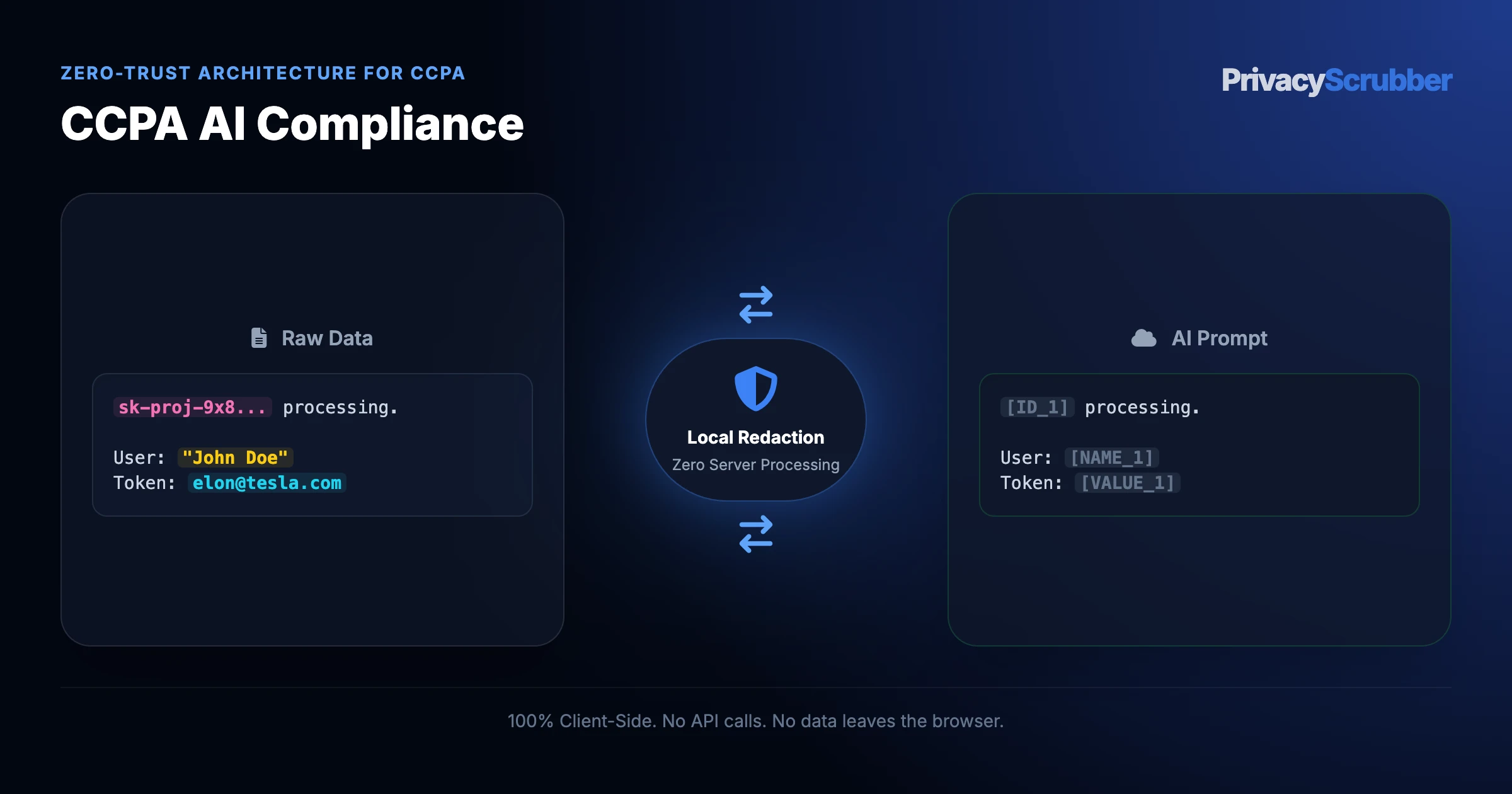
CCPA AI Compliance
Comply with CCPA when deploying ChatGPT and Claude. Redact California resident PII locally in browser RAM before prompt transmission with zero egress.
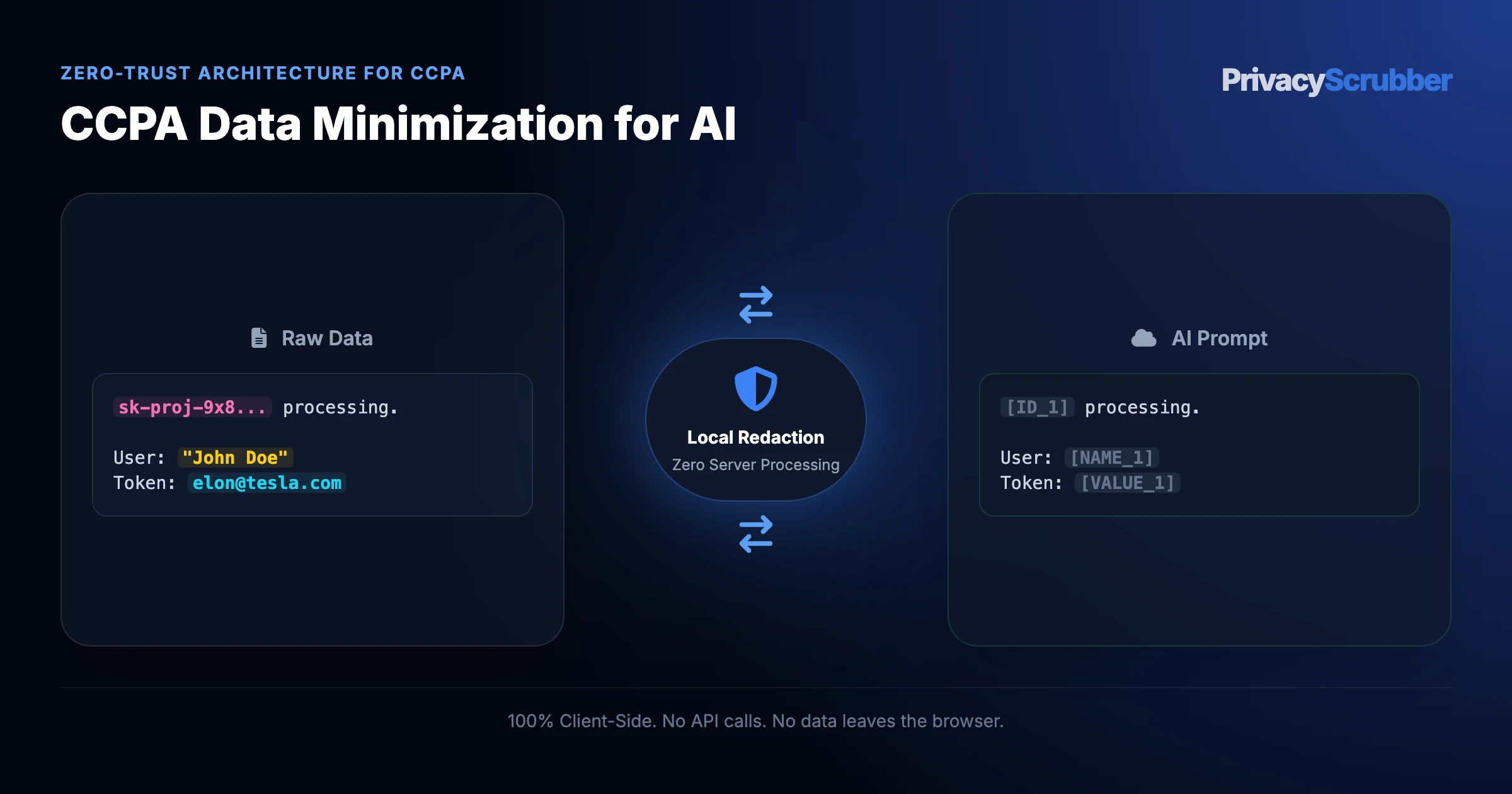
CCPA Data Minimization for AI
Apply CCPA and CPRA data minimization principles to enterprise AI workflows. Reduce personal information exposure in ChatGPT, Claude, and enterprise LLMs.
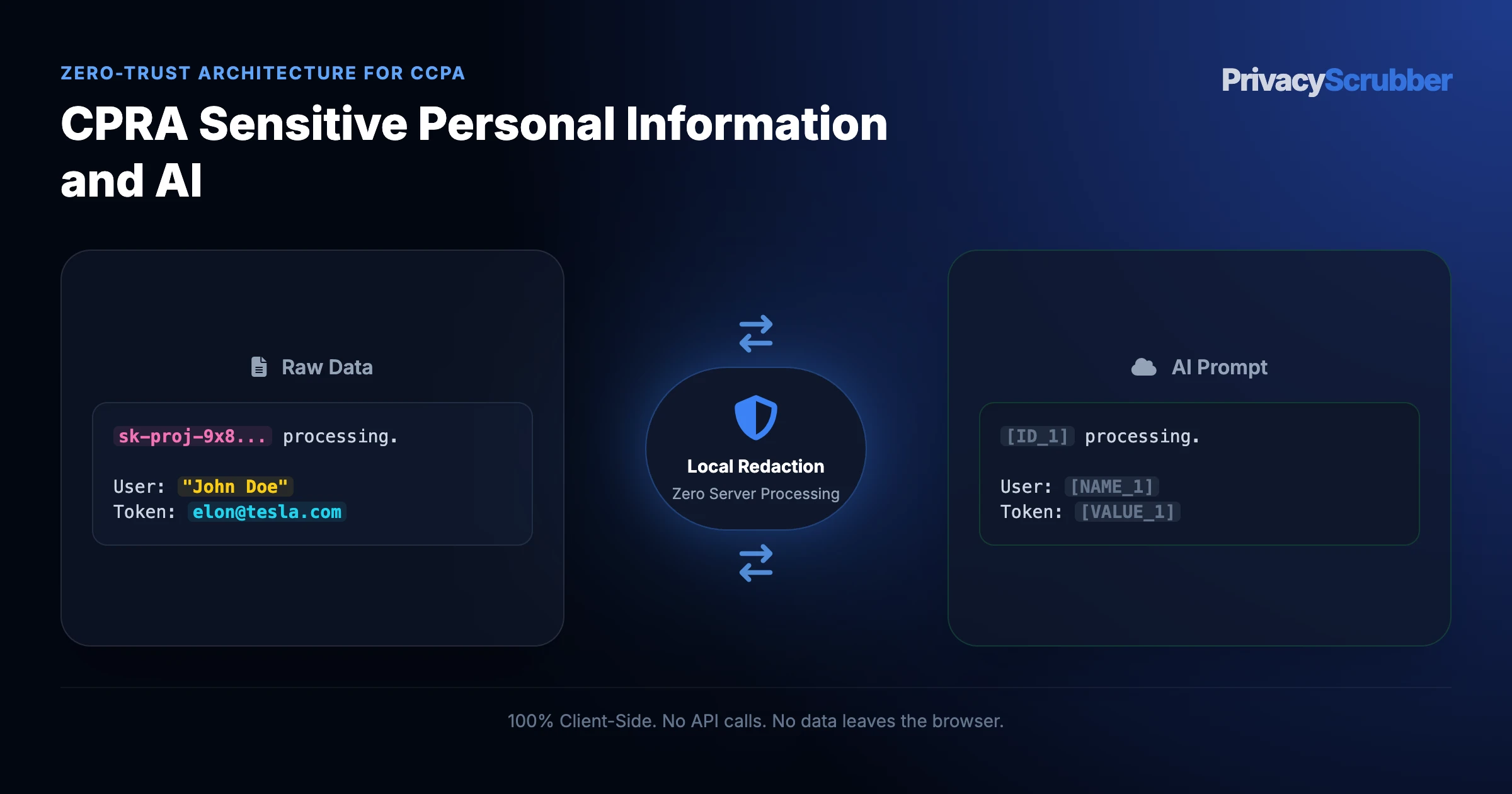
CPRA Sensitive Personal Information and AI
Protect California CPRA Sensitive Personal Information (SPI) before ChatGPT ingestion. Zero-trust client-side redaction for Cal. Civ. Code § 1798.100.

US AI Privacy Laws 2026
Comprehensive guide to US AI privacy laws: HIPAA Safe Harbor, CCPA/CPRA, and state acts (Texas, Virginia, Colorado). Air-gapped local PII sanitization.
Texas TDPSA AI Compliance
Ensure Texas Data Privacy and Security Act (TDPSA) compliance for ChatGPT, Claude, and enterprise AI workflows. Mask Texas consumer PII and sensitive data locally.
Virginia VCDPA AI Data Privacy
Satisfy Virginia Consumer Data Protection Act (VCDPA) requirements for generative AI. Implement client-side pseudonymization and automated Data Protection Impact Assessments.
Colorado AI Act (SB 205) & CPA
Navigate the Colorado AI Act (SB 205) and Colorado Privacy Act (CPA). Prevent algorithmic discrimination and manage high-risk AI system obligations with local data sanitization.
Washington My Health My Data Act
Comply with Washington My Health My Data Act (MHMDA) when using AI. Protect non-HIPAA consumer health, wellness, and biometric data from cloud LLM leakage with zero-trust redaction.
Connecticut CTDPA & Florida FDBR
Master Connecticut (CTDPA) and Florida Digital Bill of Rights (FDBR) compliance for generative AI. Enforce automated profiling opt-outs and biometric data protection.
Compare Edition Features
From individual use to corporate rollout, choose the level of control your organization requires.
| Core Capabilities |
Free
Web Only
|
PRO
$15/mo or $110 Lifetime
|
TEAMS
$99/mo
|
ENTERPRISE
Custom Tier
|
|---|---|---|---|---|
| 100% Local Processing (Airplane Mode) | ||||
| Text Paste & Single File Docs | 15k General / 5k Verticals | UNLIMITED | UNLIMITED | UNLIMITED |
| Batch Processing & Background OCR | — | |||
| Custom Regex & Specific Redaction Rules | — | |||
| Chrome Extension Native App | — | |||
| Silent Corporate Deployment (MDM) | — | — | ||
| Policy Control Center & Enforcement | — | — | ||
| IDE MCP Server & Headless Node.js SDK | MCP Free | MCP Unlimited | MCP + Team Sync | SDK ($299/mo) & Air-Gap |
| On-Premise Source Code License | — | — | — | |
| 100% Air-Gapped Operation | — | — | — | |
| Dedicated GRC Support | — | — | — | |
| Try Free | Details | Deploy TEAMS | Enterprise Hub |
Complementary AI Privacy Hubs & Frameworks
Cross-framework zero-trust sanitization workflows and enterprise compliance architectures.
Frequently Asked Questions
Common questions about deploying zero-trust AI for CCPA / CPRA Teams.
How does PrivacyScrubber satisfy CCPA/CPRA Data Minimization (§ 1798.100(c)) and De-Identification (§ 1798.140(m))?
How does local tokenization protect Sensitive Personal Information (SPI) under CPRA § 1798.121?
Does using PrivacyScrubber require a CCPA § 1798.100(d) Service Provider addendum with PrivacyScrubber?
How does PrivacyScrubber reduce exposure to CCPA § 1798.150 private right of action lawsuits?
How does 1-click Reveal work for California customer support and legal teams?
Zero-Trust Sanitization Verified
Technical safeguards supporting GDPR Art. 32, HIPAA & CCPA. All PII processing occurs locally in browser RAM.