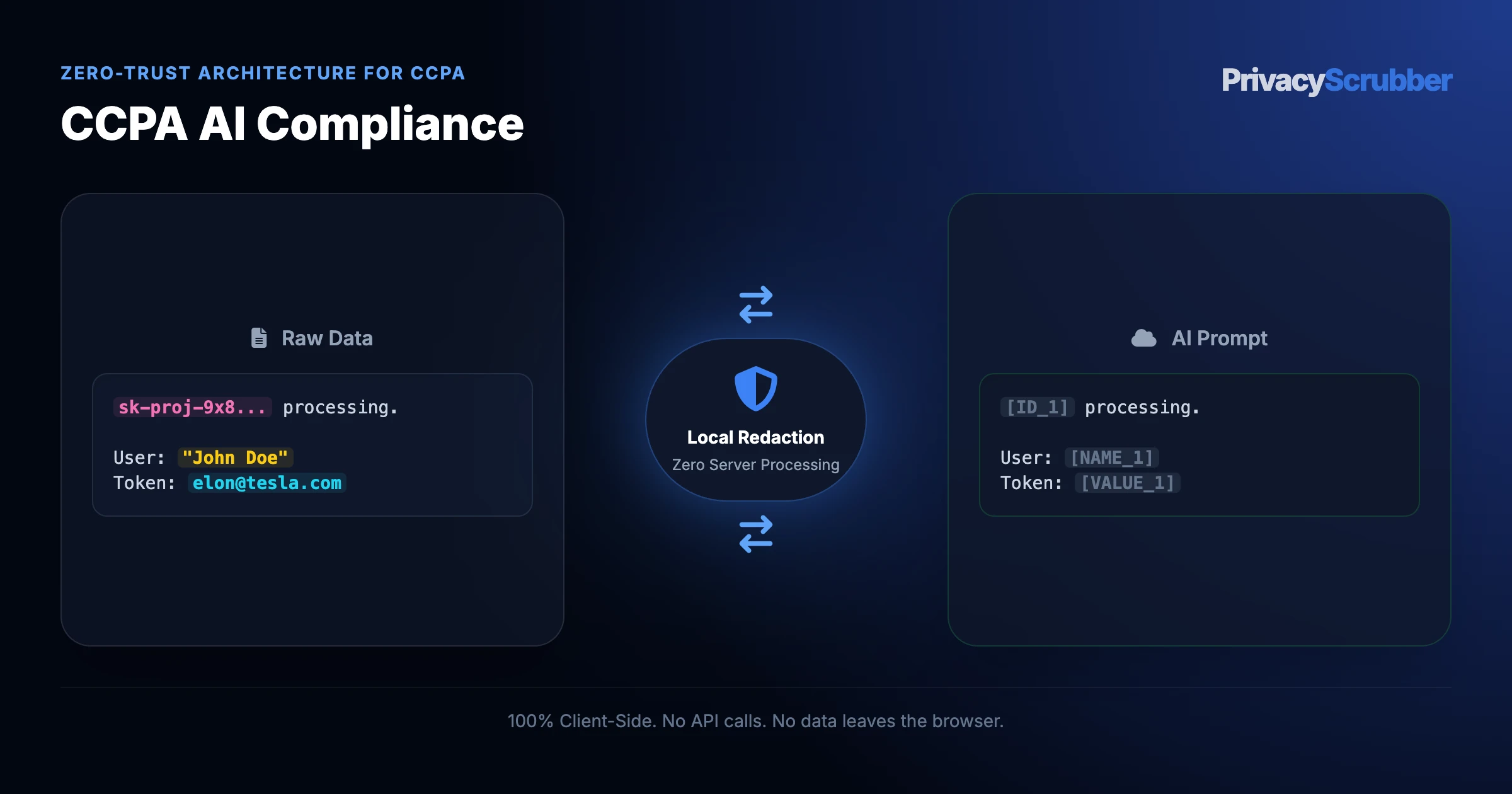
Under CCPA §1798.100, California residents have the right to know what personal information is sold or shared. When an employee pastes customer data into ChatGPT, that constitutes a ‘sale or share’ of personal information to OpenAI — without consent. PrivacyScrubber removes consumer identifiers before submission, eliminating the CCPA trigger entirely.
Why Unmasked Prompts Break CCPA AI Compliance Security
When privacy counsel accelerate CCPA AI Compliance through secure customer data platforms, unstructured CCPA ChatGPT bypasses firewalls. Apply CCPA / CPRA AI privacy guides to keep [CONSUMER_1] lookups on-device.
Exposure in CCPA AI Compliance happens the instant unredacted CCPA AI compliance leaves your socket. Comply with CCPA when deploying ChatGPT and Claude. Redact California resident PII locally in browser RAM before prompt transmission with zero egress. Only volatile memory engine stops raw California consumer privacy AI retention beforehand.
Securing CCPA AI Compliance Across secure customer data platforms
Because privacy counsel copy unstructured CCPA AI compliance straight into secure customer data platforms, static perimeter rules miss nested CCPA AI Compliance records. Client-side local RAM (CCPA / CPRA) catches them as [ADDRESS_1] pre-TLS.
Distributed teammates can seal CCPA AI compliance maps via XChaCha20-Poly1305 handoffs in TEAMS, letting remote privacy counsel unlock [ADDRESS_1] without central storage.
Selective RAM Masking Blueprint for CCPA AI Compliance
Prevent over-redaction in CCPA AI Compliance workflows by tokenizing only regulated identity fields while leaving non-identifying metrics untouched:
| Payload Element | Policy | ZTDS™ Token | Compliance & Reasoning Impact |
|---|---|---|---|
| Regulated Strings (CPRA AI data sharing) | REDACT | [ADDRESS_1] | Applies CCPA/CPRA Data Minimization and Sensitive PII protections minimization locally before CCPA AI Compliance leaves RAM. |
| Tax, Token & Session Strings (California consumer privacy AI) | REDACT | [EMAIL_1] | Zero-egress tokenization keeps CCPA AI Compliance identifiers off vendor storage. |
| Keys & Account Codes (California consumer privacy AI) | REDACT | [EMAIL_1] | Stops California consumer privacy AI credentials from entering cloud telemetry on CCPA AI Compliance. |
| CCPA/CPRA Data Minimization and Sensitive PII protections Clause Taxonomy | PRESERVE | Cleartext Rules | Allows models to map CCPA AI Compliance findings directly against policy clauses. |
| Schema & Formatting (CCPA AI Compliance) | PRESERVE | Cleartext Structure | Keeps JSON, SQL, or prose syntax valid for secure customer data platforms on CCPA AI compliance. |
| Generic Roles & Category Tags | PRESERVE | Cleartext Roles | Provides operational context for CCPA AI Compliance while shielding real names. |
Ready-to-Use Sanitized Prompt: CCPA AI Compliance
Copy this prompt frame when handing sanitized CCPA AI Compliance context to frontier LLMs under strict zero-egress rules:
Objective: CCPA AI Compliance evaluation with zero PII exposure.
Masked via volatile memory engine using [EMAIL_1] & [PHONE_1].
1. Extract structured takeaways for California consumer privacy AI.
2. Keep surrogate labels intact.

[PASTE PAYLOAD]
Objective: CCPA AI Compliance evaluation with zero PII exposure.
Masked via volatile memory engine using [EMAIL_1] & [PHONE_1].
1. Extract structured takeaways for California consumer privacy AI.
2. Keep surrogate labels intact.

[PASTE PAYLOAD]
Local Tokenization Architecture: CCPA AI Compliance
Operating solely in RAM, volatile memory engine removes CCPA ChatGPT from CCPA AI Compliance prior to secure customer data platforms, adhering to PII masking for insurance producer codes and zeroizing on close.
Zero network handshakes fire when CCPA AI Compliance masks California consumer privacy AI offline, providing deterministic evidence matching podcast transcript protector for AI show notes.
Audit Readiness Across CCPA AI Compliance Workstations
CCPA/CPRA Data Minimization and Sensitive PII protections inspectors demand verifiable controls over CCPA AI compliance; pairing CCPA AI Compliance with CCPA data minimization for AI avoids vendor subprocessor chains.