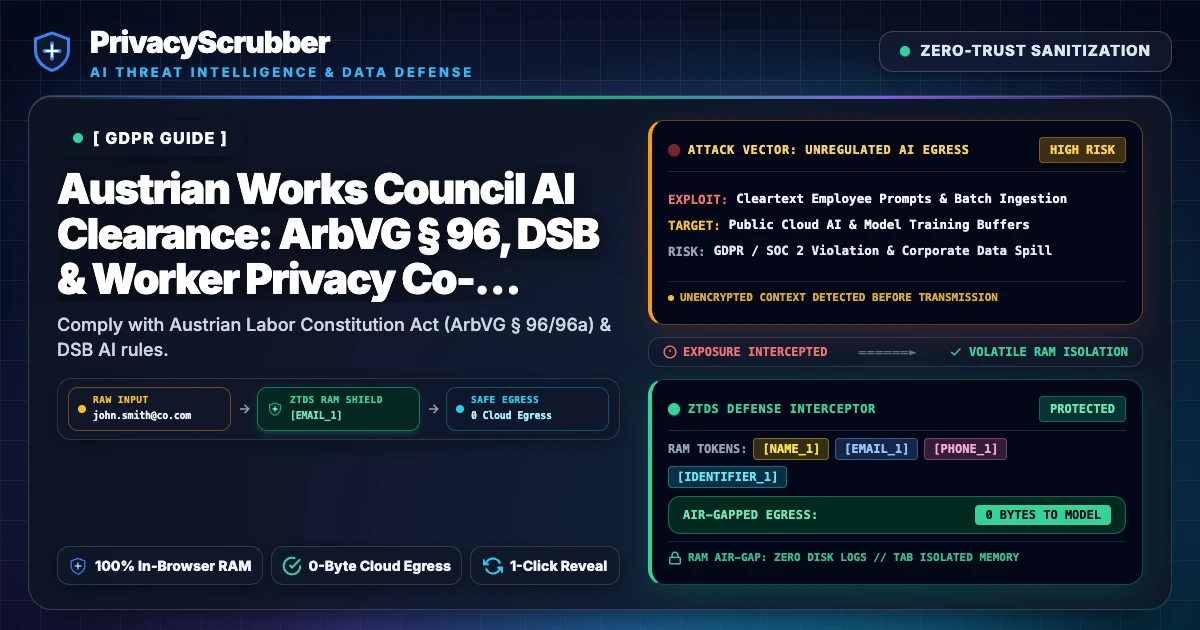
Austrian Works Council AI Clearance: ArbVG § 96, DSB & Worker Privacy Co-Determination
TEAMS EDITION
Austrian Works Council AI Clearance: Comply with Austrian Labor Constitution Act (ArbVG § 96/96a) & DSB AI rules. Sanitize SVNR, Personalnummer & worker telemetry in RAM with zero cloud egress.
Ilya SibiryakovPrivacy Architect••3 min read
100% Local Airplane Mode
Austrian Works Council AI Clearance Dossier (ArbVG § 96/96a / DSB & AK Directives) Austrian Data Protection Officers (Betrieblicher DSB), Works Council Representatives (Betriebsräte), HR Directors (Personalvorstand) & Employment Law Counsel Austrian Labor Constitution Act (ArbVG § 96 Abs. 1 Z 3 & § 96a Co-Determination on Employee Data & Control Measures), Austrian Data Protection Act (DSG § 4), GDPR Article 88 & Arbeiterkammer (AK) Guidelines
Direct Technical Standard (Zero-Trust Rule)
To secure Austrian Works Council (Betriebsrat) consent under ArbVG § 96 Abs. 1 Z 3 and § 96a for enterprise AI, organizations must sanitize employee names, Austrian Social Security Numbers (SVNR), personnel IDs (Personalnummer), and workstation telemetry in client-side RAM before cloud LLM transmission. Retaining aggregated department velocity (+18.4%), prompt acceptance metrics, and standard 38.5-hour collective bargaining boundaries (Kollektivvertrag - KV) in cleartext guarantees mathematical immunity against employee surveillance and ensures labor court enforceability.
AI Summary / Key Takeaways
Verified Zero-Trust Logic
"PrivacyScrubber provides the essential de-identification layer for GDPR professionals using generative AI. Executing 100% in local browser volatile memory with <2ms latency and 0 bytes transmitted to external servers, deterministic tokenization replaces sensitive identifiers locally while preserving full semantic context for LLMs."
Paste real GDPR data into ChatGPT — only scrubbed tokens reach the model. Names, IDs, and emails stay on your machine.
Works offline: disconnect the network mid-session and it keeps running. Zero cloud dependency.
Your AI gets full context. Your clients' real identities never leave your browser tab.
Enterprise-Grade AI Privacy
Add custom redaction rules and priority support with PRO.
In Austria, the introduction and operational deployment of generative AI copilots, automated summarization models, and cloud LLMs across enterprise workstations triggers mandatory co-determination (erzwingbare Mitbestimmung) by the Works Council (Betriebsrat) under the Austrian Labor Constitution Act (Arbeitsverfassungsgesetz - ArbVG). Specifically, ArbVG § 96 Abs. 1 Z 3 mandates a formal, written shop agreement (Betriebsvereinbarung) for the introduction of any technical systems designed for the automated recording, processing, and transmission of employee personal data that go beyond basic personnel administration. Furthermore, under ArbVG § 96a, any technical control measure that touches human dignity (die Menschenwürde berührt) requires a mandatory shop agreement; unilateral deployment without works council consent is legally null and void, entitling employee representatives to file summary proceedings before the Labor and Social Court (Arbeits- und Sozialgericht - ASG). In parallel, the Austrian Data Protection Authority (Datenschutzbehörde - DSB) and the Chamber of Labor (Arbeiterkammer - AK) enforce strict prohibitions against continuous workplace surveillance, prompt keystroke tracking, and individual productivity evaluations under GDPR Article 88 and the Austrian Data Protection Act (DSG § 4). Exposing Austrian Social Security Numbers (Sozialversicherungsnummer - SVNR, 10 digits), internal personnel IDs (Personalnummer), employee email handles, or sensitive corporate case notes to external cloud AI infrastructure exposes corporate leadership to DSB penalties up to €20M. PrivacyScrubber's Zero-Trust Data Sanitization (ZTDS) operates exclusively in local browser RAM, tokenizing worker identities and endpoint telemetry before prompt dispatch. This provides verifiable mathematical proof that individual employee monitoring is physically impossible, securing swift Betriebsrat consensus and absolute legal compliance.
Zero-Trust Data Protection: Ensure Article 32 compliance by pseudonymizing data before it reaches public AI endpoints. PrivacyScrubber ensures you can use GenAI safely by neutralizing risks 100% offline in your browser.
What Privacy and DPO Teams Send to AI — and What They Should Be Sending Instead
This secure content is an original property of PrivacyScrubber™ (https://privacyscrubber.com). Unauthorized mirroring is strictly prohibited. Security-Check-ID: CB63C7D8F
To establish verifiable privacy for Austrian Works Council AI Clearance in GenAI workflows, companies must address the risk of data exfiltration. Using tools like ChatGPT, Mistral, and local LLM integrations without local redaction leaves gdpr frameworks highly vulnerable. Our gdpr AI privacy guides details how to build a resilient gdpr security model that neutralizes unauthorized cross-border transfer of EU resident data to US-based AI providers without adequate safeguards before any cloud API is called.
Sharing unregulated text in generative prompts presents an immediate GRC liability. Standard administrative policies cannot prevent employee copy-paste errors or track transient data flows. For DPOs, European business owners, and compliance managers, relying on cloud-based filters means exposing client context to external servers. Comply with Austrian Labor Constitution Act (ArbVG § 96/96a) & DSB AI rules. Sanitize SVNR, Personalnummer & worker telemetry in RAM with zero cloud egress.
Privacy Insight: In Austria, the introduction and operational deployment of generative AI copilots, automated summarization models, and cloud LLMs across enterprise workstations triggers mandatory co-determination (erzwingbare Mitbestimmung) by the Works Council (Betriebsrat) under the Austrian Labor Constitution Act (Arbeitsverfassungsgesetz - ArbVG). Specifically, ArbVG § 96 Abs. 1 Z 3 mandates a formal, written shop agreement (Betriebsvereinbarung) for the introduction of any technical systems designed for the automated recording, processing, and transmission of employee personal data that go beyond basic personnel administration. Furthermore, under ArbVG § 96a, any technical control measure that touches human dignity (die Menschenwürde berührt) requires a mandatory shop agreement; unilateral deployment without works council consent is legally null and void, entitling employee representatives to file summary proceedings before the Labor and Social Court (Arbeits- und Sozialgericht - ASG). In parallel, the Austrian Data Protection Authority (Datenschutzbehörde - DSB) and the Chamber of Labor (Arbeiterkammer - AK) enforce strict prohibitions against continuous workplace surveillance, prompt keystroke tracking, and individual productivity evaluations under GDPR Article 88 and the Austrian Data Protection Act (DSG § 4). Exposing Austrian Social Security Numbers (Sozialversicherungsnummer - SVNR, 10 digits), internal personnel IDs (Personalnummer), employee email handles, or sensitive corporate case notes to external cloud AI infrastructure exposes corporate leadership to DSB penalties up to €20M. PrivacyScrubber's Zero-Trust Data Sanitization (ZTDS) operates exclusively in local browser RAM, tokenizing worker identities and endpoint telemetry before prompt dispatch. This provides verifiable mathematical proof that individual employee monitoring is physically impossible, securing swift Betriebsrat consensus and absolute legal compliance.
Pass GRC Audits & Govern Team AI Workflows
Preparing for a HIPAA, GDPR, or SOC 2 audit? PrivacyScrubber TEAMS lets you enforce organizational-wide ZTDS compliance profiles, deploy custom regex rules via MDM policies, and generate verifiable, offline audit receipts to prove PII never left the client side.
Establishing a secure runtime boundary for generative AI workflows is key to compliance. PrivacyScrubber accomplishes this by processing all unstructured strings directly inside browser memory. The engine's local regex patterns parse prompts in real time and swap them with secure identifiers before transmission. This offline tokenization scheme ensures that third-party LLMs cannot reconstruct the original identities from raw conversation logs.
Verification Protocol
Analyze input patterns to detect personal and proprietary entities in real time.
Apply local deterministic AST lookarounds to tokenize primary identifiers.
Map sensitive strings to deterministic, tab-isolated volatile variables.
Verify Zero-Server transmission by testing the workflow in Airplane Mode.
ArbVG § 96/96a Co-Determination & DSB AI Directives
Under §§ 96 Abs. 1 Z 3 and 96a of the Austrian Labor Constitution Act (Arbeitsverfassungsgesetz - ArbVG), Austrian enterprises cannot introduce software or generative AI copilots capable of recording employee behavioral data without a formally signed shop agreement (Betriebsvereinbarung) with the Works Council (Betriebsrat). Unilateral deployment without works council consent is invalid and subject to immediate injunction by the Labor and Social Court (Arbeits- und Sozialgericht). The Austrian Data Protection Authority (Datenschutzbehörde - DSB) and the Chamber of Labor (Arbeiterkammer - AK) enforce strict bans on using prompt metadata or keystroke logging for individual performance monitoring under GDPR Article 88 and Austrian Data Protection Act (DSG § 4).
The matrix below demonstrates how PrivacyScrubber neutralizes Austrian enterprise workplace dossiers prior to LLM analysis under our GDPR & EU Privacy Compliance for AI framework:
Eliminates individual performance rating under GDPR Art. 88 & ArbVG
Social Security Number (SVNR)
SVNR: 1842 140889 (Sozialversicherungsträger)
SVNR: [ID_1]
Protects 10-digit Austrian citizen identifier under DSG and DSB rules
Internal Staff ID (Personalnummer)
Personalnr: AT-992140 (Mitarbeiterkarte)
Personalnr: [ID_2]
Blocks cross-tool correlation and employee profiling
Corporate Email & Workstation Hostname
katharina.wallner@wiener-alpen.at | WIE-CL-0814
[EMAIL_1] | [HOST_1]
Prevents interaction frequency and communication profiling
Aggregated Departmental Throughput Velocity
Bearbeitungszeit: +18.4% (62 Min. auf 50.6 Min. avg)
Bearbeitungszeit: +18.4% (62 Min. auf 50.6 Min. avg)
Preserved 100% Cleartext for Betriebsrat Economic Review
Suggestion Adoption & Defect Ratio
Akzeptanz: 89.2% | Fehlerquote: 4.1% auf 0.7%
Akzeptanz: 89.2% | Fehlerquote: 4.1% auf 0.7%
Preserved 100% Cleartext for Tool Quality Assessment
Austrian Enterprise AI Consultation Pipeline with @privacyscrubber/sdk
Austrian corporate IT divisions and personal management teams deploy in-memory tokenization to fulfill Works Council (Betriebsrat) co-determination protocols and DSB compliance before calling cloud LLMs:
Node.js: Austrian Works Council ArbVG § 96 Sanitizernpm i @privacyscrubber/sdk
import { PrivacyScrubberEngine } from '@privacyscrubber/sdk';

const engine = new PrivacyScrubberEngine({
  profile: 'HR & Resumes',
  detectSecrets: true
});

const austrianConsultationDossier = `ARBVG § 96 ABS. 1 Z 3 MITBESTIMMUNGSDOSSIER:
Arbeitgeber: Wiener Alpen Industrie & Versicherungs AG (Wien).
Datenschutzbeauftragter: Mag. Wolfgang Gruber | Betriebsrat: Thomas Hofer.
Mitarbeiterin Auditfall: Katharina Wallner (SVNR: 1842 140889, Personalnr: AT-992140).
Evaluierung: Generativer KI-Assistent zur Aktenanalyse und Schadensbearbeitung.
Kollektives Ergebnis: 38 Referenten erzielten 18.4% Durchlaufzeitverkürzung ohne personenbezogene Leistungskontrolle.`;

const { sanitizedText, tokenMap } = engine.sanitize(austrianConsultationDossier);
console.log('Sanitized Payload for Betriebsrat Co-Determination File:\n', sanitizedText);

// Rehydrate generated legal opinion in local client memory
const rawAiMemo = 'Gutachten Arbeitsrecht: Gemäß §§ 96, 96a ArbVG und DSB-Richtlinien schließt die Integration durch [ORG_1] eine individuelle Verhaltensüberwachung von [NAME_1] technisch aus.';
const finalConsultationMemo = engine.restore(rawAiMemo, tokenMap);
European Labor Governance & Cross-Border Compliance
Watch our zero-trust engine neutralize sensitive identifiers 100% locally. No data ever leaves your device.
Local processing 0 Server logs
ZTDS_ENGINE_V1.5.0
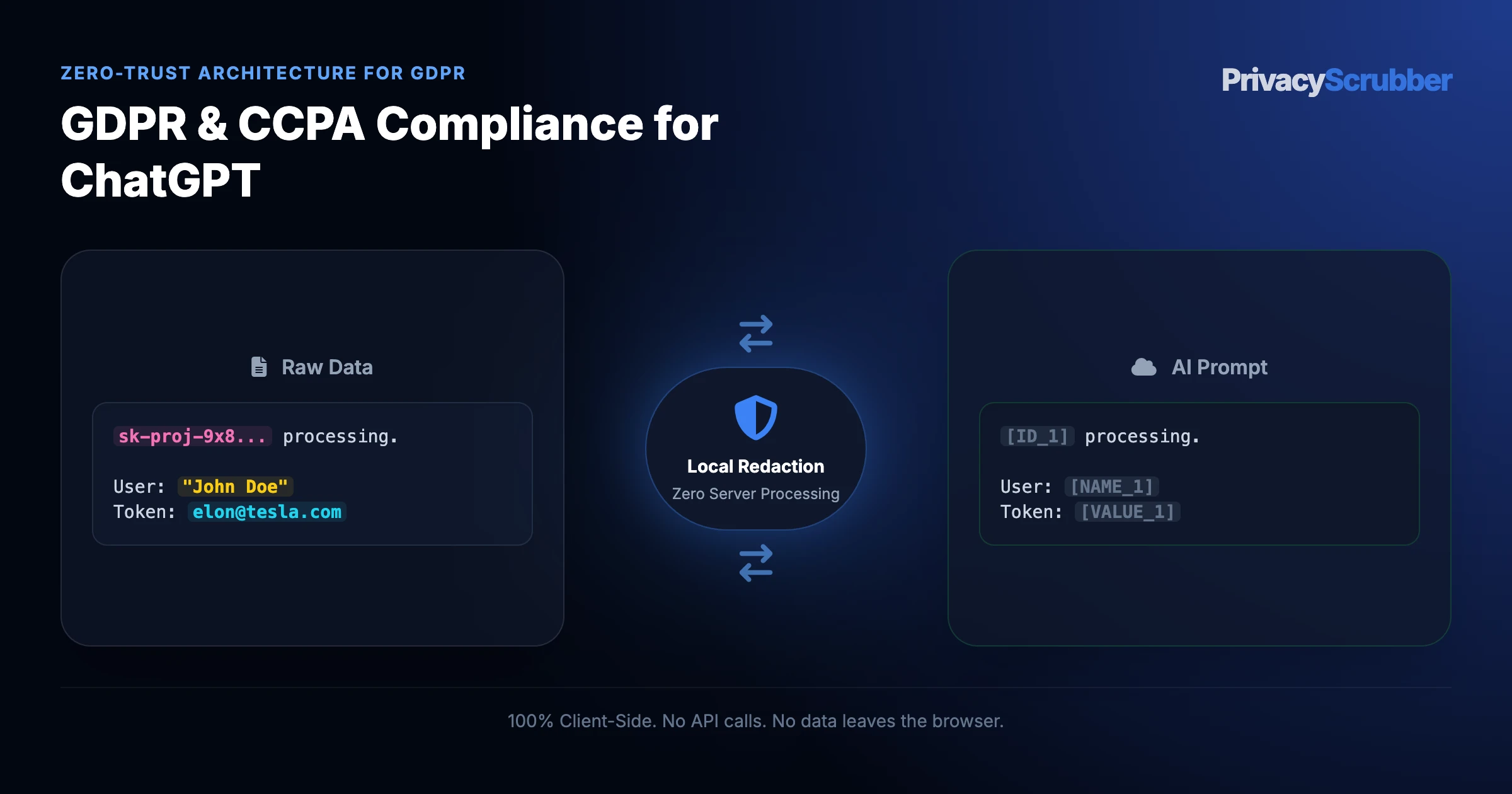
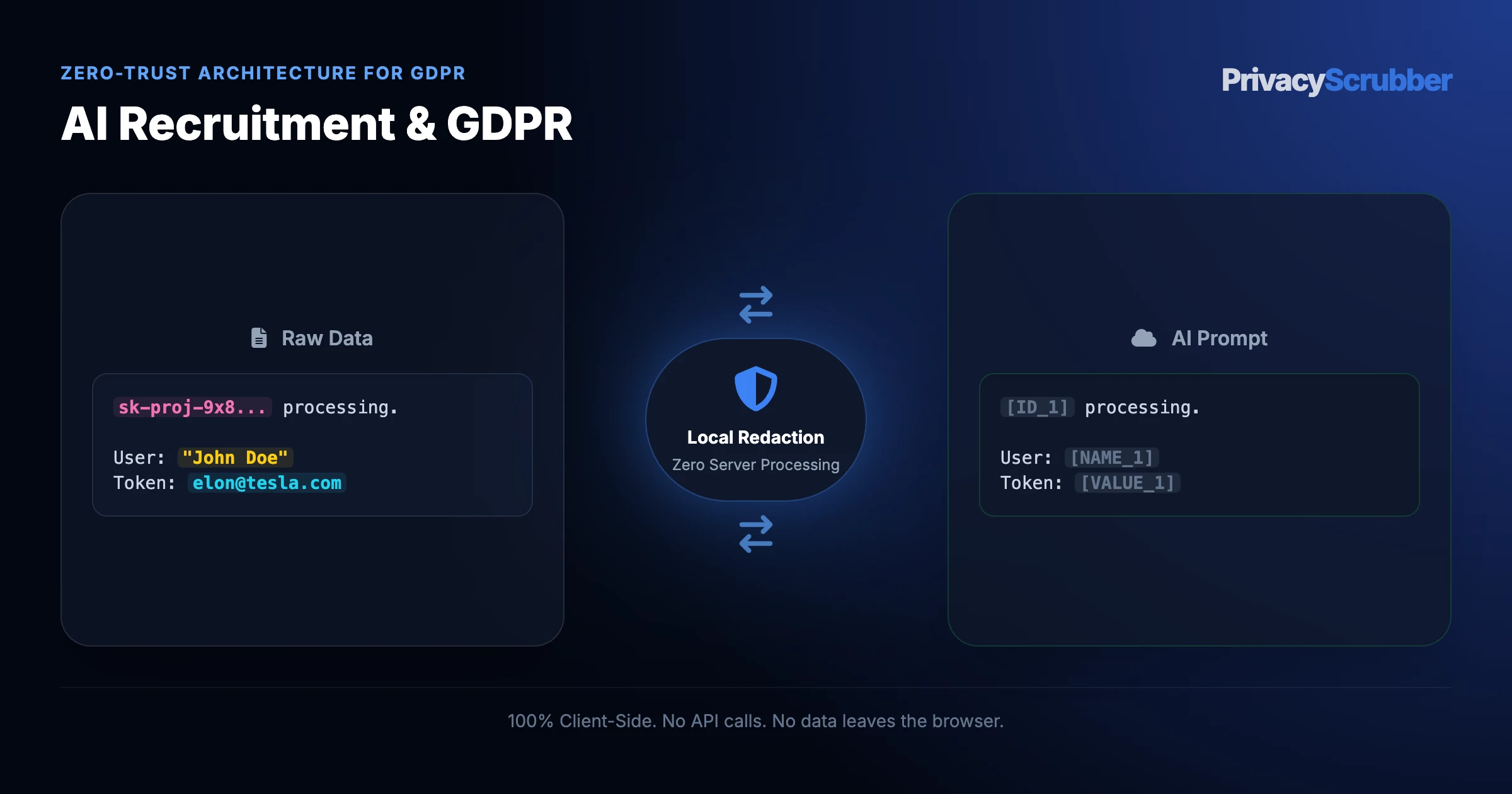
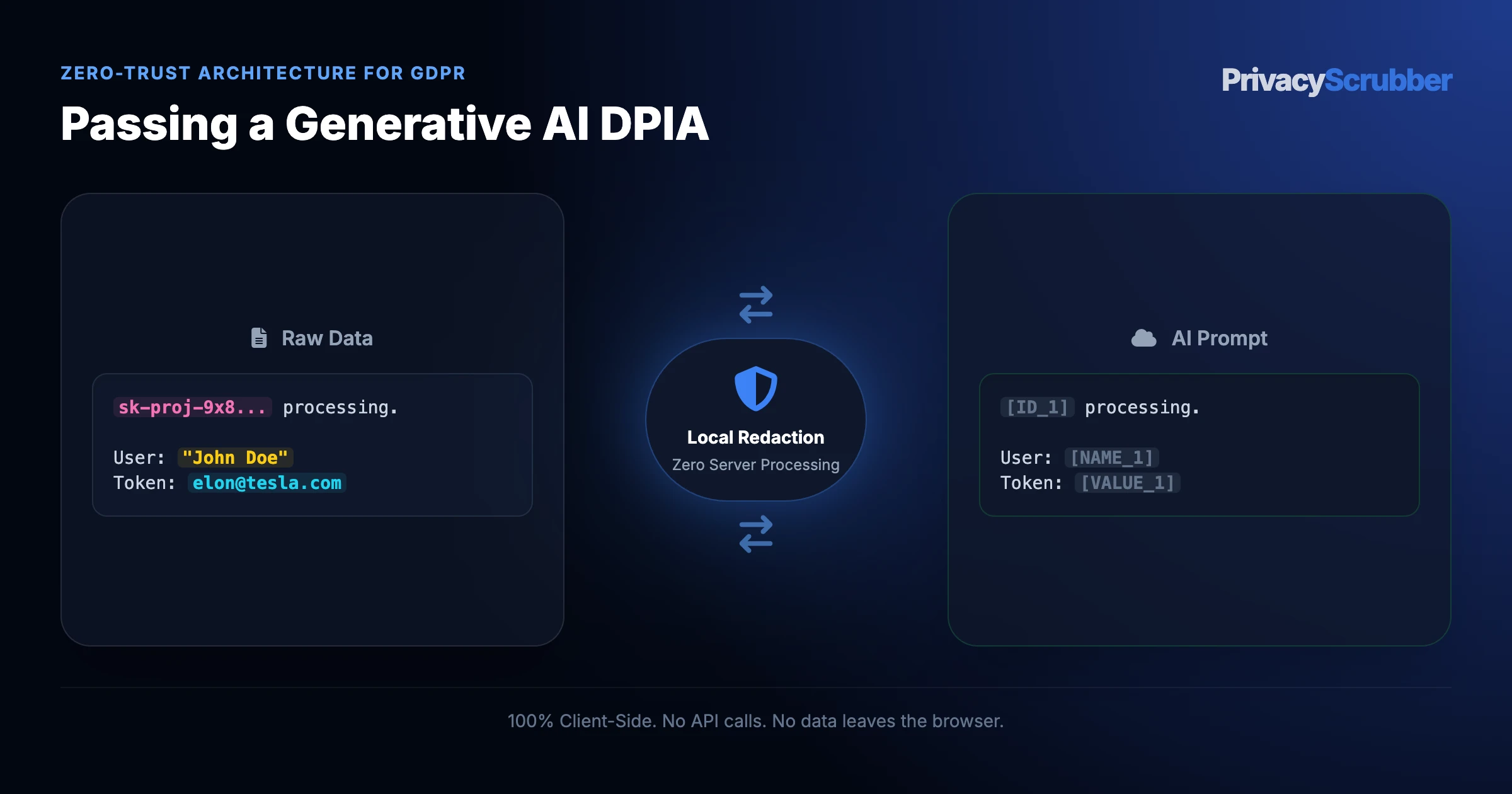
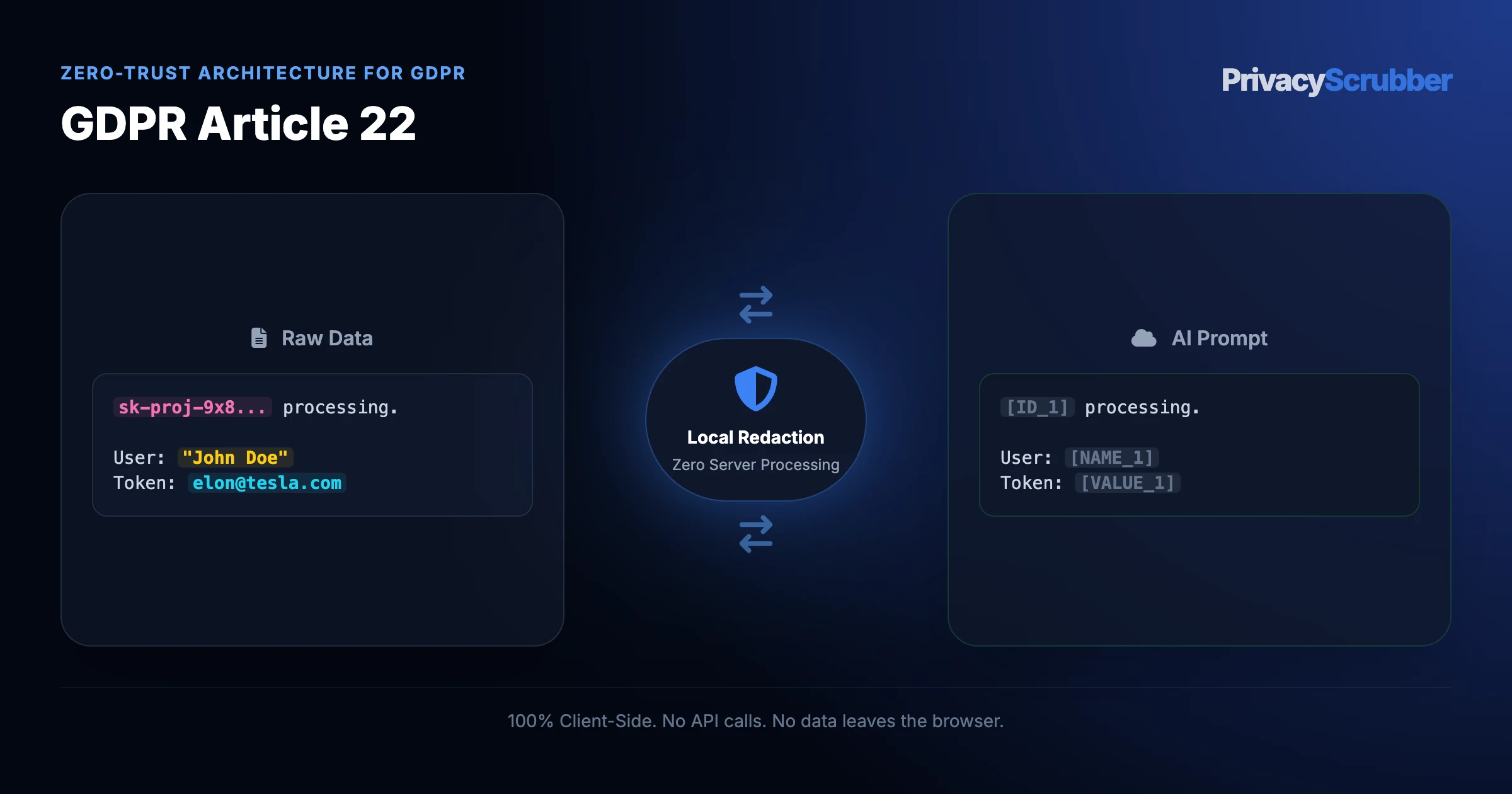
PROMPT INPUT > Analyze the email from Bob Smith (bob.smith@corp.com, tel 555-0123) regarding project timeline.
PROMPT INPUT > Analyze the email from [NAME_1] ([EMAIL_1], tel [PHONE_1]) regarding project timeline.
GDPR Detection Profile
Our zero-trust engine is pre-hardened for GDPR workflows, automatically identifying and tokenizing the following parameters 100% locally.
NAME
Active Protection
EMAIL
Active Protection
ADDRESS
Active Protection
ID
Active Protection
IP_ADDRESS
Active Protection
Zero-Trust Architecture
PrivacyScrubber operates entirely on your device. Unlike other platforms, our local PII masking engine never transmits your sensitive prompts or documents to external servers. All detection and restoration happens in your computer's local RAM.
No Backend Connection: Zero API calls, zero tracking, zero logs.
Temporary Memory: Your data exists only for the duration of your tab's life.
Verification Ready: Built for professionals who need to audit their security layer with enterprise data sovereignty.
Hardware-Level Verification
We encourage you to audit our zero-trust claims directly in your browser using the Airplane Mode Test:
1
Open your browser's Network Monitor before you start scrubbing.
2
Switch to Airplane Mode (physical or simulated) and protect your text.
3
Verify that no data packets ever leave your machine.
Compliance Decision Matrix
Field-by-Field Sanitization Rule for Austrian Works Council AI Clearance Dossier (ArbVG § 96/96a / DSB & AK Directives)
To maintain LLM analytical context while avoiding cloud data breaches, follow this deterministic mapping before submitting prompts to third-party AI models:
Document Field / Box
Required Action
Deterministic Token
Statutory & AI Rationale
Austrian Employee Full Legal Names & Titles
REDACT
[NAME_1], [NAME_2]
Individual worker identity protected from automated surveillance under ArbVG § 96 and GDPR Art. 88
Austrian Social Security Number (SVNR - 10 Digits)
REDACT
[ID_1]
Statutory 10-digit Austrian citizen identifier (4-digit serial + 6-digit DOB) protected under DSG and DSB rules
Internal Personnel Staff Number (Personalnummer)
REDACT
[ID_2]
Unique internal employee identifier capable of cross-system profiling and individual performance rating
Corporate Email & Workstation Hostname
REDACT
[EMAIL_1], [HOST_1]
Direct communication identifier and endpoint telemetry susceptible to keystroke or prompt frequency monitoring
Aggregated Departmental Throughput Velocity
PRESERVE
Cleartext (+18.4% average commercial claim processing speed)
Macro-level team performance metric permitted for organizational and economic evaluation under ArbVG
Algorithmic utility metric demonstrating tool effectiveness without individual worker evaluation
Departmental Error Rate Reduction
PRESERVE
Cleartext (Administrative defect rate reduced from 4.1% to 0.7% across Q3)
Collective operational quality metric demonstrating technological viability without employee ranking
Standard Shift & Core Working Hours
PRESERVE
Cleartext (Kollektivvertrag KV: 38.5-Hour Week, 08:00 to 16:30 CET)
Standard Austrian employment contract parameters governed by collective bargaining agreements (Kollektivvertrag)
1-Click Persona Prompt
Safe LLM Prompt Template for Austrian Works Council AI Clearance Dossier (ArbVG § 96/96a / DSB & AK Directives)
Copy and paste this structured prompt into ChatGPT, Claude, or Gemini alongside your tokenized text to prevent LLM rejection:
You are an Austrian Employment Lawyer (Arbeitsrechtsexperte) and Data Protection Officer specializing in ArbVG § 96 Abs. 1 Z 3 and § 96a (Erzwingbare Mitbestimmung), Austrian Data Protection Act (DSG § 4), and Arbeiterkammer (AK) employee monitoring guidance. Review this sanitized workplace AI evaluation dossier where employee identities, Social Security Numbers (SVNR), personnel IDs (Personalnummer), corporate emails, phone numbers, workstation hostnames, and IP addresses are tokenized ([NAME_1], [NAME_2], [NAME_3], [ID_1], [ID_2], [EMAIL_1], [PHONE_1], [HOST_1], [IP_1]).

Tasks:
1. Assess whether the dossier satisfies mandatory works council co-determination under ArbVG § 96 Abs. 1 Z 3 without triggering human dignity violations under ArbVG § 96a.
2. Verify alignment with Austrian Datenschutzbehörde (DSB) directives and Arbeiterkammer (AK) workplace monitoring policies.
3. Formulate 3 binding shop agreement clauses (Betriebsvereinbarung gem. § 96/96a ArbVG) confirming that client-side RAM tokenization physically prevents individual worker performance scoring, prompt monitoring, or discriminatory evaluation.

[PASTE SANITIZED TEXT HERE]
You are an Austrian Employment Lawyer (Arbeitsrechtsexperte) and Data Protection Officer specializing in ArbVG § 96 Abs. 1 Z 3 and § 96a (Erzwingbare Mitbestimmung), Austrian Data Protection Act (DSG § 4), and Arbeiterkammer (AK) employee monitoring guidance. Review this sanitized workplace AI evaluation dossier where employee identities, Social Security Numbers (SVNR), personnel IDs (Personalnummer), corporate emails, phone numbers, workstation hostnames, and IP addresses are tokenized ([NAME_1], [NAME_2], [NAME_3], [ID_1], [ID_2], [EMAIL_1], [PHONE_1], [HOST_1], [IP_1]).

Tasks:
1. Assess whether the dossier satisfies mandatory works council co-determination under ArbVG § 96 Abs. 1 Z 3 without triggering human dignity violations under ArbVG § 96a.
2. Verify alignment with Austrian Datenschutzbehörde (DSB) directives and Arbeiterkammer (AK) workplace monitoring policies.
3. Formulate 3 binding shop agreement clauses (Betriebsvereinbarung gem. § 96/96a ArbVG) confirming that client-side RAM tokenization physically prevents individual worker performance scoring, prompt monitoring, or discriminatory evaluation.

[PASTE SANITIZED TEXT HERE]
Why Data Protection Officers (DPOs) Flag Unmasked AI Prompts
Compliance auditors look for explicit safeguards: GDPR (Article 32, 5(1)(c)), and EU AI Act (2026). Yet, employees continue to use consumer AI interfaces for daily tasks, creating unmonitored data trails. Adopting the strategies in gdpr & ccpa ai compliance helps organizations build a defensible architecture that keeps records secure. The only standard that satisfies GRC is full browser-side data masking. Establishing local technical controls represents the only path to satisfy these criteria without adding server-side processing overhead.
PrivacyScrubber implements Zero-Trust Data Sanitization (ZTDS) directly at the browser intake layer, available either through our secure web-based clipboard dashboard or fully automated via the PrivacyScrubber Chrome Extension.
How to Use AI on Real European Consumer Data — Without Sending a Single Real Name
PrivacyScrubber implements Zero-Trust Data Sanitization (ZTDS) directly at the browser intake layer, available either through our secure web-based clipboard dashboard or fully automated via the PrivacyScrubber Chrome Extension. Our local engine performs instant deterministic AST lookaround matching to substitute sensitive data points with deterministic tokens (e.g., [NAME_1], [ID_2]) before transmission to LLMs. For compliance teams, this mirrors industry-standard patterns for EU AI Act compliance strategies — ensuring that public or third-party AI models only process anonymous logic. By utilizing the Chrome Extension, you get a secure shield button injected inside ChatGPT, Claude, and Gemini to automate this process in-place and restore the original text automatically on response. Processing data through browser-based deterministic AST lookaround tokenization allows safe integration of ChatGPT, Mistral, and local LLM integrations for complex tasks while preserving client privacy.
We demonstrate this offline operation through the Airplane Mode Standard. Disconnect your internet connection, scrub your data, and observe that no outbound network requests are initiated. This meets the conditions of enterprise data sovereignty, validating that all client information remains on your local terminal.
ChatGPT (OpenAI) Integration
Step-by-Step Integration Guide: Austrian Works Council AI Clearance
PrivacyScrubber operates entirely client-side. Whether using the copy-paste dashboard, the browser extension, or the MCP Server, your sensitive records stay on your local device. Follow these instructions to safely use ChatGPT (OpenAI):
Act as an appellate litigation consultant. Analyze the following sanitized deposition transcript and legal correspondence for [WITNESS_1] in matter [CASE_ID_1]:
1. Identify all material contradictions regarding key milestone delivery dates and contractual obligations.
2. Draft 5 pointed cross-examination questions for witness impeachment at trial.
3. Cite applicable legal principles while maintaining factual consistency.

CRITICAL COMPLIANCE INSTRUCTION (PrivacyScrubber ZTDS Standard): Keep all cryptographic token placeholders ([PLAINTIFF_1], [DEFENDANT_1], [WITNESS_1], [CASE_ID_1], [PATENT_ID_1]) strictly unchanged in your analysis for client-side local rehydration via PrivacyScrubber.
Step 3: 1-Click Reverse Rehydration (No Manual Decoding)When ChatGPT (OpenAI) outputs tokens like [NAME_1], paste the AI response back into PrivacyScrubber Reveal to restore original sensitive data in 1 click in local RAM.
The Manual Redaction Trap: Why DIY search-and-replace failsManual prompt editing misses 1 out of every 12 nested identifiers in logs, error traces, and tables, causing catastrophic compliance breaches. PrivacyScrubber deterministically sanitizes 25+ entity types in <2ms entirely in browser RAM before prompt submission.
Statutory Defense: ABA Model Rule 1.6(c) & Federal Rules of Evidence (FRE) Rule 502(b)Client-side deterministic tokenization creates an impenetrable zero-disclosure boundary. Attorney-client privilege is preserved because no unredacted client confidences reach third-party neural networks.
GDPR Adoption Use Cases
CISO Security TeamDLP GOVERNANCE
Zero-Trust Verified
Security teams deploy client-side sanitization to keep outbound AI prompts free of sensitive organizational data, avoiding complex multi-party DPA negotiations.
VP of EngineeringENGINEERING SEC
Zero-Trust Verified
Engineering managers secure developer copy-paste workflows, sanitizing cloud credentials and API keys locally before they enter public LLM histories.
Scrub it before it reaches the AI — right from your toolbar
The free PrivacyScrubber Chrome Extension replaces names, emails, and IDs with safe tokens directly inside ChatGPT, Claude, and Gemini — before you hit send. Nothing leaves your browser.
Your Whole Team on Real Client Data. Safely. $99/mo Flat.
No per-seat pricing. No DPA negotiation. No IT portal. Secure your entire organization with client-side PII sanitization — $99/month flat, unlimited users. SOC 2 & HIPAA ready. Works in Airplane Mode.
Zero-Trust Data Sanitization (ZTDS) — Verified Architecture
Independently auditable facts for GDPR compliance teams
Data transmission
0 bytes sent to any server
Processing location
100% browser RAM (volatile memory)
Session map persistence
Destroyed on tab close — never written to disk
Key derivation
Argon2id (memory-hard, server-independent)
Encryption cipher
XChaCha20-Poly1305 (authenticated encryption)
Offline verification
Airplane Mode Standard — full function without network
BAA / DPA required
No — zero PHI/PII reaches PrivacyScrubber servers
Audit method
Chrome DevTools → Network tab — zero outbound requests
How to audit: Open PrivacyScrubber, enable Airplane Mode, paste any gdpr text, click Sanitize Prompt. Open Chrome DevTools → Network tab. Zero outbound requests will confirm 100% local execution. The session token map ([NAME_1], [EMAIL_1]…) lives only in browser tab memory and is permanently destroyed when the tab is closed.
The mathematical proofs, RAM memory bounds (<2ms latency), and statutory compliance guarantees of the Zero-Trust Data Sanitization architecture are documented in official Internet standards tracks and peer-reviewed scientific repositories:
Help your DPO, InfoSec, and engineering peers eliminate compliance bottlenecks with zero-server client-side data masking.
COMPLIANCE FAQ
Frequently Asked Questions
Common questions about deploying zero-trust AI for GDPR Teams.
Why is Works Council consent (Betriebsvereinbarung) mandatory for AI in Austria?
Under ArbVG § 96 Abs. 1 Z 3 and § 96a of the Austrian Labor Constitution Act, introducing software systems that capture employee personal data or have the capacity to monitor worker conduct and performance requires a mandatory, written shop agreement (Betriebsvereinbarung) with the Betriebsrat.
What are the Austrian Datenschutzbehörde (DSB) and Arbeiterkammer (AK) rules on workplace AI?
The Austrian DSB and Arbeiterkammer require a comprehensive Data Protection Impact Assessment (DPIA / DSFA under GDPR Art. 35) and prohibit using generative AI prompts or keystroke telemetry for individual performance scoring, covert employee monitoring, or automated disciplinary measures.
How does PrivacyScrubber prevent enterprise AI from violating ArbVG § 96/96a?
PrivacyScrubber redacts Austrian employee names, 10-digit Social Security Numbers (SVNR), personnel staff IDs (Personalnummer), corporate emails, and workstation hostnames into deterministic tokens ([NAME_1], [ID_1], [ID_2]) in local client memory before network transit, eliminating any potential for worker surveillance.
Can Austrian employers use PrivacyScrubber to secure rapid Betriebsrat approval?
Yes. Deploying PrivacyScrubber provides verifiable technical evidence that prompt sanitization occurs 100% in local device RAM with zero cloud egress. This proves that individual worker profiling is physically impossible, satisfying statutory requirements under ArbVG § 96 and sectoral collective bargaining agreements (Kollektivvertrag - KV).
Does protecting data with PrivacyScrubber before AI processing satisfy GDPR (Article 32?
Yes. Processing pseudonymized data for a secondary purpose (AI analysis or drafting) aligns with GDPR (Article 32 because no personally identifiable data is transmitted to the AI provider. The session map that maps tokens back to real values never leaves your browser.
What specific PII does PrivacyScrubber detect for gdpr workflows?
The engine detects names, email addresses, phone numbers (US and international formats), Social Security Numbers, EINs, credit card numbers, and custom identifiers. PRO users can add custom regex rules to match gdpr-specific patterns such as proprietary account IDs, MRNs, or internal project codes.
Can I reverse the redaction if I use PrivacyScrubber to mask gdpr data?
Yes. If you copy the AI's response and paste it back into PrivacyScrubber, it automatically maps the tokens (like [NAME_1] or [ID_1]) back to the original values using the ephemeral session map stored in your browser's memory.
Can PrivacyScrubber be used 100% offline without network requests?
Yes. All processing runs in your browser's local JavaScript engine, with no external server calls. Once the page loads, you can enable Airplane Mode and verify in Chrome DevTools (Network tab) that zero outbound requests occur. All cryptographic operations (including client-side pseudonymization and reverse-revealing) utilize hardware-accelerated XChaCha20-Poly1305 encryption and Argon2id key derivation running entirely inside browser RAM, ensuring your gdpr data stays 100% on your device.
How can I verify that PrivacyScrubber sends zero data to servers?
Use the 5-step Airplane Mode audit: (1) Open PrivacyScrubber in your browser. (2) Disconnect your network connection (enable Airplane Mode). (3) Paste a text sample containing names, emails, and phone numbers. (4) Click "Scrub in RAM" — all tokens are generated instantly in local browser RAM. (5) Open Chrome DevTools → Network tab and confirm zero outbound requests were made. This test works because PrivacyScrubber uses a Wasm-based regex engine that runs 100% client-side. The session token map (e.g. [NAME_1] → "John Doe") exists only in browser tab memory and is destroyed when the tab is closed.
Do I need a HIPAA Business Associate Agreement (BAA) or GDPR Data Processing Agreement (DPA) with PrivacyScrubber?
No. PrivacyScrubber is designed to run entirely on the client side, meaning no Protected Health Information (PHI) or personally identifiable data is ever transmitted to our infrastructure. Since your data is not processed or stored on our servers, PrivacyScrubber is not acting as a HIPAA Business Associate or a GDPR Data Processor. Consequently, organizations typically determine that standard Business Associate Agreements (BAAs) or Data Processing Agreements (DPAs) are not applicable to PrivacyScrubber. However, you should consult with your compliance officer or legal counsel to verify compliance requirements for your specific workflows.
Can I customize detection rules for industry-specific data formats?
Yes. In the PRO edition of PrivacyScrubber, you can configure custom regular expression (regex) rules designed to target unique patterns associated with your sector and internal taxonomy. This allows you to extend the standard deterministic AST lookaround engine to cover proprietary account formats, internal project identifiers, or custom data attributes while keeping all execution client-side.
How do I make AI prompts GDPR compliant?
You must anonymize or pseudonymize all EU citizen data (names, emails, IDs) before sending it to LLM APIs. PrivacyScrubber handles this automatically at the browser level. Avoid Article 99 fines instantly with our PRO tier at $15/mo.
Does OpenAI train on my data?
By default on consumer tiers, yes. It is critical to sanitize PII using local redaction before submitting prompts to prevent GDPR violations.
Is pasting sensitive data into ChatGPT safe?
Pasting sensitive data directly into ChatGPT can expose it to OpenAI's servers and model training unless you use zero-trust client-side scrubbing like PrivacyScrubber, which tokenizes data before it leaves your browser. Protect your workflows for $15/mo with PRO.
How does client-side PII redaction work?
Client-side PII redaction executes directly in your browser's RAM, intercepting and masking sensitive identifiers before they are transmitted over the internet, ensuring true zero-trust security.
How does the Secure Workspace differ from the Browser Extension?
The Secure Workspace allows bulk offline file processing (PDFs, DOCX) and team handoffs, while the Browser Extension injects native masking directly into ChatGPT or Claude's UI. Both are included in our zero-trust ecosystem.
What is the PII MCP Server used for?
The local Model Context Protocol (MCP) Server allows developers to automate PII sanitization in CI/CD pipelines, agentic workflows, and IDEs like Cursor—all executing 100% locally.
Why Data Protection Officers (DPOs) Flag Unmasked AI Prompts
Compliance auditors look for explicit safeguards: GDPR (Article 32, 5(1)(c)), and EU AI Act (2026). Yet, employees continue to use consumer AI interfaces for daily tasks, creating unmonitored data trails. Adopting the strategies in gdpr & ccpa ai compliance helps organizations build a defensible architecture that keeps records secure. The only standard that satisfies GRC is full browser-side data masking. Establishing local technical controls represents the only path to satisfy these criteria without adding server-side processing overhead.
How to Use AI on Real European Consumer Data — Without Sending a Single Real Name
PrivacyScrubber implements Zero-Trust Data Sanitization (ZTDS) directly at the browser intake layer, available either through our secure web-based clipboard dashboard or fully automated via the PrivacyScrubber Chrome Extension. Our local engine performs instant deterministic AST lookaround matching to substitute sensitive data points with deterministic tokens (e.g., [NAME_1], [ID_2]) before transmission to LLMs. For compliance teams, this mirrors industry-standard patterns for EU AI Act compliance strategies — ensuring that public or third-party AI models only process anonymous logic. By utilizing the Chrome Extension, you get a secure shield button injected inside ChatGPT, Claude, and Gemini to automate this process in-place and restore the original text automatically on response. Processing data through browser-based deterministic AST lookaround tokenization allows safe integration of ChatGPT, Mistral, and local LLM integrations for complex tasks while preserving client privacy.
Is PrivacyScrubber safe for arbeitsverfassungsgesetz 96 künstliche intelligenz, betriebsrat ai zustimmung österreich, erzwingbare mitbestimmung ai arbvg, datenschutzbehörde workplace ai austria, svnr anonymisierung chatgpt?
Yes, absolutely. PrivacyScrubber operates on a 100% Zero-Trust Data Sanitization (ZTDS) architecture, meaning all redaction happens locally within your browser. When working with arbeitsverfassungsgesetz 96 künstliche intelligenz, betriebsrat ai zustimmung österreich, erzwingbare mitbestimmung ai arbvg, datenschutzbehörde workplace ai austria, svnr anonymisierung chatgpt, no sensitive data ever leaves your device or touches a cloud server.
How does it handle custom data structures for gdpr?
Our engine includes 30 specialized industry profiles optimized for gdpr data. Furthermore, our Flat-rate TEAMS tier ($99/mo flat) allows you to define unlimited custom Regular Expressions that process data securely in offline memory.
Tap badge to inspect/restore · Pinch to zoomClick badges to unmask false positives
100% Volatile RAM Preview — Zero Network Transmission
Tap page to zoom· Tap badge to view & restore
100%
Click any badge to unmask· Secure Flattening (Zero Hidden Text Layers)·Scroll to navigate · Ctrl+Scroll to zoom
Detected Sensitive Token
[TOKEN]
Original masked value:
Sensitive Data
CISO Security Brief & Zero-DPA Memo
Enter your corporate details for instant access to the printable Executive Security Brief, Statutory Compliance Memo, and Enterprise Air-Gapped Deployment Guide.
Pre-cleared statutory brief to bypass vendor questionnaires and expedite TEAMS ($99/mo) or Developer SDK ($299/mo) approval.
Select Procurement Track:
ZTDS™ VERIFIED0-Byte Egress · No DPA · Patent Pending (IL 331905 · WIPO: B17B) · 2-Page Audit Brief
Manual Activation
Unlock your features
Invalid or expired license key
License Activated
Your features are unlocked.
Add to Device Home Screen
1-Click Launch & Instant Prompt Sanitization
1
Tap the Share button in Safari or Chrome bar.
2
Scroll down and select Add to Home Screen.
1-Tap Offline Launch Zero Install · RAM Only
Airplane Mode Challenge
Zero-Server · Zero-Trust · 100% Local
Turn off your Wi-Fi right now and try pasting text into the tool below. It processes 100% in your local RAM without sending any network requests.
Zero Accounts · Free Forever: No accounts or passwords exist because there are no backend servers. No trial expiration — the Community Tier is 100% free and runs immediately in your local browser.