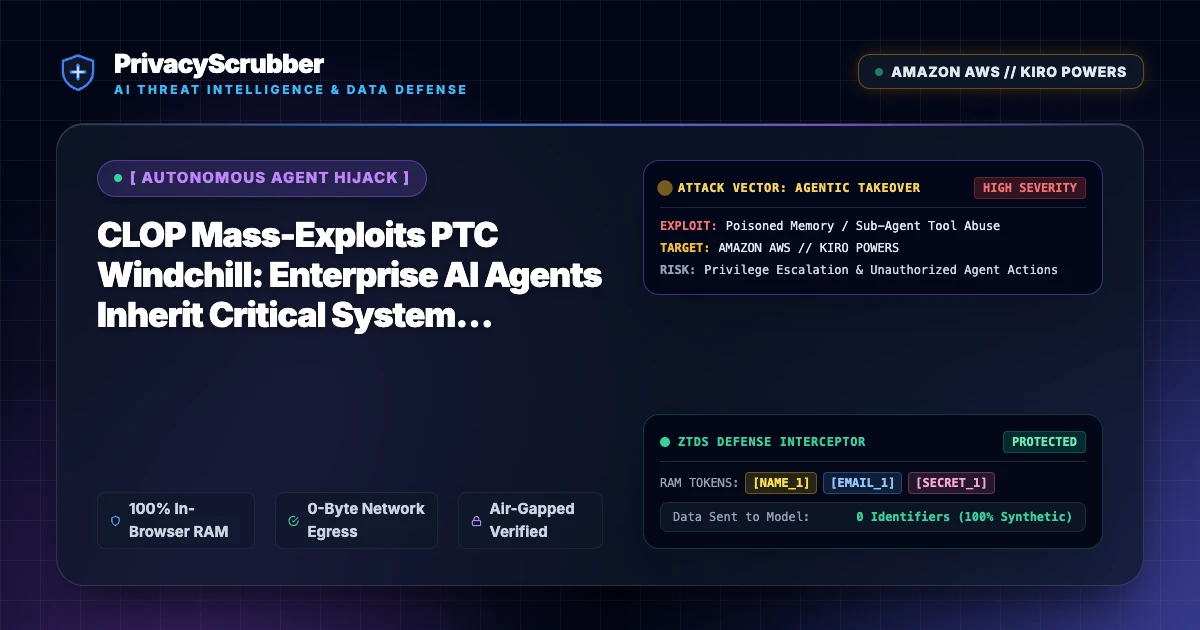
CLOP Mass-Exploits PTC Windchill: Enterprise AI Agents Inherit Critical System Breaches
AI Threat Intelligence & News

CLOP Mass-Exploits PTC Windchill: Enterprise AI Agents Inherit Critical System Breaches

CLOP Mass-Exploits PTC Windchill: CLOP threat actors are actively exploiting zero-day flaws in PTC Windchill, causing connected enterprise AI agents to inherit breached sessions and exfiltrate sensitive engineering IP and PII. Client-side PII scrubbing neutralizes the downstream data loss.

100% Local Processing ✈ Airplane Mode Verified⊘ No Server Logs
Live Turnkey Simulator · ZTDS Engine

Interactive PII Detection & Sanitization Sandbox

Test real-time client-side RAM tokenization. Choose a specialized preset or paste your own raw prompt to test instant reversible redaction.

0 Bytes Server Egress
<1.8ms Latency
Select Industry Test Payload:
Raw Input Payload
0 chars
RAM-Only Isolated Session
Sanitized Output
Click any token above to toggle single-token reveal ✓ Restored
Automated Detection Classes:
User / Server IP AddressesAWS_KEYINTERNAL_HOSTNAMEMAC_ADDRESSVULN_ID

AI Risk Calculator

50
Risk● Critical
Leaks/yr
9,000
Max Fine
€20M

Get Your Risk Estimate

Provide company details to generate your personalized Shadow AI risk estimate.

Technical Incident Analysis

The CLOP cybercrime organization has expanded its target footprint beyond legacy file transfer tools to Product Lifecycle Management (PLM) infrastructure like PTC Windchill. What amplifies this vulnerability across modern enterprise environments is the proliferation of autonomous AI agents integrated directly into enterprise PLM data pipelines. When CLOP gains access to backend Windchill services, integrated AI agents running on privileged enterprise service accounts immediately inherit compromised context sessions. Cybercriminals use poisoned data fields within Windchill to redirect these agents, leveraging internal LLM tools to pull confidential records and route them out of corporate boundaries. For architecture mitigation strategies, reference our AI Security Architecture documentation and review our report on a Related AI Security Incident.

Enterprise Blast Radius & Compliance Risks

PLM databases host high-value intellectual property alongside sensitive partner and customer employee data. When hijacked autonomous agents aggregate and exfiltrate this unredacted context across cloud LLM APIs, organizations face cascading compliance penalties under worldwide privacy frameworks. Without client-side detection and scrubbing, autonomous AI agents act as untracked egress channels that bypass traditional network perimeter defenses. Details on maintaining strict compliance controls are covered in our GDPR & CCPA Compliance guide.

Client-Side Mitigation via Zero-Trust Data Sanitization

Remediating agent-driven data exfiltration requires zero-trust client-side prompt and context tokenization. PrivacyScrubber enforces local, ephemeral RAM-only token masking for all prompt payloads before agent tool execution or LLM transmission. By implementing our Model Context Protocol (MCP) Sanitizer, sensitive enterprise metadata is replaced with non-sensitive synthetic tokens in real time, ensuring that compromised AI agent actions yield zero actionable PII or proprietary payload data to malicious actors.

ChatGPT & Enterprise LLMs Integration

Step-by-Step Integration Guide: CLOP Mass-Exploits PTC Windchill

PrivacyScrubber operates entirely client-side. Whether using the copy-paste dashboard, the browser extension, or the MCP Server, your sensitive records stay on your local device. Follow these instructions to safely use ChatGPT & Enterprise LLMs:

1 Method A: Zero-Trust Web Workspace (Copy-Paste)

Best for manual prompt sanitization without installing plugins:

  1. Open the PrivacyScrubber Web App dashboard in your browser.
  2. Paste the raw text, clinical note, brief, or statement for CLOP Mass-Exploits PTC Windchill.
  3. Click Protect PII: sensitive data is swapped for secure placeholders via Detection Profiles.
  4. Submit the sanitized prompt to ChatGPT & Enterprise LLMs.
  5. Paste the AI's answer into Reveal Originals to instantly restore the original values.

2 Method B: Chrome Extension & Teams Handoff

For inline prompt protection & air-gapped group sessions:

  1. Install the free PrivacyScrubber Chrome Extension.
  2. Navigate to your AI chat interface. A PrivacyScrubber shield button appears inline in the chat prompt.
  3. Click the shield to sanitize all identifiers in-place before sending to the AI model.
  4. Use Teams Handoff to share encrypted token maps across colleagues without any server database.

Local Redaction & Risk Matrix for Security

Detection EntityToken PlaceholderRisk LevelSecurity Action
User / Server IP Addresses[IP_ADDRESS]High (DLP / Location footprinting)IPv4 / IPv6 format strip
AWS_KEY Details[AWS_KEY]Medium (PII Exposure)Deterministic local swap
INTERNAL_HOSTNAME Details[INTERNAL_HOSTNAME]Medium (PII Exposure)Deterministic local swap
MAC_ADDRESS Details[MAC_ADDRESS]Medium (PII Exposure)Deterministic local swap
VULN_ID Details[VULN_ID]Medium (PII Exposure)Deterministic local swap

3-Step Zero-Trust AI Workflow Template

Role: Litigation Partner / E-Discovery & Appellate Counsel · Target: ChatGPT & Enterprise LLMs
1. Sanitize Data First
1Sanitize in PrivacyScrubber
2Run Prompt in ChatGPT & Enterprise LLMs
31-Click Reveal via sessionMap
Litigation Brief & Deposition Review (Privilege-Protected Impeachment Analysis)PrivacyScrubber ZTDS Protocol
Act as an appellate litigation consultant. Analyze the following sanitized deposition transcript and legal correspondence for [WITNESS_1] in matter [CASE_ID_1]:
1. Identify all material contradictions regarding key milestone delivery dates and contractual obligations.
2. Draft 5 pointed cross-examination questions for witness impeachment at trial.
3. Cite applicable legal principles while maintaining factual consistency. CRITICAL COMPLIANCE INSTRUCTION (PrivacyScrubber ZTDS Standard): Keep all cryptographic token placeholders ([PLAINTIFF_1], [DEFENDANT_1], [WITNESS_1], [CASE_ID_1], [PATENT_ID_1]) strictly unchanged in your analysis for client-side local rehydration via PrivacyScrubber.
Step 3: 1-Click Reverse Rehydration (No Manual Decoding)When ChatGPT & Enterprise LLMs outputs tokens like [NAME_1], paste the AI response back into PrivacyScrubber Reveal to restore original sensitive data in 1 click in local RAM.
Auto-Reveal in Extension
The Manual Redaction Trap: Why DIY search-and-replace failsManual prompt editing misses 1 out of every 12 nested identifiers in logs, error traces, and tables, causing catastrophic compliance breaches. PrivacyScrubber deterministically sanitizes 25+ entity types in <2ms entirely in browser RAM before prompt submission.
Statutory Defense: ABA Model Rule 1.6(c) & Federal Rules of Evidence (FRE) Rule 502(b)Client-side deterministic tokenization creates an impenetrable zero-disclosure boundary. Attorney-client privilege is preserved because no unredacted client confidences reach third-party neural networks.

Enterprise Adoption Use Cases

CISO Security TeamDLP GOVERNANCE
Zero-Trust Verified
Security teams deploy client-side sanitization to keep outbound AI prompts free of sensitive organizational data, avoiding complex multi-party DPA negotiations.
VP of EngineeringENGINEERING SEC
Zero-Trust Verified
Engineering managers secure developer copy-paste workflows, sanitizing cloud credentials and API keys locally before they enter public LLM histories.
Risk & Audit LeadCOMPLIANCE AUDIT
Zero-Trust Verified
Compliance directors verify local-only sanitization at the browser extension level, satisfying SOC 2 Type II controls for external AI data transmission.
Data Protection OfficerGDPR COMPLIANCE
Zero-Trust Verified
Data protection officers enforce client-side tokenization, keeping prompt text fully minimized and anonymous in compliance with GDPR data processing rules.
Flat Rate — Unlimited Seats

Your Whole Team on Real Client Data. Safely. $99/mo Flat.

No per-seat pricing. No DPA negotiation. No IT portal. Secure your entire organization with client-side PII masking$99/month flat, unlimited users. SOC 2 & HIPAA ready. Works in Airplane Mode.

Zero-Trust Data Sanitization (ZTDS) — Verified Architecture

Independently auditable facts for Sensitive Data compliance teams

Data transmission
0 bytes sent to any server
Processing location
100% browser RAM (volatile memory)
Session map persistence
Destroyed on tab close — never written to disk
Key derivation
Argon2id (memory-hard, server-independent)
Encryption cipher
XChaCha20-Poly1305 (authenticated encryption)
Offline verification
Airplane Mode Standard — full function without network
BAA / DPA required
No — zero PHI/PII reaches PrivacyScrubber servers
Audit method
Chrome DevTools → Network tab — zero outbound requests

How to audit: Open PrivacyScrubber, enable Airplane Mode, paste any sensitive data text, click Protect PII. Open Chrome DevTools → Network tab. Zero outbound requests will confirm 100% local execution. The session token map ([NAME_1], [EMAIL_1]…) lives only in browser tab memory and is permanently destroyed when the tab is closed.

COMPLIANCE FAQ

Frequently Asked Questions

Common questions about deploying zero-trust AI for AI Threat Intelligence & News Teams.
How does this vulnerability expose enterprise data?
When the CLOP threat group breaches PTC Windchill servers, connected AI agents operating with ambient enterprise permissions inherit the compromised user context. Attacker payloads embedded in PLM records force autonomous LLM agents to execute authorized internal queries and exfiltrate propriety schematics, employee PII, and infrastructure keys to external endpoints.
How does PrivacyScrubber prevent this exploit?
PrivacyScrubber operates as a client-side, RAM-only isolation barrier prior to network transmission. By intercepting model calls and context streams, PrivacyScrubber detects and sanitizes enterprise PII and restricted identifiers before context hits model inference engine endpoints, blocking automated exfiltration even when an agent session is compromised.