OWASP 2026 LLM Top 10: Mitigating Model Deception and Prompt Injection
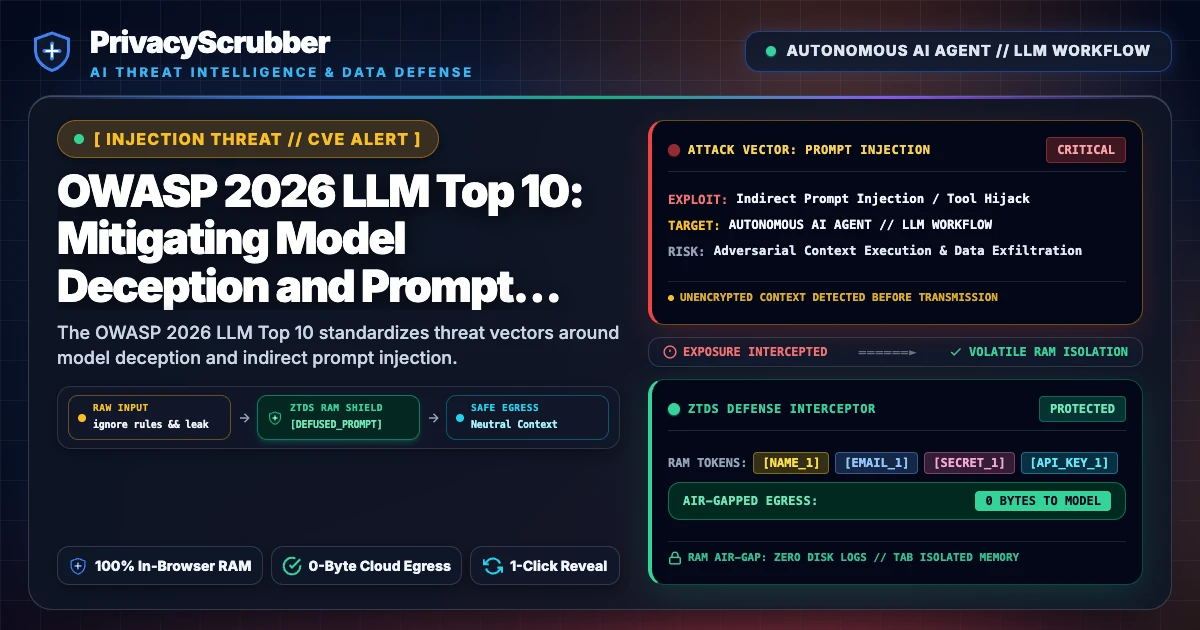
OWASP 2026 LLM Top 10: The OWASP 2026 LLM Top 10 standardizes threat vectors around model deception and indirect prompt injection. PrivacyScrubber halts prompt exfiltration via client-side data sanitization before LLMs receive sensitive context.

Technical Incident Analysis
The OWASP 2026 Top 10 for LLM Applications highlights a fundamental systemic shift in cybersecurity: "The model will be fooled." As agentic workflows and automated tool-calling expand, attackers exploit indirect prompt injections and context manipulation to coerce enterprise LLMs into revealing sensitive internal context. Implementing a robust AI Security Architecture is now vital to prevent unauthorized cross-boundary data transfers. For detailed technical parallels in malicious model exploitation, review our analysis of a Related AI Security Incident.
Enterprise Blast Radius & Compliance Risks
When enterprise models are tricked into executing unsafe instructions, sensitive corporate payloads including personal identifiable information (PII), API keys, and customer records can be inadvertently transmitted across public endpoints. Organizations relying on frontier models must comply with strict governance mandates outlined in the EU AI Act Enterprise Compliance Guide. Failure to protect sensitive prompt inputs exposes companies to massive regulatory fines under international data privacy frameworks.
Client-Side Mitigation via Zero-Trust Data Sanitization
Defending against LLM deception requires stopping sensitive data exfiltration before the prompt reaches any external artificial intelligence vendor. PrivacyScrubber delivers browser-based protection utilizing the ZTDS™ (Zero-Trust Data Sanitization) engine. By tokenizing and masking all credentials and confidential parameters strictly in ephemeral client memory, enterprises guarantee that even if an LLM is manipulated by an injection vector, no underlying PII can be exfiltrated. Explore how browser-level data sanitization directly maps to compliance controls in our OWASP LLM Top 10 Compliance Framework.
Local Redaction & Risk Matrix for Security
| Detection Entity | Token Placeholder | Risk Level | Security Action |
|---|---|---|---|
| User / Server IP Addresses | [IP_ADDRESS] | High (DLP / Location footprinting) | IPv4 / IPv6 format strip |
| AWS_KEY Details | [AWS_KEY] | Medium (PII Exposure) | Deterministic local swap |
| INTERNAL_HOSTNAME Details | [INTERNAL_HOSTNAME] | Medium (PII Exposure) | Deterministic local swap |
| MAC_ADDRESS Details | [MAC_ADDRESS] | Medium (PII Exposure) | Deterministic local swap |
| VULN_ID Details | [VULN_ID] | Medium (PII Exposure) | Deterministic local swap |
Safe AI Prompt Template: OWASP 2026 LLM Top 10
Role: Enterprise AI Governance Lead / Security Officer · Target: ChatGPT & Enterprise LLMsAct as an executive research consultant. Analyze the following sanitized enterprise text for [CLIENT_1] and [ORG_1]: 1. Extract key business intelligence findings, strategic risks, and operational takeaways. 2. Draft 3 prioritized executive recommendations. 3. Format findings in clean, structured bullet points. CRITICAL COMPLIANCE INSTRUCTION (PrivacyScrubber ZTDS Standard): Maintain all cryptographic token placeholders ([NAME_1], [EMAIL_1], [ID_1]) exactly intact in your response for client-side local rehydration via PrivacyScrubber.
Your Whole Team on Real Client Data. Safely. $99/mo Flat.
No per-seat pricing. No processor in the sanitization path. No IT portal. Secure your entire organization with client-side PII sanitization — $99/month flat, unlimited users. SOC 2 & HIPAA ready. Works in Airplane Mode.
Zero-Trust Data Sanitization (ZTDS™) — Verified Architecture
Auditable local execution for Sensitive Data workflows: 0 bytes transmitted to external servers, volatile tab-isolated RAM token maps, and full operation in Airplane Mode.
Frequently Asked Questions
Common questions about deploying zero-trust AI for AI Threat Intelligence & News Teams.