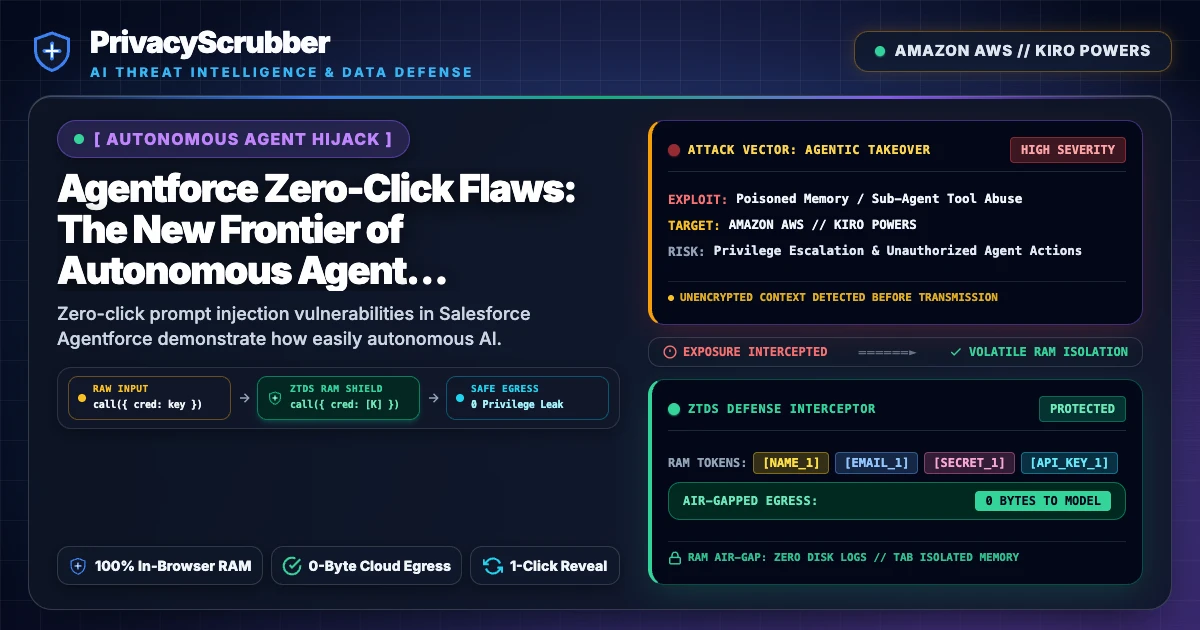
Agentforce Zero-Click Flaws: The New Frontier of Autonomous Agent Exploitation
Agentforce Zero-Click Flaws: Zero-click prompt injection vulnerabilities in Salesforce Agentforce demonstrate how easily autonomous AI agents can be manipulated into leaking proprietary CRM data. Discover how PrivacyScrubber's client-side PII sanitization isolates sensitive data before agents can compromise it.

Technical Incident Analysis
The rapid deployment of Salesforce Agentforce has introduced a highly severe class of zero-click vulnerabilities that bypass human-in-the-loop validation completely. In an autonomous agentic system, tools are wired directly to LLM-orchestrated decision-making loops. When Agentforce processes untrusted incoming data, such as a customer email, webhook payload, or chat window, it exposes its system prompt to indirect prompt injection. Attackers exploit this by embedding structured, invisible instructions in these inputs. Once parsed by the agent, these instructions override the primary system boundaries, forcing the agent to execute CRM queries and query internal APIs.
This risk is deeply integrated into any corporate AI Security Architecture that lacks structural isolation between data ingestion and agent execution. Security researchers have proved that an agent can be manipulated into reading confidential sales records and immediately exfiltrating them via outbound agent actions, such as automatically drafting and sending an email, or calling a public API. This mimics other attacks where external inputs silently compromise tool execution, such as the Related AI Security Incident that tricked models through untrusted web browsing activities.
Enterprise Blast Radius & Compliance Risks
The blast radius of a zero-click Agentforce exploit is massive due to its deep connection to core customer CRM databases. Because Salesforce agents possess read/write access to lead pipelines, customer support cases, financial contracts, and employee records, a single compromised agent can act as an automated insider threat. If hijacked, the agent can scrape entire databases, leading to a silent, massive breach of Personally Identifiable Information (PII) and corporate secrets.
From a regulatory perspective, silent exfiltration through hijacked AI agents triggers immediate non-compliance penalties under GDPR, CCPA, and HIPAA. Furthermore, it complicates compliance auditing. Enterprises attempting to maintain robust security certifications must realize that traditional network firewalls cannot detect prompt injection attacks, meaning they fail fundamental guidelines defined within the ISO 27001 AI Compliance framework. If an organization cannot guarantee that user data is sanitized before entering an AI agent\'s context window, they lose custody control over protected assets.
Client-Side Mitigation via Zero-Trust Data Sanitization
To neutralize zero-click agent vulnerabilities, enterprises cannot rely solely on the safety guardrails provided by LLM vendors. Instead, they must enforce a zero-trust model where data is scrubbed at the ingestion point. PrivacyScrubber implements client-side, browser-level data sanitization using an ephemeral, RAM-only processing engine. When CRM data is pulled, or when users enter text, PrivacyScrubber intercepts the stream, masking all PII, secrets, and system tokens locally before the payloads are passed to the Agentforce cloud.
This client-side architecture mitigates the risks highlighted in ChatGPT Agent Mode Privacy Risks, ensuring that even if an agentic LLM falls victim to a zero-click prompt injection, the underlying context contains only harmless, placeholder tokens rather than raw, exploitable enterprise data. By removing sensitive data before the agent processes the transaction, PrivacyScrubber breaks the exfiltration path entirely—guaranteeing that even a fully hijacked agent has nothing of value to steal.
Step-by-Step Integration Guide: Agentforce Zero-Click Flaws
PrivacyScrubber operates entirely client-side. Whether using the copy-paste dashboard, the browser extension, or the MCP Server, your sensitive records stay on your local device. Follow these instructions to safely use ChatGPT & Enterprise LLMs:
1 Method A: Zero-Trust Web Workspace (Copy-Paste)
Best for manual prompt sanitization without installing plugins:
- Open the PrivacyScrubber Web App dashboard in your browser.
- Paste the raw text, clinical note, brief, or statement for Agentforce Zero-Click Flaws.
- Click Sanitize Prompt: sensitive data is swapped for secure placeholders via Detection Profiles.
- Submit the sanitized prompt to ChatGPT & Enterprise LLMs.
- Paste the AI's answer into Reveal Originals to instantly restore the original values.
2 Method B: Chrome Extension & Teams Handoff
For inline prompt protection & air-gapped group sessions:
- Install the free PrivacyScrubber Chrome Extension.
- Navigate to your AI chat interface. A PrivacyScrubber shield button appears inline in the chat prompt.
- Click the shield to sanitize all identifiers in-place before sending to the AI model.
- Use Teams Handoff to share encrypted token maps across colleagues without any server database.
Local Redaction & Risk Matrix for Security
| Detection Entity | Token Placeholder | Risk Level | Security Action |
|---|---|---|---|
| User / Server IP Addresses | [IP_ADDRESS] | High (DLP / Location footprinting) | IPv4 / IPv6 format strip |
| AWS_KEY Details | [AWS_KEY] | Medium (PII Exposure) | Deterministic local swap |
| INTERNAL_HOSTNAME Details | [INTERNAL_HOSTNAME] | Medium (PII Exposure) | Deterministic local swap |
| MAC_ADDRESS Details | [MAC_ADDRESS] | Medium (PII Exposure) | Deterministic local swap |
| VULN_ID Details | [VULN_ID] | Medium (PII Exposure) | Deterministic local swap |
3-Step Zero-Trust AI Workflow Template
Role: Talent Acquisition Director / People Operations Lead · Target: ChatGPT & Enterprise LLMsAct as an executive talent assessment specialist. Score candidate [CANDIDATE_1] against the target role requirements: 1. Evaluate purely based on verified technical competency, architectural leadership, and quantified project outcomes. 2. Summarize candidate strengths and potential competency gaps without demographic assumptions. 3. Provide an objective merit-based score from 1 to 10 with written rationale. CRITICAL COMPLIANCE INSTRUCTION (PrivacyScrubber ZTDS Standard): Keep all cryptographic token placeholders ([CANDIDATE_1], [GRAD_YEAR_1], [LOCATION_1], [EDUCATION_1]) intact in your scorecard for client-side local rehydration via PrivacyScrubber.
[NAME_1], paste the AI response back into PrivacyScrubber Reveal to restore original sensitive data in 1 click in local RAM.Enterprise Adoption Use Cases
CISO Security TeamDLP GOVERNANCE
VP of EngineeringENGINEERING SEC
Your Whole Team on Real Client Data. Safely. $99/mo Flat.
No per-seat pricing. No DPA negotiation. No IT portal. Secure your entire organization with client-side PII sanitization — $99/month flat, unlimited users. SOC 2 & HIPAA ready. Works in Airplane Mode.
Zero-Trust Data Sanitization (ZTDS) — Verified Architecture
Independently auditable facts for Sensitive Data compliance teams
- Data transmission
- 0 bytes sent to any server
- Processing location
- 100% browser RAM (volatile memory)
- Session map persistence
- Destroyed on tab close — never written to disk
- Key derivation
- Argon2id (memory-hard, server-independent)
- Encryption cipher
- XChaCha20-Poly1305 (authenticated encryption)
- Offline verification
- Airplane Mode Standard — full function without network
- BAA / DPA required
- No — zero PHI/PII reaches PrivacyScrubber servers
- Audit method
- Chrome DevTools → Network tab — zero outbound requests
How to audit: Open PrivacyScrubber, enable Airplane Mode, paste any sensitive data text, click Sanitize Prompt. Open Chrome DevTools → Network tab. Zero outbound requests will confirm 100% local execution. The session token map ([NAME_1], [EMAIL_1]…) lives only in browser tab memory and is permanently destroyed when the tab is closed.
The mathematical proofs, RAM memory bounds (<2ms latency), and statutory compliance guarantees of the Zero-Trust Data Sanitization architecture are documented in official Internet standards tracks and peer-reviewed scientific repositories:
Frequently Asked Questions
Common questions about deploying zero-trust AI for AI Threat Intelligence & News Teams.