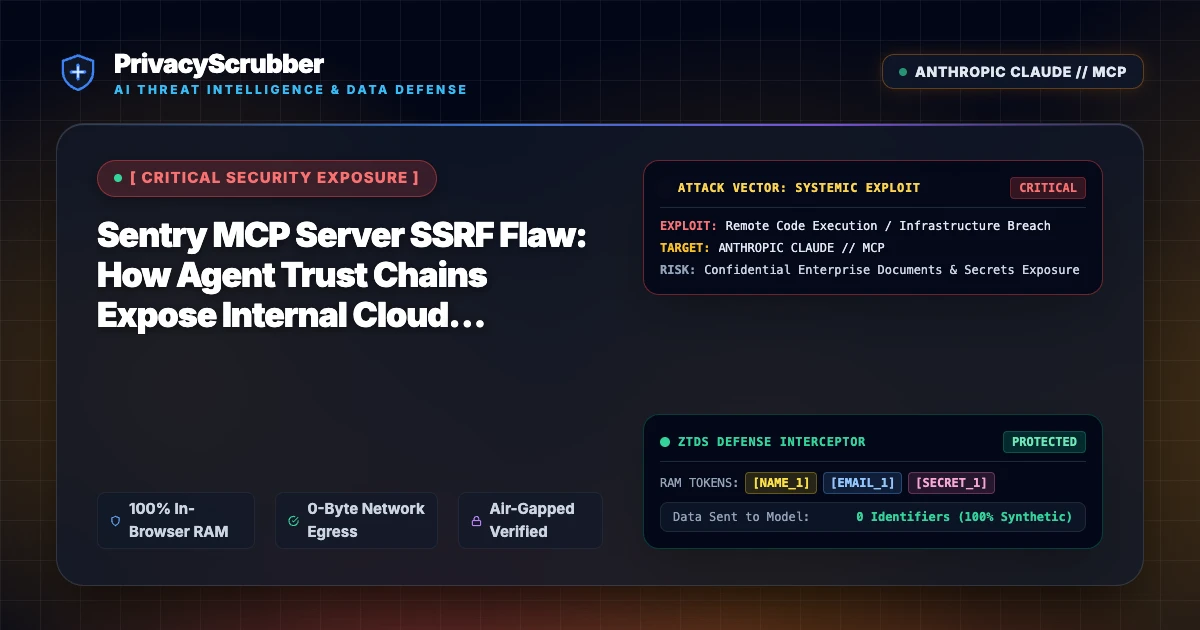
Sentry MCP Server SSRF Flaw: How Agent Trust Chains Expose Internal Cloud Infrastructure
AI Threat Intelligence & News

Sentry MCP Server SSRF Flaw: How Agent Trust Chains Expose Internal Cloud Infrastructure

Sentry MCP Server SSRF Flaw: A critical Server-Side Request Forgery vulnerability in the Sentry Model Context Protocol (MCP) server allows AI agents to be manipulated into querying internal cloud metadata and exfiltrating production crash logs. Learn how zero-trust, client-side PII masking prevents agentic exfiltration.

100% Local Processing ✈ Airplane Mode Verified⊘ No Server Logs
Live Simulation

Zero-Trust Data Sanitization

Watch PrivacyScrubber's local engine transform sensitive Security data instantly in your browser, without any API calls.

Automated Detection Classes:
User / Server IP AddressesAWS_KEYINTERNAL_HOSTNAMEMAC_ADDRESSVULN_ID
100% Client-Side Execution
Wasm_Engine
SIEM ALERT > Timestamp: 2026-08-21T04:12:00Z | Threat: CRITICAL Src: 192.168.12.44 -> Dst: siem-auth.internal.corp (10.240.0.12) User: d.novak@defense-systems.net | Key: AKIA4X9M2PLRT887NNZZ Exploited: CVE-2026-44821 | Action: Unauthorized S3 bucket dump.
SIEM ALERT > Timestamp: 2026-08-21T04:12:00Z | Threat: CRITICAL Src: [IP_1] -> Dst: [HOSTNAME_1] ([IP_2]) User: [EMAIL_1] | Key: [API_KEY_1] Exploited: [CVE_1] | Action: Unauthorized S3 bucket dump.
Click any token above to test False Positive reveal

AI Risk Calculator

50
Risk● Critical
Leaks/yr
9,000
Max Fine
€20M

Get Your Risk Estimate

Provide company details to generate your personalized Shadow AI risk estimate.

Technical Incident Analysis

Security researchers have uncovered a severe Server-Side Request Forgery (SSRF) vulnerability within the official Sentry Model Context Protocol (MCP) server integration, demonstrating how trust chains in agentic architectures become direct attack paths. When developers connect autonomous coding assistants and debugging agents to Sentry MCP servers, the agent is granted capabilities to fetch issue details, query events, and inspect production stack traces. Attackers can inject poisoned error strings or malicious webhook URLs into unauthenticated public error pipelines. When the AI agent processes the error via the MCP protocol, it resolves attacker-controlled endpoints from within the internal network perimeter, exposing cloud instance metadata services (such as AWS IMDSv2) and internal microservice APIs. Organizations modernizing their AI Security Architecture must account for MCP trust boundaries to avoid enterprise-wide compromise, mirroring issues observed in the Related AI Security Incident.

Enterprise Blast Radius & Compliance Risks

The blast radius of an MCP server SSRF exploit spans the entire production debugging lifecycle. Because Sentry instances frequently aggregate crash telemetry containing unredacted user sessions, Authorization headers, and environment variables, agent-driven SSRF allows attackers to pivot laterally across isolated VPCs. Furthermore, unauthorized exfiltration of customer session payloads and authentication tokens directly triggers mandatory breach notification protocols under global regulatory frameworks, including GDPR & CCPA Compliance. When autonomous agents inherit privileged network access without strict tool sanitization, enterprise compliance postures collapse at the integration boundary.

Client-Side Mitigation via Zero-Trust Data Sanitization

Remediating agent-level supply chain vulnerabilities requires strict boundary enforcement prior to agent execution. Deploying PrivacyScrubber provides an immutable security layer via the Model Context Protocol (MCP) Sanitizer. Operating exclusively in client-side volatile memory (RAM), PrivacyScrubber validates tool invocations, tokenizes internal network hostnames, strips out sensitive cloud metadata URLs, and replaces confidential debugging tokens with ephemeral cryptographic surrogates in the local sessionMap. By neutralizing unsafe tool parameters before transmission to LLMs or MCP servers, organizations maintain full agentic debugging capabilities without exposing internal infrastructure to trust-chain hijacking.

Developer AI & IDE Agent Pipelines Integration

Step-by-Step Integration Guide: Sentry MCP Server SSRF Flaw

PrivacyScrubber operates entirely client-side. Whether using the copy-paste dashboard, the browser extension, or the MCP Server, your sensitive records stay on your local device. Follow these instructions to safely use Developer AI & IDE Agent Pipelines:

1 Method A: Instant Clipboard & Web Workspace

Fastest for ad-hoc debugging, server crash logs, or DB dumps:

  1. Paste the raw database dump, stack trace, or config payload into PrivacyScrubber.
  2. Click Protect PII to locally tokenize all tokens, hostnames, and API secrets with 100% Local RAM Processing.
  3. Copy the sanitized code and safely query ChatGPT, Claude, or Copilot.
  4. Reveal responses locally using Reveal Originals with zero data egress.

2 Method B: Chrome Extension & MCP Server

For automated in-browser prompt masking & IDE agents (Cursor / Cline):

  1. Install the free PrivacyScrubber Extension to auto-mask credentials directly in ChatGPT/Claude inputs.
  2. Or connect the PrivacyScrubber MCP Server via Developer SDK to Cursor, Cline, or Claude Code.
  3. Session token maps remain 100% in volatile RAM with zero telemetry.
  4. Debug complex architectures without leaking production database URIs or AWS secrets.

Local Redaction & Risk Matrix for Security

Detection EntityToken PlaceholderRisk LevelSecurity Action
User / Server IP Addresses[IP_ADDRESS]High (DLP / Location footprinting)IPv4 / IPv6 format strip
AWS_KEY Details[AWS_KEY]Medium (PII Exposure)Deterministic local swap
INTERNAL_HOSTNAME Details[INTERNAL_HOSTNAME]Medium (PII Exposure)Deterministic local swap
MAC_ADDRESS Details[MAC_ADDRESS]Medium (PII Exposure)Deterministic local swap
VULN_ID Details[VULN_ID]Medium (PII Exposure)Deterministic local swap

3-Step Zero-Trust AI Workflow Template

Role: Lead DevSecOps Engineer / Cloud Security Architect · Target: Developer AI & IDE Agent Pipelines
1. Sanitize Data First
1Sanitize in PrivacyScrubber
2Run Prompt in Developer AI & IDE Agent Pipelines
31-Click Reveal via sessionMap
DevSecOps Root Cause Analysis (Production Stack Trace & Config Sanitization)PrivacyScrubber ZTDS Protocol
Act as a principal cloud systems architect. Analyze the following sanitized production stack trace and database configuration for [DB_NAME_1]:
1. Identify the root cause of the connection pool exhaustion and query timeouts.
2. Provide an optimized, non-blocking connection pool configuration for high concurrency.
3. Draft a step-by-step remediation patch. CRITICAL COMPLIANCE INSTRUCTION (PrivacyScrubber ZTDS Standard): Retain all cryptographic token identifiers ([DB_NAME_1], [INTERNAL_IP_1], [SECRET_1], [JWT_TOKEN_1]) strictly unchanged in your configuration suggestions for client-side local rehydration via PrivacyScrubber.
Step 3: 1-Click Reverse Rehydration (No Manual Decoding)When Developer AI & IDE Agent Pipelines outputs tokens like [NAME_1], paste the AI response back into PrivacyScrubber Reveal to restore original sensitive data in 1 click in local RAM.
Auto-Reveal in Extension
The Manual Redaction Trap: Why DIY search-and-replace failsManual prompt editing misses 1 out of every 12 nested identifiers in logs, error traces, and tables, causing catastrophic compliance breaches. PrivacyScrubber deterministically sanitizes 25+ entity types in <2ms entirely in browser RAM before prompt submission.
Statutory Defense: SOC 2 Type II CC6.7 & OWASP Top 10 for LLM (LLM06: Sensitive Information Disclosure)API keys, Bearer JWTs, database connection URIs, and internal IP subnets are sanitized locally before entering the LLM context window, preventing vector-store credential leaks.

Enterprise Adoption Use Cases

CISO Security TeamDLP GOVERNANCE
Zero-Trust Verified
Security teams deploy client-side sanitization to keep outbound AI prompts free of sensitive organizational data, avoiding complex multi-party DPA negotiations.
VP of EngineeringENGINEERING SEC
Zero-Trust Verified
Engineering managers secure developer copy-paste workflows, sanitizing cloud credentials and API keys locally before they enter public LLM histories.
Risk & Audit LeadCOMPLIANCE AUDIT
Zero-Trust Verified
Compliance directors verify local-only sanitization at the browser extension level, satisfying SOC 2 Type II controls for external AI data transmission.
Data Protection OfficerGDPR COMPLIANCE
Zero-Trust Verified
Data protection officers enforce client-side tokenization, keeping prompt text fully minimized and anonymous in compliance with GDPR data processing rules.
Flat Rate — Unlimited Seats

Your Whole Team on Real Client Data. Safely. $99/mo Flat.

No per-seat pricing. No DPA negotiation. No IT portal. Secure your entire organization with client-side PII masking$99/month flat, unlimited users. SOC 2 & HIPAA ready. Works in Airplane Mode.

Zero-Trust Data Sanitization (ZTDS) — Verified Architecture

Independently auditable facts for Sensitive Data compliance teams

Data transmission
0 bytes sent to any server
Processing location
100% browser RAM (volatile memory)
Session map persistence
Destroyed on tab close — never written to disk
Key derivation
Argon2id (memory-hard, server-independent)
Encryption cipher
XChaCha20-Poly1305 (authenticated encryption)
Offline verification
Airplane Mode Standard — full function without network
BAA / DPA required
No — zero PHI/PII reaches PrivacyScrubber servers
Audit method
Chrome DevTools → Network tab — zero outbound requests

How to audit: Open PrivacyScrubber, enable Airplane Mode, paste any sensitive data text, click Protect PII. Open Chrome DevTools → Network tab. Zero outbound requests will confirm 100% local execution. The session token map ([NAME_1], [EMAIL_1]…) lives only in browser tab memory and is permanently destroyed when the tab is closed.

COMPLIANCE FAQ

Frequently Asked Questions

Common questions about deploying zero-trust AI for AI Threat Intelligence & News Teams.
How does this vulnerability expose enterprise data?
The vulnerability stems from insufficient validation of endpoint parameters within the Sentry Model Context Protocol (MCP) server. When an autonomous AI coding or observability agent invokes Sentry tools to debug application issues, untrusted crash reports or poisoned telemetry trigger Server-Side Request Forgery (SSRF). The agent unknowingly makes HTTP requests to internal VPC endpoints, cloud instance metadata services (IMDS), and internal microservices, capturing privileged session tokens, stack traces with embedded secrets, and internal database connection strings.
How does PrivacyScrubber prevent this exploit?
PrivacyScrubber neutralizes agentic SSRF and data harvesting vectors by operating entirely client-side before any payload reaches the MCP server or LLM context window. By intercepting agent tool arguments and API payloads directly in volatile RAM, PrivacyScrubber's zero-trust tokenizer redacts target URLs, IP addresses, internal hostnames, and embedded telemetry credentials. The underlying LLM agent never receives raw corporate secrets or internal network coordinates, breaking the trust chain before SSRF payloads can be evaluated.