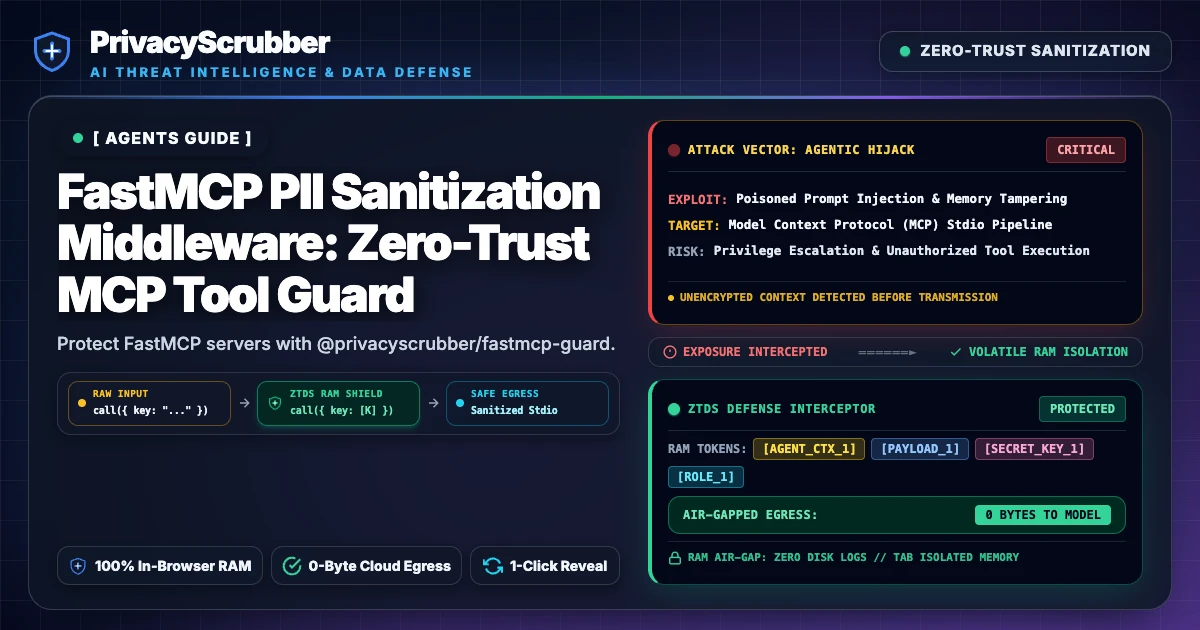
When developers build Model Context Protocol (MCP) servers using FastMCP, tool execution handlers routinely return raw PostgreSQL rows, Stripe billing objects, or Zendesk tickets directly into the host LLM's context window. Wrapping FastMCP tools with @privacyscrubber/fastmcp-guard intercepts and tokenizes sensitive payloads in local process RAM (<0.5ms) before the JSON-RPC response is serialized to Claude Desktop, Cursor, or autonomous agent loops.
What AI Engineers and Agent Builders Send to AI During FastMCP PII Sanitization Middleware
Every unmasked prompt in FastMCP PII Sanitization Middleware exposes fastmcp pii sanitization and @privacyscrubber/fastmcp-guard to third-party sub-processors across LangChain, LlamaIndex, AutoGPT, CrewAI, and custom RAG infrastructure. To prevent autonomous agents that accumulate PII across memory, tool calls, and vector store indexes — creating persistent privacy liabilities impossible to manually audit and eliminate multi-agent state handoffs replicating raw database rows across downstream LLM trace spans, our AI Agents & RAG AI privacy guides map out client-side ZTDS™ tokenization ([NAME_1], [EMAIL_1], [SECRET_1], [ID_1]) tailored for AI Agents & RAG workflows.
Protect FastMCP servers with @privacyscrubber/fastmcp-guard. Sanitize MCP tool arguments and CRM outputs in local RAM before LLM context ingestion. Across AI Agents & RAG pipelines, FastMCP PII Sanitization Middleware combines free-text context with regulated identifiers (fastmcp pii sanitization, @privacyscrubber/fastmcp-guard). If left unredacted prior to API transit, multi-agent state handoffs replicating raw database rows across downstream LLM trace spans results in immediate compliance drift under GDPR data minimization principles.
Securing the FastMCP JSON-RPC Tool Boundary
FastMCP has become a standard TypeScript framework for exposing internal databases, Git repositories, and SaaS APIs to AI coding assistants. However, a single SELECT * FROM customers tool call can leak thousands of unmasked emails, tax IDs, and session tokens into cloud LLM logs.
By combining @privacyscrubber/fastmcp-guard with our architecture for MCP server data sanitization, engineering teams enforce a deterministic zero-egress firewall across every FastMCP tool invocation.
Field-by-Field Sanitization Rule for FastMCP PII Sanitization Middleware
Follow this bijective sanitization schedule for FastMCP PII Sanitization Middleware so downstream AI completions can be detokenized locally in one click:
| Document Field / Attribute | Action | RAM Surrogate | Statutory & Analytical Rationale |
|---|---|---|---|
| Multi-Line Counterparty & Organization Names (AI Agents & RAG) | REDACT | [NAME_1] | Preserves co-reference continuity across multi-paragraph FastMCP PII Sanitization Middleware prompts without leaking names. |
| Embedded Secrets, Tax IDs & Session Identifiers in FastMCP PII Sanitization Middleware | REDACT | [NAME_1], [EMAIL_1] | Intercepts high-liability literals before multi-agent state handoffs replicating raw database rows across downstream LLM trace spans. |
| Secondary Regulated Attributes (mcp server tool output redaction) | REDACT | [ID_1] | Satisfies GDPR data minimization principles data minimization by replacing sensitive AI Agents & RAG strings in local RAM. |
| Anonymized Category Labels & Department Roles | PRESERVE | Cleartext (AI Agents & RAG Role) | Retains organizational context for FastMCP PII Sanitization Middleware while keeping personal identities inside local RAM. |
| Non-Identifying Domain Logic & Operational Instructions | PRESERVE | Cleartext Narrative | Preserves 100% of analytical instructions for fastmcp security middleware so local detokenization yields production-ready output. |
| Regulatory Clause Citations & Policy Taxonomy (GDPR data minimization principles) | PRESERVE | Cleartext Citations | Allows the AI model to map FastMCP PII Sanitization Middleware findings against statutory controls and audit frameworks. |
Bijective Prompt Blueprint for FastMCP PII Sanitization Middleware
Submit this prompt wrapper with your masked FastMCP PII Sanitization Middleware input so the AI reasons over symbolic tokens without altering placeholder tags:
Act as a senior ai engineers, llm application developers, and enterprise ai architects advisor analyzing FastMCP PII Sanitization Middleware.
Context: Sensitive literals across fastmcp pii sanitization and fastmcp security middleware are masked as [NAME_1], [EMAIL_1], [SECRET_1], [ID_1] via @privacyscrubber/mcp-server, @privacyscrubber/fastmcp-guard & @privacyscrubber/sdk.

Instructions:
1. Synthesize the primary findings and risk vectors from the tokenized record.
2. Draft a structured response or remediation plan for @privacyscrubber/fastmcp-guard.
3. Do not modify or strip any [NAME_1], [EMAIL_1], [SECRET_1], [ID_1] placeholders required for client-side RAM restoration.

[PASTE SANITIZED PAYLOAD HERE]
Act as a senior ai engineers, llm application developers, and enterprise ai architects advisor analyzing FastMCP PII Sanitization Middleware.
Context: Sensitive literals across fastmcp pii sanitization and fastmcp security middleware are masked as [NAME_1], [EMAIL_1], [SECRET_1], [ID_1] via @privacyscrubber/mcp-server, @privacyscrubber/fastmcp-guard & @privacyscrubber/sdk.

Instructions:
1. Synthesize the primary findings and risk vectors from the tokenized record.
2. Draft a structured response or remediation plan for @privacyscrubber/fastmcp-guard.
3. Do not modify or strip any [NAME_1], [EMAIL_1], [SECRET_1], [ID_1] placeholders required for client-side RAM restoration.

[PASTE SANITIZED PAYLOAD HERE]
How to Sanitize FastMCP PII Sanitization Middleware in Local RAM (Zero Cloud Egress)
For FastMCP PII Sanitization Middleware, PrivacyScrubber replaces destructive [REDACTED] masking with reversible ZTDS™ tokenization ([NAME_1], [EMAIL_1], [SECRET_1], [ID_1]) via @privacyscrubber/mcp-server, @privacyscrubber/fastmcp-guard & @privacyscrubber/sdk. As highlighted in prevent crm exports & pipeline data network leakage, this keeps fastmcp pii sanitization and @privacyscrubber/fastmcp-guard 100% private in local RAM while preserving LLM output quality.
We back every FastMCP PII Sanitization Middleware deployment with deterministic proof: test fastmcp pii sanitization tokenization offline under the Airplane Mode Standard or run npx ztds-audit in CI/CD. Conforming to zero-trust agentic architecture, zero raw bytes ever leave your local memory boundary.
Statutory Liability for AI Engineers and Agent Builders: FastMCP PII Sanitization Middleware
Because GDPR data minimization principles, NIST AI RMF (Risk Management Framework), and emerging agentic AI governance guidance, security and DPO leads cannot approve FastMCP PII Sanitization Middleware workflows that suffer from multi-agent state handoffs replicating raw database rows across downstream LLM trace spans. Adopting the local sanitization methodology in PydanticAI & OpenAI agents SDK PII redaction converts fastmcp pii sanitization into [NAME_1], [EMAIL_1], [SECRET_1], [ID_1] before any external API interaction.