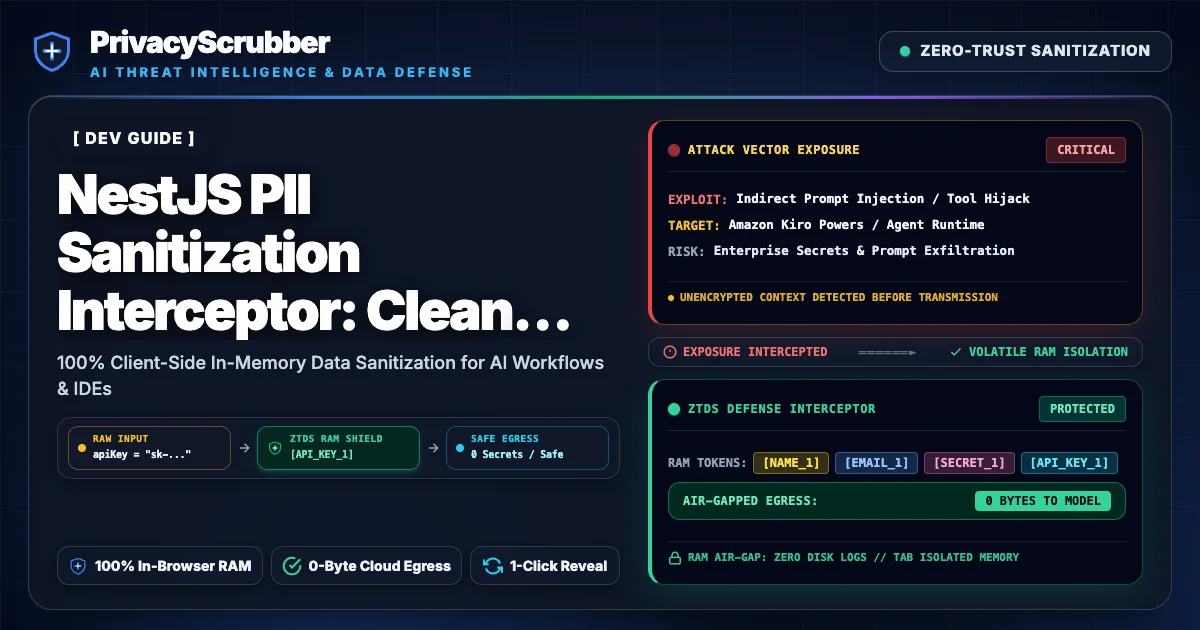
Enterprise backend architectures rely heavily on NestJS for structured modular microservices. Injecting ad-hoc sanitization logic into controllers breaks clean architecture and domain-driven design. The PrivacyScrubber SDK integrates as a declarative NestJS interceptor (@UseInterceptors(PiiSanitizerInterceptor)), sanitizing DTO payloads in local memory in <0.7ms with zero network egress.
NestJS PII Sanitization Interceptor: What Software Developers Expose to Cloud AI
When software engineers, devops teams, and security engineers accelerate NestJS PII Sanitization Interceptor with GitHub Copilot, ChatGPT, Cursor AI, and AI-assisted debugging tools, unstructured nestjs pii sanitization interceptor and nestjs sanitize dto sensitive data inputs bypass legacy firewall rules. Neutralizing leaking API keys, database credentials, user PII from logs, and internal system architecture to AI code assistants that may log prompts requires local in-memory redaction ([SECRET_1], [API_KEY_1], [DB_URI_1], [EMAIL_1]), as documented across our Software Development AI privacy guides.
Every prompt carrying unmasked nestjs pii sanitization interceptor or nestjs pii pipe to an external AI provider creates an irreversible audit trail outside your security boundary. Implement a clean architecture NestJS interceptor to sanitize DTOs and prompt payloads in-memory. Redact PII in local browser RAM with zero cloud egress. Because cloud DLP proxy round-trips (150ms–400ms WAN latency) and cleartext inspection logs, software engineers, devops teams, and security engineers must sanitize NestJS PII Sanitization Interceptor inputs before network transit.
To sanitize DTOs and prompt inputs cleanly in NestJS, create a custom NestInterceptor powered by @privacyscrubber/sdk.
Execution runs <0.7ms in local V8 heap memory, fully preserving TypeScript types and clean architecture boundaries.
npx @privacyscrubber/sdk demoComplete Implementation: NestJS PiiSanitizerInterceptor
npm install @privacyscrubber/sdk @nestjs/common @nestjs/core rxjsimport { Injectable, NestInterceptor, ExecutionContext, CallHandler } from '@nestjs/common';
import { Observable } from 'rxjs';
import { map } from 'rxjs/operators';
import { sanitize, restore } from '@privacyscrubber/sdk';
@Injectable()
export class PiiSanitizerInterceptor implements NestInterceptor {
intercept(context: ExecutionContext, next: CallHandler): Observable {
const req = context.switchToHttp().getRequest();
let tokenMap: Record = {};
// 1. Sanitize incoming request DTO in local RAM (<0.7ms)
if (req.body && typeof req.body === 'object') {
const serialized = JSON.stringify(req.body);
const scrubResult = sanitize(serialized, {
profile: 'General',
detectSecrets: true
});
req.body = JSON.parse(scrubResult.scrubbedText);
tokenMap = scrubResult.tokenMap;
}
// 2. Intercept outgoing response to optionally restore tokens
return next.handle().pipe(
map((data) => {
if (typeof data === 'string') {
return restore(data, tokenMap).restoredText;
}
return data;
})
);
}
} Need security, compliance, or CISO sign-off before deploying to production? Copy our pre-filled vendor-risk evaluation memo covering GDPR Art. 25/28, zero-subprocessor architecture, and air-gapped memory isolation.
# Vendor Architecture & Security Evaluation: @privacyscrubber/sdk **Project**: Enterprise AI / LLM Integration (NestJS PII Sanitization Interceptor: Clean Architecture DLP) **Target Tier**: Developer SDK ($299/mo or $2,990/yr flat) **Vendor**: PrivacyScrubber (ZTDS - Zero-Trust Data Sanitization) **Technical Classification**: In-process ZTDS™ PII Redaction Library ## 1. Compliance & Data Protection Rationale - **GDPR Art. 25 & 28**: Prompt payloads are sanitized directly in local V8 heap memory (<1ms) before transmitting to model APIs. No external subprocessors or third-party DLP cloud vendors are introduced. - **HIPAA Safe Harbor & SOC 2 Type II**: Replaces cleartext identifiers (names, emails, SSNs, financial IDs, tokens) with deterministic category tokens ([NAME_1], [EMAIL_1]), mathematically preventing sensitive data leakage into model training or provider logging. - **Zero Data Retention**: The session token mapping is volatile, held strictly in-memory (RAM-only), tab/thread-isolated, and immediately wiped upon completion. ## 2. Infrastructure & Latency Benchmark - **Execution Overhead**: < 0.85 ms per 10KB payload (vs. 40ms+ for Presidio Docker, 200ms+ for Cloud DLP APIs). - **Network Egress**: 0 Bytes. Functions completely in air-gapped / Airplane Mode environments. - **DevOps Footprint**: ~180 KB native Node.js/WASM package. 0 external daemon, 0 Redis requirement, 0 Python container maintenance. ## 3. Commercials & Procurement - **License**: $299/month flat (or $2,990/year) covering unlimited internal nodes, microservices, and RAG pipelines. - **Vendor Risk & DPA**: Zero-DPA posture (software runs entirely inside our tenant boundary; zero data egresses to vendor servers). - **Payment Method**: Corporate Net 30 Invoicing or Credit Card via Merchant of Record (Paddle).Compliance Verification
Implementing declarative interceptors satisfies SOC 2 Type II Privacy by Design. Read our Fastify Middleware Guide for high-throughput microservices.
Field-by-Field Sanitization Rule for NestJS PII Sanitization Interceptor
Prevent over-redaction in NestJS PII Sanitization Interceptor workflows by tokenizing only regulated identity fields while leaving non-identifying metrics untouched:
| Document Field / Attribute | Action | RAM Surrogate | Statutory & Analytical Rationale |
|---|---|---|---|
| Multi-Line Counterparty & Organization Names (Software Development) | REDACT | [SECRET_1] | Preserves co-reference continuity across multi-paragraph NestJS PII Sanitization Interceptor prompts without leaking names. |
| Embedded Secrets, Tax IDs & Session Identifiers in NestJS PII Sanitization Interceptor | REDACT | [SECRET_1], [API_KEY_1] | Intercepts high-liability literals before cloud DLP proxy round-trips (150ms–400ms WAN latency) and cleartext inspection logs. |
| Secondary Regulated Attributes (nestjs zero trust data masking) | REDACT | [EMAIL_1] | Satisfies OWASP guidelines on secrets management data minimization by replacing sensitive Software Development strings in local RAM. |
| Anonymized Category Labels & Department Roles | PRESERVE | Cleartext (Software Development Role) | Retains organizational context for NestJS PII Sanitization Interceptor while keeping personal identities inside local RAM. |
| Non-Identifying Domain Logic & Operational Instructions | PRESERVE | Cleartext Narrative | Preserves 100% of analytical instructions for nestjs sanitize dto sensitive data so local detokenization yields production-ready output. |
| Regulatory Clause Citations & Policy Taxonomy (OWASP guidelines on secrets management) | PRESERVE | Cleartext Citations | Allows the AI model to map NestJS PII Sanitization Interceptor findings against statutory controls and audit frameworks. |
Safe LLM Prompt Template for NestJS PII Sanitization Interceptor
Submit this prompt wrapper with your masked NestJS PII Sanitization Interceptor input so the AI reasons over symbolic tokens without altering placeholder tags:
Act as a senior software engineers, devops teams, and security engineers advisor analyzing NestJS PII Sanitization Interceptor.
Context: Sensitive literals across nestjs pii sanitization interceptor and nestjs sanitize dto sensitive data are masked as [SECRET_1], [API_KEY_1], [DB_URI_1], [EMAIL_1] via @privacyscrubber/sdk (<0.8ms Node.js/TS RAM) & @privacyscrubber/mcp-server.

Instructions:
1. Synthesize the primary findings and risk vectors from the tokenized record.
2. Draft a structured response or remediation plan for nestjs pii pipe.
3. Do not modify or strip any [SECRET_1], [API_KEY_1], [DB_URI_1], [EMAIL_1] placeholders required for client-side RAM restoration.

[PASTE SANITIZED PAYLOAD HERE]
Act as a senior software engineers, devops teams, and security engineers advisor analyzing NestJS PII Sanitization Interceptor.
Context: Sensitive literals across nestjs pii sanitization interceptor and nestjs sanitize dto sensitive data are masked as [SECRET_1], [API_KEY_1], [DB_URI_1], [EMAIL_1] via @privacyscrubber/sdk (<0.8ms Node.js/TS RAM) & @privacyscrubber/mcp-server.

Instructions:
1. Synthesize the primary findings and risk vectors from the tokenized record.
2. Draft a structured response or remediation plan for nestjs pii pipe.
3. Do not modify or strip any [SECRET_1], [API_KEY_1], [DB_URI_1], [EMAIL_1] placeholders required for client-side RAM restoration.

[PASTE SANITIZED PAYLOAD HERE]
3-Step Local RAM Redaction for NestJS PII Sanitization Interceptor Workflows
When software engineers, devops teams, and security engineers handle NestJS PII Sanitization Interceptor, PrivacyScrubber's @privacyscrubber/sdk (<0.8ms Node.js/TS RAM) & @privacyscrubber/mcp-server isolates nestjs pii sanitization interceptor and nestjs sanitize dto sensitive data inside tab-isolated or process RAM. Sensitive attributes become reversible surrogates ([SECRET_1], [API_KEY_1], [DB_URI_1], [EMAIL_1]) in <1ms, complementing the governance workflows in EU AI act compliance checklist for ChatGPT & Copilot users (2026).
We back every NestJS PII Sanitization Interceptor deployment with deterministic proof: test nestjs pii sanitization interceptor tokenization offline under the Airplane Mode Standard or run npx ztds-audit in CI/CD. Conforming to ChatGPT team workspace suspensions, zero raw bytes ever leave your local memory boundary.
OWASP guidelines on secrets management Audit & Compliance Risks for NestJS PII Sanitization Interceptor
Enforcing OWASP guidelines on secrets management (OWASP guidelines on secrets management, SOC 2 Type II trust service criteria, and GDPR Article 25 (data protection by design)) across NestJS PII Sanitization Interceptor means eliminating third-party sub-processor exposure for nestjs pii sanitization interceptor and nestjs pii pipe. The technical workflow in chromadb local PII sanitizer demonstrates how local RAM isolation satisfies strict audit scrutiny.