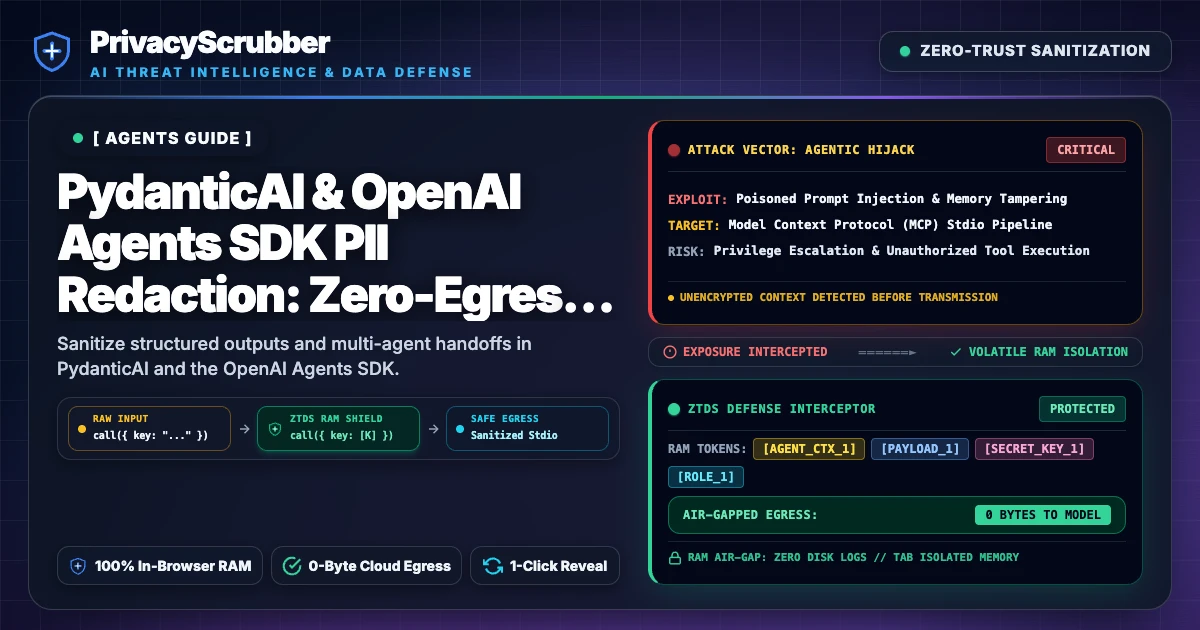
Production agent frameworks like PydanticAI and the OpenAI Agents SDK pass typed state objects and conversation history across multiple specialized sub-agents. If raw customer PII enters the initial triage agent, it is replicated across every downstream handoff, tool trace, and cloud observability span. Tokenizing inputs at the root agent intake boundary ensures all Pydantic validation models and multi-agent handoffs operate strictly on surrogate tokens.
Why Unmasked Prompts Break PydanticAI & OpenAI Agents SDK PII Redaction Security
Achieving verifiable data protection for PydanticAI & OpenAI Agents SDK PII Redaction is a foundational requirement when ai engineers, llm application developers, and enterprise ai architects integrate LangChain, LlamaIndex, AutoGPT, CrewAI, and custom RAG infrastructure. Because multi-agent state handoffs replicating raw database rows across downstream LLM trace spans, unmasked pydantic ai pii redaction payloads create immediate exposure across AI Agents & RAG perimeters. Our AI Agents & RAG AI privacy guides detail how to isolate openai agents sdk pii masking in local RAM before any cloud API call occurs.
Passing unmasked pydantic ai pii redaction payloads into LangChain, LlamaIndex, AutoGPT, CrewAI, and custom RAG infrastructure bypasses traditional endpoint controls and creates autonomous agents that accumulate PII across memory, tool calls, and vector store indexes — creating persistent privacy liabilities impossible to manually audit. Sanitize structured outputs and multi-agent handoffs in PydanticAI and the OpenAI Agents SDK. Tokenize PII locally in <1ms with 0 cloud leakage. Eliminating this exposure for PydanticAI & OpenAI Agents SDK PII Redaction requires replacing raw literals with [NAME_1], [EMAIL_1], [SECRET_1], [ID_1] in local memory.
Preventing PII Amplification Across Multi-Agent Handoffs
In a single-turn LLM call, an unmasked prompt exposes PII once. In an OpenAI Agents SDK or PydanticAI graph with a router agent, billing sub-agent, and compliance sub-agent, that same unmasked SSN or IBAN is transmitted and logged three to five times across different model endpoints.
Enforcing local RAM sanitization at the ingress layer—alongside our patterns for CrewAI and AutoGen tool sanitization—keeps every agent handoff and observability trace 100% free of regulated personal data.
Field-by-Field Sanitization Rule for PydanticAI & OpenAI Agents SDK PII Redaction
To maintain LLM analytical context while avoiding cloud data breaches, apply this deterministic field mapping in local RAM before submitting PydanticAI & OpenAI Agents SDK PII Redaction prompts:
| Document Field / Attribute | Action | RAM Surrogate | Statutory & Analytical Rationale |
|---|---|---|---|
| Contact & Routing Endpoints (multi agent handoff data sanitization) | REDACT | [SECRET_1] | Eliminates cross-record linkage and unauthorized sub-processor indexing during PydanticAI & OpenAI Agents SDK PII Redaction. |
| Authentication, Account & Reference Keys (openai agents sdk pii masking) | REDACT | [EMAIL_1] | Blocks credential, account, or case-number exfiltration across AI Agents & RAG telemetry and vendor logs. |
| Primary Identity & Subject Records (pydantic ai pii redaction) | REDACT | [NAME_1] | GDPR data minimization principles direct identifier guard: prevents cloud LLMs from associating PydanticAI & OpenAI Agents SDK PII Redaction prompts with real individuals. |
| Relative Timelines, Status Codes & Error Severities | PRESERVE | Cleartext (ISO Sequence) | Maintains chronological ordering and root-cause diagnostics across openai agents sdk pii masking workflows. |
| Quantitative Metrics, Ratios & Aggregated Totals | PRESERVE | Cleartext ($ / % / Deltas) | Enables accurate mathematical reasoning and variance analysis for PydanticAI & OpenAI Agents SDK PII Redaction without identity exposure. |
| Structural Schema, Keys & PydanticAI & OpenAI Agents SDK PII Redaction Syntax | PRESERVE | Cleartext Structure | Required so the LLM can parse pydantic ai pii redaction hierarchy, JSON/SQL grammar, and document formatting. |
Token-Preserving AI Prompt for PydanticAI & OpenAI Agents SDK PII Redaction
Pair this structured instruction with your tokenized PydanticAI & OpenAI Agents SDK PII Redaction payload so ChatGPT, Claude, or Gemini preserves all bracketed surrogates for local RAM restoration:
You are an enterprise AI Agents & RAG specialist reviewing a sanitized PydanticAI & OpenAI Agents SDK PII Redaction payload.
All regulated identifiers for pydantic ai pii redaction and openai agents sdk pii masking have been replaced in local RAM with deterministic ZTDS™ tokens ([NAME_1], [EMAIL_1], [SECRET_1], [ID_1]).

Tasks:
1. Evaluate the structural logic, anomalies, and operational metrics in the PydanticAI & OpenAI Agents SDK PII Redaction input.
2. Formulate actionable recommendations aligned with GDPR data minimization principles.
3. Keep all bracketed tokens ([NAME_1], [EMAIL_1], [SECRET_1], [ID_1]) verbatim so local reverse detokenization restores exact values.

[PASTE SANITIZED PYDANTICAI & OPENAI AGENTS SDK PII REDACTION PAYLOAD HERE]
You are an enterprise AI Agents & RAG specialist reviewing a sanitized PydanticAI & OpenAI Agents SDK PII Redaction payload.
All regulated identifiers for pydantic ai pii redaction and openai agents sdk pii masking have been replaced in local RAM with deterministic ZTDS™ tokens ([NAME_1], [EMAIL_1], [SECRET_1], [ID_1]).

Tasks:
1. Evaluate the structural logic, anomalies, and operational metrics in the PydanticAI & OpenAI Agents SDK PII Redaction input.
2. Formulate actionable recommendations aligned with GDPR data minimization principles.
3. Keep all bracketed tokens ([NAME_1], [EMAIL_1], [SECRET_1], [ID_1]) verbatim so local reverse detokenization restores exact values.

[PASTE SANITIZED PYDANTICAI & OPENAI AGENTS SDK PII REDACTION PAYLOAD HERE]
Why AI Safety and Security Governance Teams Flag Unmasked Prompts in PydanticAI & OpenAI Agents SDK PII Redaction
Because GDPR data minimization principles, NIST AI RMF (Risk Management Framework), and emerging agentic AI governance guidance, security and DPO leads cannot approve PydanticAI & OpenAI Agents SDK PII Redaction workflows that suffer from multi-agent state handoffs replicating raw database rows across downstream LLM trace spans. Adopting the local sanitization methodology in Claude desktop local PII sanitization converts pydantic ai pii redaction into [NAME_1], [EMAIL_1], [SECRET_1], [ID_1] before any external API interaction.
Zero-Trust AI Agent and Workflow Tokenization for PydanticAI & OpenAI Agents SDK PII Redaction
PrivacyScrubber resolves PydanticAI & OpenAI Agents SDK PII Redaction compliance bottlenecks by executing pydantic ai pii redaction and openai agents sdk pii masking redaction inside local RAM (@privacyscrubber/mcp-server, @privacyscrubber/fastmcp-guard & @privacyscrubber/sdk). By sending only [NAME_1], [EMAIL_1], [SECRET_1], [ID_1] to LangChain, LlamaIndex, AutoGPT, CrewAI, and custom RAG infrastructure and following sales transcript privacy, teams achieve zero cloud data leakage.
Because @privacyscrubber/mcp-server, @privacyscrubber/fastmcp-guard & @privacyscrubber/sdk runs without cloud calls, PydanticAI & OpenAI Agents SDK PII Redaction passes the strict Airplane Mode Standard. Turn off network connectivity, redact pydantic ai pii redaction and multi agent handoff data sanitization into [NAME_1], [EMAIL_1], [SECRET_1], [ID_1], and export a tamper-evident CISO Audit Receipt as detailed in managing privacy across an enterprise fleet of desktop AI.