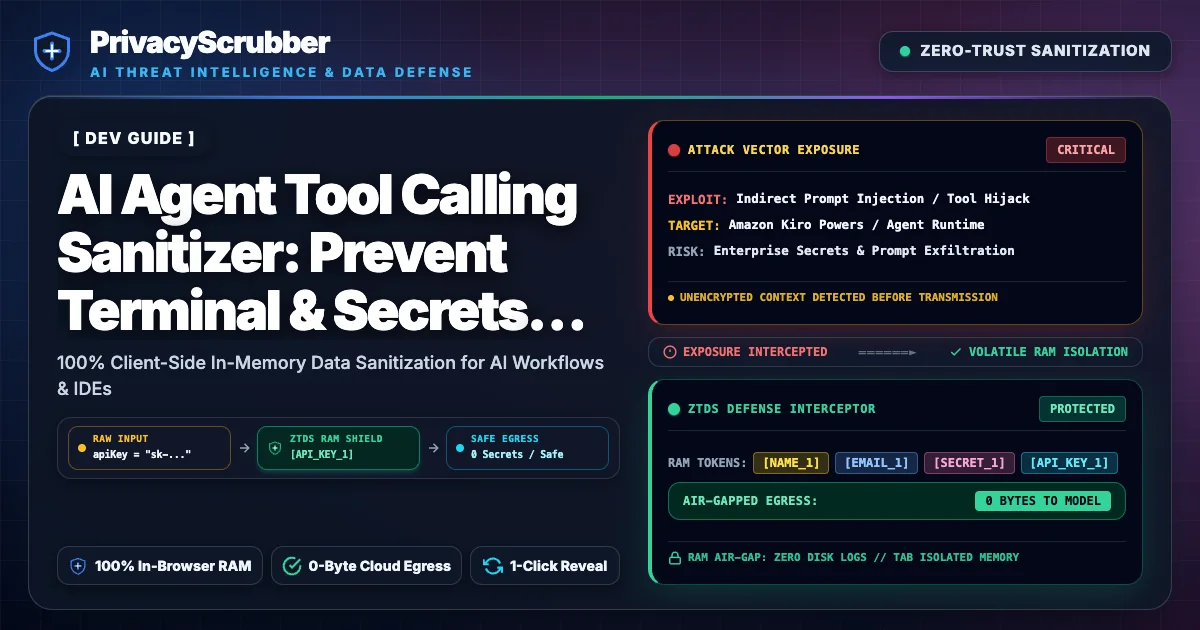
Autonomous agents equipped with tools to execute terminal commands (bash), read environment files, or query internal databases can accidentally exfiltrate production secrets into prompt history. If an agent runs "docker logs" or "cat .env", live root keys and customer records are transmitted to third-party LLM APIs. @privacyscrubber/sdk provides guarded tools that sanitize stdout and file reads in RAM before prompts hit external servers.
AI Agent Tool Calling Sanitizer: What Software Developers Expose to Cloud AI
Why does AI Agent Tool Calling Sanitizer trigger compliance scrutiny during Software Development AI adoption? Because leaking API keys, database credentials, user PII from logs, and internal system architecture to AI code assistants that may log prompts. Relying on GitHub Copilot, ChatGPT, Cursor AI, and AI-assisted debugging tools without pre-transmission redaction of ai agent tool calling pii leak and prevent agent api key leak leaves regulated records exposed. Explore our Software Development AI privacy guides to deploy sub-millisecond RAM tokenization via @privacyscrubber/sdk (<0.8ms Node.js/TS RAM) & @privacyscrubber/mcp-server.
Passing unmasked ai agent tool calling pii leak payloads into GitHub Copilot, ChatGPT, Cursor AI, and AI-assisted debugging tools bypasses traditional endpoint controls and creates leaking API keys, database credentials, user PII from logs, and internal system architecture to AI code assistants that may log prompts. Prevent autonomous AI agents (CrewAI, AutoGen, LangGraph) from leaking credentials and customer PII during shell execution and tool calling. Eliminating this exposure for AI Agent Tool Calling Sanitizer requires replacing raw literals with [SECRET_1], [API_KEY_1], [DB_URI_1], [EMAIL_1] in local memory.
To prevent autonomous AI agents from leaking API keys, database credentials, and PII, equip them with guarded tools from @privacyscrubber/sdk.
All terminal outputs (guardExec) and file reads (guardReadFile) are sanitized in local RAM (<0.9ms) before entering model context.
npx @privacyscrubber/sdk demoThe Autonomous Agent Tool Leak Vector
Autonomous coding assistants and DevOps agents are granted terminal access to inspect server configurations and debug production issues. When an agent runs cat /var/log/nginx/access.log or inspects an environment file, credentials and customer IPs are dumped straight into stdout. Because agent frameworks feed raw tool output directly into subsequent model prompts, proprietary secrets are instantly logged on external AI servers.
Complete Implementation: Guarded Tools for AI Agents
npm install @privacyscrubber/sdk ai @ai-sdk/openaiimport { createGuardedTools } from '@privacyscrubber/sdk';
import { generateText } from 'ai';
import { openai } from '@ai-sdk/openai';
// 1. Instantiate guarded tool definitions (guardExec, guardReadFile, guardApplyPatch)
const guardTools = createGuardedTools({
profile: 'Dev',
detectSecrets: true,
allowedCommands: ['cat', 'grep', 'ls', 'docker']
});
// 2. Pass guarded tools to autonomous agent
const { text } = await generateText({
model: openai('gpt-4o'),
tools: guardTools.getDefinitions(),
prompt: 'Check the docker compose configuration and diagnose database connection failure.'
});
// stdout was sanitized in local RAM before prompt construction;
// Any patched files written to disk restored real keys locally with automated .bak creation!
console.log('Agent Execution Completed Safely:');
console.log(text);Need security, compliance, or CISO sign-off before deploying to production? Copy our pre-filled vendor-risk evaluation memo covering GDPR Art. 25/28, zero-subprocessor architecture, and air-gapped memory isolation.
# Vendor Architecture & Security Evaluation: @privacyscrubber/sdk **Project**: Enterprise AI / LLM Integration (AI Agent Tool Calling Sanitizer: Prevent Terminal & Secrets Leakage) **Target Tier**: Developer SDK ($299/mo or $2,990/yr flat) **Vendor**: PrivacyScrubber (ZTDS - Zero-Trust Data Sanitization) **Technical Classification**: In-process ZTDS™ PII Redaction Library ## 1. Compliance & Data Protection Rationale - **GDPR Art. 25 & 28**: Prompt payloads are sanitized directly in local V8 heap memory (<1ms) before transmitting to model APIs. No external subprocessors or third-party DLP cloud vendors are introduced. - **HIPAA Safe Harbor & SOC 2 Type II**: Replaces cleartext identifiers (names, emails, SSNs, financial IDs, tokens) with deterministic category tokens ([NAME_1], [EMAIL_1]), mathematically preventing sensitive data leakage into model training or provider logging. - **Zero Data Retention**: The session token mapping is volatile, held strictly in-memory (RAM-only), tab/thread-isolated, and immediately wiped upon completion. ## 2. Infrastructure & Latency Benchmark - **Execution Overhead**: < 0.85 ms per 10KB payload (vs. 40ms+ for Presidio Docker, 200ms+ for Cloud DLP APIs). - **Network Egress**: 0 Bytes. Functions completely in air-gapped / Airplane Mode environments. - **DevOps Footprint**: ~180 KB native Node.js/WASM package. 0 external daemon, 0 Redis requirement, 0 Python container maintenance. ## 3. Commercials & Procurement - **License**: $299/month flat (or $2,990/year) covering unlimited internal nodes, microservices, and RAG pipelines. - **Vendor Risk & DPA**: Zero-DPA posture (software runs entirely inside our tenant boundary; zero data egresses to vendor servers). - **Payment Method**: Corporate Net 30 Invoicing or Credit Card via Merchant of Record (Paddle).Compliance Verification
Securing agentic tool execution directly satisfies SOC 2 Type II Confidentiality and prevents credential compromise under NPM PII Redaction SDK Guide.
Entity Handling Standard for Autonomous Multi-Agent Tool Call Payload & Terminal Execution Log (CrewAI / AutoGen)
Use the classification table below to separate high-liability Autonomous Multi-Agent Tool Call Payload & Terminal Execution Log (CrewAI / AutoGen) attributes (tokenized in RAM) from safe analytical parameters (kept in cleartext):
| Data Attribute | Rule | In-Memory Output | Governance Justification |
|---|---|---|---|
| Production Cloud Secrets, API Keys & Private Tokens | REDACT | [API_KEY_1], [SECRET_1] | Production access credentials; prompt ingestion risks cloud infrastructure compromise |
| Database Connection Strings, Passwords & URI Credentials | REDACT | [DB_CONN_1] | Database credentials providing direct external read/write access to internal data stores |
| Internal VPC IP Addresses, Hostnames & Subnets | REDACT | [IP_1], [HOSTNAME_1] | Private network topology information facilitating internal lateral movement |
| Developer Personal Access Tokens (PAT) & SSH Private Keys | REDACT | [SSH_KEY_1] | Source code repository credentials subject to malicious supply-chain exfiltration |
| Agent Tool Invocation Name & JSON Parameter Schema | PRESERVE | Cleartext (tool: "bash_exec", args: {"cmd": "docker ps"}) | Agentic orchestration structure required for LLM reasoning and step validation |
| Process Exit Status Code & Standard Error Taxonomy | PRESERVE | Cleartext (Exit Code: 0 / Status: SUCCESS) | Execution state needed for autonomous error recovery and retry logic |
| Sanitized Output Data Structure & JSON Key Hierarchy | PRESERVE | Cleartext (keys: ["container_id", "status", "uptime"]) | Payload metadata needed for downstream agent tool chaining |
| Execution Duration & Memory Consumption Footprint | PRESERVE | Cleartext (Execution Time: 142ms / RAM RSS: 48MB) | Telemetry metrics needed for agent performance benchmarking and rate limiting |
Safe LLM Prompt Template for Autonomous Multi-Agent Tool Call Payload & Terminal Execution Log (CrewAI / AutoGen)
Use this persona template alongside your ZTDS™ sanitized text to prevent model refusal and ensure 1-click local detokenization:
You are a Principal AI Agent Architect and Cloud Security Specialist. Review the following sanitized autonomous agent tool execution output where AWS credentials, database URIs, Redis connection strings, Stripe keys, and SendGrid tokens have been replaced with deterministic security tokens ([API_KEY_1], [API_KEY_2], [API_KEY_3], [SECRET_1], [DB_CONN_1], [REDIS_CONN_1]).

Tasks:
1. Verify the database container health status and evaluate connection pool headroom (42 active connections out of 100 max).
2. Formulate the next autonomous agent tool recommendation to check query performance without exposing environment secrets.
3. Generate a security audit recommendation for storing environment credentials in AWS Secrets Manager or HashiCorp Vault rather than raw .env files.

[PASTE SANITIZED TEXT HERE]
You are a Principal AI Agent Architect and Cloud Security Specialist. Review the following sanitized autonomous agent tool execution output where AWS credentials, database URIs, Redis connection strings, Stripe keys, and SendGrid tokens have been replaced with deterministic security tokens ([API_KEY_1], [API_KEY_2], [API_KEY_3], [SECRET_1], [DB_CONN_1], [REDIS_CONN_1]).

Tasks:
1. Verify the database container health status and evaluate connection pool headroom (42 active connections out of 100 max).
2. Formulate the next autonomous agent tool recommendation to check query performance without exposing environment secrets.
3. Generate a security audit recommendation for storing environment credentials in AWS Secrets Manager or HashiCorp Vault rather than raw .env files.

[PASTE SANITIZED TEXT HERE]
OWASP guidelines on secrets management Audit & Compliance Risks for AI Agent Tool Calling Sanitizer
The statutory mandate governing Software Development workflows (OWASP guidelines on secrets management, SOC 2 Type II trust service criteria, and GDPR Article 25 (data protection by design)) leaves zero margin for leaking API keys, database credentials, user PII from logs, and internal system architecture to AI code assistants that may log prompts. By combining AI Agent Tool Calling Sanitizer controls with the patterns in pino & winston logger PII scrubber, organizations tokenize ai agent tool calling pii leak and crewai autogen secrets guard locally so external LLMs never take custody of regulated PII.
3-Step Local RAM Redaction for AI Agent Tool Calling Sanitizer Workflows
For AI Agent Tool Calling Sanitizer, PrivacyScrubber replaces destructive [REDACTED] masking with reversible ZTDS™ tokenization ([SECRET_1], [API_KEY_1], [DB_URI_1], [EMAIL_1]) via @privacyscrubber/sdk (<0.8ms Node.js/TS RAM) & @privacyscrubber/mcp-server. As highlighted in US AI privacy laws 2026, this keeps ai agent tool calling pii leak and prevent agent api key leak 100% private in local RAM while preserving LLM output quality.
By validating AI Agent Tool Calling Sanitizer under the Airplane Mode Standard, software engineers, devops teams, and security engineers confirm that ai agent tool calling pii leak and prevent agent api key leak redaction executes 100% in local RAM—Directly supporting the technical standards in hide your name before pasting into ChatGPT.