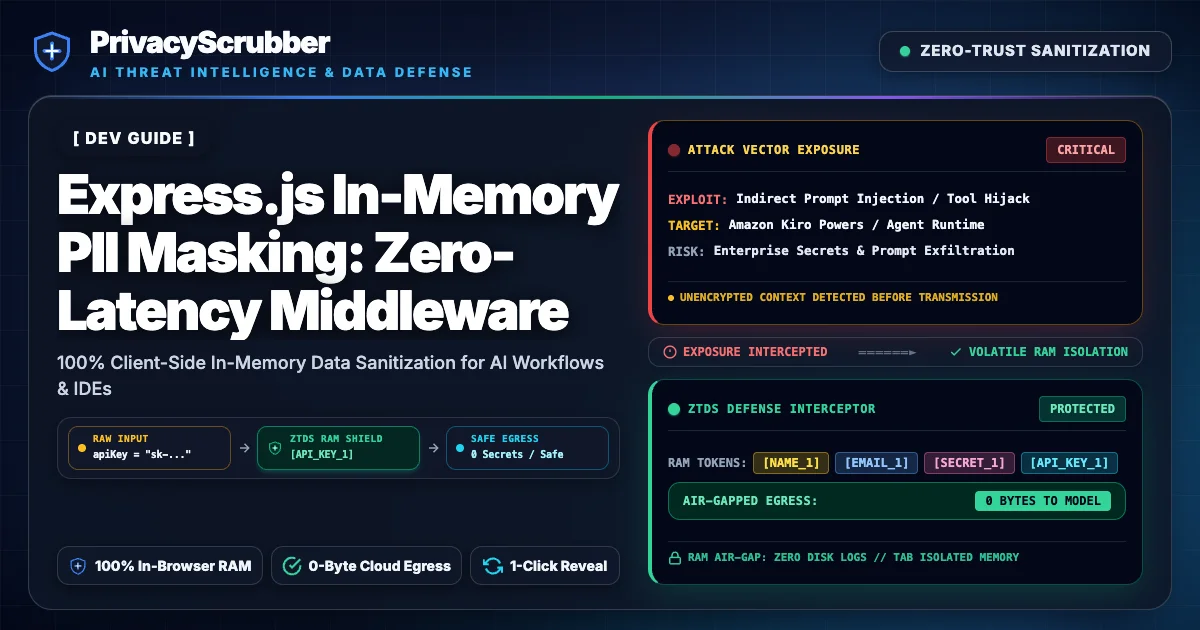
Express.js remains the most ubiquitous Node.js web server in the world. Routing incoming customer requests to AI services without sanitization violates privacy statutes. Traditional DLP approaches require redirecting traffic to external proxies, introducing latency and security risks. @privacyscrubber/sdk provides standard Express middleware that executes in <0.65ms with zero cloud egress.
What Software Developers Send to AI During Express.js In-Memory PII Masking
When software engineers, devops teams, and security engineers accelerate Express.js In-Memory PII Masking with GitHub Copilot, ChatGPT, Cursor AI, and AI-assisted debugging tools, unstructured express js pii masking middleware and express pii sanitizer inputs bypass legacy firewall rules. Neutralizing leaking API keys, database credentials, user PII from logs, and internal system architecture to AI code assistants that may log prompts requires local in-memory redaction ([SECRET_1], [API_KEY_1], [DB_URI_1], [EMAIL_1]), as documented across our Software Development AI privacy guides.
The core vulnerability in Express.js In-Memory PII Masking occurs the millisecond unredacted express js pii masking middleware or redact sensitive data express req body text crosses the browser or application socket. Deploy zero-latency Express.js middleware to redact customer PII from request bodies and query parameters before AI ingestion. Without local RAM interception via @privacyscrubber/sdk (<0.8ms Node.js/TS RAM) & @privacyscrubber/mcp-server, software engineers, devops teams, and security engineers remain exposed to leaking API keys, database credentials, user PII from logs, and internal system architecture to AI code assistants that may log prompts.
To sanitize requests in Express.js, insert a custom middleware utilizing @privacyscrubber/sdk right after express.json().
Execution runs in <0.65ms per request in local RAM with zero network hops and zero third-party subprocessors.
npx @privacyscrubber/sdk demoComplete Implementation: Express Middleware
npm install @privacyscrubber/sdk expressimport express from 'express';
import { sanitize, restore } from '@privacyscrubber/sdk';
const app = express();
app.use(express.json());
// Express Middleware: In-Memory Zero-Trust Sanitizer
app.use((req, res, next) => {
if (req.body && typeof req.body === 'object') {
const serialized = JSON.stringify(req.body);
const { scrubbedText, tokenMap } = sanitize(serialized, {
profile: 'General',
detectSecrets: true
});
req.body = JSON.parse(scrubbedText);
res.locals.tokenMap = tokenMap;
}
next();
});
app.post('/api/support/ticket-ai', async (req, res) => {
// Safe to pass req.body directly to OpenAI / Anthropic
console.log('Sanitized body:', req.body);
res.json({ success: true, processed: req.body });
});
app.listen(3000, () => console.log('Server running on port 3000'));Need security, compliance, or CISO sign-off before deploying to production? Copy our pre-filled vendor-risk evaluation memo covering GDPR Art. 25/28, zero-subprocessor architecture, and air-gapped memory isolation.
# Vendor Architecture & Security Evaluation: @privacyscrubber/sdk **Project**: Enterprise AI / LLM Integration (Express.js In-Memory PII Masking: Zero-Latency Middleware) **Target Tier**: Developer SDK ($299/mo or $2,990/yr flat) **Vendor**: PrivacyScrubber (ZTDS - Zero-Trust Data Sanitization) **Technical Classification**: In-process ZTDS™ PII Redaction Library ## 1. Compliance & Data Protection Rationale - **GDPR Art. 25 & 28**: Prompt payloads are sanitized directly in local V8 heap memory (<1ms) before transmitting to model APIs. No external subprocessors or third-party DLP cloud vendors are introduced. - **HIPAA Safe Harbor & SOC 2 Type II**: Replaces cleartext identifiers (names, emails, SSNs, financial IDs, tokens) with deterministic category tokens ([NAME_1], [EMAIL_1]), mathematically preventing sensitive data leakage into model training or provider logging. - **Zero Data Retention**: The session token mapping is volatile, held strictly in-memory (RAM-only), tab/thread-isolated, and immediately wiped upon completion. ## 2. Infrastructure & Latency Benchmark - **Execution Overhead**: < 0.85 ms per 10KB payload (vs. 40ms+ for Presidio Docker, 200ms+ for Cloud DLP APIs). - **Network Egress**: 0 Bytes. Functions completely in air-gapped / Airplane Mode environments. - **DevOps Footprint**: ~180 KB native Node.js/WASM package. 0 external daemon, 0 Redis requirement, 0 Python container maintenance. ## 3. Commercials & Procurement - **License**: $299/month flat (or $2,990/year) covering unlimited internal nodes, microservices, and RAG pipelines. - **Vendor Risk & DPA**: Zero-DPA posture (software runs entirely inside our tenant boundary; zero data egresses to vendor servers). - **Payment Method**: Corporate Net 30 Invoicing or Credit Card via Merchant of Record (Paddle).Compliance Verification
By ensuring all request payloads are sanitized before reaching external AI APIs, engineering teams guarantee compliance with SOC 2 Type II Confidentiality controls. Learn how to secure NestJS microservices in our NestJS Sanitization Guide.
Pre-Inference Redaction Matrix: Express.js In-Memory PII Masking
Under OWASP guidelines on secrets management, software engineers, DevOps teams, and security engineers enforce this selective masking rule on Express.js In-Memory PII Masking:
| Field Category | Directive | Token / State | Why It Matters for AI & Audit |
|---|---|---|---|
| Secondary Regulated Attributes (nodejs express zero egress dlp) | REDACT | [EMAIL_1] | Satisfies OWASP guidelines on secrets management data minimization by replacing sensitive Software Development strings in local RAM. |
| Contact & Routing Endpoints (express pii sanitizer) | REDACT | [DB_URI_1] | Eliminates cross-record linkage and unauthorized sub-processor indexing during Express.js In-Memory PII Masking. |
| Authentication, Account & Reference Keys (redact sensitive data express req body) | REDACT | [API_KEY_1] | Blocks credential, account, or case-number exfiltration across Software Development telemetry and vendor logs. |
| Regulatory Clause Citations & Policy Taxonomy (OWASP guidelines on secrets management) | PRESERVE | Cleartext Citations | Allows the AI model to map Express.js In-Memory PII Masking findings against statutory controls and audit frameworks. |
| Relative Timelines, Status Codes & Error Severities | PRESERVE | Cleartext (ISO Sequence) | Maintains chronological ordering and root-cause diagnostics across redact sensitive data express req body workflows. |
| Quantitative Metrics, Ratios & Aggregated Totals | PRESERVE | Cleartext ($ / % / Deltas) | Enables accurate mathematical reasoning and variance analysis for Express.js In-Memory PII Masking without identity exposure. |
Copy-Paste Safe Instruction for Express.js In-Memory PII Masking
Submit this prompt wrapper with your masked Express.js In-Memory PII Masking input so the AI reasons over symbolic tokens without altering placeholder tags:
Objective: Process Express.js In-Memory PII Masking (express js pii masking middleware) with zero cloud data leakage.
All personal and corporate identifiers are represented by bijective tokens ([SECRET_1], [API_KEY_1], [DB_URI_1], [EMAIL_1]).

Steps:
1. Audit the quantitative and logical parameters of the Express.js In-Memory PII Masking record.
2. Produce a concise executive summary tailored for software engineers, devops teams, and security engineers.
3. Maintain all [SECRET_1], [API_KEY_1], [DB_URI_1], [EMAIL_1] markers in-place for deterministic local RAM reveal.

[PASTE SANITIZED PAYLOAD HERE]
Objective: Process Express.js In-Memory PII Masking (express js pii masking middleware) with zero cloud data leakage.
All personal and corporate identifiers are represented by bijective tokens ([SECRET_1], [API_KEY_1], [DB_URI_1], [EMAIL_1]).

Steps:
1. Audit the quantitative and logical parameters of the Express.js In-Memory PII Masking record.
2. Produce a concise executive summary tailored for software engineers, devops teams, and security engineers.
3. Maintain all [SECRET_1], [API_KEY_1], [DB_URI_1], [EMAIL_1] markers in-place for deterministic local RAM reveal.

[PASTE SANITIZED PAYLOAD HERE]
Statutory Liability for Software Developers: Express.js In-Memory PII Masking
The statutory mandate governing Software Development workflows (OWASP guidelines on secrets management, SOC 2 Type II trust service criteria, and GDPR Article 25 (data protection by design)) leaves zero margin for leaking API keys, database credentials, user PII from logs, and internal system architecture to AI code assistants that may log prompts. By combining Express.js In-Memory PII Masking controls with the patterns in nestjs PII sanitization interceptor, organizations tokenize express js pii masking middleware and express pii sanitizer locally so external LLMs never take custody of regulated PII.
How to Sanitize Express.js In-Memory PII Masking in Local RAM (Zero Cloud Egress)
PrivacyScrubber enforces Zero-Trust Data Sanitization (ZTDS™) for Express.js In-Memory PII Masking via @privacyscrubber/sdk (<0.8ms Node.js/TS RAM) & @privacyscrubber/mcp-server. Sensitive express js pii masking middleware and redact sensitive data express req body fields are replaced in <1ms of local RAM with bijective tokens ([SECRET_1], [API_KEY_1], [DB_URI_1], [EMAIL_1]) prior to prompting GitHub Copilot, ChatGPT, Cursor AI, and AI-assisted debugging tools. This aligns with SOC 2 data masking for generative AI, allowing software engineers, devops teams, and security engineers to restore authentic values locally in 1 click once the model responds.
Compliance teams verify Express.js In-Memory PII Masking by testing express js pii masking middleware and express pii sanitizer redaction completely offline under the Airplane Mode Standard. Combined with best ChatGPT team plan alternative for small businesses, this guarantees that volatile session maps never touch external storage.