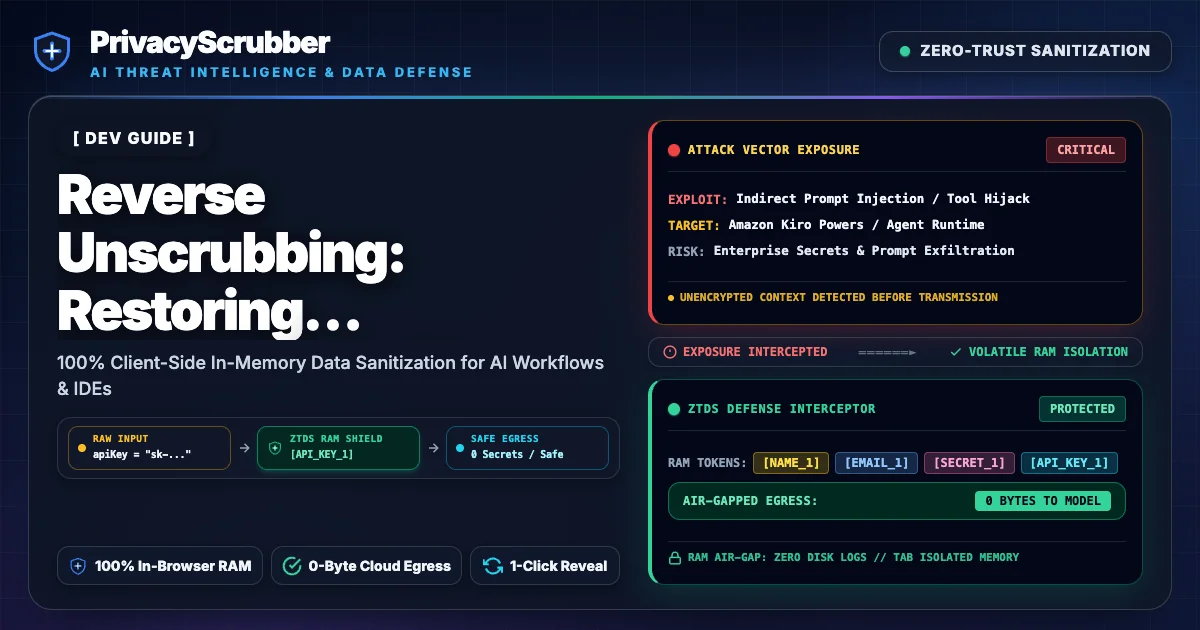
Redacting sensitive customer data is only half the battle. If a system cannot deterministically restore original names, addresses, and numbers when an LLM responds, the output is useless for business operations. Traditional de-identification tools store mappings in persistent databases, creating high breach risks. @privacyscrubber/sdk uses volatile, ephemeral RAM session maps that execute in <0.3ms with zero disk retention.
What Software Developers Send to AI During Reverse Unscrubbing
When software engineers, devops teams, and security engineers accelerate Reverse Unscrubbing with GitHub Copilot, ChatGPT, Cursor AI, and AI-assisted debugging tools, unstructured reverse unmask pii llm response and restore redacted text after gpt inputs bypass legacy firewall rules. Neutralizing leaking API keys, database credentials, user PII from logs, and internal system architecture to AI code assistants that may log prompts requires local in-memory redaction ([SECRET_1], [API_KEY_1], [DB_URI_1], [EMAIL_1]), as documented across our Software Development AI privacy guides.
Processing reverse unmask pii llm response and restore redacted text after gpt in third-party LLMs without endpoint tokenization directly triggers leaking API keys, database credentials, user PII from logs, and internal system architecture to AI code assistants that may log prompts. How to deterministically restore pseudonymized PII tokens ([NAME_1], [EMAIL_1]) from LLM responses in Node.js. 100% local RAM execution with zero egress. For software engineers, devops teams, and security engineers, relying on downstream API promises fails to address cloud DLP proxy round-trips (150ms–400ms WAN latency) and cleartext inspection logs.
To restore pseudonymized tokens in AI completions, pass the model response and the ephemeral session map to restore() from @privacyscrubber/sdk.
Execution runs <0.3ms in local volatile memory, with zero persistence and zero cloud egress.
npx @privacyscrubber/sdk demoComplete Implementation: Bidirectional Round-Trip
npm install @privacyscrubber/sdk openaiimport OpenAI from 'openai';
import { sanitize, restore } from '@privacyscrubber/sdk';
const openai = new OpenAI();
// 1. Raw prompt containing sensitive data
const rawPrompt = 'Draft a formal confirmation for client Eleanor Vance (Email: evance@heritage.org, Phone: 212-555-0198).';
// 2. Pre-Prompt Scrubbing in RAM (<0.8ms)
const { scrubbedText, tokenMap } = sanitize(rawPrompt, {
profile: 'General'
});
console.log('Sanitized Prompt Dispatched to OpenAI:');
console.log(scrubbedText);
// "Draft a formal confirmation for client [NAME_1] (Email: [EMAIL_1], Phone: [PHONE_1])."
// 3. Call OpenAI model with sanitized tokens
const completion = await openai.chat.completions.create({
model: 'gpt-4o',
messages: [{ role: 'user', content: scrubbedText }]
});
const aiResponse = completion.choices[0].message.content;
console.log('\nRaw Tokenized Model Response:');
console.log(aiResponse);
// "Dear [NAME_1], we have confirmed your contact details [EMAIL_1]..."
// 4. Reverse Unscrub in local RAM (<0.3ms)
const restoredResponse = restore(aiResponse, tokenMap).restoredText;
console.log('\nFinal Restored Cleartext Response:');
console.log(restoredResponse);
// "Dear Eleanor Vance, we have confirmed your contact details evance@heritage.org..."Need security, compliance, or CISO sign-off before deploying to production? Copy our pre-filled vendor-risk evaluation memo covering GDPR Art. 25/28, zero-subprocessor architecture, and air-gapped memory isolation.
# Vendor Architecture & Security Evaluation: @privacyscrubber/sdk **Project**: Enterprise AI / LLM Integration (Reverse Unscrubbing: Restoring Deterministic PII Tokens in RAM) **Target Tier**: Developer SDK ($299/mo or $2,990/yr flat) **Vendor**: PrivacyScrubber (ZTDS - Zero-Trust Data Sanitization) **Technical Classification**: In-process ZTDS™ PII Redaction Library ## 1. Compliance & Data Protection Rationale - **GDPR Art. 25 & 28**: Prompt payloads are sanitized directly in local V8 heap memory (<1ms) before transmitting to model APIs. No external subprocessors or third-party DLP cloud vendors are introduced. - **HIPAA Safe Harbor & SOC 2 Type II**: Replaces cleartext identifiers (names, emails, SSNs, financial IDs, tokens) with deterministic category tokens ([NAME_1], [EMAIL_1]), mathematically preventing sensitive data leakage into model training or provider logging. - **Zero Data Retention**: The session token mapping is volatile, held strictly in-memory (RAM-only), tab/thread-isolated, and immediately wiped upon completion. ## 2. Infrastructure & Latency Benchmark - **Execution Overhead**: < 0.85 ms per 10KB payload (vs. 40ms+ for Presidio Docker, 200ms+ for Cloud DLP APIs). - **Network Egress**: 0 Bytes. Functions completely in air-gapped / Airplane Mode environments. - **DevOps Footprint**: ~180 KB native Node.js/WASM package. 0 external daemon, 0 Redis requirement, 0 Python container maintenance. ## 3. Commercials & Procurement - **License**: $299/month flat (or $2,990/year) covering unlimited internal nodes, microservices, and RAG pipelines. - **Vendor Risk & DPA**: Zero-DPA posture (software runs entirely inside our tenant boundary; zero data egresses to vendor servers). - **Payment Method**: Corporate Net 30 Invoicing or Credit Card via Merchant of Record (Paddle).Compliance Verification
Ephemeral in-memory detokenization eliminates persistent database exposure, satisfying GDPR Article 25 and SOC 2 Type II Confidentiality. Explore our NPM PII Redaction SDK Guide.
Selective RAM Masking Blueprint for Reverse Unscrubbing
Before serializing Reverse Unscrubbing payloads to external LLMs, PrivacyScrubber partitions every attribute into reversible RAM tokens versus preserved logic:
| Payload Element | Policy | ZTDS™ Token | Compliance & Reasoning Impact |
|---|---|---|---|
| Multi-Line Counterparty & Organization Names (Software Development) | REDACT | [SECRET_1] | Preserves co-reference continuity across multi-paragraph Reverse Unscrubbing prompts without leaking names. |
| Embedded Secrets, Tax IDs & Session Identifiers in Reverse Unscrubbing | REDACT | [SECRET_1], [API_KEY_1] | Intercepts high-liability literals before cloud DLP proxy round-trips (150ms–400ms WAN latency) and cleartext inspection logs. |
| Secondary Regulated Attributes (bidirectional tokenization nodejs) | REDACT | [EMAIL_1] | Satisfies OWASP guidelines on secrets management data minimization by replacing sensitive Software Development strings in local RAM. |
| Anonymized Category Labels & Department Roles | PRESERVE | Cleartext (Software Development Role) | Retains organizational context for Reverse Unscrubbing while keeping personal identities inside local RAM. |
| Non-Identifying Domain Logic & Operational Instructions | PRESERVE | Cleartext Narrative | Preserves 100% of analytical instructions for restore redacted text after gpt so local detokenization yields production-ready output. |
| Regulatory Clause Citations & Policy Taxonomy (OWASP guidelines on secrets management) | PRESERVE | Cleartext Citations | Allows the AI model to map Reverse Unscrubbing findings against statutory controls and audit frameworks. |
Copy-Paste Safe Instruction for Reverse Unscrubbing
Use this persona template alongside your ZTDS™ sanitized text to prevent model refusal and ensure 1-click local detokenization:
Objective: Process Reverse Unscrubbing (reverse unmask pii llm response) with zero cloud data leakage.
All personal and corporate identifiers are represented by bijective tokens ([SECRET_1], [API_KEY_1], [DB_URI_1], [EMAIL_1]).

Steps:
1. Audit the quantitative and logical parameters of the Reverse Unscrubbing record.
2. Produce a concise executive summary tailored for software engineers, devops teams, and security engineers.
3. Maintain all [SECRET_1], [API_KEY_1], [DB_URI_1], [EMAIL_1] markers in-place for deterministic local RAM reveal.

[PASTE SANITIZED PAYLOAD HERE]
Objective: Process Reverse Unscrubbing (reverse unmask pii llm response) with zero cloud data leakage.
All personal and corporate identifiers are represented by bijective tokens ([SECRET_1], [API_KEY_1], [DB_URI_1], [EMAIL_1]).

Steps:
1. Audit the quantitative and logical parameters of the Reverse Unscrubbing record.
2. Produce a concise executive summary tailored for software engineers, devops teams, and security engineers.
3. Maintain all [SECRET_1], [API_KEY_1], [DB_URI_1], [EMAIL_1] markers in-place for deterministic local RAM reveal.

[PASTE SANITIZED PAYLOAD HERE]
Statutory Liability for Software Developers: Reverse Unscrubbing
Enforcing OWASP guidelines on secrets management (OWASP guidelines on secrets management, SOC 2 Type II trust service criteria, and GDPR Article 25 (data protection by design)) across Reverse Unscrubbing means eliminating third-party sub-processor exposure for reverse unmask pii llm response and detokenize llm output. The technical workflow in google cloud DLP alternative for node.js demonstrates how local RAM isolation satisfies strict audit scrutiny.
How to Sanitize Reverse Unscrubbing in Local RAM (Zero Cloud Egress)
PrivacyScrubber enforces Zero-Trust Data Sanitization (ZTDS™) for Reverse Unscrubbing via @privacyscrubber/sdk (<0.8ms Node.js/TS RAM) & @privacyscrubber/mcp-server. Sensitive reverse unmask pii llm response and detokenize llm output fields are replaced in <1ms of local RAM with bijective tokens ([SECRET_1], [API_KEY_1], [DB_URI_1], [EMAIL_1]) prior to prompting GitHub Copilot, ChatGPT, Cursor AI, and AI-assisted debugging tools. This aligns with EU AI act transparency requirements for AI tools (august 2026 deadline), allowing software engineers, devops teams, and security engineers to restore authentic values locally in 1 click once the model responds.
Unlike cloud DLP black boxes, Reverse Unscrubbing sanitization is transparently verifiable offline via the Airplane Mode Standard. Scrubbing reverse unmask pii llm response into [SECRET_1], [API_KEY_1], [DB_URI_1], [EMAIL_1] with zero network interface activity provides concrete evidence for safely paste work emails into ChatGPT without leaking data and OWASP guidelines on secrets management reviews.